Stephen Kwan, Christian Stiefmueller, Christine Leitner (2024). Exploring regulatory frameworks for AI/ML through different lenses: A comparative approach. In: The Human Side of Service Engineering. AHFE Open Access, vol. 143, pp. 23–35. https://doi.org/10.54941/ahfe1005080
The recent rapid availability of AI/ML technologies to the general public has hastened responses varying from governments' consideration of imposing regulations to international and regional organizations in setting technical standards. Initiatives at national and international levels have thrown into sharp relief the differences in the way major global jurisdictions approach the governance and regulation of new, emerging technologies. The most prevalent model of analysing and characterising these approaches looks at the legal and socio-economic arrangements that define and govern the relation between the state, markets, enterprises, and citizens. This paper will use this model to map the respective roles of these stakeholders and their interaction within the emerging AI/ML ecosystem. The analysis will focus on the consumer/citizen lens under the watchful eyes of the governance and regulatory perspectives. This is followed by characterization of the governance and regulatory frameworks proposed by governments in the U.S., Europe, and China and identify the differences in policy priorities and preferences that shape their respective approaches. The paper concludes with an initial analysis of commonalities and divergences of these different approaches to AI/ML regulation, which could serve as a basis for further study.
The emergence of Artificial Intelligence (AI), based essentially on the conver- gence of Machine Learning (ML), Natural Language Processing, and machine vision, has come to dominate the discourse on regulating technology in recent years. Major jurisdictions, such as the United States (US), the European Union (EU), and the People’s Republic of China (China), have put forward regula- tory frameworks in an effort to establish a dominant paradigm and shape the global debate. Each of them embodies a distinct regulatory model that draws on “different theories about the relationships between markets, the state, and individual and collective rights” ((Bradford, 2023) pp. 7–8).This article attempts to map these frameworks against a model of the AI ecosys- tem, which looks at the legal and socio-economic arrangements that define and govern the relation between the state, markets, enterprises, and citizens.
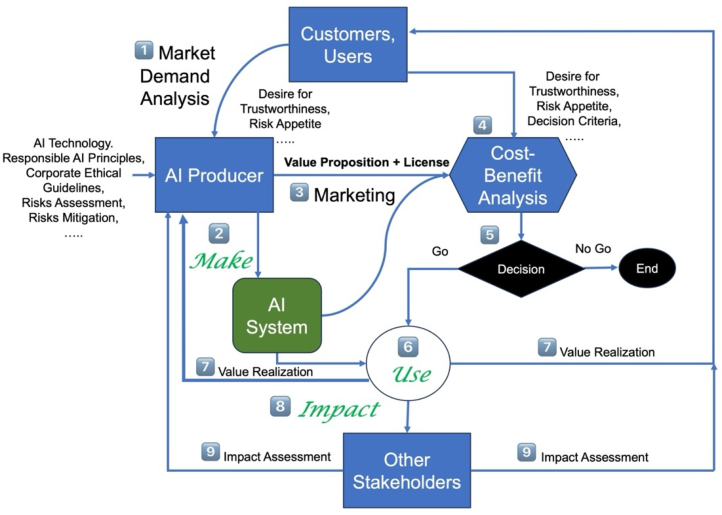
MAPPING THE AI ECOSYSTEM The AI ecosystem is made up of many stakeholders including AI producers, AI customers and users, deployers, regulators and policy makers, and external stakeholders. The latter include legal and natural persons who either actively participate in, or are otherwise involved in or affected by its use. Producers and customers/users make and use the AI system, which will result in impacts on other stakeholders, including the general public1. Figure 1 illustrates the dynamics of this ecosystem with the perspective of value creation as a general depiction and can be applied to different domains and scenarios (ISO/IEC AWI TR 21221, n.d.).
Figure 1: AI ecosystem and creation of AI system value.
An AI producer uses market demand analysis to ascertain potential cus- tomers/users’ risk appetite, functionality of the AI system and the desire for its trustworthiness, etc. The AI producer uses these information to align with the corporation’s ethical and responsible AI guidelines, risk assessment and mitigation strategies to make the AI system. This AI system is then mar- keted to potential customers/users with a value proposition (either directly or through intermediaries, such as distributors). The value proposition can include a software license with behavioural-use clauses for the licensed arti- facts.2 The potential customers/users could then perform their cost-benefit analysis with the value proposition based on their own desires, expectations 1The make, use and impact perspectives [emphasis added] on an AI system from its stakeholders are from ISO/IEC 5339:2024 Information technology — Artificial Intelligence — Guidance for AI applications (ISO/IEC 5339:2024, n.d.). 2See RAIL examples at URL: https://www.licenses.ai/ and the work undertaken by IEEE P2840 Working Group at: URL: https://sagroups.ieee.org/2840/
Exploring Regulatory Frameworks for AI/ML Through Different Lenses 25
and decision criteria, etc. If the customers/users decided to accept the value proposition with its obligations, they can then acquire the use of the AI sys- tem and deploy it for their own purposes. Value is incurred when the AI system is used and could then be assessed by the customers/users and the AI producer based on the promises in the value proposition. The use of the AI system will also produce assessable impacts on other stakeholders, such as other customers/users, businesses and the general public on a grander scale.
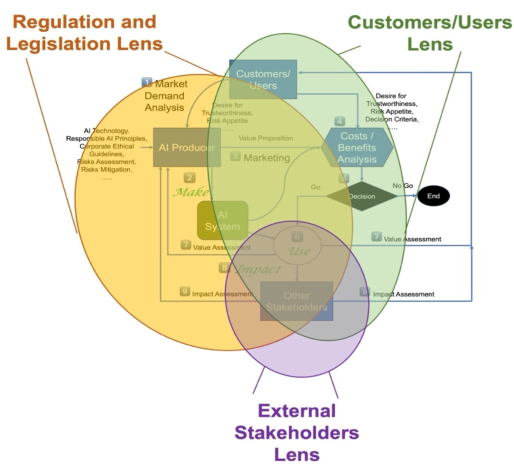
APPLYING THE CONSUMER AND REGULATORY LENS We have seen a dramatic change in the AI market place since the introduction of generative AI products such as ChatGPT in November 2022 followed by rapid introduction of improved versions among a variety of competitive prod- ucts (OpenAI, 2023). This phenomenon had resulted in a growing debate in public about the impacts of this technology on jobs, productivity, desirability and even the effects on humanity. As in the introduction in history of a new and impactful technology, the scale of which was not yet totally understood, governments started to contemplate the need to regulate the technology to protect their workers and their jobs as well as potential harmful effects on their citizenry. Figure 2 shows the lens that different stakeholders could put on the AI ecosystem. We will discuss these perspectives in examples in the next section.
Figure 2: Various stakeholder lenses on the AI ecosystem.
The Regulation and Legislation Lens from regulators and policy mak- ers are on the make, use and impact of the AI system but rarely on the customers/users’ desires and decisions on using the AI system.
The customers/users’ lens are on the desirability, cost/benefits of the AI system when deciding on acquiring the use of the AI system. This could also include an assessment on the potential impact on themselves and other exter- nal stakeholders. Once the AI system is in use, the customers/users could then assess the return of value and actual impact on stakeholders.
Figure 2 also includes the external stakeholders’ lens even though they are not the operative actors in the AI ecosystem. The impacts on them could be less obvious but the effects could be significant. These impacts could poten- tially affect other consumers in the community where the AI system is in use and even amplified to society at large.
COMPARATIVE ANALYSIS OF APPROACHES TO AI REGULATIONS The role of government in general is to protect and provide for its citizens. In the context of regulating technology the role of government is more refined and three-dimensional: it acts as a user, a regulator to safeguard its citi- zens from the impact of risks and harms, and, potentially, a promoter of the innovation and industry of the technology at the same time. To calibrate its regulatory response “government needs to assess and monitor the allocation of roles and responsibilities between public and private sectors, and design and implement inclusive consultation and communication processes with cit- izens and, specifically, those stake-holder groups likely to be most affected by their expected impact” ((Leitner and Stiefmueller, 2019) p. 238). Depending on their regulatory model, which determines how this balance is struck, gov- ernments in different jurisdictions will arrive at different approaches towards regulation, both in terms of form and content. In the following, we will take this approach to compare to the approaches to AI regulation in China, US and EU.
The US approach, which takes the form of an Executive Order (President Joe Biden, 2023), is addressed, first and foremost, at the administration itself and intends to lay down rules for the government itself (as a user and/or promoter of the technology) on the one hand, and set out guiding principles for future legislation, on the other – although the administration cannot pre- empt, i.e. formally oblige the legislator. In the EU, by contrast, the AI Act (European Parliament, 2024) is a binding legal instrument, issued by the EU co-legislators and directed primarily at market participants and the general public. It sets out general principles, based on fundamental rights and values enshrined in the EU Treaties and the EU Charter of Fundamental Rights, but excludes areas that pertain specifically to the exercise of sovereign power, such as national security and defence, from its scope.
In the following, we will look at these three in more details. Using the AI ecosystem, regulation lens and government duties. This is followed by a survey of the perspectives on AI technology in other countries.
REGULATIONS OF THE PEOPLE’S REPUBLIC OF CHINA The government of the People’s Republic of China had been promulgat- ing various regulations on AI technology: Internet Information Service
Exploring Regulatory Frameworks for AI/ML Through Different Lenses 27
Algorithmic Recommendation Management Provisions (2022) (Cyberspace Administration of China, 2022), Internet Information Service Deep Synthesis Management Provisions (2023) (Cyberspace Administration of China, 2023) and Technology Ethics Review Measures (2023) (Ministry of Science and Technology of China, 2023). These regulations were put into effect by gov- ernment ministries directed at protecting citizens and workers of China and its innovation, industry and market.
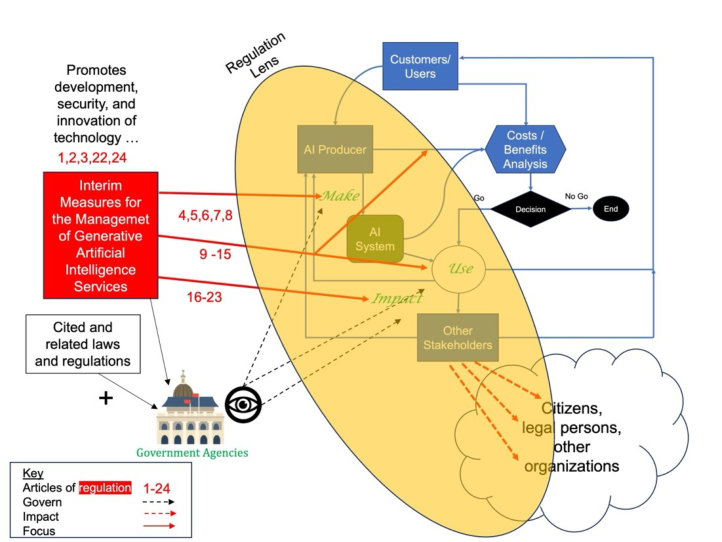
In response to the surgent application of generative AI technology, the government of China enacted “The Interim Measures for the Management of Generative Artificial Intelligence Services” in August 2023 (Cyberspace Administration of China, 2023). A schematic of the regulation is shown in Figure 3 which illustrated the regulation lens on the make, use and impact of the AI technology.
Figure 3: China’s generative AI regulation.
The regulation aimed at the producers of AI technology in order to “safeguard national security and social public interests, and protect the legit- imate rights and interests of citizens, legal persons and other organizations” ((Cyberspace Administration of China, 2023) Art. 1)3. The scope of this regu- lation covered the provision and use of the technology within China for using data and models from legitimate sources, not infringe intellectual property
3Author’s translation.
rights, use personal data with consent only, increase quality of authentic- ity, accuracy, objectivity and diversity of training data (summarized from Cyberspace Administration of China (2023) Art. 7). The regulation also calls for providers to register their products that passed a security assessment with the government before offering service to the public. As of March 2024, over 500 enterprises had registered their AI products since the enactment of this regulation (China Money Network, 2024).
The Chinese government had also been providing funding to smaller enter- prises engaging in the development of AI technology so that they could be more competitive. In 2024, the Chinese government announced its new “AI Plus” program to promote the application of AI technology in various industry sectors (Xinhua, 2024).
In January 2024, the Chinese government’s Ministry of Industry and Information Technology published an invitation for public comments on “Guidelines for the Construction of a Comprehensive Standardization Sys- tem for the National Artificial Intelligence Industry” (Ministry of Industry and Information Technology of China, 2024). These guidelines, in conjunc- tion with the Key Points of National Standardization Work (Standardization Administration of China, 2024) and the Global Artificial Intelligence Gover- nance Initiative (Ministry of Foreign Affairs of China, 2024) will likely form the foundation of a policy framework for the Chinese government on the AI industry. These guidelines promote technology progress and enterprise devel- opment in upgrading industrial security. Part of the guidelines also promotes the development of Chinese national standards (likely to be referenced in reg- ulations) for AI technology as well as encouragement for Chinese experts to participate in the development of international standards.
UNITED STATES EXECUTIVE ORDER The US government had always taken the approach that industry should for- mulate their own regulatory and standards regime from the “bottom-up”. The government will step in when there is a need for additional or extraor- dinary measures. The AI industry had grown so quickly in the last few years that the industry had not been able to settle on its own controls to allay fears of risks and doom. There were some talks of the industry coming up with its own “code of conduct” but not much had been agreed upon. This is one of the instances when the US government see the importance to play a timely role of providing governance guidance. For example, the publication of the “Blueprint for an AI Bill of Rights” (Office of Science and Technology Policy, 2022) in 2022 and the influential “AI Risk Management Frame- work” (National Institute of Standards and Technology, 2023) in 2023, all in adding AI technology context to the reinforcement of the Executive Order on Advancing Racial Equity..” (President Joe Biden, 2021) in 2021. Amid much discussion in public about the current and future of AI technology, President Biden issued “Executive Order on the Safe, Secure, and Trustworthy Devel- opment and Use of Artificial Intelligence” in October 2023 (President Joe Biden, 2023).
Exploring Regulatory Frameworks for AI/ML Through Different Lenses 29
The Executive Order is not a regulation and does not carry the mandatory compliance requirement of a law. It only applies to the executive branch of the US Federal Government4 (namely, the Fed). Table 1 shows the eight Guiding Principles and Priorities governing the development and use of AI as defined in the Executive Order.
Table 1. Eight principles and priorities governing the development and use of AI.
Table available in the original PDF paper.
a) AI must be Safe and secure – needs to mitigate risks, requires robust, reliable, repeatable, standardized testing & evaluation, Fed will work on labeling, content provenance b) Promote responsible innovation, competition and collaboration; Fed will invest in education, training, development, research and capacity, protect IP, maintain open ecosystem and marketplace for smaller developers c) Support and protect US workers and a diverse work force, Fed will adapt job training and education, provide access to opportunities, deployment of AI in the workplace should not harm the workers, etc., AI development for responsible use to improve workers’ lives, positively augment human work, help all people enjoy the gains and opportunities from technological innovation d) Advance equity and civil rights, improves quality of life, not tolerate bias, abuses and discrimination based on standards, ensure compliant with all Federal laws, promote robust technical evaluations, careful oversight, engagement with affected communities, and rigorous regulations e) Protect American consumers with existing consumer protection laws and principles plus enforce safeguards against harms from AI, promote responsible use, Fed enforces consumer protection laws, esp. in certain domains where harm could be inflicted on consumers or jeopardize safety and rights. Fed will promote “good” products and services f) Protect American’s privacy and civil liberties, strengthen privacy-preserving techniques and technologies, agencies will employ PETs where appropriate g) Manage the risks from the Federal Government’s own use of AI, increase its internal capacity to regulate, govern and support responsible use of AI h) The Federal Government should maintain global leadership in its responsible use of AI, engage international allies and partners in developing a framework to manage AI’s risks, unlock AI’s potential for good and promote common approaches to shared challenges.
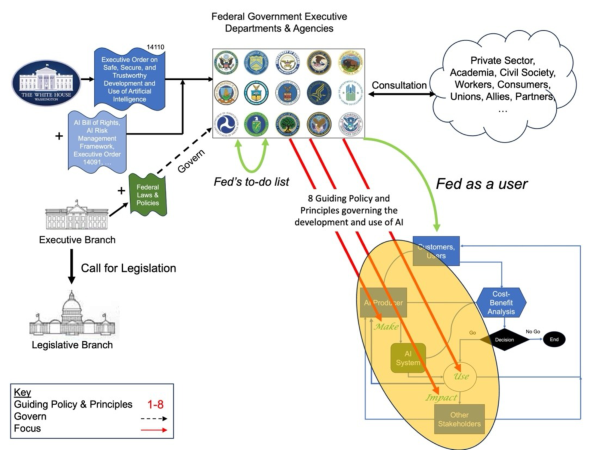
Figure 4 describes the landscape of the Executive Order and its relationship to the legislative branch, the departments and agencies, and the consultative body of stakeholders. The National Institute of Standards and Technol- ogy (NIST) had taken a leading role in the undertaking of the Executive Order in soliciting public comments and in establishing the US AI Safety Institute (USAISI) as a consortium of government, industry and academic stakeholders.
Figure 4 also shows the foci of the eight policy and principles on the make, use and impact of the AI ecosystem. The details of the Executive Order spell out the duties of the government, the Fed as a user and as a role model for the nation. The Executive Order also laid out a list of tasks the Fed will do to support the industry in the form of education, talent identification, leadership and promotion of US AI industry (depicted as the Fed’s to-do list in Figure 4). These tasks were assigned to various departments and agencies to perform within a time frame before a July 2024 deadline. These tasks were designed to build a solid foundation for regulations and legislations (from the legislative branch) to come in the near future.
4In the US, the Legislative Branch (Senate and House of Representatives) makes laws, Executive Branch (President, Vice President, Cabinet, departments and agencies) carries out laws, Judicial Branch (Supreme Court, Federal Courts) evaluates laws.
Figure 4: US executive order.
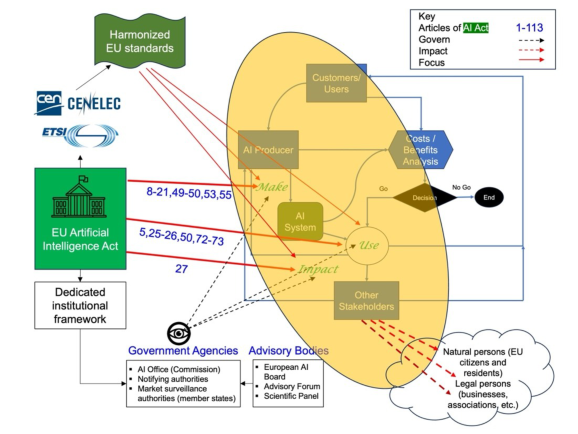
EUROPEAN UNION ARTIFICIAL INTELLIGENCE ACT As mentioned previously, the point of departure of the EU approach is given by the EU Treaties and the EU Charter of Fundamental Rights. This emphasis on the impact of AI is reflected in the chart below (Figure 5) where ‘other stakeholders’ play an integral role in the regulatory set-up.
Figure 5: EU artificial intelligence act.
Exploring Regulatory Frameworks for AI/ML Through Different Lenses 31
The architecture of the AI Act comprises both material provisions and structural features that reflect both the complex multi-level governance of the EU – including its institutions and agencies at the Union and member-state levels, and the formal inclusion of citizens, and other stakeholders, not only as recipients of rules but also as participants in the regulatory process. This is achieved, for instance, through the establishment of a European AI Board of member-state representatives, with the European Data Protection Board (EDPB) attending as an observer ((European Parliament, 2024) Art. 56), an Advisory Forum of stakeholder representatives ((European Parliament, 2024) Art. 67), and a Scientific Panel of Independent Experts ((European Parliament, 2024) Art. 68).
The AI Act covers AI systems that are either used on a stand-alone basis or as a component of another product. With regard to the latter, the AI Act is closely interwoven with the ‘New Legislative Framework for the Marketing of Products’ (NLF)5, which comprises (i) complementary, sectoral legislation setting out ‘essential requirements’, e.g. on health and safety, for industrial machinery, radio equipment, toys, and a wide range of other products and services ((European Parliament, 2024) Annex I); (ii) harmonised standards issued by the relevant European standardisation bodies upon request by the European Commission, and based on this legislation (Art. 40); (iii) a harmonised procedure for assessing conformity with these standards ((Euro- pean Parliament, 2024) Annexes VI and VII); and (iv) allocation of roles, competencies and obligations to member-state authorities tasked with organ- ising and monitoring the implementation of conformity assessments, and with supervising the relevant product market. With the advance of embed- ded AI applications the regulatory scope of the AI Act is likely to expand considerably and could become very comprehensive.
The AI Act applies a risk-based approach, which bans certain uses of AI which are considered incompatible with EU fundamental rights and values (‘prohibited practices’, (European Parliament, 2024) Art. 5) and designates others as high-risk ((European Parliament, 2024) Annex III). For high-risk applications, the AI Act requires registration with the competent authori- ties (which includes a number of technical and other disclosures; (European Parliament, 2024) Art. 49), a conformity assessment ((European Parlia- ment, 2024) Art. 43), and, in some instances, a fundamental rights impact assessment ((European Parliament, 2024) Art. 27). Providers of high-risk AI systems who are domiciled outside the EU are obliged to appoint an authorised representative in the EU ((European Parliament, 2024) Art. 22). Providers of ‘general-purpose AI models’ (defined in the AI Act as a model ‘that displays significant generality and is capable of competently performing a wide range of distinct tasks [ …] and that can be integrated into a vari- ety of downstream systems or applications’ are subject to specific obligations 5Regulation (EC) No 765/2008 of the European Parliament and of the Council of 09 July 2008 setting out the requirements for accreditation and market surveillance relating to the marketing of products, OJ L 218, 13 August 2008, p. 30; Decision No. 768/2008/EC of the European Parliament and of the Council of 09 July 2008 on a common framework for the marketing of products, OJ L 218, 13 August 2008, p. 82; and Regulation (EU) 2019/1020 of the European Parliament and of the Council of 20 June 2019 on market surveillance and compliance of products, OJ L 169, 25 June 2019, pp. 1–44.
((European Parliament, 2024) Art. 53–54). Additional obligations apply to providers of general-purpose AI models that are classified by the Commis- sion as posing a systemic risk ((European Parliament, 2024) Art. 51 and Art. 55–56). The AI Act applies to AI systems that are placed on the market, put into service, and/or used in the EU. Similar to the General Data Protection Reg- ulation (GDPR)6 the scope is cast deliberately wide and seeks to impose its obligations on all elements of the distribution chain. Most relevant for mar- ket participants domiciled outside the EU, obligations for providers of AI systems apply irrespective of whether they have a legal establishment in the EU. Even deployers of AI systems in third countries are legally bound by the AI Act if the output produced by that system is used in the EU (Art. 2).
INITIATIVES IN OTHER COUNTRIES AND REGIONS Apart from the US, EU and China, countries around the globe are making efforts to regulate AI in response to the rapid proliferation of AI technologies and solutions. These initiatives cover a wide spectrum including “[…] com- prehensive legislation, focused legislation for specific use cases, national AI strategies or policies, and voluntary guidelines and standards.”7 As mentioned above, there is no standard approach but common patterns can be observed. All jurisdictions are faced with the same challenge, to strike a balance between promoting innovation and regulating risks. While some jurisdictions operate with ‘soft’ policy instruments, such as national strategies, codes of conduct or ethics guidelines, others are laying down the law with binding legislation.
While individual jurisdictions have advanced their national and regional regulatory and policy frameworks, a number of multilateral efforts to align different approaches have been initiated. The Organisation for Economic Co- operation and Development (OECD) has played a pivotal role in this regard. The OECD AI principles (Organization for Economic Co-operation and Development, 2019) have been referred to in many different contexts, includ- ing the EU AI Act and the G7 Hiroshima Declaration (Group of Seven, 2023). UNESCO, the International Organisation for Standardisation, the African Union and the Council of Europe are all working on multilateral AI gover- nance frameworks. The UK Government organised the first AI Safety Summit in 2023 for government and industry stakeholders to agree upon, evaluate and monitor the most significant risks from AI (The Bletchley Declaration, 2023). The United Nations have recently adopted a resolution supported by more than 120 member states on the promotion of “safe, secure and trustworthy” artificial intelligence systems that “will also benefit sustainable development for all.” The UN also recognised AI’s potential towards reaching the 17 Sustainable Development Goals (SDG) (United Nations Organisation, 2024).
6Regulation (EU) 2016/679 of the European Parliament and of the Council of 27 April 2016 on the protection of natural persons with regard to the processing of personal data and on the free movement of such data, OJ L 119, 04 May 2016, pp. 1–88 7https://iapp.org/resources/article/global-ai-legislation-tracker/
Exploring Regulatory Frameworks for AI/ML Through Different Lenses 33
CONCLUSION
The three examples, from the US, the EU, and China, show a number of com- monalities as well as divergences. We have shown that each of them applies the regulation and legislation lens differently, in keeping with what Bradford terms the “market/state/rights-driven regulatory models” of technology gov- ernance (Bradford, 2023). At the same time, these approaches also seem to be reflective of different views in these jurisdictions on (i) generally, at what stage of the development and adoption cycle of a new technology regulatory action becomes appropriate, if not necessary; and (ii) specifically, where AI currently stands in its cycle (Leitner and Stiefmueller, 2019).
Each of the three frameworks reflects, in different ways, a global ambition to regulate AI. Probably the most transparent expression of this ambition are claims for jurisdiction over third-country market participants (extraterritori- ality). The EU has set a precedent in this respect with the GDPR (Bradford, 2023), which the AI Act is clearly designed to follow. The US and China have been less explicit so far in staking legal claims of this kind and, at this stage at least, appear to rely more on economic weight and political suasion.
Divergent approaches to regulation, and disagreements over jurisdiction, may ultimately impact on global trade. Already well before the enactment of the AI Act by the EU, China had been raising specific trade concerns (STCs) at the World Trade Organization (WTO)8 about potential technical barriers to trade (TBT) related to certain aspects of the proposed EU legislation. More arguments, e.g. about market access, permitted use, and intellectual property (mandatory disclosure of source code, copyrights), are likely to emerge as the adoption of AI application progresses.
Another key debate around regulating AI at the global level, besides trade, revolves around its impact on fundamental rights and its potential for achieving progress towards the UN’s SDG. Western democracies, the EU in particular, are placing fundamental rights at the forefront of their policies and regulations, e.g. by requiring a fundamental rights impact assessment for specific deployments of AI. Developing countries, meanwhile, are empha- sising the use of AI to promote collective global rights, such as sustainable development, inclusion, and meaningful participation.
Ultimately, given the scale of the regulatory challenge and the complex and multi-faceted balance of interests involved, global co-operation will be indispensable in order to render AI technology truly “safe, secure and trustworthy”.
REFERENCES
Bradford, Anu (2023). Digital Empires, The Global Battle to Regulate Technology.
Oxford University Press, Oxford / New York. ISBN 9780197649268. China Money Network (2024) China’s Tech Giants Lead Among 546 Registered AI Algorithms; Industry-Specific Algorithms are More Popular in China. March 7, 2024. https://www.chinamoneynetwork.com/2024/03/07/chinese-tech-giants- dominate-ai-algorithms-with-a-focus-on-industry-specific-applications#: ∼: text= Since%20June%202023%2C%20authorities%20in, their%20applications%20 is%20also%20expanding
Council of the European Union, Proposal for a Regulation of the European Parliament and the Council laying down harmonized rules on artificial intelligence (Artificial Intelligence Act) and amending certain Union Legislative Acts – Out- come of the European Parliament’s first reading (Strasbourg, 11 to 14 March 2024) (ST 7536 2024 INIT). Cyberspace Administration of China (CAC) (2022). Internet Information Service
Algorithmic Recommendation Management Provisions (March 2022). Cyberspace Administration of China (CAC) (2023) Internet Information Service Deep Synthesis Management Provisions (January 2023). Cyberspace Administration of China (CAC) (2023). Interim Measures for the Man-
agement of Generative Artificial Intelligence Services. Effective on August, 15, 2023. European Parliament (2024). Legislative resolution of 13 March 2024 on the proposal for a regulation of the European Parliament and of the Council on laying down harmonised rules on Artificial Intelligence (Artificial Intelligence Act) and amending certain Union Legislative Acts (COM (2021)0206 – C9-0146/2021 – 2021/0106(COD)). Group of Seven (G7), Hiroshima Process International Code of Con- duct for Organizations Developing Advanced AI Systems (2023); https: //digital-strategy.ec.europa.eu/en/library/hiroshima-process-international-code- conduct-advanced-ai-systems. International Association of Privacy Professionals (IAPP), Global AI Law and Policy
Tracker https://iapp.org/resources/article/global-ai-legislation-tracker/ ISO/IEC 5339:2024 Information technology — Artificial Intelligence — Guidance for AI applications. ISO/IEC AWI TR 21221 — Beneficial AI systems:202(x) (in progress). Leitner C., Stiefmueller C. (2019) “Disruptive Technologies and the Public Sector:
The Changing Dynamics of Governance”, in: Baimenov, Alikhan, Liverakos, Panos (eds.), Public Service Excellence in the 21st Century, Palgrave Macmillan Singapore, 2019. https://doi.org/10.1007/978-981-13-3215-9_8 Ministry of Foreign Affairs of China (MIFA) (2023) Global AI Gover- nance Initiative. October 10, 2023 https://www.mfa.gov.cn/eng/wjdt_665385/ 2649_665393/202310/t20231020_11164834.html. Ministry of Industry and Information Technology of China (MIIT) (2024). Guidelines for the Construction of a Comprehensive Standardization System for the National Artificial Intelligence Industry – Request for comments. January 17–30, 2014 https://www.miit.gov.cn/gzcy/yjzj/art/2024/art_983199be0766 49d494690135c0b4d168.html. Ministry of Science and Technology of China (2023) Technology Ethics Review
Measures (Trial) (September 2023). National Institute of Standards and Technology (NIST) “AI Risk Management Framework (AI RMF 1.0)”, NIST AI 100-1, January 2023. Office of Science and Technology Policy (OSTP) “Blueprint for an AI Bill of Rights –
Making Automated Systems Work for the American People”, The White House, October 2022. OpenAI. (2023). ChatGPT 3.5. https://chat.openai.com Organization for Economic Co-operation and Development (OECD) (2019), AI Principles; https://www.oecd.org/digital/artificial-intelligence/, https://oecd.ai/en/ai-pr inciples
Exploring Regulatory Frameworks for AI/ML Through Different Lenses 35
President Joe Biden “Executive Order on the Safe, Secure, and Trustworthy Development and Use of Artificial Intelligence” 14110, The White House, October 30, 2023. President Joe Biden “The Executive Order On Advancing Racial Equity and Sup-
port for Underserved Communities Through the Federal Government” 14091, The White House, January 20, 2021. Standardization Administration of China (SAC) (2024) Key Points of National Standardization Work in 2024. February 4, 2024 https://www.china-cas.org/u/cms/www/202402/0609454811nu.pdf. The Bletchley Declaration, November 1, 2023; https://www.gov.uk/government/pu blications/ai-safety-summit-2023-the-bletchley-declaration/the-bletchley-declar ation-by-countries-attending-the-ai-safety-summit-1-2-november-2023. United Nations Organisation (UNO), Seizing the opportunities of safe, secure and
trustworthy artificial intelligence systems for sustainable development, General Assembly Resolution A/78/L.49, March 11, 2024. https://news.un.org/en/story /2024/03/1147831 Xinhua (2024) “China to launch AI Plus initiative: report”, March 5, 2024. https://english.www.gov.cn/news/202403/05/content_WS65e67fcac6d0 868f4e8e4a82.html
LISTED IN THE AHFE DIGITAL BOOKSTORE CATALOGUE
Explore the complete digital volume
The Human Side of Service Engineering
Read this individual research paper free through the original publisher, or explore the full digital proceedings book.
ISBN 978-1-964867-19-9
Explore this ISBN in the AHFE Bookstore ↗Listed in the July 2026 bookstore catalogue; search by ISBN to confirm current availability · Digital book purchase optional