Johannes Stübinger (2024). Beyond traditional boundaries: The impact of Generative Artificial Intelligence on higher education. In: The Human Side of Service Engineering. AHFE Open Access, vol. 143, pp. 160–166. https://doi.org/10.54941/ahfe1005094
The upcoming of Generative Artificial Intelligence has initiated a transformative era across various sectors, education being a prominent one. Especially in university settings, this technology redefines the landscape of traditional learning methodologies and experiences. This paper investigates this fact by analyzing the knowledge acquisition of students augmented by Generative Artificial Intelligence. For this purpose, we evaluate this technology via two meaningful student situations. First, we shift our focus to the journey of composing one's first scientific article, exploring the various stages from conception to completion, inclusive the complexities and hurdles encountered. Second, our research delves into the process of mastering a new programming language within the realms of Machine Learning and Artificial Intelligence, examining the intricacies and challenges involved. We evaluate the two learning situations along the three critical dimensions “Efficiency”, “Competency”, and “Creativity”, providing a holistic view of the educational differences. In the realm of “Efficiency”, the paper evaluates the speed and success rate of both learning processes. Regarding the aspect “Competency”, the focus shifts to the depth of understanding and skill acquisition. Under the purview of “Creativity”, we investigate how the approach supports students to exceed their own limits.
In a time marked by the rapid user growth of platforms like ChatGPT, the term “Generative Artificial Intelligence” (Generative AI) has surfaced as a transformative force within the digital landscape (Banh and Strobel, 2023; Dwivedi et al., 2023; Teubner et al., 2023; Wessel et al., 2023). In con- trast to traditional data-driven AI tasks such as predictions, classifications, or recommendations, latest advancements allow to generate unique, real- istic, and creative content, e.g., text, images or even music. The outputs are almost indistinguishable from human-created work. Following Burström et al. (2021) and Moussawi et al. (2021), new spheres of activity and busi- ness opportunities can be explored and utilized, e.g., process optimization and decision making. As development progresses, Generative AI promises to push the boundaries of human creativity and open up new horizons in human-machine collaboration.
Beyond Traditional Boundaries: The Impact of Generative Artificial Intelligence 161
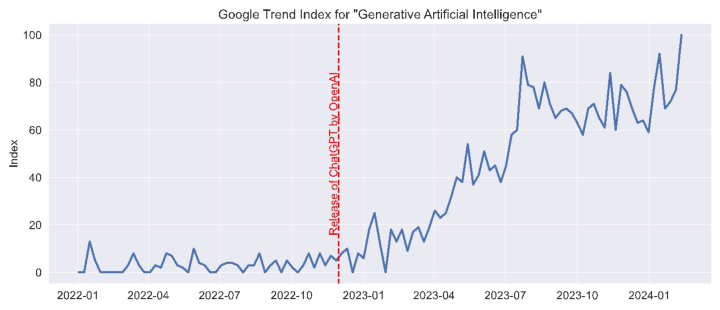
index represents a real-time daily and weekly index of the volume of queries that users enter into Google. Furthermore, the maximum query share in the time period specified is normalized to be 100 and vice versa. We observe a meaningful increase of the index at the end of 2022 when OpenAI released the Large Language Model ChatGPT. Wu et al. (2023) summarize that ChatGPT encourages the transformation of AI from data understanding to data gener- ation, achieving a leap from machine perception to machine creation. Thanks to its enormous flexibility and scalability, ChatGPT is used in a wide range of application and subject areas, e.g., education, marketing, software engi- neering, and healthcare (Fraiwan and Khasawneh, 2023). Chui et al. (2023) estimate that the impact of Generative AI on productivity could add trillions of dollars in value to the global economy. Roughly 75 percent of the gener- ated value are created in the four areas customer operations, marketing and sales, software engineering, and R&D.
This paper analyzes the impact of ChatGPT, the most widespread represen- tative of Generative AI, on higher education. To be more specific, interviews are conducted with students on the Digital Transformation course, in which they are asked about their experience of this new technology in the typical educational situations “Scientific Writing” and “Programming”. Hereby, we focus on the aspects of “Efficiency”, “Creativity”, and “Competency”. The statements made are evaluated and differences and similarities between the two educational situations are highlighted.
The paper is structured as follows: Section 2 classifies Generative AI in the world of AI. In section 3, we describe the interviewees and the interview guide. Section 4 analyzes the results of the interviews. Finally, section 5 gives a conclusion and outlooks for further developments.
Figure 1: Google trend index for “generative artificial intelligence” between 2022 and 2024.
GENERATIVE ARTIFICIAL INTELLIGENCE
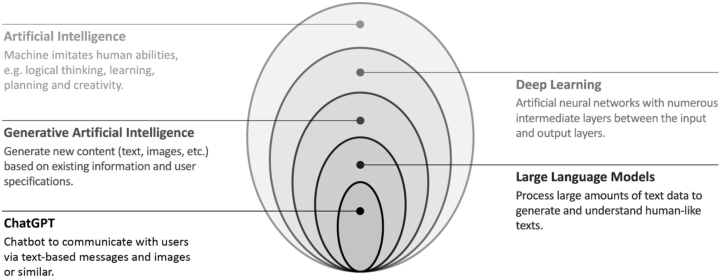
Figure 2 shows the classification of Generative AI in the world of AI. Follow- ing Banh and Strobel (2023), we observe that AI is the broadest category in this hierarchy, encompassing machines designed to mimic human abil- ities such as logical thinking, learning, planning, and creativity, enabling
162 Stübinger
them to perform tasks that typically require human intelligence. Within AI, Deep Learning is a specialized technique that employs Artificial Neural Net- works with a large number of hidden layers between the input and output layer, allowing the system to learn complex patterns in large amounts of data. A subset of Deep Learning is Generative AI, which has the capabil- ity to create new content, including text, images, or music, by drawing upon existing data and adhering to user-provided guidelines. Until recently, Discriminative AI has been still predominantly used, focusing primarily on classification and prediction. In contrast to Generative AI, no new content is created – the input is merely interpreted and displayed according to the respective instruction. Large Language Models are a refined form of Gen- erative AI, specifically designed to process and generate text data, resulting in outputs that resemble human-written text in both style and substance. At the most specific level of this hierarchy is ChatGPT, a chatbot application of Large Language Models developed by OpenAI, which interacts with users by generating conversational text-based messages and can also understand and respond to images, demonstrating the culmination of AI’s generative and learning capabilities. This paper analyzes the impact of ChatGPT, the most widespread representative of Large Language models and Generative AI, on higher education.
Figure 2: Overview of terms in the context of generative AI.
DATA For analyzing the impact of Generative AI in the field of higher education, we interview the students of the first and third semester of the Bachelor Science course Applied Digital Transformation. This course focuses on teach- ing students how to leverage digital technologies to fundamentally change how businesses operate and deliver value to customers. Furthermore, this degree course is characterized by a) innovative teaching, i.e., all modules are sequentially structured in 3-week cycles and b) practice-oriented teaching, i.e., theory and practice go hand in hand, e.g. practical tasks are part of the exams. The age of the students ranges between 18 and 28 and the gender is similarly distributed.
Beyond Traditional Boundaries: The Impact of Generative Artificial Intelligence 163
In the first semester, students take the subject “Academic Research”. The course focuses on three main areas: The introduction to various research methods for systematically conducting research, learning how to write clear and structured scientific texts, including correct citation, and paraphrasing techniques, and developing the ability to critically read, analyze and evaluate scientific literature. Overall, seven students participate in this subject and fill in the questionnaire.
In the third semester, students take the subject “Data & Knowledge Engi- neering”, which focuses on the concepts and techniques of data acquisition, processing, and analysis. The course covers three main areas: First, students will learn how to use the programming language Python to extract and pro- cess data from various sources to prepare it for analysis. The focus will then turn to analyzing this data, covering statistical techniques, Machine Learn- ing and data visualization. Finally, knowledge is put into practice by teaching students how to extract knowledge from the analyzed data and use it effec- tively to make data-driven decisions and gain insights. In total, nine students participate in this subject and fill in the questionnaire.
Students from both cohorts are asked to evaluate nine statements pertain- ing to the topics of “Scientific Writing” (first semester) and “Programming” (third semester). Specifically, the students assessed three statements within the realms of “Efficiency”, “Competency”, and “Creativity” using a five-point Likert scale, which includes the options “Strongly disagree”, “Disagree”, “Neutral”, “Agree” and “Strongly agree”. For this purpose, the survey is created in Microsoft Forms, which can be completed from anywhere at any time.
The domain “Efficiency” covers the optimal utilization of resources to achieve goals and complete tasks with minimal effort and maximum effective- ness. This fundamental requirement for success is covered by the following three statements:
“The use of Generative AI reduces the time needed to complete my tasks.”
“The ratio of effort to benefit from using generative AI tools is positive.”
“The results of Generative AI do not require manual corrections or post- processing.”
On the other hand, “Competency” pertains to the mastery of necessary skills and knowledge that enable an individual to perform tasks reliably, effectively, and at a high level. In this domain, we create the following statements:
“The use of Generative AI contributes to an expansion of my professional skills.”
“No specific skills or knowledge are required for using Generative AI tools.”
“I am able to critically judge the results produced by Generative AI.”
Lastly, Creativity is defined as the ability to think beyond existing bound- aries and develop innovative, unconventional solutions to problems, often leading to groundbreaking ideas and advancements that can profoundly alter the way we work and live. Within this area, the following statements were evaluated:
164 Stübinger
“Generative AI develops new ideas and approaches.”
“Generative AI helps me overcome creative blocks.”
“Interacting with Generative AI leads to a greater variety of results.”
RESULTS
The responses to the surveys presented in the previous chapter are analyzed in Jupyter Notebook using Python. Jupyter Notebook is an open-source web application that enables the creation and sharing of document-like inter- faces that integrate live code, equations, visualizations, and explanatory text. Python is a versatile and widely used programming language characterized by its clear syntax and readability, making it popular in scientific data analysis. This combination is often used in Data Science as it provides an interactive environment for exploratory analysis and promotes the reproducibility of research results.
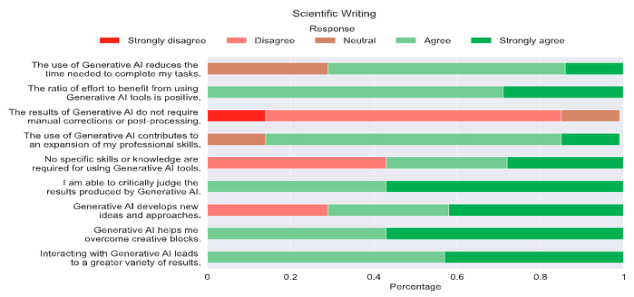
Figure 3 shows the survey responses about the use of Generative AI in “Scientific Writing”. To be more specific, the answers range from “Strongly disagree” (dark red) to “Strongly agree” (dark green). The majority of stu- dents (71%) agree or strongly agree that Generative AI speeds up their work. This statement is even confirmed by additionally considering the invested time: 100% state that the benefits outweigh the effort required. Interestingly, all respondents must conduct manual corrections or post-processing – Gener- ative AI without human is not working in this area. Furthermore, professional skills are enlarged by using this kind of Deep Learning (86% agree or dis- agree). The need for specific skills or knowledge for using Generative AI tools shows a divided opinion, with responses spread across the spectrum rang- ing from 43% disagreement to 29% strongly agreement. We observe 100% agreement that users feel (highly) competent in critically judging the output of this black box. The role of Generative AI in developing new ideas and approaches and in helping to overcome creative blocks is strongly recognized, with the majority (strongly) agreeing. Lastly, interaction with Generative AI leads to a greater variety of results is also met with 100% agreement, indicating that users value the diverse outcomes.
Figure 3: Students’ levels of agreement or disagreement in the topic “scientific writing”.
Beyond Traditional Boundaries: The Impact of Generative Artificial Intelligence 165
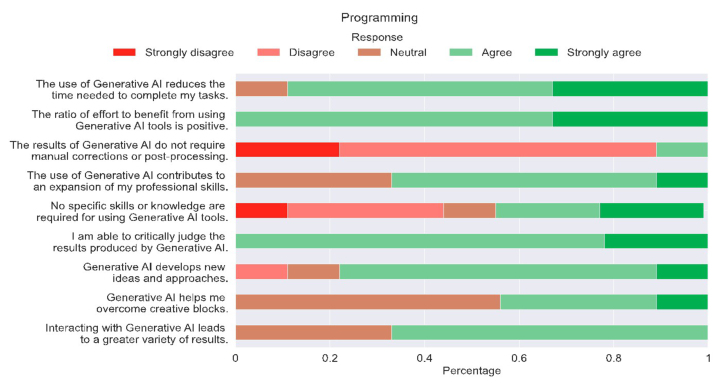
In Figure 4, we depict the survey responses about the use of Generative AI in “Programming”. Again, the answers range from “Strongly disagree” (dark red) to “Strongly agree” (dark green). Similar to “Scientific Writing”, Gen- erative AI speeds up work (89% (strongly) agreement) and shows a positive cost-benefit ratio (100% (strongly) agreement). 89% of the students men- tion that manual corrections or post-processing of the results are required. Compared to scientific writing, fewer people state that they improve their skills through the use of Generative AI. We may carefully conclude this result is related to the level of complexity in programming, e.g., transforming the business case to programming language is highly difficult. This statement is confirmed by the fact that more than 50% request prior knowledge in the field of programming. Comparable to scientific writing, 100% of the people agree to feel highly comfortable in critically evaluating the results of Generative AI. Almost 80% of the students indicate that this state-of-the-art technology supports to generate new ideas and approaches. Overcoming cre- ative blocks is more challenging than in the field of scientific writing: Only 46% find Generative AI useful for this part. Analogous, 33% of the students states a neutral variation of the results.
Figure 4: Students’ levels of agreement or disagreement in the topic “programming”.
CONCLUSION
In conclusion, we investigate the impact of Generative AI in scientific writ- ing and programming based on the fields “Efficiency”, “Competency”, and “Creativity”. We find in both fields a substantial increase in efficiency, char- acterized by a speedup in task completion and a positive cost-benefit ratio. However, our study shows that there is a need for post-processing of AI- based results suggesting that it cannot replace humans in scientific writing and programming. Notably, respondents feel capable of critically assess- ing the outcomes produced by Generative AI. This fact indicates a level of competence in integrating these technologies within their workflows.
166 Stübinger
We find domain-specific differences, particularly in the area of “Compe- tency” and “Creativity”. While Generative AI significantly enhances profes- sional skills in scientific writing, its impact is less pronounced in program- ming. Furthermore, Generative AI is notably effective in overcoming creative blocks and enriching the quality of the results, a benefit that does not translate as strongly to the field of programming.
For future work, it is recommended to increase the sample size by involv- ing more students to derive more detailed results. Expanding the research across various fields and domains will also provide a broader understanding of Generative AI’s impact. Moreover, investigating multivariate dependen- cies between the backgrounds of students and their respective domains could offer deeper insights into how individual factors influence the effectiveness of Generative AI tools. This comprehensive approach will allow for a more nuanced understanding of Generative AI’s role across different academic and professional landscapes.
REFERENCES
Banh, L., Strobel, G. (2023). Generative Artificial Intelligence Electronic Markets.
33(1), 1–17. Burström, T., Parida, V., Lahti, T., Wincent, J. (2021). AI-enabled business-model innovation and transformation in industrial ecosystems: A framework, model and outline for further research. Journal of Business Research, 127, 85–95. Chui, M., Hazan, E., Roberts, R., Singla, A., Smaje, K., Sukharevsky, A., Yee,
L., Zemmel, R. (2023). The economic potential of Generative AI. McKinsey & Company. Choi, H., Varian, H. (2012). Predicting the present with Google Trends. Economic record, 88, 2–9. Dwivedi, Y. K., Kshetri, N., Hughes, L., Slade, E. L., Jeyaraj, A., Kar, A. K., Baabdul-
lah, A. M., Koohang, A., Raghavan, V., Ahuja, M., Albanna, H., Albashrawi, M. A., Al-Busaidi, A. S., Balakrishnan, J., Barlette, Y., Basu, S., Bose, I., Brooks, L., Buhalis, D., Wright, R. (2023). ”So what if ChatGPT wrote it?” Multidisciplinary perspectives on opportunities, challenges and implications of generative conver- sational AI for research, practice and policy. International Journal of Information Management, 71, 102642. Fraiwan, M., Khasawneh, N. (2023). A review of ChatGPT applications in education, marketing, software engineering, and healthcare: Benefits, drawbacks, and research directions. Working paper, Jordan University of Science and Technology. Moussawi, S., Koufaris, M., Benbunan-Fich, R. (2021). How perceptions of intel-
ligence and anthropomorphism afect adoption of personal intelligent agents. Electronic Markets, 31(2), 343–364. Teubner, T., Flath, C. M., Weinhardt, C., van der Aalst, W., Hinz, O. (2023). Welcome to the era of ChatGPT et al.: The prospects of large language models. Business & Information Systems Engineering, 65, 95–101. Wessel, M., Adam, M., Benlian, A., Majchrzak, A., Thies, F. (2023). Call for papers to
the special issue: Generative AI and its transformative value for digital platforms. Journal of Management Information Systems. Wu, T., He, S., Liu, J., Sun, S., Liu, K., Han, Q. L., Tang, Y. (2023). A brief overview of ChatGPT: The history, status quo and potential future development. IEEE/CAA Journal of Automatica Sinica, 10(5), 1122–1136.
LISTED IN THE AHFE DIGITAL BOOKSTORE CATALOGUE
Explore the complete digital volume
The Human Side of Service Engineering
Read this individual research paper free through the original publisher, or explore the full digital proceedings book.
ISBN 978-1-964867-19-9
Explore this ISBN in the AHFE Bookstore ↗Listed in the July 2026 bookstore catalogue; search by ISBN to confirm current availability · Digital book purchase optional