Andrea Martina Aegerter, Corina Schneider, Markus Melloh, Achim Elfering (2024). WeMoveVirtual: Results from a Brief Virtual Movement Intervention for Musculoskeletal Pain and Well-being in Knowledge Workers. In: Human Factors and Wearable Technologies. AHFE Open Access, vol. 141, pp. 61–69. https://doi.org/10.54941/ahfe1005055
In 2022, the on-site multi-component intervention of the project “Neck Exercise for Productivity (NEXpro)” demonstrated effectiveness in reducing pain and enhancing well-being among office workers. However, the shift towards a virtual and remote work setting necessitates the adaption of interventions like NEXpro for independent use, irrespective of time and location. Thus, we developed a virtual version of the NEXpro intervention.Purpose: Our aim was to implement and pilot a virtual version of the NEXpro intervention – specifically, a virtual brief movement intervention designed to reduce musculoskeletal pain and improve well-being.Methods: This observational study was conducted from October to December 2022. We recruited 22 employees from the University of Bern, Switzerland, without severe neck pain. The intervention consisted of a 6-week smartphone application-based movement program with 10 exercises designed to strengthen neck and back muscles. Throughout the intervention period, participants completed daily electronic diary forms. These forms assessed self-reported neck and back pain (each on a Visual Analogue Scale VAS from 0=no pain to 10=maximum pain), muscle and joint flexibility (VAS from 0=bad flexibility to 10=good flexibility), and physical and mental well-being (each on a VAS from 0=bad well-being to 10=good well-being). Additionally, participants documented the number of training sessions (i.e., training adherence). We conducted multilevel regression analyses for all outcomes of interest, including neck pain, back pain, flexibility of muscles and joints, physical well-being, and mental well-being.Results: Data from 22 participants (mean age: 33.36 years, 90.90% female) resulted in 392 daily electronic diary reports. The most frequent reported areas of pain were the neck (90.90%), shoulders (81.80%), upper back (72.70%), and lower back (68.20%). Participants demonstrated an average training adherence of 1.45 training days per week. The correlation between the presence of back and neck pain was high (r=0.69, p<.001). Multilevel regression analyses indicated a positive linear trend, with significant improvements in neck pain (B=-0.02), back pain (B=-0.03), muscle flexibility (B=0.02), physical well-being (B=0.04), and mental well-being (B=0.03, all p-values<.01). The individual number of training sessions during the intervention period showed a significant positive association with back pain (B=0.11, p<.05). Regarding the implementation process, it is noteworthy that the reminder function for training and questionnaires did not function properly.Conclusion: Overall, the implementation of the smartphone application was successful, with minor technical issues. The study demonstrated that the smartphone application can be used as a brief movement intervention to reduce musculoskeletal pain and increase well-being in knowledge workers. Importantly, the intervention effect in reducing neck pain was comparable to the on-site multi-component NEXpro intervention. However, it's important to acknowledge that training adherence was nearly half as much as observed in the NEXpro study. This insight underscores the need for continued development and refinement of the brief virtual movement intervention. The study's findings serve as a foundation for future developments aimed at optimizing training adherence and maximizing the effectiveness of the smartphone application in reducing musculoskeletal pain and enhancing well-being among knowledge workers.
Digitalization enables more spatially flexible working (remote work) and has thus helped us navigate through the challenges posed by the Coronavirus dis- ease 2019 (COVID-19) pandemic. However, remote work is accompanied by changes that promote musculoskeletal complaints. For example, working from home eliminates the need to commute to the work site (i.e., resulting in less physical activity), and we tend to spend longer hours sitting at work- stations, some of which are poorly designed ergonomically (Aegerter et al., 2021). An increase in health-related presenteeism (i.e., working despite ill- ness) is therefore likely, which represents a major challenge, particularly in the context of knowledge work.
As part of a project funded by the Swiss National Science Foundation (SNSF) titled “Prevention and Intervention of Neck Pain in Swiss Office Workers (NEXpro)”, we developed a physiotherapeutic brief movement intervention to maintain and / or improve the strength and mobility of neck and shoulder muscles (Aegerter et al., 2020). The intervention was tested on office workers over a 12-week period, demonstrating decreased productivity loss (i.e., increased productivity) (Aegerter et al., 2023). In particular, health- related presenteeism, which is a common issue among office workers, was reduced. In the SNSF project, the intervention was delivered on-site (e.g., in the office) in small groups (Aegerter et al., 2020; Aegerter et al., 2023). However, given the ongoing digital transformation, it is crucial to evaluate the intervention delivery mode and adapt it to the new virtual work setting.
The goals of the new project “WeMoveVirtual” are to further develop and contextually adapt the brief movement intervention from the NEX- pro project for the virtual work setting, aiming to prevent and / or reduce musculoskeletal complaints and reduce health-related presenteeism among knowledge workers. Special attention is given to knowledge workers, partic- ularly postdoctoral students and PhD students, as this group is at increased risk.
The final product of the WeMoveVirtual project is a user-friendly virtual brief movement intervention, specifically designed for knowledge workers to use independently, regardless of time and place, and promoting training adherence during remote work. In addition to implementing the virtual brief movement intervention, its effectiveness will be assessed during a pilot phase.
METHOD
Sample Twenty-two employees from the Institute of Education and the Institute of Psychology at the University of Bern participated in the study in November and December 2022. All participants were engaged in a primarily seden- tary occupation and either suffered from neck pain or wanted to address it preventively (Aegerter et al., 2020; Aegerter et al., 2023).
The study was classified as not requiring approval by the Cantonal Ethics Committee of Bern (2022-00970) and was deemed ethically unobjectionable according to the internal faculty ethics committee (2022-08-01). The study
WeMoveVirtual: Results From a Brief Virtual Movement Intervention 63
was registered on clinicaltrials.gov (NCT05676528) and received funding from the Faculty of Human Sciences of the University of Bern as part of the funding projects “Humans in digital transformation”.
Intervention The virtual brief movement intervention spanned six weeks. Participants were asked to exercise individually at least three times per week for 20 minutes each, equivalent to a training adherence of at least 18 out of 42 days. Par- ticipants were given the autonomy to choose which exercises they wanted to perform from a given set of ten neck and shoulder exercises (Aegerter et al., 2020; Aegerter et al., 2023). All exercises were stored on a smart- phone application (PhysiApp, hosted by the Physitrack® platform) and were initially instructed by a physiotherapist at the beginning of the intervention. The training material was provided free of charge to the participants. In the first, third, and sixth week, a joint group training session took place via a virtual platform (e.g., Microsoft Teams) to verify the correct execution of the exercises and address any questions.
Measurements Three different methods were used to collect data. First, participants were asked to complete a ten-minute questionnaire prior to the brief movement intervention (baseline) and immediately after it (follow-up). Second, a daily short questionnaire (e.g., electronic diary) was to be completed. Both ques- tionnaires had a focus on neck pain, back pain, flexibility in muscles and joints, and physical and mental well-being. Third, participants were asked to record their training in the smartphone application so that a conclusion could be drawn about training adherence (including dose-response).
Data Analysis Data analysis included a description of the sample, findings on the implemen- tation process, evaluation of training adherence, and analysis of intervention effects. Diary data were analysed with longitudinal multilevel regression anal- ysis using the MLwiN software package version 2.33 (Rasbash et al., 2000). Because differences between participants as well as within participants over time in outcomes were expected, the intercept was conceptualized as a ran- dom effect on both levels. Since the immediate effect of the brief movement intervention and the slow accumulated training effect shown in the rate of change of outcome were the primary focus of the present study, and the data collection period was equal for all subjects in the sample, a linear trend across time and the daily training effect (0 = no training day, 1 = training day) as predictors were set as fixed effects. Age was entered in the regres- sion model as a grand-mean centred variable, while the individual training number remained uncentred. Gender was included (0 = f, 1 = m). The regres- sion model assumed the development of neck pain, back pain, flexibility in muscles and joints, and physical and mental well-being over time, and in dependence of training as fixed effects, with no variation in individual regres- sion slopes was postulated. The general multilevel regression model used to
test the intervention effect and examine the positive effects of training on musculoskeletal pain outcomes was: outcomeij = β0ij constant + β1ij linear trend across time
+ β2ij training on that day + β3i age + β4i gender + β5i individual number of trainings (sum)
β0ij = β0 + u0j + e0ij (1) The subscript i indicates the level 1 (day of study, 1-42) variable, and j indicates the level 2 (person) variable. The outcomes were all as mentioned above. The level of significance was set at p < 0.05 (two tailed).
RESULTS
Sample Eighteen out of 22 employees (81.81%) completed the study in full. The other four employees dropped out, on average, on the 19th out of 42 intervention days (ranging from the 11th to the 31st intervention day). Analyses included all participants, but because of missing data in the baseline questionnaire (n = 2), the final sample size in multilevel regression analyses included 20 individuals.
On average, study participants were 33.36 years old (standard deviation SD 10.22), and the majority were female (n = 20, 90.91%), had Swiss citi- zenship (n = 19, 86.36%), were in a relationship but not married (n = 12, 54.55%; married: 22.73%; no relationship: 22.73%), and had a tertiary edu- cation (n = 20, 90.91%). They had been working at the University of Bern for an average of 5.16 years (SD 5.56). The majority held the function of a doctoral student (n = 8, 36.36%; auxiliary assistant or intern: 22.73%; administrative-technical staff: 18.18%; research assistant: 9.09%; research associate: 9.09%; professor: 4.05%), were employed on a temporary basis (n = 16, 72.73%), worked part-time (n = 15, 68.18%), had no management responsibility (n = 16, 72.73%), and earned an average monthly salary of 4,772.70 Swiss francs CHF (SD 2,926.60). The most common areas of pain were the neck (n = 20, 90.91%), shoulders (n = 18, 81.82%), upper back (n = 16, 72.73%), and lower back (n = 15, 68.18%).
Implementation The implementation of the brief movement intervention was very success- ful. Overall, the smartphone application functioned smoothly, the exercise records could be viewed, and the training documented. However, technical issues arose with the automatically generated exercise reminders and daily questionnaires. Despite these challenges, three out of 22 employees requested an extension of the smartphone application to continue training after the end of the study.
WeMoveVirtual: Results From a Brief Virtual Movement Intervention 65
Descriptive Outcome Analyses Mean pain levels in the neck and back, measured using the Visual Analogue Scale (VAS) ranging from 0 = no pain to 10 = maximum pain, suggest the absence of serious pain problems (e.g., an average VAS of < 3.0) (Table 1). Nevertheless, all but two individuals reported experiencing neck pain when asked with a binary response option (0 = no pain, 1 = pain), and the numbers were similar in binary reports of low back pain (upper back: n = 6, lower back: n = 7). Indicators of mental and physical well-being reflected the good health status of our participants (e.g., mean values of > 6.0) (Table 1). In summary, the sample mean values represent levels of the normal workforce and indicate no clinical levels of health problems.
Table 1. Mean values and standard deviations of predictor and outcome variables.
Table available in the original PDF paper.
Means S.D.’s Neck pain 2.70 2.40 Back pain 2.32 2.20 Physical well-being 6.45 1.69 Mental well-being 7.34 1.66 Flexibility of muscles and joints 6.06 1.74
Note. N = 392.
Noteworthy, participants who reported higher neck pain on a specific day also tended to report higher back pain (r = 0.69, p = < 0.001, Table 2). Thus, the correlation between neck pain and back pain was high. Other correlations between outcome variables were found to be moderate.
Table 2. Correlation of predictor and outcome variables.
Table available in the original PDF paper.
Neck Pain
Back Pain
Physical Well-Being
Mental Well-Being
Flexibility of Muscles and Joints
−0.53 −0.49 0.39 0.29 1
Neck pain 1 Back pain 0.69 1 Physical well-being −0.26 −0.24 1 Mental well-being −0.23 −0.30 0.51 1 Flexibility of muscles and joints Note. N = 392, all correlations p < 0.001.
Training Adherence During the intervention period, participants exercised on average on 8.73 of 42 intervention days (SD 6.50, range from 0 to 19), or 1.45 days per week.
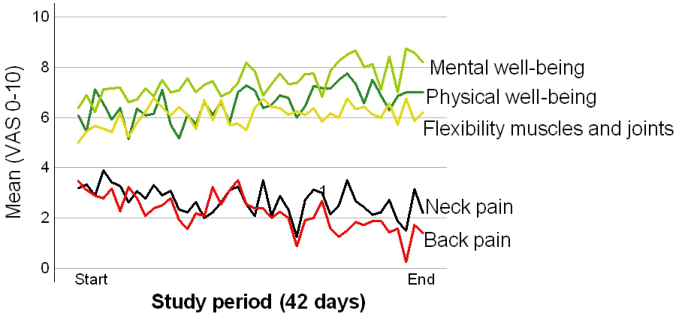
Intervention Effects After the start of the intervention, there was a significant positive linear trend towards an improvement of neck pain, back pain, flexibility in mus- cles, physical well-being, and mental well-being (Figure 1). Figure 1 shows
the improvement in outcomes over the course of mean daily outcome val- ues across the 42-day intervention period. The multilevel-regression analysis confirms the improvement in outcome, indicating significant linear trend factors for neck pain and back pain (Table 3), as well as flexibility in mus- cles and joints, physical well-being, and mental well-being (Tables 4 and 5). Furthermore, the individual number of training sessions during the interven- tion period was significantly positively associated with back pain, indicating that participants with more severe back pain tended to use the smartphone application more frequently (Table 3).
Figure 1: Trends of mean values in study outcomes across the 42-day intervention period.Table 3. Prediction of daily neck pain and daily back pain.
Key: Person-level n = 20, Day-level n = 392. B = fixed unstandardized regression coefficient, SE = stan- dard error of estimation, IGLS = Iterative Generalised Least Squares.
WeMoveVirtual: Results From a Brief Virtual Movement Intervention 67
Table 4. Prediction of physical well-being and mental well-being.
Table available in the original PDF paper.
Physical Well-Being Mental Well-Being B SE t p B SE t p
Key: Person-level n = 20, Day-level n = 392. B = fixed unstandardized regression coefficient, SE = stan- dard error of estimation, IGLS = Iterative Generalised Least Squares.
Table 5. Prediction of flexibility in muscles and joints.
Table available in the original PDF paper.
Flexibility in Muscles and Joints B SE t p
Constant 6.12 0.30 10.23 < 0.00001 Training day (0=no, 1=yes) −0.16 0.12 −1.37 0.1705 Linear trend in time 0.02 0.01 3.37 0.0008 Gender (0=f, 1=m) −1.34 0.99 −1.35 0.1775 Age 0.03 0.03 0.83 0.4065 Individual number of trainings (sum) −0.03 0.05 −0.65 0.5141 Variation person-level 1.44 0.49 Variation day-level 1.24 0.09 IGLS 1249.05 Key: Person-level n = 20, Day-level n = 392. B = fixed unstandardized regression coefficient, SE = stan- dard error of estimation, IGLS = Iterative Generalised Least Squares.
DISCUSSION
The aim of the project was to implement and pilot a virtual brief movement intervention among knowledge workers of the University of Bern. The goal was fully achieved: 22 employees of the University of Bern tested the brief movement intervention over a period of six weeks. The training adherence was 1.45 training days per week. Significant improvement was observed in neck pain, back pain, flexibility of muscles and joints, physical well-being, and mental well-being.
Regarding the intervention effect, participants of the NEXpro study showed a 1.5-point reduction on the VAS of neck pain after the 12-week inter- vention. These results could be reproduced with the purely virtual 42-day movement intervention.
The training adherence in the current study was comparably low. Partici- pants completed on average 1.45 trainings per week, while participants in the
NEXpro study completed almost twice as many trainings (2.6 trainings per week) (Aegerter et al., 2023). Therefore, the improvements in outcomes (e.g., reduction of neck pain) are relevant, considering that the training duration and training adherence were lower than in the NEXpro study. Addition- ally, the current study was solely based on the brief movement intervention, while the NEXpro study included a 12-week multi-component intervention, combining neck exercises, an ergonomic check-up, and workshops on health behaviour change.
Another observation is the considerable involvement of PhD students and postdoctoral students in the study. This might suggest that they experience substantial needs or encounter significant challenges concerning muscu- loskeletal pain and well-being.
Limitations The study is only observational and lacks a control group and randomized allocation of participants to conditions. Hence, no causal inference can be drawn. However, the intervention of the current study was one component of the randomized controlled trial in the NEXpro project, which demon- strated improvements in neck pain. Despite some technical issues with the smartphone application, another limitation is that all measures were self- reported, and we cannot rule out common method bias, which may inflate the correlation between study variables.
CONCLUSION
The implementation of the virtual brief movement intervention with employ- ees of the University of Bern was successful. A smartphone application proved effective in delivering a brief movement intervention to knowledge workers, successfully reducing neck and back pain, and improving flexibil- ity of muscles and joints, as well as physical and mental well-being. Some technical issues with the smartphone application could be identified, which contributes to the further development of the application. Training adherence with the virtual brief movement intervention should be increased in future applications.
ACKNOWLEDGMENT
The authors would like to acknowledge the Faculty of Human Sciences of the University of Bern for funding this study.
REFERENCES
Aegerter, A. M., Deforth, M., Johnston, V., Ernst, M. J., Volken, T., Luomajoki, H., Brunner, B., Dratva, J., Sjøgaard, G., Elfering, A. & Melloh, M. 2020. On-site multi-component intervention to improve productivity and reduce the economic and personal burden of neck pain in Swiss office-workers (NEXpro): protocol for a cluster-randomized controlled trial. BMC Musculoskelet Disord, 21(1), p. 391.
WeMoveVirtual: Results From a Brief Virtual Movement Intervention 69
Aegerter, A. M., Deforth, M., Johnston, V., Sjøgaard, G., Volken, T., Luomajoki, H., Dratva, J., Dressel, H., Distler, O., Elfering, A. & Melloh, M. 2021. No evidence for an effect of working from home on neck pain and neck disability among Swiss office workers: Short-term impact of COVID-19. Eur Spine J, 30(6), pp. 1699–1707. Aegerter, A. M., Deforth, M., Volken, T., Johnston, V., Luomajoki, H., Dressel,
H., Dratva, J., Ernst, M. J., Distler, O., Brunner, B., Sjøgaard, G., Melloh, M. & Elfering, A. 2023. A Multi-component Intervention (NEXpro) Reduces Neck Pain-Related Work Productivity Loss: A Randomized Controlled Trial Among Swiss Office Workers. J Occup Rehabil, 33(2), pp. 288–300. Rasbash, J., Browne, W., Goldstein, H., Yang, M., Plewis, I., Healy, M. & Lewis, T.
2000. A user’s guide to MLwiN, London: Multilevel Models Project, Institute of Education, University of London.
LISTED IN THE AHFE DIGITAL BOOKSTORE CATALOGUE
Explore the complete digital volume
Human Factors and Wearable Technologies
Read this individual research paper free through the original publisher, or explore the full digital proceedings book.
ISBN 978-1-964867-17-5
Explore this ISBN in the AHFE Bookstore ↗Listed in the July 2026 bookstore catalogue; search by ISBN to confirm current availability · Digital book purchase optional