Tamaki Mitsuno, Mayuko Yoshimura (2024). Seasonal variations in the comfortable bedroom temperature at the time of waking. In: Human Factors for Apparel and Textile Engineering. AHFE Open Access, vol. 134, pp. 77–84. https://doi.org/10.54941/ahfe1004916
In Japan, many women complain of coldness, and suggestions for addressing the problem are needed. This study derived a comfortable waking room temperature based on bedroom and outdoor temperatures during waking hours and the associated thermal sensations, which were measured over a period of 16 months for a participant who experienced strong coldness. The basal body temperature remained biphasic but varied seasonally. In addition, the thermal sensations changed during the year. From winter to summer, the participant did not report being comfortable unless the bedroom temperature reached 21.4 °C, whereas from summer to winter, the comfortable temperature threshold was 17.3 °C. The bedroom had a desirable temperature of 20 °C without adjustment in November and a comfortable enough temperature of 18 °C in December and April and 17 °C in January to March. In summer, bedroom temperatures of 24 °C (reduced by 2.5 °C) in July and 26 °C (reduced by 1 °C) in August would be sufficient for the body to acclimatize to the heat.
In Japan, a person’s susceptibility to feeling coldness is not treated as a dis- ease (Inaba et al., 2009) but considered as an indefinite complaint (Yamazaki et al., 2023), and therefore no active medical treatment has been proposed. However, many women complain of coldness (Nagashima et al., 2002), and solutions to treating the problem are desired (Lopez et al., 2018). Character- istics of people with a cold constitution are a large difference between central and peripheral body temperatures and a slow recovery of the peripheral body temperature, even in a warm environment (Kono et al., 2019). Much research has been conducted on the causes of and solutions to such characteristics. We previously reported that the daytime limb skin temperature is affected by the bedroom temperature at waking (Mitsuno et al., 2008), but we did not exam- ine the relationship between these temperatures in detail. In addition, it is not easy to adjust the room temperature to an individual’s preferred temperature during the day because people spend most of their time in public, whereas the bedroom temperature can be adjusted frequently during hours of wak- ing according to a person’s temperature and cold sensations. Therefore, this
study derived a comfortable waking room temperature based on bedroom and outdoor temperatures during waking hours and a person’s temperature and cold sensations, which were measured on 479 consecutive days over a period of 16 months.
EXPERIMENTAL METHODS The participant was a 22-year-old woman who had a strong perception of coldness. The study was conducted in the participant’s home in Nagano, Japan, over a period of 6 months (479 consecutive days) from September 2020 to December 2021, when it was impossible to recruit participants and conduct a study at a research facility owing to the COVID-19 pandemic. The participant’s oral temperature (MC-172L, Omron, Japan), bedroom tem- perature and relative humidity (DEWTEC, China), and warm/cold sensation based on a ratio scale were measured by the participant herself upon waking (7:30 ± 2:30 AM). The recorded outdoor temperature and humidity at the time of the oral temperature measurement were those for the nearest observa- tion site (Nagano, Japan) as announced by the Japan Meteorological Agency. The discomfort index of the bedroom and outside air was calculated from the ambient temperature and humidity using Equation 1.
Discomfort index = 0.81 temperature + 0.01 humidity × (0.99 × humidity −14.3) + 46.3 (1) (Japan Weather Association, 2023)
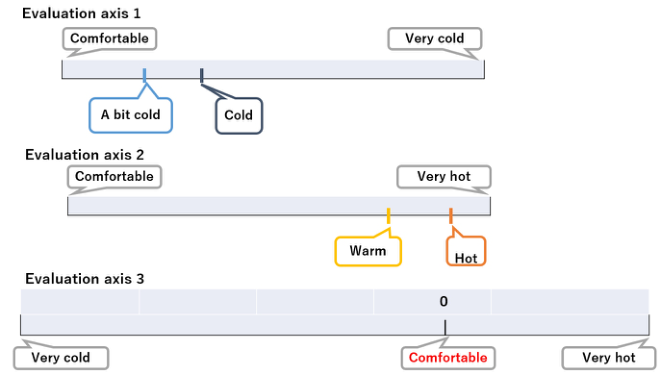
Thermal sensations were measured using a ratio scale (see Figure 1). Cold sensory receptors are shallower than warm sensory receptors, and Asians, who are used to high temperatures and humidity, are reported to be more acutely sensitive to cold sensations. Therefore, two axes (evaluation axes 1 and 2) were used to evaluate hot and cold sensations. For the assessment of hot and cold sensations felt by the participant upon waking each day, the participant entered her sensations of hot and cold for the day on evaluation axes 1 or 2 in either order.
Figure 1: Three evaluation axes for thermal sensation.
Seasonal Variations in the Comfortable Bedroom Temperature at the Time of Waking 79
For both axes 1 and 2, the left end was set to a sensation that was com- fortable and the right end to a sensation that was very cold or very hot. In addition, cold and slightly cold sensations were recorded on evaluation axis 1 and warm and hot sensations were recorded on evaluation axis 2. On evalua- tion axis 3, the left end was set to a sensation that was very cold and the right end was set to a sensation that was very hot, and a comfortable sensation was plotted on the axis.
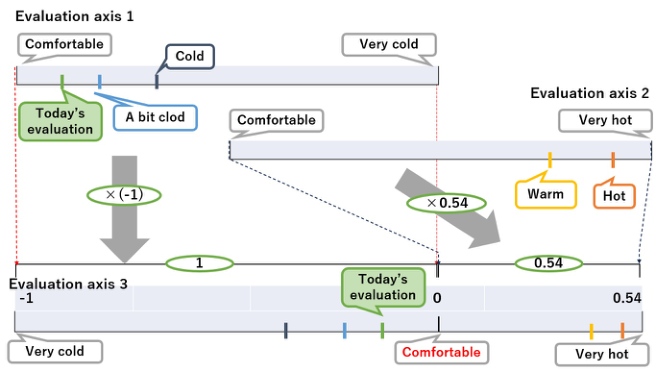
Figure 2: Conversion of the thermal sensation.
An example of the procedure for converting the warm and cold sensations is shown in Figure 2. In plotting the results of evaluation axes 1 and 2 on evaluation axis 3, the value for very hot was determined as the ratio of the distance from very cold to comfortable and the distance from very hot to comfortable on evaluation axis 3 in Figure 1, with very cold set at −1 and comfortable set at zero. The hot value was obtained as +0.54. Incidentally, the cold value on the day relevant to Figure 2 was −0.13. In this way, the warm and cool sensations on day 479 were quantified.
RESULTS
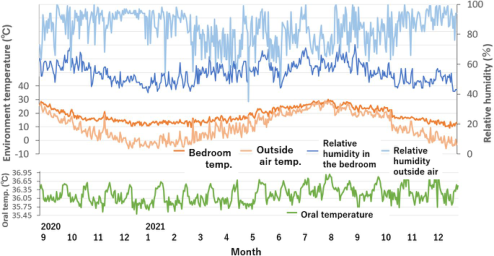
The participant’s oral temperatures and the temperature and humidity of the bedroom and environment are shown in Figure 3. The oral temperature of the participant was biphasic across all months, and the participant’s basal body temperature fluctuated with the participant’s menstrual cycle. The coef- ficients of correlation between the oral temperature, bedroom temperature, outdoor temperature, and the discomfort indices of the bedroom and out- door air were thus calculated. Significant positive correlations (p < 0.001; correlation coefficients ranged between 0.333 for the oral temperature and bedroom temperature and 0.999 for the bedroom temperature and bedroom discomfort index) were found for all combinations of the oral temperature, bedroom temperature, bedroom discomfort index, outdoor temperature, and
80 Mitsuno and Yoshimura
outdoor air discomfort index. Thus, on days when the external ambient tem- perature was higher, the bedroom temperature and oral temperature were higher, as was the bedroom and outdoor air discomfort index. In addition, the basal body temperature was found to have remained biphasic but varied seasonally.
Figure 3: Oral/bedroom/outside air temperatures and relative humidities across all seasons.Table 1. Coefficients of correlation between oral/bedroom/outside air temperatures and discomfort indices.
Discomfort index (1) 0.336 ∗∗∗ 0.999 ∗∗∗ 0.962 ∗∗∗ 0.957 ∗∗∗ Outside of air temperature Disconfort index (2) 0.336 ∗∗∗ 0.958 ∗∗∗ 0.957 ∗∗∗ 0.998 ∗∗∗ Discomfort index (1) is bedroom discomfort index whereas discomfort index (2) is the outdoor air discomfort index.
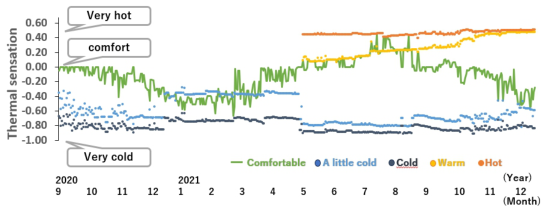
Figure 4: Changes in thermal sensation across the season.
Figure 4 presents warm and cold sensations based on the ratio scale. In addition to cold and slightly cold sensations on the same day, warm and hot
Seasonal Variations in the Comfortable Bedroom Temperature at the Time of Waking 81
Table 2. Coefficients of correlation between the thermal sensation and oral/bedroom/outside air temperatures and discomfort indices.
Discomfort index (1) is the bedroom discomfort index whereas discomfort index (2) is the outdoor air discomfortable index.
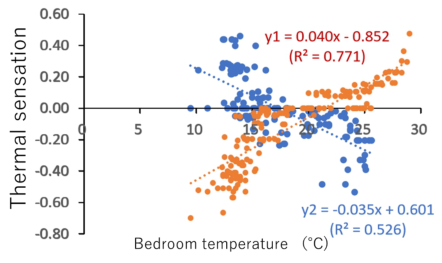
Figure 5: Relationship between the thermal sensation and bedroom temperature.
sensations were included from May 2021 because they were rarely felt in 2020. The coefficients of correlation between the sensations of warm and cold in the bedroom upon waking and the oral, bedroom, and outdoor tem- peratures and the bedroom and outdoor air discomfort indices are given in Table 2. The significant positive correlations (p < 0.001) between the daily waking temperature and the cold sensation and oral, bedroom, and outside air temperatures and bedroom and outside air discomfort indices showed that the bedroom temperature increased or decreased with the outside air tem- perature, and a higher bedroom temperature corresponded to a higher oral temperature and discomfort index. In addition, the cold, slightly cold, warm, and hot sensations differed between summer and winter, with the interval between warm and hot sensations decreasing from summer to winter, almost reaching zero in winter. The warm and cold sensations thus varied seasonally.
The days and bedroom temperatures rated as comfortable from Febru- ary to July (phase I) and from August to December (phase II) are shown in Figure 5. The data are presented for the year 2021. A significant regression line was obtained between the comfortable thermal sensation x and com- fortable bedroom temperature. The comfortable bedroom temperature was y1 = 0.04x −0.852 (R2 = 0.771) in phase I and y2 = −0.035x + 0.601 (R2 = 0.526) in phase II.
Substituting y1 = 0 and y2 = 0 into the respective equations gives x = 21.4
C in phase I and x = 17.3
C in phase II. The mean oral and bed- room temperatures were respectively 36.3 and 20.7
C in phase I and 36.1 and 18.1
C in phase II, with the former temperatures being significantly greater than the latter temperatures.
82 Mitsuno and Yoshimura
In phase I, the participant did not report being comfortable unless the bedroom temperature reached 21.4
C, whereas in phase 2, the participant did not report being comfortable unless the bedroom temperature reached 17.3
C. In other words, the participant judged a comfortable bedroom temperature after a hot day to be lower than the average annual bedroom temperature but that after a cold day to be higher than the average annual bedroom temperature. Thus, because humans judge their current comfort based on the environmental temperature information stored in their bodies after spending several months in an environment, temperature information accumulated for several months should be considered to create the current comfortable bedroom temperature.
DISCUSSION
We found that the bedroom temperature and oral temperature changed sig- nificantly (p < 0.001) with the temperature of the external environment. In addition, the judgment of whether the bedroom temperature was comfort- able related to the accumulation of temperature information over previous months. The study investigated when and by how much the room tem- perature needs to be adjusted to create a more comfortable waking room temperature.
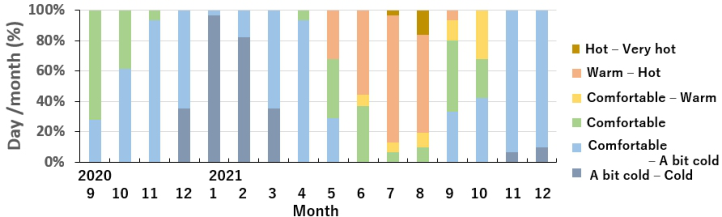
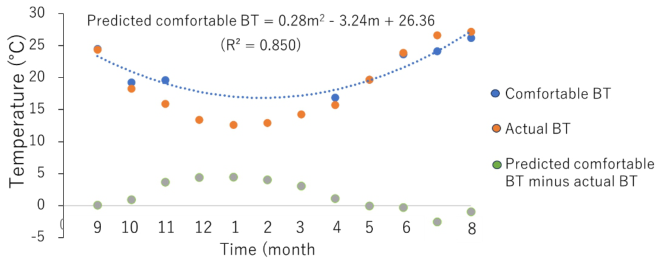
The relative number of days of hot and cold thermal bedroom sensa- tions at waking by month, broken down by rating, is shown in Figure 6. From December 2020 to March 2021 and from November and December 2021, not a single day was rated as being comfortable. A hot sensation was recorded only on a few days in July and August 2021. The monthly bedroom comfort temperatures and actual bedroom temperatures and their differences are shown in Figure 7. An approximate prediction curve was obtained from the monthly average of the comfortable bedroom temperature data (Septem- ber/October 2020 and April–August 2021); i.e., the predicted comfortable bedroom temperature was 0.28m2 −3.24m + 26.36 (R2 = 0.850). This shows that in winter, the bedroom temperature should be increased by 4.5
C in December and January, 4 in November and February, and 3
C in March to be comfortable. In summer, a reduction of 2.5
C in July would create a comfortable waking environment.
According to Fukai et al. (1993), the neutral temperature range of Japanese office hours is approximately equal between summer and winter (22 – 26
C). However, according to Kubo et al. (1993), the difference of comfortable room temperature occurred between summer (22 – 30
C) and winter (20 – 28
C). We previously reported that a bedroom temperature of 20
C set 30 minutes before waking to increase the skin temperature of the limbs kept the skin warm during the day. The predictive equation obtained in this study showed that the bedroom has a desirable temperature of 20
C without adjustment in November and comfortable enough temperatures of 18
C in December and April and 17
C from January to March. In summer, bedroom temperatures of 24
C (reduced by 2.5
C) in July and 26
C (reduced by 1
C) in August would be sufficient for the body to acclimatize to the heat. Incidentally, in the present study, the bedroom temperatures in May, June, September, and
Seasonal Variations in the Comfortable Bedroom Temperature at the Time of Waking 83 October were 19.7, 23.6, 23.8, and 20.4
C, respectively, and would not have required adjustment. Thus, if the room temperature was adjusted 30 minutes before waking from December to March and in July, every day could be spent in comfort. However, the comfortable bedroom temperature at waking time in this study differed by 4.1
C between 21.4
C (winter-summer) and 17.3
C (summer to winter). From the perspective of the SDGs, it is important to avoid unnecessary energy use. Further research is needed to increase the number of participants in the future.
Figure 6: Ratios of the numbers of days of bedroom thermal sensations by month.Figure 7: Predicted comfortable bedroom temperature.
CONCLUSION
In Japan, many women complain of coldness, and suggestions for addressing the problem are needed. This study derived a comfortable waking room tem- perature based on bedroom and outdoor temperatures during waking hours and the associated thermal sensations, which were measured over a period of 16 months for a participant who experienced strong coldness. The basal body temperature remained biphasic but varied seasonally. In addition, the thermal sensations changed during the year. From winter to summer, the par- ticipant did not report being comfortable unless the bedroom temperature reached 21.3
C, whereas from summer to winter, the comfortable temper- ature threshold was 17.2
C. The bedroom had a desirable temperature of
84 Mitsuno and Yoshimura
20
C without adjustment in November and a comfortable enough temper- ature of 18
C in December and April and 17
C in January to March. In summer, bedroom temperatures of 24
C (reduced by 2.5
C) in July and 26
C (reduced by 1
C) in August would be sufficient for the body to accli- matize to the heat. Thus, the preferred waking room temperature changed as the outdoor/bedroom temperatures changed over the annual cycle.
ACKNOWLEDGMENT
Part of this work was supported by the Japanese Society for the Promo- tion of Science, KAKENHI Grant Number 22K02111. We thank Edanz (https://jp.edanz.com/ac) for editing a draft of this manuscript.
REFERENCES
Fukai, K. Gotoh, S. Saito, J. Ito, H. Aku, S (1993) Experimental study on correlation between standard new effective temperature (SET) and Japanese thermal sensation: Part 2 Comparison of thermal sensation in winter and summer sea- son, Air-Conditoning and Sanitary Engineers, 51:139–147 (English abstract and Japanese text). Inaba, R. Kurokawa, J. Mirbod, SM (2009) Comparison of Subjective Symptoms
and Cold Prevention Measures in Winter between Traffic Control Workers and Construction Workers in Japan, Industrial Health 2009, 47:283–291. Japan Weather Association (2023) Discomfort index, https://tenki.jp/indexes/. Kono, K. Ogata, Y. Kaneko, K. Taneichi, A. Yamamoto, M (2019) Physiological Mechanism of Hiesho in Terms of Thermogenesis: A Study Using Basal Metabolic Rate, Muscle Mass, Bulletin of Dokkyo Medical University School of Nursing, Vol. 13, 41–47 (Japanese text). Lopez, G. Tokuda, T. Oshima, M. Nkurikiyeyezu, K K. Isoyama, N. Itao, K. (2018)
Development and Evaluation of a Low-Energy Consumption Wearable Wrist Warming Device, International Journal of Automation Technology, Volume 12, Issue 6, Page 911–920 Special Issue, doi: 10.20965/ijat.2018.p0911. Kubo, H. Isoda, N. Yanase T (1993) Seasonal variations of air temperature for the thermal comfort, J. Human and Living Environment 1:51–57. Mitsuno, T. Naito, Y. Seki, M (2008) Effect of some factors on skin temperature of
the palm in daytime: in special reference to the relation between skin temperature of rising in bedroom, Physiological Anthropology 13: 179–183 (English abstract and Japanese text). Nagashima, K. Yoda, T. Yagishita, T. Taniguchi, A. Hosono, T. Kanosue, K.
(2002) Thermal regulation and comfort during a mild-cold exposure in young Japanese women complaining of unusual coldness, J Appl Physiol 92: 1029–1035. doi: 10.1152/japplphysiol. 00399.2001. Yamazaki, F. Inoue, K. Ohmi, N. Okimoto, C. (2023) A two-week exercise intervention improves cold symptoms and sleep condition in cold-sensitive women, Journal of Physiological Anthropology volume 42, Article number: 22 doi: 10.1186/s40101-023-00339-y.
LISTED IN THE AHFE DIGITAL BOOKSTORE CATALOGUE
Explore the complete digital volume
Human Factors for Apparel and Textile Engineering
Read this individual research paper free through the original publisher, or explore the full digital proceedings book.
ISBN 978-1-964867-10-6
Explore this ISBN in the AHFE Bookstore ↗Listed in the July 2026 bookstore catalogue; search by ISBN to confirm current availability · Digital book purchase optional