Tamaki Mitsuno, Ami Sugawara (2022). Effect of the shoe heel height on lower-limb muscle activity. In: Physical Ergonomics and Human Factors. AHFE Open Access, vol. 63, pp. 13–20. https://doi.org/10.54941/ahfe1002591
Women often wear high-heeled shoes to make their feet look slender and tall. We focused on the muscle activity of the lower limbs and investigated how the presence or absence of shoes and the change in heel height affect the lower-limb muscles. The participants were eight women in their twenties, and the lower-limb muscle activity was measured while the participants wore running/low-heeled/high-heeled shoes. The surface myoelectric potential was measured for eight muscles around the knee/waist using a multi-channel telemeter as the participants walked on a treadmill. The root-mean-square myoelectric potential and thus muscle activity were significantly higher for bare feet than for wearing shoes. Additionally, there was no significant difference in muscle activity between low-heeled and high-heeled shoes, but the activity was less for these shoes than for running shoes. Thus, as the heel height in-creased, the muscle activity around the knee decreased whereas that around the lumbar spine increased.
Women often wear high heels to make their feet look slender, beautiful, and tall. However, the wearing of high heels applies more strain to the lower legs than having bare feet. Kim et al. showed that the balance of walking move- ments is worse when walking in high heels than when walking with bare feet, and not only is there shoe rubbing and foot pain but also increased fatigue when wearing high heels. Wiedemeijer and Otten showed that the increase in fatigue is due to changes in walking morphology, and that focusing on the kinematics of the gait, the medial load of the knee is increased by an increase in the peak of the internal knee abduction moment as the heel height incre- ases. Barkema reported that changes in ankle movement may be associated with an increase in the medial knee load. Simonsen showed that walking in high-heeled shoes reduces the ankle joint moment because of a reduced muscle fiber length and/or increased co-contraction about the joint, the exten- sor moment of the knee joint when wearing high-heeled shoes is almost twice that when walking barefoot at the same velocity, and electromyographic acti- vity increases in the leg muscles when wearing high-heeled shoes. Blanchette et al. showed that wearing high heels increases the chances of slipping and falling and that the friction in walking is affected by the height of the heel, with a higher heel resulting in more used friction, a stronger shear force, and
a weaker normal force. The desire to be visually beautiful thus presents risks of muscle fatigue and falling. Thus, many researchers have pointed out the dangers of wearing high-heeled shoes and muscle fatigue. Nevertheless, our desire to be visually beautiful remains, and poses a risk of muscle fatigue and falls. The present study focused on the muscle fatigue of the lower limbs when participants wore shoes and investigated the dependence of the muscle acti- vity of the lower limb on the presence or absence of shoes and the height of the heel. Our final goal is to develop stockings that reduce leg muscle fatigue when wearing heels. In this report, we clarify the difference in muscle activity depending on the type of shoe as preliminary work, leaving the development of such stockings as future work.
EXPERIMENTAL METHODS Participants and Experimental Conditions
The physical characteristics of the participants are given in Table 1. The par- ticipants were eight women in their twenties, each having a figure slightly narrower than the average figure of Japanese women. Each participant slept for 7 hours the night before the measurement and woke at 6 am, ate break- fast at 7 am, and entered an artificial-climate room at Shinshu University at 8 am. The artificial-climate room had an environmental temperature of 24.5 °C, relative humidity of 50%, an illuminance of 800 lx, and airflow of 0.5 m/s. After entering the room, the participant remained in a sitting position for 1 hour, and the myoelectric potential of the lower limbs during walking was then measured. The participant had (1) bare feet (heel 0 cm) and wore own (2) running shoes (with heels no higher than 1 cm), (3) low-heeled shoes (with heels of approximately 3.5 cm), and (4) high-heeled shoes (with heels of 7–8 cm) as the four experimental conditions and walked at 4 km/h on a treadmill for 3 min for each condition.
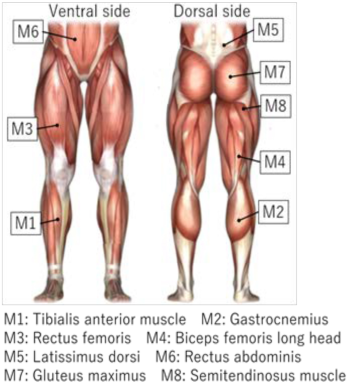
Method of Measuring Muscle Activity The surface myoelectric potential was measured during walking using a multi-channel telemeter (WEB-1000, Nihon Kohden, Japan). The measuring points are shown in Fig. 1. Eight measuring points on the right half of the body were separated into two groups of muscle: muscles around the knee (i.e., the tibialis anterior muscle, gastrocnemius muscle, rectus femoris muscle, and biceps femoris long head) and waist muscles (i.e., the rectus abdominis, latissimus dorsi, gluteus maximus, and semitendinosus). A root-mean-square (RMS) value of muscle activity was calculated from the myoelectric potential
Effect of the Shoe Heel Height on Lower-Limb Muscle Activity 15
Figure 1: Measuring points for muscle activity.
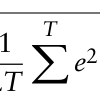
signal obtained for 2 minutes of a 3-minute measurement using Equation (1) for conditions (1) to (4).
Equation reproduced from the original PDF.
v u u t 1 2T −T
Here, T is selection time, e is potential at the time of observation, t is the observation time, and τ is a time constant. The values obtained for bare feet and running/low-heeled/ high-heeled shoes were confirmed to be significantly different in a paired analysis of variance, with the significance tested using the Bonferroni method.
RESULTS AND DISCUSSION
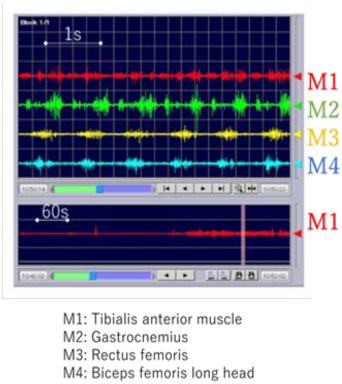
RMS Muscle Activities for Bare Feet and Wearing Each Type of Shoe A typical example of the myoelectric potential when a participant walked barefoot is shown in Fig. 2. The figure shows the real-time monitoring of the muscle activity of measuring points M1 to M4, with the bottom trace for M1 having a longer time axis than the upper traces for M1 to M4. The four muscles are the muscles surrounding the knee from the rostral (M3/M4) and caudal (M1/M2). M3/M4 are related thigh muscles and M1/M2 are related lower leg muscles. It then becomes clear from the electromyogram, that par- ticipants used either tight or lower leg more depending on the shoes during walking. M1/M3 are ventral muscles whereas M2/M4 are dorsal muscles, i.e., these muscles form a group of antagonistic muscles in walking movement. The phase shift in muscle activity between the ventral and dorsal muscles (e.g., M2 and M3) reveals that the ventral and dorsal muscles are used alter- nately in the walking motion. In this study, the RMS muscle activity was
Figure 2: A typical example of muscle activity.Figure 3: RMS of bare feet and wearing each shoe.
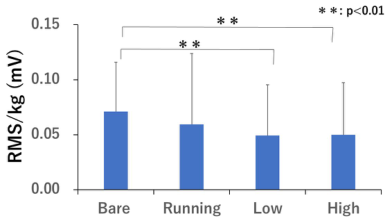
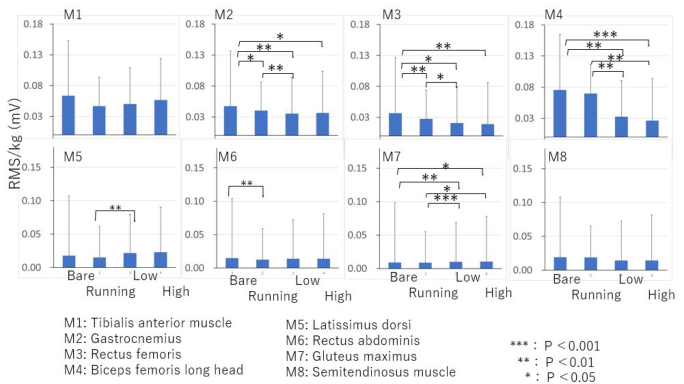
obtained by extracting data for 2 minutes from 3 minutes of data of walking under one condition, such shoe that the phase difference could be ignored. Each participant’s muscle activity during walking ranged from 7% to 38% of maximum voluntary contraction (% MVC: Maximum Voluntary Contra- ction). According to Muller and Hettinger has a muscle strength-enhancing effect when about 2/3 of the maximum muscle strength is exerted, but the effect cannot be expected and no individual difference in the muscle load amount by walking in this study. In other words, the walking motion during this experiment was not so specific to muscle load. In addition, since the participants with a significant bodyweight generally have a large amount of muscle, the standardization for RMS was performed by dividing by the wei- ght of the participants. The RMS muscle activities for bare feet and wearing each type of shoe are shown in Fig. 3. The RMS muscle activity for bare feet was significantly larger than that for wearing low-heeled and high-heeled shoes. Bare feet thus allow the foot to move more freely than heeled shoes, and the muscle activity was lower for wearing low-heeled/high-heeled shoes than for bare feet.
Effect of the Shoe Heel Height on Lower-Limb Muscle Activity 17
Figure 4: RMS of each muscle.
RMS Activity of Each Muscle The RMS activity of each muscle is shown in Fig. 4. Muscles M2/M3/M4/M6, and M7 were less active when shoes were worn, whereas there was no dif- ference between wearing shoes and bare feet for muscles M1/M5/M8. In particular, the activities of muscles M2/M3 varied significantly, decreasing in the order of bare feet, running shoes, low-heeled shoes, and high-heeled shoes, and these muscles are thus less used when shoes are worn and the heel increases. Meanwhile, the activity of muscle M7 increased in the order of bare feet, running shoes, low-heeled shoes, and high-heeled shoes, and this muscle is thus used more when shoes are worn, and the heel is high. The results show that the use of main muscles depends on the wearing of shoes and the heel height. Specifically, a higher heel resulted in the lower activity of the muscles around the knee and higher activity of the muscles around the waist, especially the gluteal muscles.
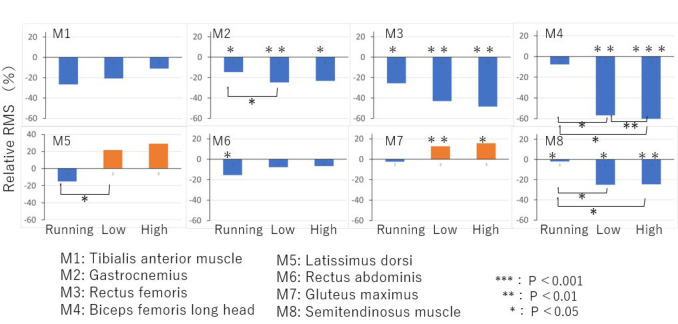
Relative RMS Activity of Each Muscle The RMS activity of each muscle when wearing each type of shoe relative to that for bare feet is shown in Fig. 5. An asterisk at the top of a bar indicates a significant difference between the bare feet and shoe conditions whereas an asterisk above a bridge indicates a significant difference between shoes. Zero on the vertical axis is the RMS myoelectric potential (muscle activity) for bare feet. The activities of muscles M2/M3/M4/M8 were significantly lower when shoes were worn whereas the activity of muscle M7 was significantly higher when low- and high-heeled shoes were worn. Satsumoto et al. reported that the electromyogram became highest at the muscle of tibias anterior (M1 in this paper) and the gastrocnemius (M2) of 7cm heel pumps among 3/5/7 cm heeled shoes. Our M1 and M2 results showed that the higher the heel, the less muscle activity. Considering Satsumoto’s results by age, the results for young people were less clear than those for older people, so they were
Figure 5: Relative RMS in each muscle to bare feet.
in good agreement with ours. Muscles M2/M4/M5/M7/M8 are all dorsal muscles, but the muscles around the knees (M2/M4) had lower activity and the muscles around the waist (M5/M7 but not M8) had higher activity when all shoes were worn. As such, when heeled shoes were worn, the activities of muscles M2/M4/M5/M7/M8 change significantly, and when the heel is high, the dorsal muscles around the knees are not used whereas those around the hips are used. This result is consistent with Snow’s report that the vertical force exerted on the forefoot during standing increases with the heel height, and a higher heel shifts the center of gravity the forward from the dorsal (Snow et al.). It is likely that the muscles on the dorsal side become difficult to use when wearing high-heeled shoes.
CONCLUSION
Women often wear high-heeled shoes to make their feet look slender and tall. We focused on the muscle activity of the lower limbs and investigated how the presence or absence of shoes and the change in heel height affect the lower-limb muscles. The participants were eight women in their twenties, and the lower-limb muscle activity was measured while the participants wore running/low-heeled/high-heeled shoes. The surface myoelectric potential was measured for eight muscles around the knee/waist using a multi-channel telemeter as the participants walked on a treadmill. The root-mean-square myoelectric potential and thus muscle activity were significantly higher for bare feet than for wearing shoes. Each participant’s muscle activity during walking ranged from 7% to 38% of maximum voluntary contraction (% MVC: Maximum Voluntary Contraction) and no individual difference in the muscle load amount by walking in this study. In addition, since the partici- pants with a significant bodyweight generally have a large amount of muscle, the standardization for RMS was performed by dividing by the weight of the participants. The RMS/kg muscle activities for wearing low-heeled and high- heeled shoes were significantly smaller than that for bare feet. Bare feet thus
Effect of the Shoe Heel Height on Lower-Limb Muscle Activity 19
allow the foot to move more freely than heeled shoes, and the muscle acti- vity was lower for wearing low-heeled/high-heeled shoes than for bare feet, that is, suppressed muscle activity. Additionally, there was no significant dif- ference in muscle activity between low-heeled and high-heeled shoes, but the activity was less for these shoes than for running shoes. Thus, as the heel height increased, the muscle activity around the knee decreased whereas that around the lumbar spine increased. On the dorsal side, the muscles around the knees had lower activity and the muscles around the waist had higher activity when all shoes were worn. As such, when heeled shoes were worn, the muscle activities on the dorsal side change significantly, such as when the heel is high, the dorsal muscles around the knees are not used whereas those around the hips are used. The muscles on the dorsal side become dif- ficult to use when wearing high-heeled shoes. Assuming that the pattern of muscle activity in bare feet is the least tiring, it is important to create pant- yhose that do not decrease muscle activity around knee muscles and do not increase the Gluteus Maximus muscles even when wearing shoes with heels. In addition, to improve comfort, it is necessary to devise a good arrangement of the pressure gradient from the toes to the waist [Mitsuno, Kai / Mitsuno, Kondo]. The present study found that wearing shoes changes muscle activity. In future work, to reduce fatigue of the lower limbs in walking, we intend to use this result in developing stockings that reduce muscle activity inclu- ding muscle fatigue (Masakado, Kiryu, Yoshida et al.) around the knees and increase muscle activity around the waist.
ACKNOWLEDGMENT
Part of this work was supported by the Japanese Society for the Promotion of Science KAKENHI Grant Number 17H01954/22K02111. We thank Edanz (https://jp. edanz.com/ac) for editing a draft of this manuscript.
on utilized coefficient of friction during walking.” Gait Posture. 34, 107–10Kim, Y., Koo, J., Oh, D. (2013), “Influence of Shoe Heel Height and Muscle Fatigue on Static and Dynamic Balance in Healthy Young Women.” Phys. Ther. Kor. 20, 36–44. Hettinger T, Muller E.A. (1953), “Muskelleistung and Muskeltraining” Arbeits Physiologie, 15, 111–126. Kiryu T. (1997), “See local muscle fatigue on surface EMG.” Journal of the Society
of Biomecha-nisms Japan, 21, 75–80 (in Japanese). Masakado, Y., Nod, Y., Hase, K., Komura, A., Chino N. (1994), “Muscle fatigue assessed by frequency analysis of surface electromyographic signals: topographical analysis in the same muscle.” Jpn J Rehabil Med, 31, 409–414 (English abstract and Japanese text). Mitsuno, T., Kai, A. (2019) “Distribution of the preferred clothing pressure over the
whole body.” Textile Research Journal, 89, 2187–2198.
Mitsuno, T., Kondo, S. (2022) “Clothing pressure and pressure sensation while wearing pantyhose: Muscle activity changes in the legs” TBIS 2022- Blended Conference proceeding full paper (in press). Muller E.A. (1957), “The regulation of muscular strength”. Assoc Phys Med Rehabil
J, 11: 41–47. Satsumoto, Y., Shimazaki Y., Saito H., Maruta N. (2020), “The effect of the height of the heel of pumps and the age to the gait analysis in wearing business pumps.” Desant sports science, 40, 236–246. Simonsen, E.B. (2014) Contributions to the understanding of gait control. Dan Med
J. 61, B4823. Snow, R.E., Williams, K. R. (1994), “High heeled shoes: their effect on center of mass position, posture, three-dimensional kinematics, rearfoot motion, and ground reaction forces.” Arch Phys Med Rehabil. 75, 568–576. Wiedemeijer, M.M., Otten, E. (2018), “Effects of high heeled shoes on gait. A review.”
Gait Posture. 61, 423–430. Yoshida, H., Ujiie, H., Ishimuta, K., Wada, M. (2004), “The estimation of muscle fatigue using chaos analysis.” Journal of the Society of Biomechanisms Japan, 28, 201–212 (English abstract and Japanese text).
LISTED IN THE AHFE DIGITAL BOOKSTORE CATALOGUE
Explore the complete digital volume
Physical Ergonomics and Human Factors
Read this individual research paper free through the original publisher, or explore the full digital proceedings book.
ISBN 978-1-958651-39-1
Explore this ISBN in the AHFE Bookstore ↗Listed in the July 2026 bookstore catalogue; search by ISBN to confirm current availability · Digital book purchase optional