Yuling Zhan, Chunheng Ho (2024). Correlation research on early-stage Design Data Search Strategies and Design Quality. In: Ergonomics In Design. AHFE Open Access, vol. 129, pp. 212–220. https://doi.org/10.54941/ahfe1004826
Data searching is an essential process in design, and research within the design field indicates a distinction in how expert designers and novice designers approach design problems. Expert designers, possessing a wealth of specialized knowledge, tend to search for additional information less frequently during the design process. In contrast, novice designers, due to their lack of professional knowledge, often need to search for, redefine, or organize information. (Ho, 2001; Cross et al., 1994). Consequently, novice designers tend to spend a significant amount of time repeatedly searching for information, leading not only to time wastage but also to designs that lack comprehensive consideration. Therefore, this study posits that the data collection process at the onset of design significantly affects the quality of design outcomes, necessitating further exploration of the relationship between various search strategies and design quality.The methodology involves think-aloud protocols, with the selection of coding systems based on search strategies divided into 0 to 3 dimensions as proposed by Gero and McNeill (1998) within the "problem domain" abstraction. Dimension 0 defines the system from the product's usage and user needs; 1 pertains to the product's interaction, styling, and imagery; 2 involves subsystems from product specifications, functions, behaviors, principles, and pain points; 3 considers details, integrating product principles with design elements and local details for effective optimization within the design concept. Additionally, regarding the quality of design outcomes, this study draws from the basic criteria for product design concepts proposed by Li, Feng-Qiang et al. (2016), encompassing ten aspects: functionality (F), usability (U), aesthetics and form (A), innovation (I), sustainability (ST), possibility (P), safety and regulation (SA), and marketability (M). These ten design criteria serve as a standard for assessing the quality of product design. Through the "problem domain" and "ten design criteria," this study aims to explore the differences in data search processes between novice and expert designers and the resulting impact on design quality.The findings reveal that novice designers mainly focus on the shallow, basic search dimensions of 1 and 2, lacking in-depth understanding of product details, which often leads to insufficient information for design execution. Experts iterate across dimensions 0 to 3, gaining a comprehensive understanding of the product, which better supports the subsequent design process. In terms of design criteria, novices focus on aesthetics/form (A) and innovation (I), with functionality also considered to some extent, while other aspects appear to be unconsciously neglected. Moreover, interviews and data organization revealed that novices tend to search from their personal experiences, whereas experts start from user needs, leading to more effective and accurate searches. Hence, in design education, teaching students to conduct comprehensive data collection could significantly enhance their design quality.
Correlation Research on Early-Stage Design Data Search Strategies and Design Quality 213
INTRODUCTION
In the design process, data search is an indispensable step before the start of design. Previous research has indicated that spatial searches have an impact on the solution of design concepts (Sarkar & Chakrabarti, 2014). Con- ceptual design is a fundamental phase in the product development process, where creativity is present in every step of the design (Dixon, 2011; Ralph, 2010) Exploring the creative process is an important direction in creativ- ity research (Lubart, 2001). Therefore, designers often generate ideas and evaluate them through the process of problem definition, picture collection, and data analysis, and finally measure the level of creativity through eval- uation. Kovacs, O’Donovan, Bala, and Hertzmann (2018) mentioned that diagrammatic design tools provide expert designers with powerful creative capabilities, but for novice designers, the choices often leave them at a loss. Additionally, Gomes, Ogliari, Fernandes, and Marques (2022) mentioned that in product development, designers use technology to overcome creativ- ity barriers, with most stimuli presented to designers in the form of text and images during the data search process. Therefore, it is necessary to further explore the relationship between different search strategies and the quality of design outcomes. Hence, this paper will discuss the steps of data search at the beginning of the design, using images and textual data as research motiva- tions, to explore the thinking patterns of expert and novice designers during the data search process, as well as the thought process and methods behind their search actions.
In research related to the design field, studies have shown that expert designers and novice designers handle design problems differently (Ho, 2001). Thus, it is necessary to further explore whether there are signifi- cant differences in the data collection process at the beginning of the design. Ho (2001) and Cross (1994) found that novice designers tend to deal with aesthetic problems due to the lack of clear design standards, focusing only on the surface level; while experts tend to make their concepts feasible. Sim- ilarly, Cross, Christiaans, and Dorst (1994) observed that novice designers often find themselves lacking data halfway through sketching and return to searching for data. Therefore, it is necessary to establish a more systematic set of search criteria during the data search process to allow designers to search with higher accuracy and effectiveness, thereby assisting subsequent design.
This study primarily explores the process of data search actions by design- ers before starting the design work, mainly analyzing the differences in the thought process of expert and novice designers during the text and image data search process; and during the data search process, whether designers have conscious or unconscious data search actions regarding the basic crite- ria of design, for evaluating subsequent design. Therefore, it is necessary to establish a more systematic search orientation during the data search process to allow designers to search with higher accuracy and effectiveness, thereby assisting subsequent design.
214 Ling and Chun-Heng
Data Searching Before Design Starts In the design field, Ralph (2010) proposed that design is not merely about solving problems but encompasses four fundamental qualities: a creative way of thinking; continual stimulation during the design process; a comprehensive reconfiguration of the problem; and innovations and valuable products that are recognized and accepted within the designer’s culture. Chan and Chan (2015) believe that design creativity is a form of deliberate reasoning behav- ior that can produce design concepts, which often emerge during the data searching and sketching processes. In summary, creativity, processes, or work in design must at least meet four conditions: innovation (Simonton, 2013) value (Ulrich & Eppinger, 2016), function (Yuan & Lee, 2014), and domain knowledge (Gabriel, Monticolo, Camargo, & Bourgault, 2016). Therefore, this study combines the ten basic criteria for product design concepts pro- posed by (李奋强, 常慧贞, 郭延鑫, & 周飞, 2016) as the first coding system of this study, to identify the differences in the search process between novice and expert designers. Additionally, this paper also applies a second coding, following the classification of “problem domain” (Gero & Mc Neill, 1998), coded into two dimensions: “level of abstraction” and “reasoning mode”, with this paper coding only from the dimension of “level of abstraction”. Herein, this paper applies two sets of coding systems to explore the decom- position strategies and differences in the data search process of expert and novice designers.
Colloquial Data In the design process, data searching is an essential component. However, the search process itself is part of design thinking. The method of verbal analysis originates from the fields of cognitive psychology and cognitive science (Gero & Mc Neill, 1998) and (Gero & Tang, 2001) and is currently one of the most effective and widely accepted research methods in cognitive psychology stud- ies. The so-called verbal analysis is a research method that involves collecting and analyzing visual and graphical data from design experiments through specific data extraction and recording techniques. It is primarily divided into concurrent and retrospective types (Dorst & Dijkhuis, 1995). The concurrent verbal analysis, also known as the think-aloud method, requires subjects to narrate their thought processes in real-time oral narratives during the exper- imental process. The advantage of this method is that it can extract a large amount of detailed design content. The downside is that it may interfere with decision-making activities in design, as well as lead to repetitive explanations and narrations (Dorst & Dijkhuis, 1995). In researching data searching, this paper uses the think-aloud verbal analysis to explore the differences in data searching between expert and novice designers and the related differences in the quality of design outcomes that result from these differences.
Experiments The author invited students, novice designers, and expert designers from the Department of Industrial Design to participate in a design task based on their experience and knowledge. The task was to design “a nebulizer that
Correlation Research on Early-Stage Design Data Search Strategies and Design Quality 215
does not generate resistance in children’s psychology.” The search process for the design topic included text, images, URLs, and time without any restric- tions, continuing until the subjects were ready to start sketching. During this period, subjects were required to think aloud. The author observed the entire search process of the designers through online meetings, conducting screen and audio recordings, and subsequently converting the audio into verbatim transcripts. The verbal data of the subjects were coded using two selected coding systems and analyzed upon completion.
The experimental subjects were all from the Department of Industrial Design at Success University. The novice designers (2 individuals) were first- year undergraduate freshmen who had only received one year of design education; thus, they were defined as novice designers in this study. On the other hand, the expert designers (2 individuals) majored in industrial design but had received over six years of design education and had been awarded in the design field. Therefore, they were defined as expert-level designers in this study.
Coding System This study utilized two coding systems to explore the differences in search dimensions between experts and novices. The first dimension concerns the “problem domain” of the search process, focusing on how designers define the content and direction of their searches. The abstraction levels range from 0 to 3, where 0 represents comprehensive design issues; 1 corresponds to subsystem interactions; 2 is about the details of subsystems; and finally, 3 pertains to the details within the functioning of subsystems. This frame- work employs the abstraction dimensions within the “problem domain” proposed (Gero & Mc Neill, 1998) as the theoretical model’s foundational structure, as illustrated in Table 1.
Table 1. Problem domain categories.
Table available in the original PDF paper.
Definition
Level of Abstraction 0 System Understand the uses and needs of atomizers 1 System and Subsystems Shape pictures of atomizer machine 2 Subsystems Atomizer specifications (categories) as well as functions, behaviors, principles, and pain points 3 Design details The atomizer principle is combined with the design, mask, handheld cup, local details of the fuselage, etc. How to effectively integrate the principle into the main design concept.
The second coding system involves ten basic criteria for product design: Functionality (F), Usability (U), Aesthetics and Form (A), Innovativeness (I), Sustainability (ST), possibility (P), Safety and Regulatory Compliance (SA),
216 Ling and Chun-Heng
Marketability (M), Social Value (SV), and Cultural Context (CC). Ultimately, Social Value (SV) and Cultural Context (CC) were excluded, as they seemed not applicable to the design search in this study. Within the design criteria, this research aims to investigate whether experts and novices conduct their initial design searches based on a framework of design criteria, potentially leading to the generation of design ideas, as shown in Table 2.
Table 2. Basic principles of design.
Table available in the original PDF paper.
No. Design Principles Definition
1. Functionality/F User needs, functional presentation, appropriate functions, clear functions, rational and objective 2 Usability/U Easy to operate, human factors considerations, comfortable operation, high readability 3 Aesthetics and form /A Visual pleasure, shape proportions, exquisite quality and excellent materials 4 Innovation/I Prevention of counterfeiting, perceptual interest, trends, novelty and uniqueness, conceptual design 5 Sustainability/ST Environmental harmony, considerate life, respect for humanity, environmental awareness 6 Possibility/P Design should take into account current manufacturing techniques and materials to ensure the product can actually be produced 7 Safety and regulation /SA Safety markings, performance specifications, error proofing, structural safety 8 Marketability/M Commercial value, ease of sale, acceptance, cost-effectiveness
Results and Analysis This study discovered that there was not a significant difference in the amount of time spent searching between experts and novices, therefore, time will not be discussed further. The primary focus of the discussion will be on the design- ers’ search frequency within the problem domain’s abstraction dimension and the design criteria.
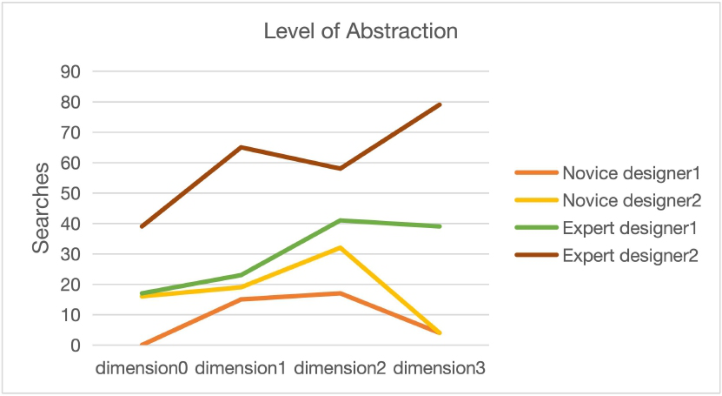
Problem Domain Level of Abstraction Based on the coding results of the subjects’ abstraction levels from “0 to 3”, the search dimensions of designers were summarized. Novice designers pri- marily focused on dimensions 1 and 2, mainly searching for the form of the nebulizer as well as specifications and behaviors, concentrating on more superficial levels of search. In the breadth and depth of searches at levels 0 and 3, novices appeared to be more unconscious, and it was observed that during their search process, novice designers could deviate from the direc- tion, leading to the encounter of incorrect stimuli, thus deemed as ineffective searches.
Numerous studies indicate that design is not a simple linear process (Chen, Chen, & Yang, 2022). Expert designers engage in both breadth and depth
Correlation Research on Early-Stage Design Data Search Strategies and Design Quality 217
searches, and in the experimental analysis, it is visible that experts iterate through the dimensions from 0 to 3. Design behavior involves the constant switching between divergent and convergent thinking that occurs throughout all stages of the design process (Green, Southee, & Boult, 2014), as shown in Figure 1.
Figure 1: Problem domains for novices and experts.
In the early stages of the design process, the search dimensions already reveal differences in the behavior of expert and novice designers during their search process. Clearly, this difference manifests itself in the design data search process, as Christiaans and Dorst (1992) mentioned that both junior and senior industrial design students fall into the information gathering pro- cess; however, junior students typically collect less information and are less aware of potential criteria and possible difficulties they may encounter. In contrast, another group of senior students, who collect a large amount of information, demand more information, structure the problem earlier, and consciously obtain better solutions in terms of creativity (Cross et al., 1994). Therefore, the information searched by expert designers in the early stages is more effective and supportive for later stages of design.
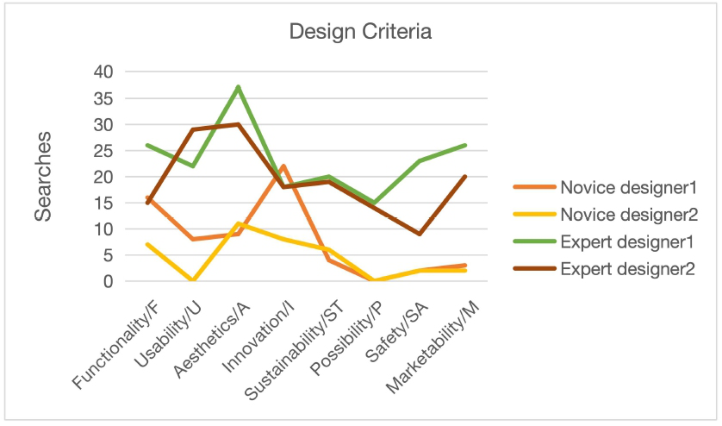
Basic Principles of Design In the search process, novice designers primarily focus on Aesthetics and Form (A) and Innovativeness (I), with some preliminary consideration given to Functionality (F). They seem to be more unconscious of other aspects. In contrast, expert designers consciously engage in a comprehensive considera- tion and divergent search in each design dimension.
Regarding design thinking, given the inclusion of children, both experts and novices tend to search in directions related to cuteness, color, and toys. Novices mainly aim to attract children by combining cute designs, readily extrapolating several design ideas from a single cute form, which seems to
218 Ling and Chun-Heng
them a highly creative approach. However, they seem to overlook the feasi- bility of their solutions. Experts, on the other hand, start by identifying pain points, such as why children might fear the device, considering a range of possibilities like noise and masks. They think about how to turn these disad- vantages into advantages to make the device more acceptable to children, thus expanding their search space during the process. They comprehensively assess the effectiveness of the information gathered for preservation, as shown in Figure 2.
Figure 2: Design principles for novices and experts.
Cross et al. (1994) and Ho (2001) have found through experimental results that novice designers tend to focus on aesthetic issues due to the lack of clear design standards, concentrating only on superficial aspects. In con- trast, experts are inclined to make their concepts realistically feasible. Thus, from this study, it is evident that this phenomenon already occurs during the information search stage, resulting in novices focusing more on surface-level details in their later designs, while experts take a comprehensive approach, making the designed products more feasible.
CONCLUSION
This study analyzed the data search process conducted by novice and expert designers at the preliminary stage of design. Novices primarily focused on dimensions 1 and 2 of the abstraction level in the problem domain, mainly searching for images, specifications, and forms. This led to a broader search space, causing novice designers to lack focus on the product core during their search. Conversely, expert designers engaged in an iterative process involving both breadth and depth of search across dimensions 0 to 3, leading to a more
Correlation Research on Early-Stage Design Data Search Strategies and Design Quality 219
comprehensive understanding of the product and more accuracy in image searching.
Furthermore, in terms of design criteria, novice designers mainly focused on aesthetics, form, and creativity, showing significant concern for the prod- uct’s appearance and originality, with some preliminary consideration of functionality. Cross et al. (1994) found that novice designers often realized midway through sketching that they lacked sufficient information, lead- ing them to return to data searching. From the design criteria perspective, novices’ searches are primarily focused on form, resulting in insufficient infor- mation in later design stages. In contrast, expert designers’ search processes are more dispersed, with a conscious focus on usability, sustainability, tech- nical feasibility, and market aspects. Safety and regulatory compliance are among the important criteria for medical products, which novices seem to overlook entirely, whereas experts consciously consider the safety and legality of materials.
In conclusion, differences already exist between novices and experts in the information gathered at the preliminary design stage, affecting later design sketches and products. Novice designers base their searches on personal life experiences, while experts start from user needs, resulting in more effective and accurate search processes. Therefore, in design education, guiding stu- dents to engage in broad searches before delving into depth could significantly enhance design quality.
REFERENCES
Chan, C.-S., & Chan, C.-S. (2015). Development of Studies in Creativity. Style and Creativity in Design, 243–272. Chen, H.-J., Chen, Y.-T., & Yang, C.-H. (2022). Behaviors of novice and expert
designers in the design process: From discovery to design. International Journal of Design, 16(3), 59–76. Christiaans, H., & Dorst, K. (1992). An empirical study into design thinking.
Research in Design Thinking, Delft University Press, Delft, The Netherlands, 119–125. Cross, N., Christiaans, H., & Dorst, K. (1994). Design expertise amongst student designers. Journal of Art & Design Education, 13(1), 39–56. Dixon, R. A. (2011). Selected core thinking skills and cognitive strategy of an expert
and novice engineer. Journal of STEM Teacher Education, 48(1), 7. Dorst, K., & Dijkhuis, J. (1995). Comparing paradigms for describing design activity.
Design studies, 16(2), 261–274. Gabriel, A., Monticolo, D., Camargo, M., & Bourgault, M. (2016). Creativity support systems: A systematic mapping study. Thinking Skills and Creativity, 21, 109–122. Gero, J. S., & Mc Neill, T. (1998). An approach to the analysis of design protocols.
Design studies, 19(1), 21–61. Gero, J. S., & Tang, H.-H. (2001). The differences between retrospective and concurrent protocols in revealing the process-oriented aspects of the design process. Design studies, 22(3), 283–295. Gomes, M. G., Ogliari, A., Fernandes, R. B., & Marques, K. O. (2022). Evaluation
of physical models as creative stimuli in conceptual design of products. Design studies, 81, 101119.
220 Ling and Chun-Heng
Green, S., Southee, D., & Boult, J. (2014). Towards a design process ontology. The Design Journal, 17(4), 515–537. Ho, C.-H. (2001). Some phenomena of problem decomposition strategy for design
thinking: Differences between novices and experts. Design studies, 22(1), 27–45. Kovacs, B., O’Donovan, P., Bala, K., & Hertzmann, A. (2018). Context-aware asset search for graphic design. IEEE transactions on visualization and computer graphics, 25(7), 2419–2429. Lubart, T. I. (2001). Models of the creative process: Past, present and future.
Creativity research journal, 13(3–4), 295–308. Ralph, P. (2010). Comparing two software design process theories. Paper presented at the Global Perspectives on Design Science Research: 5th International Conference, DESRIST 2010, St. Gallen, Switzerland, June 4-5, 2010. Proceedings. 5. Sarkar, P., & Chakrabarti, A. (2014). Ideas generated in conceptual design and their
effects on creativity. Research in Engineering Design, 25, 185–201. Simonton, D. K. (2013). Creative thought as blind variation and selective retention: Why creativity is inversely related to sightedness. Journal of Theoretical and Philosophical Psychology, 33(4), 253. Ulrich, K. T., & Eppinger, S. D. (2016). Product design and development:
McGraw-hill. Yuan, R., & Lee, I. (2014). Understanding language teacher educators’ professional experiences: An exploratory study in Hong Kong. The Asia-Pacific Education Researcher, 23, 143–149. 李奋强, 常慧贞, 郭延鑫, & 周飞. (2016). 基于顾客满意度的产品概念设计评价研究.
包装工程, 37(24), 17–21.
LISTED IN THE AHFE DIGITAL BOOKSTORE CATALOGUE
Explore the complete digital volume
Ergonomics In Design
Read this individual research paper free through the original publisher, or explore the full digital proceedings book.
ISBN 978-1-964867-05-2
Explore this ISBN in the AHFE Bookstore ↗Listed in the July 2026 bookstore catalogue; search by ISBN to confirm current availability · Digital book purchase optional