Gérard Chollet, Hugues Sansen, Yannis Tevissen, Jérôme Boudy, Mossaab Hariz, Christophe Lohr, Fathy Yassa (2024). Privacy Preserving Personal Assistant with On-Device Diarization and Spoken Dialogue System for Home and beyond. In: Human Interaction and Emerging Technologies (IHIET-AI 2024): Artificial Intelligence and Future Applications. AHFE Open Access, vol. 120, pp. 270–279. https://doi.org/10.54941/ahfe1004577
In the age of personal voice assistants, we have witnessed the proliferation of "personal" vocal companions across smartphones, smart speakers, and other smart devices. Yet, the question arises: Are these virtual assistants genuinely "personal"? The answer may surprise you. Most of these digital companions lack the ability to remember past interactions or truly understand who you are. They heavily rely on an internet connection to process your spoken words in remote servers. Even though users provide informed consent for these interactions, concerns linger regarding potential misuse of speech data, like invasive targeted advertising. The advent of high-performance co-processors, such as GPUs and TPUs, in modern smartphones has rendered cloud-based speech processing obsolete, paving the way for local, on-device solutions.Personal assistants for the elderly serve a unique role, requiring functionalities distinct from those catering to digital natives. Notably, they must excel at aiding memory recall during conversations, making them invaluable in scenarios like medical examinations. By documenting and contextualizing exchanges during medical visits through diarization, a personal assistant can empower individuals or caregivers to revisit and understand the details at their convenience. This autonomy necessitates operation without an internet connection, ensuring utmost privacy during such sensitive interactions.The e-ViTA project has successfully developed a versatile conversational application with a rich set of features:• Local use on both Android and iOS smartphones, no internet connection required.• The capability to remember previous interactions.• Speaker recognition for personalized experiences.• Local processing for automatic speech recognition, spoken language understanding, dialogue management, and speech synthesis.• Secure web searches after anonymizing requests.• The ability to handle telephone calls, read emails, SMS, and messages.• Text preparation through voice dictation.• Assistance with daily activities and acting as a companion or butler.• Facilitating inter-lingual communication via integration with TalkMondo, among other functions.Unlike facial recognition, vocal recognition, and speaker differentiation provide a less invasive and cost-effective solution. Being based on the smartphone's microphone, they do not rely on the camera, which would necessitate complex mechanisms to track the speaker's position.This paper highlights the critical importance of speaker diarization, which allows the system to preserve users' conversations while ensuring the highest level of privacy. Additionally, when deployed on embedded devices, this technology can contribute to monitoring the well-being of the elderly, offering vital contextual information enriched by domotics sensors (motion, intrusion, door or window sensors), actimetry sensors from smartphones or smartwatches, or weather station. The data fusion of these different data streams leverages more personalized and optimized assistance and services, through user-adapted dialogues, or the elderly based on his context and activity.In conclusion, the ability of a system to generate personalized dialogue synthesis is pivotal in the realm of personal voice assistants. With secure, local processing and advanced features, such as speaker differentiation and diarization, enriched by sensor data fusion, we can ensure that virtual companions truly cater to the individual needs of users, without compromising their privacy or data security. This marks a significant step towards a more "personal" experience with our digital assistants.
Since the availability of Siri on iPhones, a large number of “personal” vocal assistants are proposed on smart phones, smart speakers, smart watches, … But, are these truly “personal”? They all need an internet connection to cap- ture your speech utterances in order to process them on the cloud. What are the cloud operators doing with these data? Even if it is true that you have given your informed consent to interact with these applications, there is still a risk that your speech data could be used for unwanted purposes like model training or exploitation of private information for targeted adver- tisement. Furthermore, none of these applications keep memory of previous interactions. They do not know who you are! In fact, they are quite “in- personal”. But, with the availability of fast co-processors (GPUs and TPUs) on smartphones, there is no need to perform speech recognition and under- standing on the cloud. The entire spoken dialog system can be embedded
(Chollet et al., 2022). In the framework of the e-ViTA project (https://www.e- vita.coach/), we have developed such an application which does not need an internet connection to be operational.
Personal assistants for the elderly must bring functionalities that may not be useful for the digital natives. In particular, they have to be memory helpers for what has been said during a conversation. Among the identified use cases, the medical examination can be seen as the most obvious. By keeping track of the exchanges during the visit through speaker diarization, a personal assis- tant can build a context that can be interrogated later either by the person or by a caregiver, either at home or in nursing homes. Such a use case requires a real autonomy of a personal assistant, usually with no connection to the Internet, while keeping the privacy of the visit.
In the framework of the e-ViTA project, we have developed a spoken conversational application which could be used locally on android and IOS smartphones without an internet connection. It keeps track of previous inter- actions, recognizes who is speaking, performs automatic speech recognition, spoken language understanding, dialogue management and speech synthe- sis on the smartphone, searches the web if necessary, after anonymization of the requests, answers telephone calls, reads your emails, SMS, messages, prepares texts under your dictation, coaches your activities, behaves like a companion/butler and interacts with TalkMondo (https://talkmondo.com/) to facilitate inter-lingual communications.
Being perceived as less intrusive than facial recognition, vocal recogni- tion/differentiation of the speaker requires less complex hardware since the device doesn’t have to turn a camera towards a speaker. With the addition of a camera, which most smartphones have, the latter technique would need a beam-forming technique for spatial location of the speaker before ori- enting the camera, increasing the cost of a device and by extension of the maintenance.
In this paper, we emphasize the necessity of speaker diarization that allows the system to keep track of the user’s conversations in a privacy preserv- ing scheme. This technology, when deployed on an embedded device can also help track the elderly person’s loneliness and give essential contextual information when a risk is detected by other sensors in a smart home for example.
RELATED WORKS There is a large number of vocal personal assistants available on smart- phones, smart speakers and smart watches. They include Siri, Google Now and Google Assistant, Cortana, Alexa, Bixby, Elsa, SoundHound, Sherpa, Extreme, HeadUp, Jarvis, Voice Search, Voice Access, Android Auto, DataBot, Robin, Lyra, Otter, Fireflies, Murf, Socratic, Youper, Melissa, Api, Wit, Your Phone Companion, Friday, Tolkie, Vani, Vision, Bestee, 24me, Assistant, Dragon, EasilyDo, Indigo, Luiza, Reata and possibly many others,... Most of them need an internet connection to capture your speech signal and process it on the cloud. Shoebox (https://en.wikipedia.org/wiki/IBM_Shoebox) was an early exception by IBM
in 1961 but it could only recognize the ten digits and 16 key words. Per- sonal Digital Assistants (Psion, IBM Simon, Palm, Pocket PC,...) were popular in the 90s but they could not offer a vocal interface. Mycroft (https://mycroft.ai/) has been the world’s first open source voice assistant which could be embedded on a desktop, in an automobile, on a Raspberry Pi,... and operates without connections. Snips (Coucke, A et al., 2018) planned to embed spoken language understanding on smartphones but was purchased by Sonos to be embedded in a smart speaker. It is only now that smartphones integrate co-processors which are capable of real time speech recognition, understanding and synthesis.
USE CASES While on, an individual vocal assistant (Iva) could start a dialogue with an unknown person and reveal information about the owner. The following use cases make the hypothesis that the persons around the owner accept being recorded. In this text we describe a simple day of interaction with Iva, with each phase being a use case of its own. When the smartwatch and the sensors located in the room detect an activity, early in the morning, Iva welcomes the owner by wishing a good day, recalling an appointment with the medical doctor at 10 AM and giving the weather forecast for the day. Arriving at the doctor’s, Iva recognizes a new speaker and asks the speaker’s name and activity. Until the end of the consultation, Iva doesn’t intervene unless she is asked to. She just transcripts the dialogue between both persons. At a certain point, the doctor can ask Iva what the heart rate of the owner was when she woke up. Back home, the owner can ask an explanation related to the consultation, in less technical terms. Enters a caregiver. The caregiver asks Iva to summarize the consultation. Iva recognizes the caregiver and adapts the summary according to the needs of the caregiver. Would it be a housekeeper, Iva would respond whether the owner is in good health, if ill, contagious or not. Later in the day, the owner asks a question about history. Iva makes a Web search and answers the question. Later in the day, Iva interrogates the owner about her life, an endless source of dialogue. Days after days, enough information is gathered to reconstitute the life of the owner and write her biography, her lifeline (López A. et al., 2017). This “LifeLine” feature is a short term/long term memory stimulation for the owner and a posthume gift for her family. Moreover, Iva is never bothered by being told the same story for the nth time, making Iva the best confidant one could dream of.
For John, this is another case. John is in his late sixties and still in good shape, at least he thinks he is, except that he has had to visit the bathroom many times each night for a few weeks. Besides having poor sleep, he is ashamed of the situation. He reassures himself into believing it will natu- rally improve. The sensors installed in his house as well as his smartwatch detect his nightly activity and report it to the e-ViTA application embedded on his phone, not on the Internet. Because it is an obvious health alarm, for a few days, e-ViTA has been recommending that he should consult a medical doctor. At the moment, this is still a secret between him and his phone. A secret to which no software vendors have access.
Privacy Preserving Personal Assistant 273
Some use cases have been left aside for the moment, such as how to avoid the service to engage in a dialogue with the TV or with another vocal assistant. The latter case is of course weird, but can also be used as a way to train and improve the service. Finally, the benefits of being able to be used without having to connect to a cloud server through the Internet has its benefits on its own as the service can be used out of any connection, like during outage or when no reliable connection to a 5G network is available.
Besides the usage, a designer must also take into account the operating cost of a service and its deployment. By integrating most of the processing on a device that is ubiquitous, we get rid of the operation of a server and we can benefit from the deployment platforms used for those devices. This contributes to making the service affordable for the targeted users, with a simple subscription model.
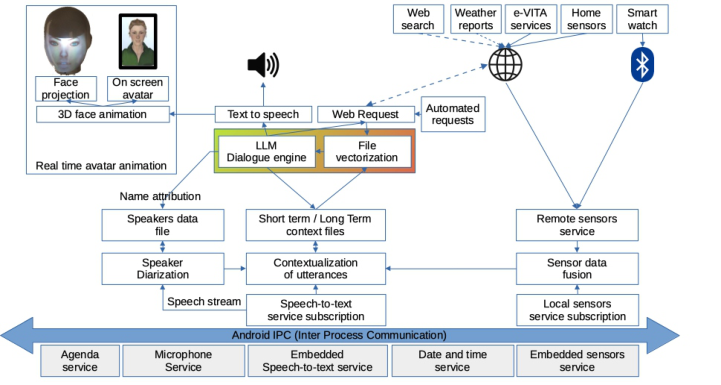
SYSTEM ARCHITECTURE Benefiting from the processing power of modern smartphones, the archi- tecture of the assistant embeds all the processing of the services inside an Android device (Pixel 6/7/8) (Figure 1). To preserve the privacy of the dia- logue exchanges, and to allow the usage in a non connected mode, all private interactions are performed on the device, with no exchange of private data with Cloud servers.
Figure 1: Ideal architecture blueprint of the individual voice assistant on an android phone (for clarity not all relationships are represented).
This architecture preludes the integration of talking faces initiated in the Empathic project (Torres M. I. et al., 2019) to animate a face in real time (Figure 1 top left). The very same architecture will be used in the animation of the projected face of the robot “Roberta Ironside”(Sansen H. et al., 2016). By embedding all the logic inside a mass market device, such as a high end
smartphone, the architecture allows the conception of a physical compan- ion/embedded avatar that will be affordable for a population with limited resources while facilitating the maintenance and the reliability.
Unfortunately, many Android security features prevent a simple realization of this architecture:
Google speech recognizer doesn’t return the audio stream of the speech being recognized, the callback is just optional.
It is not possible to allocate the microphone simultaneously to the diariza- tion and the speech recognizer. A solution that could have been a workaround to the previous point, but that is not possible for obvious security policies.
As a result, either the project will have to abandon the diarization, or wait for Google integrated diarization that has been demonstrated in 2019 (El Shafey L. et al., 2019). The third option being the integration of a cus- tom speech recognition, a project in itself that may be a last resort which is currently under investigation with partners.
SENSORS DATA FUSION Data fusion is the process by which data from different sources are combined to obtain new, higher-level knowledge. Thanks to the proposed architecture, data fusion can be managed both at cloud level and at the edge; by edge device, we mean here the smartphone that implements our system.
Firstly, the system can make web requests to a cloud server. As a server, the e-ViTA platform collects data from the user’s environment, performs data fusion processes and makes the results available to the user’s services (Szczepaniak et al., 2023).
For example, e-ViTA manages infrared motion sensors, door-opening sen- sors, indoor temperature and climate, and so on. The data minimization and data fusion component integrated in the platform provides statistics on the amount of time the user spends in each room (and deduces a level of sedentarization), but also allows proceeding algorithms for Human Activity Recognition (HAR) which produces labels with timing such as “cooking” “eating” “resting” “toileting” etc.
Those raw data and computed labels can be retrieved by the smartphone, after authentication, as for any other web queries. Since it is not mandatory for user services to get at real-time a report on these activities over time, it can be chosen to download this sporadically.
Secondly, the proposed system enables the smartphone itself to fuse data. The smartphone is a source of data (e.g. accelerometer, gyroscope and mag- netometer), which can be analysed by itself to produce labels about the user’s pose (“standing” “sitting” “lying” “walking”). The user’s activity (at least time of the day) with the coaching application is also a source of data and knowledge.
Finally, the data fusion embedded on the smartphone can combine infor- mation from the web and itself. For example, it can deduce the preferred
Privacy Preserving Personal Assistant 275
context (location, pose, time) when the user likes to chat with the coaching application.
SPEAKER RECOGNITION AND DIARIZATION As the elderly person interacts with the assistant on a daily basis, there will be many situations where this person won’t be alone and possibly not the only one speaking. Therefore, the system needs to be able to focus on its primary user voice. Such technologies exist and are already embedded in several home assistants such as the Google Home that possess an implementation of the Personal VAD technology (Ding et al., 2020).
Moreover, the system needs to understand the conversational context in which it is evolving. It needs to keep track of the conversations of its user to provide more relevant answers. For example, it should be able to summarize a conversation between the user and his doctor to help the former with his treatment or diet (Riad et al., 2022).
For this to happen in a privacy-preserving scheme, speaker diarization is directly implemented on the device. Performing speaker diarization is equiv- alent to answering the question of “who spoke, and when?”. By extracting speaker turns, the system can easily isolate one speaker’s instructions and dis- card the ambient speech if it has no interest for the assistant. Recent speaker diarization methods are based on several deep learning modules that seg- ment the audio into small atomic segments, then create speaker embeddings for each segment and finally cluster them to find the different speaker relative identity.
SPOKEN DIALOGUE SYSTEMS AND LLMS In parallel with our developments, the e-ViTA partners have developed a more traditional approach based on a private cloud server to satisfy the needs of the robotic systems being experimented (Mc Tear et al., 2023). Several of these devices (Nao, Gatebox, Daruma, SanTO and Android robots) use cloud based interfaces by default. The smartphone and the tablet were chosen in addition to facilitate privacy preserving experimentations. The Google Pixel 6, 7 and 8 offer an embedded ASR running on TPU with higher performances than cloud based solutions.
The architecture embeds a LLM model on the phone inside Android code that reproduces some functionalities of Langchain (https://www.lang chain.com/). Domain specific files are introduced and vectorized to constitute a permanent vector base. Temporary files, e.g. Web documents, are added in a temporary vector base as they are received. The vector bases used for the day are merged into a workspace vector base to serve as the workspace con- text. Additional events, diarization, sensor events, Web searches, are added to a temporary vector base that is merged to the workspace vector base as they arrive. Despite being powerful, the devices (Pixel 6/7/8) have a RAM of 8GB (12GB for the Pro version) while LLama2-7b (16GB) requires 6.52GB of RAM when quantized in 8 bits, a technique introduced in 2018 (Polino, A. et al., 2018). In order to keep enough memory space for other applications,
it is necessary to lower the quantization to 4 bits or less. Elias Frantar et al. have shown that their “method can still provide reasonable accuracy in the extreme quantization regime, in which weights are quantized to 2-bit or even ternary quantization levels” (Frantar E. et al., 2022).
Google’s TensorFlow-Lite, i.e. TensorFlow for mobiles, has been designed to work with 8byte quantized models and is supposed to use the TPU of Google Pixel phones. The Keras formatted GPT2 model that is used to answer questions, occupies 1.5GB once quantized. Even if GPT2 on TensorFlow-Lite is sufficient for a proof of concept, the TPU is not used and the response time, ranging from 15s to more than a minute on a Pixel 6 or a Pixel 7 is incompati- ble for a serious dialogue. As is, the solution cannot be proposed as a product. Thus we will have to wait for the availability of Gemini, an evolution of Bart (Gemini Team, 2023), in its mobile version: Gemini nano for the Pixel 8 Pro in Europe. This should happen when Google demonstrates the compatibility with the recent regulations of the European Union on AI. The drawbacks are a price tag around €1000 for the Pixel 8 Pro that will significantly increase a potential subscription fee for the service, and the uncertainty of the truly delivered functionalities.
As an alternative to TensorFlow-Lite, Llama CPP, an Open Source C++ implementation of Llama, designed to run on CPUs, is under investigation. This solution has to be integrated on Android in its 4 bit quantization version. Without the usage of the TPU, there is no hope to obtain a better response time, though, as tests on PCs show a response time around 1mn.
With context documents covering the targeted domain, and with a good tuning, the answers are sufficiently reliable for a concise dialogue, while larger models may be out of reach. To deal with the response time, a smaller model rephrases the questions, and the “large model” constructs the answers while the TTS reads the text of the rephrased question. Despite positive results, improvements are needed. In the project roadmap, Llama 2, of which the availability on Keras was announced last July, will be tested after quantization when the application is stable.
Because not all answers of the dialogue system are meant to be given to the user, they are filtered according to a marker. Sensor data are an example of events that do not require answers except when they are out of a given pattern. When an unregistered speaker is detected by the speaker diarization, the utterance is marked as such and triggers a question by the dialogue sys- tem to request the name of the speaker. Those that are marked as responses to the questions of a speaker are forwarded to a text-to-speech module. Since the native TTS service of the Android library doesn’t support prosody anno- tations, Speech Morphing TTS is preferred. It is a commercial solution in which two of our authors are involved. A similar approach has been used in the Empathic project in conjunction with the talking faces (Torres M.I. et al., 2019).
AUTOMATED ACTIONS Some actions such as weather report retrieval, agenda for the day announce- ment, are automated so that they can be announced at the start of the
Privacy Preserving Personal Assistant 277
application. Such actions run in a background process even while the appli- cation is not running. At the moment, we are still questioning whether the service should wake up when unusual events are detected by the sensors.
DISCUSSIONS AND UPCOMING CHALLENGES The Open Voice Network Association (https://openvoicenetwork.org/), W3C (https://www.w3.org/) and MPAI (https://mpai.community/) are developing recommendations and standards that we are contributing to. The need for a cloudless approach that would protect the user’s privacy seems shared by other teams such as Apple’s (Aas, C. et al., 2023).
The e-ViTA project targets a population that may not feel the need for changing its habits. As always, the real difficulty is not applying a technol- ogy but to make it relevant and easy to use, especially when dealing with non digital natives. At the moment the installation of the embedded service involves complex operations that are acceptable in an evaluation phase. The personalization of the settings presents another source of difficulties for the user, even for people comfortable with the technology. To be successful we will need to adapt services to fit the needs and culture of a specific population as well as to make the application easy to install. For the settings, we can use the vocal interaction with the service, but even if this interaction is facilitated, the verbatim must also be easily understandable. The same way that people may like or dislike the announcements of their GPS navigation system, (in 200 meters, turn left!), a personal assistant must adapt its volubility to the user, a conundrum even in real life.
The start and stop of the application necessitates a physical action on the phone. In some cases, it would be interesting to start or stop it vocally or stop it when there is no vocal ambiance. This involves a background process that consumes energy when the system is idle. Some analog solutions, such as Aspinity’s AML100, exist but are not integrated in smartphones. While possible on a robot as a plug-in device, they may not appear on smartphones before a while unless a smartphone OS provider includes it in its roadmap.
On the other hand, leaving some services to mobile OS providers presents the risk of leaving the management of privacy preservation to big compa- nies as well as a potential risk of indoctrination of the users. A risk that an independent designer of a service may not be protected from either. Can we imagine the designer being trialed for having built a service that pro- vided malicious advice? As for autonomous cars, the e-ViTA project is not immune from an accident due to AI, despite the best intentions. Unfortu- nately, usages have shown that even restrictions applied to AI systems can be worked around by asking questions differently. Some issues are addressed by papers about voluntarily or involuntarily malicious usages of AI such as (Brundage M. et al., 2018), but the extreme complexity of data in current AI systems may bring hurdles that cannot be solved.
Technically, embedding a large language model on a device, as powerful as the recent high end models, is a challenge. It will necessitate fine tuning at every level of the different modules of the application. Some capacities
available with the e-ViTA cloud server will be degraded on its embedded counterpart.
It is not clear at the moment if, by distributing the processes on the client side, the global carbon footprint is reduced compared to the processing on a centralized server. The first option consumes energy only when in use while the latter is always on, even when no processes are active. On the other hand, storing energy on a battery is not environment-friendly, and, when used, mass market wireless charging doesn’t have a good efficiency. A future evolution could be the monitoring of the battery consumption by the application even if this feature may not be perceived positively by the marketing.
CONCLUSION
The computing power of smartphones allows for vocal interactions without an Internet connection. Automatic Speech Recognition, Spoken Language Understanding and Speech Synthesis can be embedded with improved per- formances. In particular, the latency is considerably reduced and the models can be adapted to the user.
These recently available technical capacities of smartphones allow service designers to fulfil usage constraints such as the guarantee of the encapsulation of private data on a device owned by the user. This guarantee is the primary goal of the embedding of the service on the client side. In this process, the diarization of the speaker plays a major role, as it allows the management of who can interact with the service and in some cases adapt the level of privacy with which the application can answer a question.
Affordability is a major concern for the project and the targeted users. By relocating the processing on the user device, the exploitation model is streamlined and the operating costs are reduced, making the service more affordable for the user. This raises a question about the greenness of such a service, an issue that all designers must keep in mind. Unfortunately, by distributing the energy consumption, it becomes hard to evaluate the real impact on the environment, and centralized systems are supposed to be more virtuous than distributed ones. On the other hand, a developer, who has to deal with the limited resources of the mobiles, is naturally more conscious of power consumption. Privacy preservation or greenness, this is the dilemma.
ACKNOWLEDGEMENT
The authors would like to acknowledge the financial support of the Euro- pean Commission and the Japanese MIC through the H2020 e-ViTA project (https://www.e-vita.coach/) and the contributions of Florian Szczepaniak in the early stages of this project.
REFERENCES
Aas, Cecilia et al. (2023), “Intelligent Assistant Language Under- standing On Device”, Machine Learning Research, Apple, https://arxiv.org/pdf/2308.03905.pdf.
Privacy Preserving Personal Assistant 279
Brundage, Miles et al. (2018), “The Malicious Use of Artificial Intelligence: Forecasting, Prevention, and Mitigation”, Future of Humanity Institute, Oxford, https://arxiv.org/pdf/1802.07228.pdf. Chollet, Gérard et al. (2022) “REATA: A Privacy-Preserving Vocal Personal Digital
Assistant”, presented at the Conversational Interaction Conf., AVIOS, San Jose, USA. Coucke, Alice et al. (2018) “Snips Voice Platform: an embedded spoken language Understanding System for private-by-design voice interfaces”, presented at the Privacy in Machine Learning and AI Workshop, ICML, Stockholm, Sweden. Dettmers, Tim et al., (2022) LLM.int8(): 8-bit Matrix Multiplication for Transform-
ers at Scale, https://arxiv.org/abs/2208.07339. Ding, Shaojin et al. (2020) “Personal VAD: Speaker-Conditioned Voice Activity Detection”. In Odyssey 2020 The Speaker and Language Recognition Workshop. El Shafey, L. et al., (2019) Joint Speech Recognition and Speaker Diarization via
Sequence Transduction, https://arxiv.org/pdf/1907.05337.pdf. Frantar E. et al., (2022) “GPTQ: Accurate Post-Training Quantization for Generative Pre-trained Transformers”, ICLR 2023, https://arxiv.org/abs/2210.17323. Gemini Team, (2023) Gemini: A Family of Highly Capable Multimodal Models,
https://storage.googleapis.com/deepmind-media/gemini/gemini_1_report.pdf. López, A et al. (2016) “LifeLine Dialogues with Roberta”, proceedings of FETLT: International Workshop on Future and Emerging Trends in Language Technology, Machine Learning and Big Data. McTear, Michael et al. (2023) “Interaction with a virtual coach for Active and
Healthy Ageing”, in MDPI Sensors 23(5). Polino, A. et al., (2018), Model compression via distillation and quantization, Int.
Conf. on Learning Representations, https://arxiv.org/abs/1802.05668. Riad, Rachid et al. (2022) “A Comparison Study on Patient-Psychologist Voice Diarization”. In Ninth Workshop on Speech and Language Processing for Assis- tive Technologies (SLPAT-2022), 30–36. Sansen, Hugues et al. (2014) “vAssist: Building the Personal Assistant for Dependent
People”, proceedings of the 7th Int. Conf. on Health Informatics, Angers, France. Sansen, Hugues et al. (2016). The Roberta IRONSIDE project : a dialog capable humanoid personal assistant in a wheelchair for dependent persons. ATSIP 2016 : 2nd International Conference on Advanced Technologies for Signal and Image Processing, Mar 2016, Monastir, Tunisia. pp. 381–386, ⟨10.1109/ATSIP.2016.7523110⟩. ⟨hal-01447016⟩ Szczepaniak, Florian et al. (2023) “A Virtual Assistant Dedicated to the Accompaniment of the Person informed of his Life Context thanks to the Smartphone”, proceedings of the CRYSTAL workshop, PETRA, ACM, Corfu, Greece. Tevissen, Yannis et al. (2023) “Home monitoring for frailty detection through sound
and speaker diarization analysis”, proceedings of the JetSan conference, Paris, France. Torres, Maria Ines et al. (2019) “The EMPATHIC project: Mid-term Achievements”, proceedings of the 12th ACM PETRA conference, Rhodes, Greece.
LISTED IN THE AHFE DIGITAL BOOKSTORE CATALOGUE
Explore the complete digital volume
Human Interaction and Emerging Technologies (IHIET-AI 2024): Artificial Intelligence and Future Applications
Read this individual research paper free through the original publisher, or explore the full digital proceedings book.
ISBN 978-1-958651-96-4
Explore this ISBN in the AHFE Bookstore ↗Listed in the July 2026 bookstore catalogue; search by ISBN to confirm current availability · Digital book purchase optional