Livia Tenuta, Susanna Testa, Beatrice Rossato (2024). Immersive Innovation: Bridging Digital Design and Virtual Realities in Jewellery. In: Human Interaction and Emerging Technologies (IHIET-AI 2024): Artificial Intelligence and Future Applications. AHFE Open Access, vol. 120, pp. 217–226. https://doi.org/10.54941/ahfe1004571
The paper presents the results of the workshop "Utopia: Jewelry Beyond the Body," held at the School of Design of the Politecnico di Milano as part of the Master degree program with the aim to develop an innovative design methodology for future creatives. The workshop's main objective was to explore the process of designing a virtual jewelry collection conceived to be worn and experienced in the digital world. The paper describes the workshop's deifferent stages of the methodology, with a specific focus on the use of Artificial Intelligence for the ideation phase, and the creation of a virtual exhibition hosted on Spatial.io, in the final stage.First, the paper addresses the context of the workshop. The jewelry and fashion fields have undergone a profound transformation, with a gradual shift from tangible, physical interactions to the dematerialized domain of the virtual. The pervasive integration of digital technology has affected the entire value chain of these sectors, from design practices to distribution consumptions. Considering this change, the work highlights the need to explore digital manifestations of tangible products and experiment with spaces of digital co-creation. Then the contribution focuses on the methodology implemented in the workshop, integrating digital technologies, such as virtual reality and artificial intelligence.Finally, the document presents the experience's outputs with quantitative and qualitative results. The results provide insights into the effectiveness of the design methodology, highlighting the impact of the research conducted.Furthermore, the experience is evaluated with a focus on the possibilities that can be obtained merging jewellery design and virtual exhibition practices.The "Utopia: Jewelry Beyond the Body" workshop represents an initiative between jewelry design, digital innovation, and academic pedagogy. By describing the workshop's evolving context, methodology, and results, this article contributes to a deeper understanding of the relationship between digital technology, design creativity, and the evolution of the jewelry industry.
Digital transformation, particularly thanks to the recent changes driven by the pandemic (Business of Fashion, 2022), is a source of constant change in most industries, not excluding fashion and jewelry, despite its strong attach- ment to the physicality of products, processes, and services (Arribas and Alfaro, 2018). In particular, the jewelry sector is an area strongly linked to tradition. However, it has always been so multifaceted in its links with art, fashion, design, or craftsmanship that, over time, it has become accustomed
to absorbing and becoming a mirror of the spirit of the time (Cappellieri, 2016). In the contemporary context, the significant changes underway are mainly linked to dematerialization (Morhart et al., 2020) and the impact of artificial intelligence (Kumar et al., 2023) on businesses, which consequently also reflect on everyone’s daily lives. Dematerialization refers to the partial or total loss of the physicality of products or services connected to a par- ticular industry (Thackara, 2005). The radical evolution and adoption of mixed reality in the fashion context has made products increasingly virtual, with digital influencers wearing them, as in the case of Noonoouri. Products become virtual assets that customers experience mainly through virtual or augmented reality platforms, therefore designed for predominantly digital use (Baek et al., 2022). Despite this, digital products are often conceived as copies of physical ones rather than as stand-alone projects. Design methodologies are rooted in the culture of the physical products and relegate the digital to communication support or functional simulation in the design process rather than as an artifact worthy of a life of its own (Bitonti, 2016).
There is, therefore, a growing need to investigate the creative process, starting from digital products and immersing future creatives in a learning process that sees digital technologies as the means and end of their design process (Tenuta et al., 2023). One of these technologies that is certainly hav- ing a strong impact on the fashion system is Artificial Intelligence. Elfar and Dawood (2023) propose a definition concerning humans, defining it as “the process of creating intelligent machines that can imitate or exceed human abilities in specific tasks,” focusing on its ability to simplify human activities and the consequent need for man to adapt to “new ways of doing almost everything” (Elfar and Dawood, 2023). In the fashion and jewelry indus- tries, AI is now starting to be radically inserted into processes, and it is particularly used for customer preferences analysis, efficient inventory man- agement, quality control and authentication, pricing and market insights, supply chain optimization, and virtual try-on services for retail or online shopping. Moreover, addressing, in particular, the jewelry industry, AI is reshaping the personalized customer experience, empowering systems with recommendations based on the analysis of vast amounts of customer data (Miking, 2023).
The retail experience itself is greatly benefiting from the use of AI technol- ogy. The launch of Cartier’s Looking Glass demonstrates how these changes are already a reality in jewelry retail. The virtual try-on system includes an in-store device that allows the jewelry item to be rendered on the digital visualization of the consumer’s hand in high resolution (Jordan, 2023). A system that changes the way of the shopping experience and fits into tradi- tional practices also due to its ease of use: according to Wired (Ashworth, 2023), you need a desk, a lamp, and a black band ring to dress on your cho- sen finger which immediately allows you to simulate the result on an iPad. Virtual try-on can even precede physical customer-retail interaction, position- ing itself as a tool to support online purchasing decisions. Maria Tash, after more than five years of experimentation, launched the Tash Studio software. This online platform allows consumers to try different piercing patterns from home: a simulation of the ears with different skin tones is the canvas where
Immersive Innovation: Bridging Digital Design and Virtual Realities in Jewelry 219
the customer can try different compositions, combine different outfits, and be creatively inspired. With the technological advancements of AI, its use expands not only to the sales and retail experience but also to the creative design process. Researchers are investigating how AI can become an effec- tive creativity support tool for designers, especially by inserting it as a tool in the ideation phase. Microsoft (Sciling, 2022) is already experimenting with intelligent systems to deliver good-quality jewelry designs, helping design- ers speed up their product design processes. AI can quickly generate a wide range of design concepts, allowing “human” designers to select the best ones to pursue further and streamlining the design process. This allows them to save a considerable amount of time and focus on the creative aspects of the design, having more references available and operating a selection process on more creative inspirations that can lead to a more satisfactory result. Design- ers can have more options in less time, focusing on the creative association of ideas and choosing which ones to implement. Designers’ creative options are influenced by their training and experiences. AI can propose design styles they are less familiar with, cultural cues they did not grow up with, and other keywords that broaden their design horizon and help identify possi- ble areas of design research and development. Moreover, AI can improve productivity: Wu et al., (2023) have developed an artificial intelligence tool, StyleMe, which learns the designer’s drawing style and manages to replicate it, speeding up the fashion sketching process and the creation of different color variations. Alternatively, another example, Amine Messaoudi, general director and co-founder of Atelier Mille Or, a Parisian company specializing in custom-made jewelry, said that they use AI mainly to increase creativity: “We can experiment with countless design variations in a short period, giving us more freedom to innovate and create unique pieces”(Messaoudi, 2023). In those cases, the tool allows designers to focus on critical design aspects while AI handles more repetitive and time-consuming tasks and provides them with more initial inspiration. The ability of AI to enhance the creativity of design- ers is a relevant aspect that researchers have to take into consideration to implement not only the systems but also the teaching methodologies con- nected to the technology. Nowadays, there are increasing online tools for designers to experiment with generative AI and produce innovative images for their designs. Among these, StarryAI is an AI image-creation platform that guides jewelry creation with generative AI. The five proposed steps are choosing the correct platform, setting the design parameters, letting AI work, reviewing the results and refining the concept, and creating a final prototype. It is interesting to note that there is a need to define parameters for the design to communicate with the AI. Furthermore, the final human intervention is essential for correctly creating the finished product. In this scenario of man- machine co-creation, experimentation with creative futures becomes crucial for understanding which methodologies to implement. From our review of the state of the art related to artificial intelligence, we noticed two main gaps. On the one hand, AI tools are mainly used to create finished products, often images or artistic representations of the item, or as a support for product communication in retail. On the other, when tools are used in the design process, they are often instructed to produce infinite variables that designers
should then choose. However, the research focuses little on co-creation and the inspiration exchange between the designer and the machine.
In the workshop that we describe in the paper, the challenge was to use AI as a brainstorming companion to validate the guiding stylistic codes for the project. The following sections illustrate the methodology used for the workshop and present the main results, both for the use of the AI tool and for comparison with the results obtained using the Spatial.io platform.
IMPLEMENTING CREATIVITY THROUGH EXPERIMENTATION We analyze the integration of artificial intelligence and virtual exhibition spaces in the Utopia workshop within the Accessory Design Studio course at the Politecnico di Milano with the students of the Master’s Degree in Design for the Fashion System. The primary information related to the course development and the innovative methodology proposed can be found in our previous papers (Tenuta et al., 2023). To facilitate the understanding of the study described here, a brief definition of the objectives and methods used to conduct the workshop follows. The objective of the workshop was to expose the 38 international learners to interactions with digital tools, specifically by using artificial intelligence (i.e., Midjourney) and creating a virtual exhibi- tion in Spatial.io as part of the design process. The project brief involved the design of a collection of digital jewels, which were then transformed into physical twins, starting from the digital simulation. The central focus was to bring design attention back to digital objects to give them a worthy life in digital environments and to insert digital technologies inside the design process. It is essential to underline that the workshop took place between November and December 2022, when the Midjourney platform was still in its embryonic stage of development. The tool was used in its free version, with 30 iterations for each student. Spatial.io was chosen as the platform to design five virtual exhibitions with the learners’ projects divided into thematic areas. At the beginning of the workshop, theoretical lessons were proposed to inform students about the project brief, the methodology to be used, and the digital technologies to be integrated into the design process.
The workshop, particularly the interaction with artificial intelligence, was evaluated through observation of the design process and with two ques- tionnaires submitted to the participants at the beginning and the end of the workshop.
In the following sections, we describe the main results proposed regarding the use of the AI tool and the virtual exhibition created.
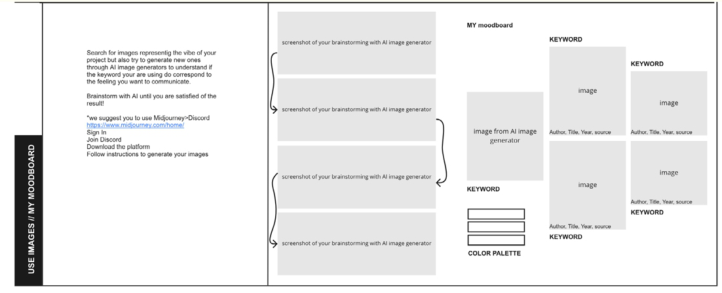
AI as Tool to Brainstorm Through Images As seen in the introduction, there are several scenarios in which AI can be used. In this paper, we will outline an innovative method called AI-Mood Validation, which helps designers test their brainstorming in a co-creation process with the AI tool Midjourney. We proposed a scheme shared through the Miro platform to support the organization of the images and the use of the method (Figure 1). The scheme is structured with an initial iterative process of AI image creation, structuring a prompt related to keywords properly selected
Immersive Innovation: Bridging Digital Design and Virtual Realities in Jewelry 221
to mirror the aesthetic and brand choices of the students. Among the images generated, students had to choose one key image to start building the mood board. The subsequent images were gathered by the students with traditional search methods (e.g., searching via Pinterest, Instagram, Google images, and personal photographs).
Figure 1: Scheme on miro shared board for the AI-mood validation process (created by the author, 2022).
In detail, students were requested to search for images representing the vibe of the project but also try to create new ones through AI image generators to understand if the keywords they were using corresponded to the feeling they wanted to communicate. They had to brainstorm with AI until they were sat- isfied with the result. The objective of this request was to push students to be as detailed as possible in defining and describing the mood board and to raise their awareness of the importance of the words they choose and the choices they make while collaborating with an AI tool. For example, we noted how if the prompt included the request to represent an image in red and if the adjective red was used in the first three words, then all the proposals would be characterized by that. The same methodological principle applies to cre- ating the mood board, whether defined via AI or traditional methods. The definition of aesthetic branding codes is an action that involves an a priori decision of characteristics to which one should remain faithful throughout product development. We also noticed how this caused one of the main diffi- culties for the students, who received answers from the AI that differed from what they imagined and had to reiterate the word order of the prompt to obtain a coherent result.
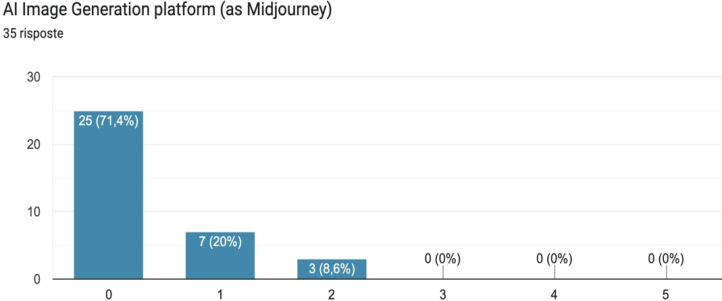
The results of the questionnaires demonstrated how the students had no previous knowledge regarding the proposed generative AI tool: 25 out of 35 students had no knowledge of artificial intelligence platforms for image generation (such as Midjourney), 7 evaluated their knowledge as “1” on a scale of 0 to 5, and 3 students self-rated as “2” (Figure 2). This contributes significantly to the difficulties in constructing the prompt and communicating with the AI tool.
Figure 2: Results of the questionnaire related to previous knowledge of students on AI image generation platform (2022).
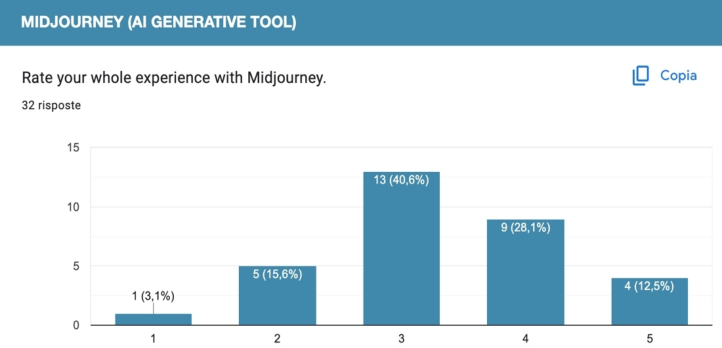
From the responses to the questionnaire, it also emerges that the students were, on average, satisfied with the experience: 43.8% maintain that the Creative AI tool is among the most implemented skills, and for 50% of the students, this contributed to greater self-expression, understood as the production of images not present in traditional search engines but creatively co-created with AI (Figure 3).
Figure 3: Results of the questionnaire related to general rating of the workshop’s experience on AI tool (2022).
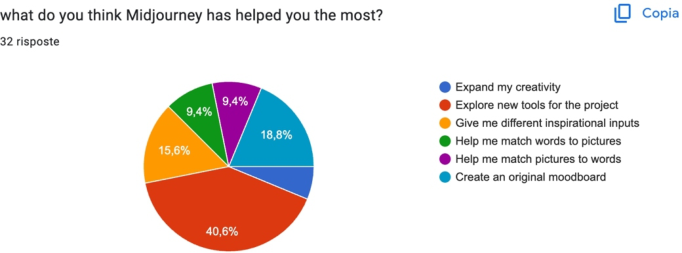
Furthermore, the majority of students, 40.6%, stated that Midjourney was interesting for exploring new design tools, 18.8% that it served to create an original mood board, 15.6% that it provided various inputs from the point of view of inspiration, and less relevant percentages evaluate it as a tool to create connections between words and images and vice versa or as input to implement one’s creativity (Figure 4).
Immersive Innovation: Bridging Digital Design and Virtual Realities in Jewelry 223
Figure 4: Results of the questionnaire related to the usefulness of the AI tool (2022).
To support those results, below are some significant students’ comments on the experience emerging from the questionnaires: “I got what I was looking for by typing in what I was imagining”; “Interesting and, for me, a new way of working”; “Midjourney was difficult to digest, I realize the usefulness of the tool for learning to find the right keywords, but I was never satisfied with the results. So many words that mean something to me are misread by arti- ficial intelligence, and the images always come out so-so unreal, ruining the whole composition.”; “In using it, the images generated after entering key- words were often not to my satisfaction.” These represent just some of the comments collected and bring out two categories: on the one hand, those stu- dents who were fascinated by the tool even in its unpredictability, and on the other hand, those who were frustrated by the interpretative misunderstand- ings between the expected results and the images obtained. On the one hand, this signals the need to support students in defining the prompt, expanding their skills, and working on teaching methodologies that integrate innovative digital technologies; on the other hand, the limits of the AI tool have to be considered. As previously mentioned, Midjourney has undergone significant updates and is now a more qualitatively reliable tool than last year. We are currently continuing our research with new experiments in the application of artificial intelligence in the jewelry and accessory sector, in particular, in the educational experiences of future creatives.
BEYOND PHYSICAL: EXPLORING SPATIAL.IO Secondly, the Spatial.io platform was tested for developing five digital exhi- bitions containing the jewels designed during the workshop, divided into thematic categories. The details on the creation of the exhibitions and the results obtained were published in a previous article of ours (Tenuta and Rossato, 2023). However, considering the new results produced by the anal- ysis of the use of AI, it is interesting to draw parallels. In particular, the main difficulties in using Spatial.io that emerged from the questionnaires are technical, relating to the interface management or the processing capac- ity of the computers used by the students. Entering into the perspective of
technology implies knowing how to govern it: as with AI tools, these are new languages to be included within the skills of future designers. Unlike AI, however, most comments underlined the creative possibilities that the digital environment entailed, without geographical restrictions or exploiting oppor- tunities to create anything desired. Similar to using AI, the importance of maintaining conceptual coherence across the project emerges. As with the words used in the prompt and the stylistic codes chosen when creating mood boards with AI, the same aesthetic characteristics had to be respected for the digital exhibition. This aspect was mainly respected by one group out of five, proposing a digital environment in line with the thematic characteristics of the area assigned to them. This is a difficulty that once again underlines, on the one side, the technical insufficiency of the platform, on the other, the lack of skills of the students to cooperate with the new digital tools.
CONCLUSION
In this paper, we have shown the results of the “Utopia: Jewelry Beyond the Body”workshop linked to the introduction of innovative digital technologies within the design process of the jewelry and accessory students of Politecnico di Milano. By describing the workshop’s evolving context, methodology, and results, this article contributes to a deeper understanding of the relationship between digital technology, design creativity, and the evolution of the jewelry industry.
The contribution offered is twofold. On the one hand, the paper analyzes an innovative method of using technology in AI-Mood Validation, which opens significant discussions around the relationship between the machine and the designer. In particular, future research should be directed towards the analysis of this relationship because artificial intelligence is increasingly trying to imitate human behavior and language while, on the contrary, there is the need on the part of man, in this case, designers, to adapt to the computational language.
On the other hand, the paper questions teaching methodologies with the integration of dematerialized experiences to support the presentation of digi- tal products. It becomes essential to focus the design process on strengthening the aesthetic codes of the product so that, transferred and used on differ- ent platforms, they are equally recognizable and coherent. The lines between physical and digital are blurring, requiring a new design language that is flex- ible yet distinctive. Digital tools are now becoming a critical component of the design process, deeply rooted not only in industries but also in the every- day practices of our lives. This permeability of innovative technologies and the increasingly digitalized use of products outlines the need to educate future creatives and designers in the different languages of technologies.
In approaching the future, it is essential to continue experimenting with the capabilities of AI but also address the ethical implications that these new opportunities bring along. AI may offer unexplored design scenarios but brings fundamental questions about authenticity, privacy, and the responsi- ble use of sensitive data. As educators and pioneers of these technologies, we should not only teach our students how to apply these innovative tools
Immersive Innovation: Bridging Digital Design and Virtual Realities in Jewelry 225
within processes but also guide them through the ethical challenges these tools present (Verbeek, 2006).
Our current investigation has laid the foundation for a more in-depth and widespread investigation, extending beyond the boundaries of creativity and design. Our future research will address not only the experimentation with artificial intelligence per se but also its relationship with society and ethics. We will encourage students to independently incorporate AI into their design processes, recognizing how the technology has evolved rapidly, expanding the tools and skills at their disposal in a short space of time. These tools, although not yet fully explored, offer a panorama of broad creative scenarios.
With this view, our study aims to address the discussion that merges the design process and education methods with ethics, technology, and the social fabric in which we operate. We embrace change with a holistic view, know- ing that the decisions we make now in jewelry design and beyond have the potential to significantly influence the world of tomorrow.
ACKNOWLEDGMENT
The authors would like to acknowledge all the students who participated in the “Utopia: Jewellery Beyond the Body” workshop.
REFERENCES
Arribas, V., Alfaro, J. A. (2018). 3D technology in fashion: from concept to consumer, Journal of Fashion Marketing and Management: An International Journal, Volume 22, No. 2. 240–251. Ashworth, Boone (January 19, 2023). Cartier Beams That Diamond Ring Right to
Your Finger, Wired Website: https://www.wired.co.uk/article/cartier-beams-that- diamond-ring-right-to-your-finger. Baek, E., Haines, S., Fares, O. H., Huang, Z., Hong, Y., Lee, S. H. M. (2022). Defining digital fashion: Reshaping the field via a systematic review, Computers in Human Behavior, Volume 137. Bitonti, F. A. (2016). When Matter Becomes Media: How Our New Tools Are
Reinventing Physicality. Archit. Design, Volume 86, pp. 100–107. Business of Fashion. (2022). The State of Fashion 2022, pp. 57–60. Cappellieri, A. (2016). Brilliant! The futures of Italian jewellery. Corraini Edizioni, Mantova, Italy. Elfar, M. A. A., Dawood, M. E. T. (2023). Using Artificial Intelligence for enhancing
Human Creativity, Journal of Art, Design and Music: Volume 2, No. 2. Jordan, Sarah. (April 19, 2023). Cartier’s Looking Glass Is Luxury’s Latest Frontier, Rapaport Website: https://rapaport.com/magazine-article/cartiers-looking-glass-i s-luxurys-latest-frontier/ Kumar, S., Lim, W. M., Sivarajah, U., Kaur, J. (2022). Artificial Intelligence and
Blockchain Integration in Business: Trends from a Bibliometric-Content Analysis, Information Systems Frontiers, Volume 25, 871–896. Messaoudi, Amine. (May 30, 2023). Pioneering the Future of Jewelry Design with AI: The Next Big Leap Forward, Linkedin Website: https://www.linkedin.com/p ulse/pioneering-future-jewelry-design-ai-next-big-leap-amine-messaoudi/ Miking. (August 2, 2023). How Artificial Intelligence is Revolutionizing the Jew-
Morhart, F., Wilcox, K., Czellar, S. (2020). Research Handbook on Luxury Branding.
Edward Elgar Publishing. Sciling. (2022). How artificial intelligence has revolutionized the jewelry market, Linkedin: https://sciling.com/how-artificial-intelligence-has-revolutionized-t he-jewelry-market/?lang=en Tenuta, L., Rossato, B., Cappellieri, A. (2023). From digital to physical twin. An
innovative design methodology for future creatives, Proceedings of INTED2023 Conference, pp. 5301–5307. Tenuta, L., Rossato, B. (2023). Digital Jewelry and Virtual Exhibition: Interaction in the Metaverse, in proceeding of EDULEARN23 Conference, pp. 7554–7560. Thackara, J. (2005). In the Bubble: Designing in a Complex World, Cambridge: MIT
Press. Verbeek, P. P. (2006). Materializing Morality: Design Ethics and Technological Mediation. In Science, Technology, & Human Values, Vol. 31, No. 3, Ethics and Engineering Design (May, 2006), pp. 361–380. Published by: Sage Publications, Inc. Stable URL: https://www.jstor.org/stable/29733944 Wu, D., Yu, Z., Ma, N., Jiang, J., Wang, Y., Zhou, G., Deng, H., Li, Y. (2023).
StyleMe: Towards Intelligent Fashion Generation with Designer Style, in Pro- ceedings of the 2023 CHI Conference on Human Factors in Computing Systems, pp. 1–16, ACM.
LISTED IN THE AHFE DIGITAL BOOKSTORE CATALOGUE
Explore the complete digital volume
Human Interaction and Emerging Technologies (IHIET-AI 2024): Artificial Intelligence and Future Applications
Read this individual research paper free through the original publisher, or explore the full digital proceedings book.
ISBN 978-1-958651-96-4
Explore this ISBN in the AHFE Bookstore ↗Listed in the July 2026 bookstore catalogue; search by ISBN to confirm current availability · Digital book purchase optional