Jinghao Hei, Jing Liang (2023). Exploring the Potential of Human-Centered Design Combined With Narrative Medicine Theory for Children-Friendly Healing Environment Design. In: Emerging Technologies in Healthcare and Medicine. AHFE Open Access, vol. 116, pp. 254–263. https://doi.org/10.54941/ahfe1004379
Applying narrative medicine theory to the design of the healing environment is a kind of HCD thinking. This paper conducts proper user research for a children-friendly healing environment, considering children's cognitive level and stakeholders, utilises general inductive topic analysis to identify key concerns and position them as design possibilities. This paper then examines the objects' existing experience and summarises three children-friendly healing narrative design strategies based on narrative design theory. Prototypes are constructed and evaluated. This paper applies design thinking and narrative medicine theory to inventive environmental design, developing a system framework and suggestions for a children-friendly healing environment.
Hospital environmental functions are changing from curative to healing- focused. Healing environments focus on both physical and mental health (Gross, 1998). In China, 247 million paediatric outpatient visits represented 9.1% of general hospital outpatient visits (National Health Commission of China, 2022). Despite the large number of paediatric patients, the lack of a children-friendly healing environment that fits the treatment process makes it difficult to promote children and family comprehension and collaboration. It led to increased medical anxiety in paediatric clinics, which is a common psy- chological issue (Hart and Bossert, 1994), affecting compliance, adaptation, and healing efficacy.
The application of narrative medicine theory in healing communication to minimise medical anxiety is becoming frequent. Narrative medicine the- ory (Charon, 2008) effectively combines medical knowledge with principles of storytelling, facilitating interdisciplinary, aligning with the principles of human-centered design. However, the design of the physical healing envi- ronment has been undervalued with narrative medicine theory. The healing
Exploring the Potential of Human-Centered Design 255
environment emphasises physical, psychological, and spiritual healing while fulfilling basic medical needs, which is crucial to improving the patient’s recovery experience (Holahan and Saegert, 1973; Dijkstra, Pieterse and Pruyn, 2006). Narrative, which is valued both in medicine and design, is essential to comprehending a healing environment. The integration of phys- ical environment design with narrative medicine theory holds the potential for facilitating effective communication and collaboration between designers, medical professionals, and patients, hence enhancing the provision of health- care services. A healing environment is an ideal context for the realization of the potential inherent in Human-Centered Design.
This paper takes healing environment design as the entry point to alleviate the medical anxiety of pediatric patients, and attempts to prove that HCD is the necessary condition to promote the design of a children-friendly healing environment.
METHODS OF APPLYING NARRATIVE MEDICINE TO THE HEALING ENVIRONMENT This chapter describes how we integrated narrative medicine theory and other HCD methods into innovative environmental design. Human-Centered Design uncovers beneficiaries’ needs, innovates solutions, and implements (IDEO, 2011). This paper used questionnaire surveys and semi-structured interviews to gather insights from all stakeholders about their experiences and needs for children-friendly healing environments.
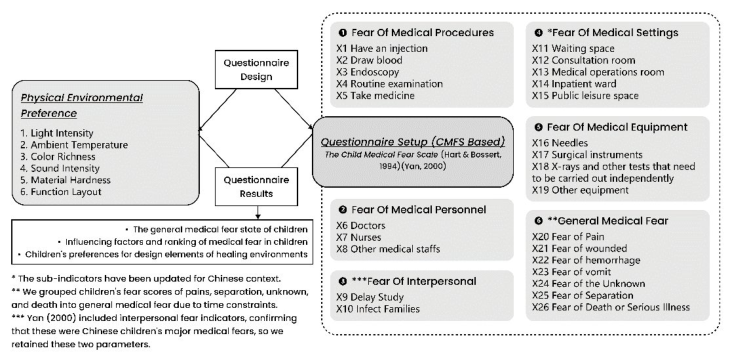
Figure 1: The index and structure of the questionnaire survey (source: the authors).
The index questionnaire (see Figure 1) was based on the Child Medical Fear Scale (CMFS) (Hart and Bossert, 1994; McMurtry et al., 2011), which allows the examiner to use text, photographs and other narrative mediums (Bossert, 1994). The scale evaluates child healing intervention characteris- tics (Delvecchio et al., 2019), helps measure a child’s anxiety and gathers fundamental medical fears and preferences for healing environment design. This study used the translated and verified Chinese version (Yan, 2000). Each
256 Hei and Liang
item was evaluated from 1 (not scared) to 3 (extremely fearful). To enhance the alignment of the survey findings with the healing environment design (Huisman et al., 2012), we added healing environment preference to the questionnaire.
Due to the complexity, fluidity, multi-stakeholder nature, and unpre- dictability of healthcare issues, our design process followed the classic design thinking methodology of empathize, define, ideate, prototype, and test (Camacho, 2016), which makes all design procedures user-centred.
EMPATHIZE 1: CONTEXT RESEARCH The IDEO HCD approach—hear, create, deliver—was applied in our project. (IDEO, 2011). This study included site investigation, questionnaire surveys, and semi-structured interviews to acquire insights in the beginning.
We first did a field assessment of the children’s healing environment and analysed the physical space characteristics and user experience procedures. The general environment feeling is ruthless. Graphic pavement blends colours and comic elements to create a chaotic image and unity. Despite popularis- ing sophisticated pre-diagnosis and registration services, the hospital lacks instruction and has a high operation threshold in terms of the experience pro- cess, most parents directly ask registration pre-diagnosis guide desk, making the waiting area noisy.
Stakeholders’ impact is proven substantial (Adam et al., 2019). So, after field inquiry, we interviewed 7 clinical professionals. These stakeholders, with extensive clinical healing experience, are either medical staff (e.g., sample 2, 3, 4, 5) or social forces (e.g., sample 1, 6, 7), including 1 male and 6 females, aged 25-55, with 5 to 25 years of experience. The semi-structured interview outline is shown in Table 1.
EMPATHIZE 2: CORE USER RESEARCH This paper acknowledged the investigation’s unique traits. We carefully selected child-specific user research methods and materials. It was empha- sised that user research ought to encompass both children and their families. Since children are the main users, their lack of expression makes it hard to express their needs. During the research and testing phases, we determined that children and families needed more concrete tale resources, while tangi- ble user interfaces (TUIs) such as storyboards can better capture children’s responses. Therefore, we collected data through on-site interviews with chil- dren and accompanying family members in the treatment hall and provided visual props.
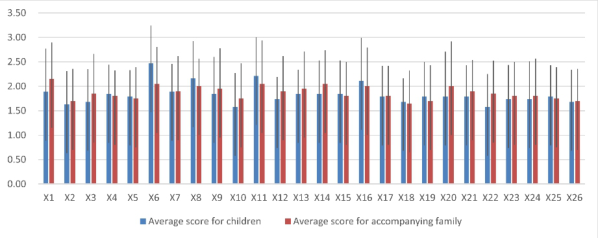
We numbered the variables X1-19 (see Figure 2) and distributed paper questionnaires. 39 of 55 were valid, including 19 children (9 males, 10 females) and 20 adults (6 males, 14 females). The results of the questionnaire showed that medical anxiety was widespread among children, mainly about injections (X1, 16). Interestingly, both children and their parents had a high score of fear of healthcare work- ers (X6, 7, 8). The waiting space (X11) is the place where medical anxiety
Exploring the Potential of Human-Centered Design 257
is highest among children, and parents feel anxious in most healing Spaces (X11, 12, 13, 14).
Table 1. Semi-structured interview outline (source: the authors).
Table available in the original PDF paper.
Category Sub-Category Detail description Patient’s observation Sources of patient’s anxiety a-1. What causes paediatric medical anxiety in your experience? a-2. Do parents help children overcome medical anxiety? What do they generally do or feel? Experience b. Which hospital anxiety-reduction methods work best? Doctor-patient communication
Key information
c. What information do you wish to provide and get from the patient or family? Communication difficulties
d-1. Doctor-patient communication’s major challenge? d-2. What is your largest doctor-patient communication issue with children? Do you think these issues stem from children’s psychological or linguistic development? Please illustrate. Auxiliary tools e-1. How can you help doctors and kids com- municate? Have you used toys, art, or VR for communication? How effective? e-2. How can other healthcare professionals improve doctor-patient communication and create a better healing environment based on your experience? Healing environment
Judgment and opinion
f-1. How important is a nice and soothing healing environment for children? f-2. Do these surroundings ease the patient’s medical anxiety? f-3. Does it impact doctor-patient relationships?
Figure 2: Questionnaire result (mean and SD) (source: the authors).
258 Hei and Liang
Table 2. Analysis of the empathize result (source: the authors).
Video game dependency; The strangeness of leaving home.
Recognise their environment; Stay-and-immerse surroundings; Encourage self-expression; Interactive exploration. Patient’s family
Cannot calm kids; Determine the child’s disease severity.
Unknown duration; Personal stress.
Repetition of fixed tasks.
Befriend the child; Manage child treatment plans; Learn nursing precautions. Medical staff Countless consultations with kid families; Uncooperative kids.
Workplace comfort; Patient-communication aids
We then listed users’ recessive (R), dominant (D) pain points and require- ments table (see Table 2). Children often experience a sense of mistrust towards the hospital setting, requiring the provision of soothing informa- tion to alleviate their anxiety and facilitate their acceptance of the waiting atmosphere and subsequent medical care. The family members strongly desire to comprehend the child’s health, leading to heightened worry and frequent communication with the doctor for confirmation. This aspect of doctor- patient communication has been identified as a primary source of distress, as stated by the doctor.
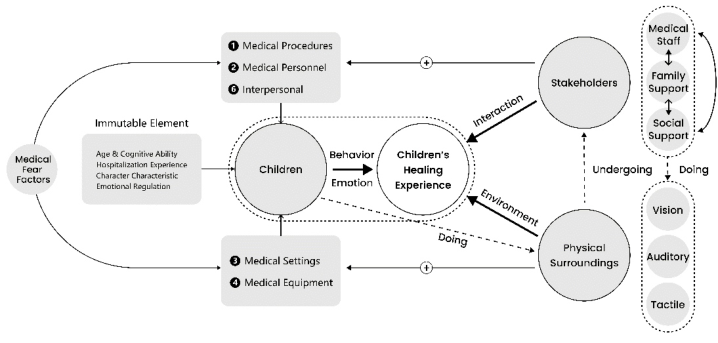
DEFINE: DEFINITION FOR THE FRAMEWORK OF CHILDREN-FRIENDLY HEALING ENVIRONMENT DESIGN Adopting a ‘human-environment’ approach, inspired by Dewey’s (2005) con- ceptualization of experience as the coherent interaction between an individual and their surroundings, this paper presents a streamlined and systematic model (see Figure 3). Three main actors in the framework are therefore identified in this study: physical space, stakeholders, and children.
First, the main actor is children. Age, cognitive aptitude, medical experi- ence, and personality are unchangeable in the near run. The other component includes dynamic elements that reduce medical anxiety in children, such as the dread of medical procedures, staff, settings, and equipment.
Secondly, stakeholders include medical workers, family members, and social supporters. Communication and support will improve children’s emo- tional and psychological recuperation.
Finally, the physical environment. Previous research underpins this paradigm (Ulrich, 1984; Reynolds and Kaplan, 1990). Environmental elements’ degrees of influence on the healing environment were classed (Schweitzer, Gilpin and Frampton, 2004). We contained visual, aural, and tactile aspects according to questionnaire feedback.
Exploring the Potential of Human-Centered Design 259
Figure 3: Framework of children-friendly healing environment design (source: the authors).
IDEATE AND PROTOTYPE: STRATEGIES FOR CHILDREN-FRIENDLY HEALING ENVIRONMENT DESIGN BASED ON NARRATIVE MEDICINE THEORY We organised structured brainstorming sessions for Children’s Medical Cen- tre staff. This impacted our macro-level design approach and proposed improvements to one of Shanghai’s children’s hospitals’ spatial narrative arrangement. Based on narrative medicine theory, we developed children- friendly healing environment design strategies.
First, is functional optimisation. Children-friendly healing narrative design improves spatial and functional layout and comforts youngsters. Due to children’s cognitive and expression restrictions, how to make children under- stand and participate in the healing process, correctly instruct children to finish the operation behaviours, and support smooth healing.
Second, is the emotional experience. Sensory items evoke emotions. Age, life events, and emotional responses direct children’s emotional experiences. Narrative design can boost children’s participation and interaction.
Third is the notion of communication. Healing narratives inform children and parents about health and expand the meaning of healing situations. This will lessen children’s and families’ medical anxiety, improve doctor-patient communication, and improve children’s settings.
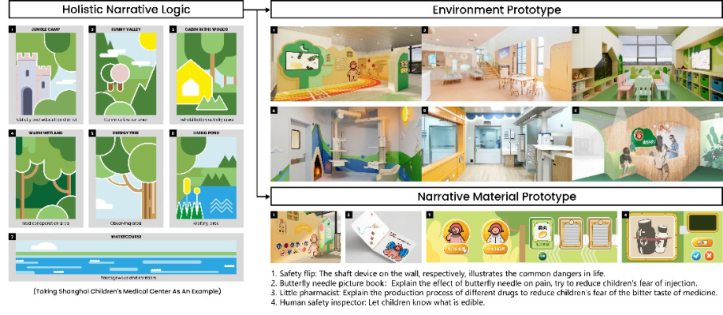
Afterwards, through field research, we found seven components in children-friendly healing environments (see Table 3). We then combine medi- cal and natural elements to create a narrative that matches the entire medical treatment procedure and introduces children to a simple narrative tale.
Finally, prototype designs for environment design and narrative materi- als were created (see Figure 4) and got positive evaluation feedback from the hospital government and design professionals. Iterations and continuous test- ing were used, and certain spaces had been built. The narrative materials also include two information popularisation activities based on Figma to promote
260 Hei and Liang
children’s medical understanding, in addition to the effect drawing and the physical manual.
Table 3. Examples of classification, function, and narrative of children-friendly healing environments (source: the authors).
Table available in the original PDF paper.
District Narrative Classify Feature Theme Description Publicity and education Jungle camp
Interactive technology engages kids, and medical knowledge lessens fear.
Hospitalisation education area, public publicity column, etc., alerting them of precautions and explaining health concepts.
Sunny Valley
The related props are designed in the form of valley plants to ensure the privacy of the conversation.
Communication Help parents and children relax throughout the conversation with medical workers.
Cabin in the woods
Rehabilitation activity area
Bright wooden cottage in the forest to support recovering emotionally.
Narrative props help doctors communicate with children and their families.
Form a relationship with the waiting area, perform acupuncture, medicine and other medical operations Energy tree Observing area The medical team observes the youngster in the infusion area and after anaesthesia.
Living pond
Using the forest’s flowing pond and the pool’s animals to inspire kids
Tell children how different drugs affect the body after entering, help them wait patiently, and participate in medical monitoring. Waiting area To distract kids from pain and other symptoms, create a peaceful, comfortable, and entertaining setting.
watercourse Design flowing geometric
Passageway & corridors
lines.
Encourage children to explore and move forward.
In the prototype test, the spatial design and narrative materials have been recognized by the users, and so far, the three spatial prototypes (2, 4, 5) have been successfully built and put into use.
Exploring the Potential of Human-Centered Design 261
Figure 4: Narrative IP, spatial prototype and narrative material prototype (source: the authors).
CONCLUSION AND DISCUSSION This paper has made a practical contribution to improving children-friendly healing environment design, which is also a kind of HCD exploration. This paper conducted user research on children and stakeholders, then systemat- ically designed the framework of the children-friendly healing environment design. The findings were then used to inform the design of some prototype healing environments and narrative materials.
This paper introduces three novel ideas. Firstly, our user research matches the previous study’s value and key points (Yan, 2000), and innovatively creates a system-thinking-based framework for children’s healing environ- ments, supporting stakeholders’ views. Through the HCD approach, this study was able to confirm that children’s fear in a medical setting is a chal- lenge for caretakers. Children’s unwarranted dread of medical procedures can be decreased and the healing environment’s affinity can be increased by using interactive content and physical space design in children-friendly healing narratives. Secondly, this paper demonstrates how a children-friendly healing environment should follow design principles as well as suit hospital operation needs. Thirdly, by employing the philosophy of narrative medicine theory, we explained the connections between narrative medical procedures and the design of healing environments using media, pictures, and logic that children can understand.
However, the research did reveal some limitations. Because we sampled children in a hospital waiting room, the cognitive strata in the sample were uneven. Age-appropriate surveys and partnerships with educational institu- tions will ensure that children at various cognitive development stages are included in future studies, making results more detailed and dependable. Additionally, the current project implementation is not uniform, the entire narrative is not fully conveyed, and the relationship between space and space guidance has not been given much thought. HCD has been linked to the pub- lic health system since 1999 when home health management was introduced (Lathan et al., 1999). Other HCD strategies, such as those for building online
262 Hei and Liang
communities and mobile information management systems, are conceivable and represent potential research directions.
With its emphasis on organisational innovation and health data manage- ment but a dearth of research on design entities, this study compensates for the usual pairing of HCD and the health area. To create a children- friendly healing environment, system design, spatial classification, and proto- type design are carried out by merging narrative medicine theory with HCD. We exploited the potential of narrative medicine theory and human-centered design for the children-friendly healing environment.
ACKNOWLEDGMENT
Supported by The International Knowledge Centre for Engineering Sciences and Technology (IKCEST) under the Auspices of UNESCO, Beijing 100088, China. The authors would like to acknowledge the editor for their careful reading of the manuscript and all the medical workers and patients who were interviewed.
REFERENCES
Adam, M. et al. (2019) ‘Human-Centered Design of Video-Based Health Education: An Iterative, Collaborative, Community-Based Approach’, Journal of Medical Internet Research, 21(1), p. e12128. Available at: https://doi.org/10.2196/12128. Beres, L. K. et al. (2019) ‘Human-Centered Design Lessons for Implementation Sci-
ence: Improving the Implementation of a Patient-Centered Care Intervention’, JAIDS-Journal of Acquired Immune Deficiency Syndromes, 82, pp. S230–S243. Available at: https://doi.org/10.1097/QAI.0000000000002216. Bossert, E. (1994) ‘Factors influencing the coping of hospitalized school-age children’, Journal of Pediatric Nursing, 9(5), pp. 299–306. Camacho, M. (2016) ‘David Kelley: From Design to Design Thinking at Stanford
and IDEO’, She Ji: The Journal of Design, Economics, and Innovation, 2(1), pp. 88–101. Available at: https://doi.org/10.1016/j.sheji.2016.01.009. Charon, R. (2008) Narrative medicine: honoring the stories of illness. First issued as an Oxford University Press paperback. Oxford New York: Oxford University Press. Daniel, D. M. et al. (2013) ‘Assessing Progress toward Becoming a Patient-Centered
Medical Home: An Assessment Tool for Practice Transformation’, Health Services Research, 48(6pt1), pp. 1879–1897. Available at: https://doi.org/10.1111/1475- 6773.12111. Delvecchio, E. et al. (2019) ‘Hospitalized Children: Anxiety, Coping Strategies, and Pretend Play’, Frontiers in Public Health, 7, p. 250. Available at: https://doi.org/ 10.3389/fpubh.2019.00250. Dewey, J. (2005) Art as experience. Perigee trade pbk. ed. New York, New York:
Berkeley Publ. Group (A Perigee book). Dijkstra, K., Pieterse, M. and Pruyn, A. (2006) ‘Physical environmental stimuli that turn healthcare facilities into healing environments through psychologically medi- ated effects: systematic review’, Journal of Advanced Nursing, 56(2), pp. 166–181. Available at: https://doi.org/10.1111/j.1365-2648.2006.03990.x. Gross, R. (1998) ‘Healing Environment in Psychiatric Hospital Design’, General Hos-
pital Psychiatry, 20(2), pp. 108–114. Available at: https://doi.org/10.1016/S0163- 8343(98)00007-3.
Exploring the Potential of Human-Centered Design 263
Hart, D. and Bossert, E. (1994) ‘Self-reported fears of hospitalized school-age children’, Journal of Pediatric Nursing, 9(2), pp. 83–90. Holahan, C. J. and Saegert, S. (1973) ‘Behavioral and attitudinal effects of large-scale
variation in the physical environment of psychiatric wards.’, Journal of Abnormal Psychology, 82(3), pp. 454–462. Available at: https://doi.org/10.1037/h0035391. Huisman, E. R. C. M. et al. (2012) ‘Healing environment: A review of the impact of physical environmental factors on users’, Building and Environment, 58, pp. 70–80. Available at: https://doi.org/10.1016/j.buildenv.2012.06.016. IDEO (ed.) (2011) Human centered design: toolkit. 2nd ed. San Francisco, Calif.:
IDEO. Langberg, E. M., Dyhr, L. and Davidsen, A. S. (2019) ‘Development of the concept of patient-centredness – A systematic review’, Patient Education and Counseling, 102(7), pp. 1228–1236. Available at: https://doi.org/10.1016/j.pec.2019.02.023. Lathan, C. E. et al. (1999) ‘Human-centered design of home care technologies’,
NeuroRehabilitation, 12(1), pp. 3–10. Available at: https://doi.org/10.3233/NR E-1999-12102. McMurtry, C. M. et al. (2011) ‘Children’s fear during procedural pain: Preliminary investigation of the Children’s Fear Scale.’, Health Psychology, 30(6), pp. 780–788. Available at: https://doi.org/10.1037/a0024817. Melles, M., Albayrak, A. and Goossens, R. (2021) ‘Innovating health care: key char-
acteristics of human-centered design’, International Journal for Quality in Health Care, 33 (Supplement_1), pp. 37–44. Available at: https://doi.org/10.1093/intqhc /mzaa127. Mullaney, T. et al. (2012) ‘Thinking beyond the Cure: A Case for Human-Centered Design in Cancer Care’, International Journal of Design, 6(3), pp. 27–39. National Health Commission of the People’s Republic of China. (2022)
‘ [China Health Statistical Yearbook]’, Beijing: [China Union Medical University Press], (in Chinese). Reynolds, P. and Kaplan, G. A. (1990) ‘Social Connections and Risk for Cancer: Prospective Evidence from the Alameda County Study’, Behavioral Medicine, 16(3), pp. 101–110. Available at: https://doi.org/10.1080/08964289. 1990.9934597. Schweitzer, M., Gilpin, L. and Frampton, S. (2004) ‘Healing Spaces: Elements of
Environmental Design That Make an Impact on Health’, The Journal of Alterna- tive and Complementary Medicine, 10(supplement 1), p. S-71–S-83. Available at: https://doi.org/10.1089/acm.2004.10.~S-71. Ulrich, R. S. (1984) ‘View Through a Window May Influence Recovery from Surgery’, Science, 224(4647), pp. 420–421. Available at: https://doi.org/10.1126/ science.6143402.
LISTED IN THE AHFE DIGITAL BOOKSTORE CATALOGUE
Explore the complete digital volume
Emerging Technologies in Healthcare and Medicine
Read this individual research paper free through the original publisher, or explore the full digital proceedings book.
ISBN 978-1-958651-92-6
Explore this ISBN in the AHFE Bookstore ↗Listed in the July 2026 bookstore catalogue; search by ISBN to confirm current availability · Digital book purchase optional