Jinghao Hei (2024). Towards Safer Routes: Exploring the Potential of Artificial Intelligence and Augmented Reality in Children's School Commuting Environment Design. In: Artificial Intelligence and Social Computing. AHFE Open Access, vol. 122, pp. 217–229. https://doi.org/10.54941/ahfe1004659
Augmented reality technology is characterised by its mobile, practical, multimodal, and data-driven trend. This paper presents a design framework that employs AI and augmented reality technologies to address an entire process of intelligent perception and design intervention for mitigating risks in children's school commuting environments. For intelligent perception section, 617 accident news texts were used for training purposes utilising natural language processing (NLP) and machine learning techniques. As a result, 6 influential characteristics related to children's school commuting environment (Time, road type, surrounding features, area functional type, user, age type and connection type). The prediction model holds 3 severity degrees and covers 6 types of incidents. For design intervention section, design strategies and techniques are defined based on various degrees. The prototype is designed using a mobile augmented reality device and a smart watch as design touchpoints.
The spatial quality and environmental structure of urban residential areas play a crucial role in children’s growth and development (Visser & Van Aalst, 2022). As an important part of urban transportation, children’s school commuting environment has been wildly concerned (Ali et al., 2023). The school catchment policy devotes a lot of school-age children’s activity time to commuting, which is vital for their growth (Kaseva et al., 2023).
School commute has clear destinations and travel chains, the spatial scale is concentrated on the residence, school and the path between them (Hoelscher et al., 2022). When school commuting is based on walking and promotes developmental dimensions including independence and sociality, it is defined as active school commute (Morris & Hardman, 1997; Tudorlocke et al., 2001). Active school commute is particularly effective against static lifestyles such as childhood obesity (Martin-Moraleda et al., 2022). It also allows children to stroll in the community life cycle and develop social communication and behaviour (Ding et al., 2023). Therefore, the
pedestrian-oriented children’s school commuting environment should be advocated and promoted.
However, urban transportation area is dangerous for children. Road traf- fic is the second leading cause of unintentional injury deaths among children (World Health Organization, 2023). In China, nearly 40,000 children die from unintentional injuries every year, drowning, traffic injuries and falls/- falls were the top three causes of injury (Chinese center for disease control and prevention, 2022). The safety of children is essential for every family, thus school commuting environment ought to be safe. SRTS programs cre- ate safe and convenient walking paths for children by improving the physical environment and facilities (Boarnet et al., 2005). The Dutch government has connected play spaces near schools to pavements and created Kindlint, a chil- dren’s walking network (Liangwa, 2017). In Northeastern Ontario, a walking school bus pilot conducted practice (Scharoun Benson et al., 2020). Japan’s urban planning laws already cover children’s school commuting environment (Hino et al., 2021).
Regarding security, predicting is crucial. How can we predict hazard given existing hardware and environmental conditions? This demands intelligent environmental perception. This leads to 2 research questions: RQ1: What affect the safety of children’s school commuting environment? RQ2: How to develop an intelligent children’s school commuting environ- ment security assessment model?
Once the risk occurrence mechanism is established, how can one quickly and accurately identify the present danger factor and notify the user? This article uses augmented reality (AR) to build a real-time monitoring and inter- vention system for children’s school commuting environment. AR blends the physical and digital worlds into one experience (Vallino & Brown, 1998). It improves perceptions by integrating physical, geographical, traffic flow and user data to track environmental conditions continuously. This leads to the other research question: RQ3: How can technologies represented by AI and AR empower the children’s school commuting environment design?
This paper takes the environmental safety of children’s school commuting as the starting point, explores how to combine AI and AR to forecasting, evaluating potential risks and implementing targeted interventions. Section 2 discusses the reasons why AR can enable school commuting environmental security. Section 3 introduces the overall framework of intelligent perception and design intervention. Section 4 covers data supply, processing, neural net- work machine learning model training and effect verification, and sensorium deployment via evaluation mechanism. Section 5 describes the systematic integration of the design intervention component with safety perception risk grading. Section 6 discusses innovations, limitations and future directions of improvement. Section 7 summarizes this paper.
MOBILE, PRACTICAL AND MULTIMODAL DATA-DRIVEN AR AR technology is evaluated and its technical prospects, design aims, and application trends are discussed in this chapter. It demonstrates why augmented reality could enhance children’s school commuting environment safety.
Towards Safer Routes: Exploring the Potential of Artificial Intelligence 219
AR Technical Prospect: From Desktop to Mobile AR technology and research can be defined by virtual-real content, real-time interaction, and 3D registration (Billinghurst et al., 2015). The typical appli- cation of desktop computing is zSpace (Aljumaiah & Kotb, 2021). Most desktop AR apps display 3D material using PCs and cameras. Mature desk- top AR application devices are costly and limited in use because to their size and discomfort. Therefore, more applications transition from desktop computing to mobile computing (Farooq et al., 2002).
Mobile Augmented Reality (MAR) is a mobile device-based augmented reality interaction idea due to improved industrial production capac- ity and computer graphics and human-computer interaction technologies (Irshad et al., 2018). MAR allows real-time depiction of virtual material in free movement while maintaining an ideal spatial relationship between actual and virtual objects, which enhances the implantation of mobile augmented reality in our lifes (Henrysson, 2007). MAR developed in three phases.
The first stage, supported by smart glasses and helmets, uses autonomous AR hardware and software to perform spatial scanning, modelling and infor- mation processing. Modern HMDs allow toggling between virtual and reality (Pointecker et al., 2022). Microsoft HoloLens, Meta 2, and Google Glass are examples.
The second phase provides a MAR application combining AR software with desktops and smartphones. Integrated technologies such as efficient object tracking, fast processing, display and sensor, digital image recogni- tion, computer vision tracking and registration are widely used (Reitmayr & Drummond, 2006; Feng Zhou et al., 2008). Interaction technologies such as browser-oriented interaction, analog video transmission and context-based interaction are also indispensable (Hürst & Van Wezel, 2013). After installing AR application software on their personal devices, users can apply the cam- era to scan and register to overlay virtual items in the actual world. Personal mobile smart devices make augmented reality more accessible.
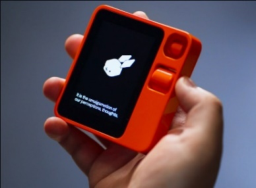
Figure 1: Rabbit R1. (Source: Rabbit R1.)
The third phase of AR applications involves using AR as a bigger base layer to connect universal information functions. Meta-universe has spurred the development of virtual-application technology. New AR devices like the Rabbit R1 (see Figure 1) have sparked thinking about the next generation of personal computing platforms (Rabbit Technologies, 2024).
220 Hei
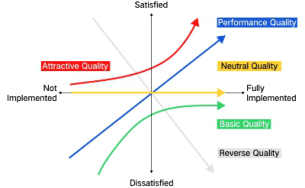
Figure 2: KANO model (Kano, 1984).
There is a progressive relationship between these 3 stages. The first stage completes the transition from AR technology to AR products, the second expands and promotes AR technology. The third indicates that MAR will become more important and widespread.
AR Design Goals: From Immersion to Practicality AR has often been described to enhance user perception (Lindeman & Noma, 2007). It enhances user perception by displaying visuals, text, audio and video in real and virtual dimensions, creating an immersive experience (Bekele, 2021). AR fosters social connection through immersive personalised experiences, hence researches have examined immersion indicators in AR applications (Hofman et al., 2022; Kim et al., 2023). AR has proven to be valuable in improving attractive quality like immersion by encouraging user input through immersive encounters (Lee et al., 2022). If we back cast depending on user demand in the KANO model (Figure 2), may future AR enhance basic quality such as live security (Kano, 1984)?
It is limiting to regard augmented reality as just a display and interac- tive medium. AR differs from computers and mobile phones because it can capture actual space in real time, produce virtual space and content, and increase virtual-real merging. mobile devices will make Personal data gather- ing, analysis, and engagement more possible. Thus, future MAR should cover social functions, besides entertaining interaction, experiential immersion and aesthetic presentation.
AR Interaction: From Visualization to Multimodal and Data-Driven Initially, AR was used to improve information visualisation, proving its effec- tive appeal (Azuma et al., 2001). Information is connected to actual objects to improve visual perception (Sereno et al., 2020). This is a relatively simple visual superposition. Later study focused on AR’s lightweight properties and how it may replace physical things. REVEL allows participants to feel vir- tual tactile textures when they touch real physical markers (Bau & Poupyrev, 2012). Two-way AR motion games let users feel the simulated applied force of the hit (Lindeman et al., 2012). AR reduces the need for real-world equipment to conserve resources and cost.
Multimodal AR, which integrates with reality, has emerged with spatial computing technologies. A virtual spider can respond to the real environ- ment by blocking, accompanying and crossing (Corbett-Davies et al., 2012).
Towards Safer Routes: Exploring the Potential of Artificial Intelligence 221
Chinese Academician Wu Zhiqiang’s team has carried out city-scale AR appli- cations (Liang et al., 2023). AR may engage all our senses with non-visual virtual and actual inputs. Thus, multimodal AR applications emerged.
Figure 3: Different stages of AR application function. (Source: the author.)
Lately, AR has expanded beyond the physical item, breaking through human perception of the actual world to assist people get abstract material like information flow and data more effectively and intuitively. ARToolKit tracking, point cloud identification and other three-dimensional spatial data acquisition methods reduce the threshold of virtual space reconstruction (Khan et al., 2018). Information simulation-based AR lets users see facts under the surface since technology can detect and react to real-world proper- ties that humans cannot. MAR will be applied to perceive space, comprehend society, and touch information in addition to content presentation.
AR for mobility, practicality, and multimodality is vital while the fun- damental and prospective innovation lies in data (see Figure 3). Smart city security relies on scientific traffic management systems based on urban sen- sors (Wang et al., 2023). This paper aims to improve the safety of children’s school commuting environment via AR by applying urban physical and information data.
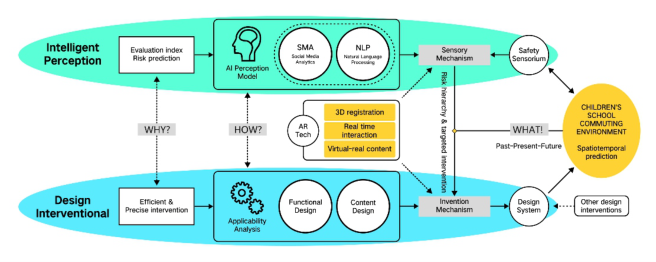
Design Framework Centred on AR With AR technology supports, this paper forms a framework for chil- dren’s school commuting environmental safety design, including intelligent perception chain and design intervention chain (see Figure 4).
Figure 4: Framework of perception and intervention for children’s school commuting environment. (Source: the author.)
222 Hei
INTELLIGENT PERCEPTION OF CHILDREN’S SCHOOL COMMUTING ENVIRONMENT In this section, artificial intelligence and machine learning algorithms are used to analyse urban safety incident news texts. Urban safety influencing factors are summarise, risk assessment models are trained.
Data Crawling and Sorting We analysed recent news to understand accidental injury. News data is clear and succinct, making it easier to analyse accident causes and consequences. Most news reports include accident monitoring, scene images, and other useful information to assist researchers comprehend the scenario.
Table 1. Basic data. (Source: the author.)
Table available in the original PDF paper.
Source Type Raw data Valid data Sina Weibo social media 127 107 safehoo.com safe management website 284 252 toutiao.com news portal 175 161 chinanews.com.cn news portal 144 97
Python were used to extract information from different types of news web- sites. A total of 730 raw data were crawled. Due to each platform’s core data formats and settings, some data is obsolete, duplicate, or irrelevant. This paper manually screened and unified 617 valid data.
Data Processing and Calibration The paper organised the dispersed and imbalanced data using natural lan- guage recognition (NLP) and manual calibration, then processes the news text into the dataset. Factors (see Table 2) were explained by the logical of when (X1)-where (X2, X3, X4)-who (X5, X6) and 2 outputs (Y1, Y2).
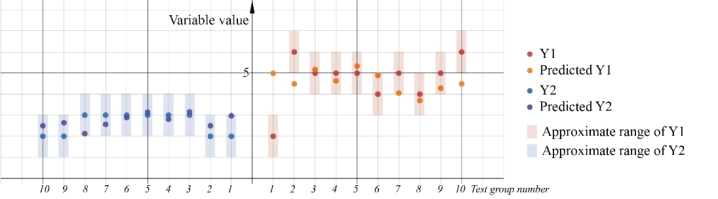
Sensory Mechanism Model Training and Verification This paper used machine learning models to predict the relationship between variables. The pandas and TensorFlow libraries were employed. After scan- ning training data, input and output variables were split and a neural network model with two hidden layers and a ReLU-activated output layer is trained. The mean square error loss function and Adam optimizer were used. 10 epochs were trained. 10 new accidents were collected for verification. The model performance was preliminarily evaluated by comparison (see Table 3).
Figure 5 shows the output and predicted output values to illustrate the discrepancy between model predictions and actual results. The average pre- diction deviation of the model for the comprehensive accident occurrence type is 0.97, but the average prediction deviation for mechanical injury (Y1=5) is only 0.5. The average difference degree of Y2 is 0.45. It may attribute this to the abundance of news accounts detailing incidents involving mechanical injuries seen in the original data set.
Towards Safer Routes: Exploring the Potential of Artificial Intelligence 223
Table 2. Risk factors affecting children’s school commuting environment. (Source: the author.)
Table available in the original PDF paper.
Subject & Serial Subject terms X1 Time 2 Daytime (7:00-19:00) 1 Night (19:00-7:00 the next day) X2 Road type 3 Highways, traffic hubs, three-fork intersections, parking lots and other vehicle gathering places 2 Special or non-standard roads such as national roads, mountain roads, village roads, bridge 1 Standard urban street 0 Not urban road accidents X3 Prominent features of surrounding area
5 Comprehensive function area
4 Crowded places such as downtown, urban center area, important business districts 3 Water bodies such as swimming pools, rivers, ponds and surrounding areas 2 Site with height difference such as roof, hillside, high wall, fence or there are deep pits 1 Isolated or enclosed spaces 0 Not mentioned X4 Mainly area functional types 4 Industrial functional areas such as chemical factory 3 Commercial function area 2 Green area 1 Residential community and campus area 0 Not mentioned X5 Age type of victim 4 Adult (over 18 years old) 3 Youth (13-17 years old) 2 Children (7-12 years old) 1 Infant (0-6 years old) 0 Multiple ages included X6 Connection type 1 Accompanied or supervised 0 Unaccompanied or unsupervised Y1 Accident type 6 Drop, downfall 5 Mechanical injuries such as collisions, blows, car accidents 4 Drowning, falling into the water, collapse, suffocate 3 Electric shock 2 Scald 1 Biochemical damage such as poisoning, insect bites Y2 Accident severity 3 Cause death 2 No deaths, but injuries 1 No deaths or injuries were reported
It performed well on training data and made good validation data pre- dictions. This illustrates that this model can capture the inner relationship, laying the groundwork for safety sensorium in the following section.
Safety Sensorium In this chapter, a safety sensorium is organized. Low-precision urban area data will be provided using GIS and POI. Point cloud scanning and element identification will convert real objects into input data by providing high- precision and real-time information on the current condition of children’s school commute environment. User age will be pre-set. User response within the community will be used to gauge the exist of connection.
Figure 5: Visualization of the test group compared to the actual Y value. (Source: the author.)Table 4. Security level define. (Source: the author.)
Table available in the original PDF paper.
Security level Annotation
0.00<Predicted_Y2<1.50 I Very low risk, less likely to cause harm 1.50≤Predicted_Y2<2.50 II May cause injury, need attention 1.50≤Predicted_Y2 III May cause life threatening injury
Table 5. The correspondence between safety sensorium and technology. (Source: the author.)
Table available in the original PDF paper.
City sensor Personal mobile devices (AR-enabled) Other sources X1 Time set X2 GIS data GPS data 3D Point cloud scanning Street view features identification X3 X4 POI data X5 Pre-set user information X6 Bluetooth search
This processing connects the real school commute environment and users with the perception chain, making it simple for both professional or non- professional stakeholders, like designers, teachers and parents, to assess the road safety of children’s school commutes and define potential hazards.
Towards Safer Routes: Exploring the Potential of Artificial Intelligence 225
DESIGN INTERVENTION OF CHILDREN’S SCHOOL COMMUTING ENVIRONMENT Aiming at security, efficient implementation and information customisa- tion are essential. Efficient implementation requires respond rapidly in an emergency. Information customisation demands easy-to-understand security interventions to treat and avoid hazards for varied risk and site.
Figure 6: Invention mechanism of severity, function and design strategy. (Source: the author.)
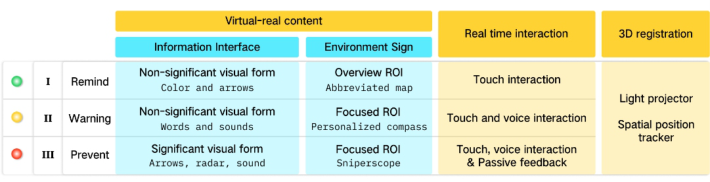
This chapter takes MAR applications and smart watches as design touch- points for prototype. Three functions are defined. Level I correspond to the Remind function, which sends a message to remind the user to focus. Level II correspond to the Warning function, which contains light warnings and warnings of danger sources. Level III correspond to Prevent, which includes continuous audible and light warnings, as well as the activation of commu- nity alarm services. Then, the content design is determined according to the three definitions of AR (see Figure 6). The design content is classified in visual form and region of interest.
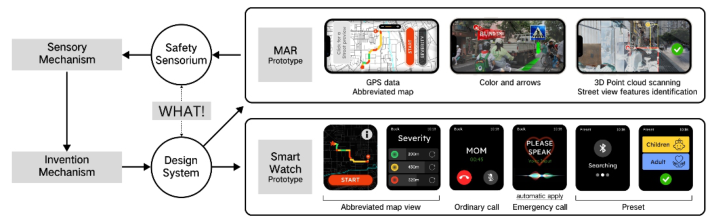
Figure 7: Prototyping and system operation structure. (Source: the author.)
Environment perception, real-time input, and community mutual per- ception are used to create the prototype (see Figure 7). This system can enhance the safety of children’s school commute and offer an innovative and intelligent approach to urban planning and safety management.
226 Hei
DISCUSSION
This paper establishes an evaluable and perceptive intelligence model for the safety evaluation of children’s school commuting environment. Using mobile data and AR technology, a system of hardware wearables and smart peer school commuting apps is formed.
However, this paper only provides limited implementation approaches, and other design methods and innovations may merit debate. The risk factors in this research can be subdivided. School commuting behaviour is also affected by weather and other variables (Antoniadis et al., 2020). Along with road accidents, violent and gun-related crimes are also impor- tant threats (Gobaud et al., 2023). Future accident data additions may make the prediction model more ubiquitous, model verification accuracy can be improved with frequent verification and many average values.
CONCLUSION
This paper proposed a design framework that prioritises data and intelligent algorithms above mere spatial regeneration, to investigate the development of a smart, safe and sustainable school commuting environment. It forms effec- tive evaluation indicators, which can form intelligent perception of urban environment and human flow behavior with the help of urban sensors, and carry out cyclic and dynamic evaluation and prediction of children’s school commuting environments. Augmented reality and artificial intelligence are applied to create a design system that encompasses environment perception, real-time feedback and community mutual perception. It provides a useful experience for creating a safer commuting environment for children’s schools, also proposed an approach for future city perception and interaction.
ACKNOWLEDGMENT
Supported by The International Knowledge Centre for Engineering Sciences and Technology (IKCEST) under the Auspices of UNESCO (CKCEST-2022- 1-42).
REFERENCES
Ali, A. et al. (2023) ‘Road safety hazards for children while commuting to school: Findings from a pilot study in Karachi, Pakistan’, Injury-international Journal of the Care of the Injured, 54. doi: https://doi.org/10.1016/j.injury.2022.11.018. Aljumaiah, A. and Kotb, Y. (2021) ‘The Impact of Using zSpace System as a Vir-
tual Learning Environment in Saudi Arabia: A Case Study’, Education Research International. Edited by E. Namaziandost, 2021, pp. 1–12. doi: https://doi.org/ 10.1155/2021/2264908. Antoniadis, D., Katsoulas, N. and Papanastasiou, D. K. (2020) ‘Thermal Environment of Urban Schoolyards: Current and Future Design with Respect to Children’s Thermal Comfort’, Atmosphere, 11(11), p. 1144. doi: https://doi.org/10.3390/at mos11111144. Azuma, R. et al. (2001) ‘Recent advances in augmented reality’, IEEE Computer
Graphics and Applications, 21(6), pp. 34–47. doi: https://doi.org/10.1109/38. 963459.
Towards Safer Routes: Exploring the Potential of Artificial Intelligence 227
Bau, O. and Poupyrev, I. (2012) ‘REVEL: tactile feedback technology for augmented reality’, ACM Transactions on Graphics, 31(4), pp. 1–11. doi: https://doi.org/10. 1145/2185520.2185585. Bekele, M. K. (2021) ‘Clouds-Based Collaborative and Multi-Modal Mixed Reality
for Virtual Heritage’, Heritage, 4(3), pp. 1447–1459. doi: https://doi.org/10.3390/ heritage4030080. Billinghurst, M., Clark, A. and Lee, G. (2015) ‘A Survey of Augmented Reality’, Foundations and Trends® in Human–Computer Interaction, 8(2–3), pp. 73–272. doi: https://doi.org/10.1561/1100000049. Boarnet, M. G. et al. (2005) ‘Evaluation of the California Safe Routes to School
legislation’, American Journal of Preventive Medicine, 28(2), pp. 134–140. doi: https://doi.org/10.1016/j.amepre.2004.10.026. Li, S. et al. (2016) ‘A case study of teaching probability using augmented reality in secondary school’, in Proceedings of the 24th International Conference on Com- puters in Education, India, pp. 340–344. Available at: https://aic-fe.bnu.edu.cn/ docs/20181011172141143713.pdf. Chinese center for disease control and prevention. (2022) ‘Chinese Adolescents and
Children Injury Review Report’. Corbett-Davies, S., Dunser, A. and Clark, A. (2012) ‘An interactive Augmented Reality system for exposure treatment’, in 2012 IEEE International Symposium on Mixed and Augmented Reality - Arts, Media, and Humanities (ISMAR-AMH). 2012 IEEE International Symposium on Mixed and Augmented Reality - Arts, Media, and Humanities (ISMAR-AMH), Atlanta, GA, USA: IEEE, pp. 95–96. doi: https://doi.org/10.1109/ISMAR-AMH.2012.6483998. Ding, P. et al. (2023) ‘Do long school commutes undermine teenagers? wellbeing?
Evidence from a nation-wide survey in China’, Journal of Transport & Health, 30. doi: https://doi.org/10.1016/j.jth.2023.101605. Farooq, U. et al. (2002) ‘M-Education: bridging the gap of mobile and desktop computing’, in Proceedings. IEEE International Workshop on Wireless and Mobile Technologies in Education. IEEE International Workshop on Wireless and Mobile Technologies in Education, Vaxjo, Sweden: IEEE Comput. Soc, pp. 91–94. doi: https://doi.org/10.1109/WMTE.2002.1039226. Feng Zhou, Duh, H. B.-L. and Billinghurst, M. (2008) ‘Trends in augmented real-
ity tracking, interaction and display: A review of ten years of ISMAR’, in 2008 7th IEEE/ACM International Symposium on Mixed and Augmented Reality. 2008 7th IEEE/ACM International Symposium on Mixed and Augmented Real- ity (ISMAR), Cambridge, UK: IEEE, pp. 193–202. doi: https://doi.org/10.1109/IS MAR.2008.4637362. Gobaud, A. N. et al. (2023) ‘Assessing the Gun Violence Archive as an Epidemiologic Data Source for Community Firearm Violence in 4 US Cities’, JAMA Network Open, 6(6), p. e2316545. doi: https://doi.org/10.1001/jamanetworkopen.2023. 16545. Henrysson, A. (2007). ‘Bringing Augmented Reality to Mobile Phones’, Linköping
University, Norrköping. Available at: https://api.semanticscholar.org/CorpusID: 18161923. Hino, K. et al. (2021) ‘Associations of neighborhood built, safety, and social environment with walking to and from school among elementary school-aged children in Chiba, Japan’, International Journal of Behavioral Nutrition and Physical Activity, 18(1), p. 152. doi: https://doi.org/10.1186/s12966-021-01202-y. Hoelscher, D. M. et al. (2022) ‘Effects of Large-Scale Municipal Safe Routes to
School Infrastructure on Student Active Travel and Physical Activity: Design,
228 Hei
Methods, and Baseline Data of the Safe Travel Environment Evaluation in Texas Schools (STREETS) Natural Experiment’, International Journal of Environmen- tal Research and Public Health, 19(3), p. 1810. doi: https://doi.org/10.3390/ijer ph19031810. Hofman, K., Walters, G. and Hughes, K. (2022) ‘The effectiveness of virtual vs real-life marine tourism experiences in encouraging conservation behaviour’, Jour- nal of Sustainable Tourism, 30(4), pp. 742–766. doi: https://doi.org/10.1080/ 09669582.2021.1884690. Hürst, W. and Van Wezel, C. (2013) ‘Gesture-based interaction via finger track-
ing for mobile augmented reality’, Multimedia Tools and Applications, 62(1), pp. 233–258. doi: https://doi.org/10.1007/s11042-011-0983-y. Irshad, S. et al. (2018) ‘Measuring User Experience of Mobile Augmented Reality Systems Through Non-instrumental Quality Attributes’, in N. Abdullah, W. A. Wan Adnan, and M. Foth (eds) User Science and Engineering. Singapore: Springer Singapore (Communications in Computer and Information Science), pp. 349–357. doi: https://doi.org/10.1007/978-981-13-1628-9_31. Kano, N., Seraku, N., Takahashi, F., & Tsuji, S. (1984). ‘Attractive Quality and Must-
Be Quality’. Journal of the Japanese society for quality control, pp. 14, 39–48. Kaseva, K. et al. (2023) ‘Associations of active commuting to school in childhood and physical activity in adulthood’, Scientific Reports, 13(1). doi: https://doi.org/ 10.1038/s41598-023-33518-z. Khan, D. et al. (2018) ‘Robust Tracking Through the Design of High Qual-
ity Fiducial Markers: An Optimization Tool for ARToolKit’, IEEE Access, 6, pp. 22421–22433. doi: https://doi.org/10.1109/ACCESS.2018.2801028. Kim, J.-H. et al. (2023) ‘Immersive interactive technologies and virtual shopping experiences: Differences in consumer perceptions between augmented reality (AR) and virtual reality (VR)’, Telematics and Informatics, 77, p. 101936. doi: https: //doi.org/10.1016/j.tele.2022.101936. Lee, H., Xu, Y. and Porterfield, A. (2022) ‘Antecedents and moderators of con-
sumer adoption toward AR-enhanced virtual try-on technology: A stimulus- organism-response approach’, International Journal of Consumer Studies, 46(4), pp. 1319–1338. doi: https://doi.org/10.1111/ijcs.12760. Liang, J. et al. (2023) ‘How to promote consumption in city metaverse? Research on XR experience design and consumer behavior of commercial streets’, in IASDR 2023: Life-Changing Design. IASDR 2023: Life-Changing Design, Design Research Society. Liangwa, C. (2017) ‘The Research on Safety Children’s Travel Route on Child-
Friendly City of Netherlands’, International Journal of Environmental Protection and Policy, 5(6), p. 94. doi: https://doi.org/10.11648/j.ijepp.20170506.12. Lindeman, R. W. et al. (2012) ‘GeoBoids: A mobile AR application for exergaming’, in 2012 IEEE International Symposium on Mixed and Aug- mented Reality - Arts, Media, and Humanities (ISMAR-AMH). 2012 IEEE International Symposium on Mixed and Augmented Reality - Arts, Media, and Humanities (ISMAR-AMH), Atlanta, GA, USA: IEEE, pp. 93–94. doi: https://doi.org/10.1109/ISMAR-AMH.2012.6483997. Lindeman, R. W. and Noma, H. (2007) ‘A classification scheme for multi-sensory augmented reality’, in Proceedings of the 2007 ACM symposium on Virtual reality software and technology. VRST07: The ACM Symposium on Virtual Real- ity Software and Technology, Newport Beach California: ACM, pp. 175–178. doi: https://doi.org/10.1145/1315184.1315216.
Towards Safer Routes: Exploring the Potential of Artificial Intelligence 229
Martin-Moraleda, E. et al. (2022) ‘Associations among Active Commuting to School and Prevalence of Obesity in Adolescents: A Systematic Review’, International Journal of Environmental Research and Public Health, 19(17). doi: https://doi.or g/10.3390/ijerph191710852. Morris, J. N. and Hardman, A. E. (1997) ‘Walking to Health’, Sports Medicine, 23(5),
pp. 306–332. doi: https://doi.org/10.2165/00007256-199723050-00004. Pointecker, F. et al. (2022) ‘Bridging the Gap Across Realities: Visual Transitions Between Virtual and Augmented Reality’, in 2022 IEEE International Symposium on Mixed and Augmented Reality (ISMAR). 2022 IEEE International Sympo- sium on Mixed and Augmented Reality (ISMAR), Singapore, Singapore: IEEE, pp. 827–836. doi: https://doi.org/10.1109/ISMAR55827.2022.00101. Rabbit Technologies. (2024) Home of Rabbit Technologies. Available at: https://www.rabbit.tech (Accessed: 1 January 2024). Reitmayr, G. and Drummond, T. (2006) ‘Going out: robust model-based tracking
for outdoor augmented reality’, in 2006 IEEE/ACM International Symposium on Mixed and Augmented Reality. 2006 IEEE/ACM International Symposium on Mixed and Augmented Reality, Santa Barbara, CA, USA: IEEE, pp. 109–118. doi: https://doi.org/10.1109/ISMAR.2006.297801. Scharoun Benson, S. M., Bruner, B. and Mayer, A. (2020) ‘Encouraging active transportation to school: Lessons learned from implementing a walking school bus program in Northeastern Ontario’, Journal of Transport & Health, 19, p. 100914. doi: https://doi.org/10.1016/j.jth.2020.100914. Sereno, M. et al. (2020) ‘Collaborative Work in Augmented Reality: A Survey’, IEEE
Transactions on Visualization and Computer Graphics, pp. 1–1. doi: https://doi. org/10.1109/TVCG.2020.3032761. Tudorlocke, C., Ainsworth, B. E. and Popkin, B. M. (2001) ‘Active Commuting to School: An Overlooked Source of Childrens Physical Activity’, Sports Medicine, 31(5), pp. 309–313. doi: https://doi.org/10.2165/00007256-200131050-00001. Vallino, J. R., & Brown, C. M. (1998). ‘Interactive Augmented Reality’. Visser, K. and Van Aalst, I. (2022) ‘Neighbourhood Factors in Children’s Outdoor
Play: A Systematic Literature Review’, Tijdschrift voor Economische en Sociale Geografie, 113(1), pp. 80–95. doi: https://doi.org/10.1111/tesg.12505. World Health Organization. (2023). ‘Global status report on road safety 2023’.
Available at: https://www.who.int/publications-detail-redirect/9789240086517 (Accessed: 1 February 2024). Wang, F. et al. (2023) ‘Privacy-Aware Traffic Flow Prediction Based on Multi-Party Sensor Data with Zero Trust in Smart City’, ACM Transactions on Internet Technology, 23(3), pp. 1–19. doi: https://doi.org/10.1145/3511904.
LISTED IN THE AHFE DIGITAL BOOKSTORE CATALOGUE
Explore the complete digital volume
Artificial Intelligence and Social Computing
Read this individual research paper free through the original publisher, or explore the full digital proceedings book.
ISBN 978-1-958651-98-8
Explore this ISBN in the AHFE Bookstore ↗Listed in the July 2026 bookstore catalogue; search by ISBN to confirm current availability · Digital book purchase optional