Bryan Colorado, Christian Zambrano, Lileana Saavedra Robles, Juan Briones, Rommy Torres (2023). Multicriteria analysis for the design of interactive public spaces as potential catalysts for local development in Guayaquil. In: Human-Centered Design and User Experience. AHFE Open Access, vol. 114, pp. 360–373. https://doi.org/10.54941/ahfe1004254
The development of the City of Guayaquil, around its urban peripheries, generates a problem for traditional territorial planning, since emerging solutions must be generated to problems such as the deficit of public spaces and green areas. The multi-criteria analysis between variables such as decision making and the development of sustainable designs generates a path for the local development of peri-urban communities, a specific case of analysis for the study, the Cooperativa Sergio Toral 1, is visualized as a booming territory of urban growth. unplanned, taking into account its accelerated expansion, the means of how these internal communities can generate a source of sustainable employment through decision-making provides possibilities for change in view of the sustainable development of the territory. The objective is to establish a choice parameter that develops the local potential of the territory for the socio-economic benefit of these communities within the Sergio Toral 1 Cooperative. Among the findings of the qualitative methodology, it was obtained that the creation of self-constructed designs through design participatory increases the autonomy of choice and that the synthesis of quantitative data allowed the generation of variables not foreseen in the study. As a result, the exposure of two dependent variables subject to testing configured independent variables that contribute to more effective decision-making and that the development of furniture designs increases the capacity for local development through the creation of spaces for ventures, thus concluding in the creation of interactive public spaces that connect the territory and promote the sustainable growth of the territory, increasing by 7 m2. per inhabitant the amount of green area and the economic development of 30% of the population.
The development of urban peripheries in Guayaquil, Ecuador, follows a pat- tern like that of urban expansion in many other Latin American cities since it develops emerging from the need for the progressive search for urban living and to generate a process of radical settlement and appropriation (Nassar &
Multicriteria Analysis for the Design of Interactive Public Spaces 361
Elsayed, 2018). This radical growth has experienced significant growth and urbanization in recent decades as opportunities to obtain dignified housing through housing plans (Siqueira-Gay & Sánchez, 2019), urban peripheries are activated, they become centers of development influenced by several fac- tors, including demographic growth, the economic opportunities and the infrastructure development that is planned by the inhabitants; which, as an effect, is developed without urban planning consistent with the preparation and projection of a territory that is suitable and whose risks are minimal.
Efforts to manage the development of urban peripheries in Guayaquil will need to focus on sustainable development, community participation and inclusive planning to ensure that the city’s growth benefits all residents and maintains its cultural value and environmental identity (Sánchez Padilla et al., 2021). Urban planning at the outset and local governance at a development stage play a crucial role in achieving this balance.
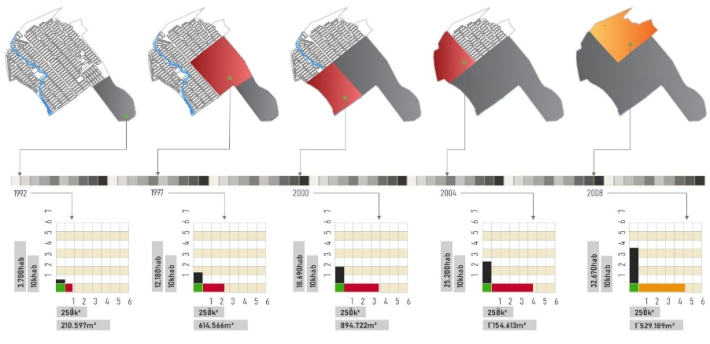
Urban growth is influenced by a sudden settlement criterion, generating a compact configuration of the territory, without sustainable development paths and with few means for the development of infrastructure, equipment, design of green areas and public space (See Figure 2).
Figure 1: Peripheral urban development of Sergio Toral 1. Source: Analysis of partici- patory urban design proposals in Guayaquil, 2021.
Multicriteria variable choice theory, often called multicriteria decision analysis (MCDA) or multicriteria decision making (MCDM), is a decision- making approach that deals with complex decisions involving multiple crite- ria or objectives, an often contradictory (Awasthi et al., 2018). This theory provides a structured framework to systematically evaluate and select the most appropriate variables, alternatives, or solutions in a decision-making process. That in cases of urban planning they intervene in decision alter- natives and joint or participatory decision-making (Mulliner et al., 2016) in response to a reality or experimental experience for the development of designs for the new territorial configuration.
MATERIALS AND METHODS
This section describes both the raw materials used and their level of con- sumption, as well as the description of the theoretical tests and laboratory tests.
Plastic Consumption Plastic waste worldwide has achieved an abrupt peak growth until 2022 due to high consumerism towards the plastic industry, largely due to the emission of plastic bottles, bags and containers that currently together generate 150 million metric tons of this amount of waste, only 9% are recycled according to the OECD Global Plastic Outlook report (Pang et al., 2022).
Plastics have 3 variants that contribute to better recycling when incor- porated into construction (Jafari, 2022). Firstly, there is PET (Polyethylene Terephthalate), which is easy to recycle since you can obtain crushed shav- ings, synthetic fibers. Casings and strips of minimum thicknesses between 0.2 and 0.6 centimeters can be easily incorporated into a dosage, with lightening, waterproofing properties, and medium bending resistance (Yun et al., 2022).
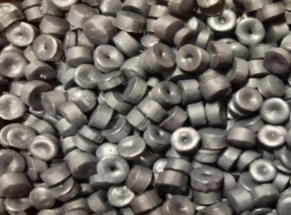
HDPE (High Density Polyethylene), a material found in spherifications and small quadrants no larger than 0.01 centimeters in height and width, this material has interesting properties of resistance to low and high temper- atures (Tippner et al., 2022), absorbent and with high resistance to bending and compression. PVC (Polyvinylchloride), a material with an intermediate level of degradation, is rarely used since its recycling process (Zorpas, 2020) involves more complex and expensive processes that mean that this material is only found in spherifications that are introduced at dosages of construction materials generate a high flexural strength and a high average compression strength (See Figure 2).
High-density polyethylene (HDPE) produces 25% of this globalized plas- tic waste, which is why it is a segment of interest that can help reduce 88% of the carbon footprint in Spain alone (Smith et al., 2023), its use in construc- tion has helped to redirect these wastes towards this industry that increas- ingly integrates HDPE in presentations such as spherifications, fibers or plates.
Multicriteria Analysis for the Design of Interactive Public Spaces 363
This category of post-consumer recycled plastics addresses the reuse of waste to generate an extended life cycle and generate more efficient degra- dation. One of the most frequent uses is in pavements and concrete panels, which secondly cause greater plastic consumption. recycling composed of up to 75% of this recycled plastic in fiber presentation (Xanthopoulou et al., 2023). The adhesion of this type of high-density plastic in previous studies has shown a superior characterization of the physical and mechanical properties of the construction elements (Kumar & Aggrawal, 2023), such as a reduc- tion in the corrosion time of rods within reinforced concrete structures by generating protective coverage and in the elasticity and flexural resistance in concrete columns and beams.
Another highly demanded application of HDPE in buildings is found in sanitary systems that provide a more efficient structure for the conduction of water and resistance to bending, providing an added value of lightness of the pipes, improving construction times both in their part of transportation and installation. HDPE’s versatility, durability and resistance to various environ- mental factors make it a valuable material in the construction industry for a wide range of applications, contributing to the longevity and performance of many types of structures.
Currently, studies have been carried out that show that HDPE can be intro- duced into almost any construction material (Abu Hassan et al., 2023) in this case, reinforced concrete and plastic alloys with wood for the production of furniture and flexible spaces that promote the use of a line of sustainable materials and increase the life cycle of this type of plastic.
Theoretical and Laboratory Test HDPE has certain advantages over other plastics in construction products due to its physical and mechanical properties and a complementary factor that contributes to local development such as the level of recycling and reuse, since for every kilogram of plastic of this type consumed it can be take advantage of up to 42% of its total structure. Low apparent density between 950–970 kg/m3, tensile strength around 20–35 MPa and relatively high ignition tem- perature of 487
C (Xanthopoulou et al., 2023). It is also a chemically inert material, which suits it adapts with its incorporation as aggregate in construc- tion materials (Gebremariam et al., 2020). As a result, it has been used as a fine aggregate in the production of heavy and light concrete, where materials with good thermal behavior, lower workability are obtained by increasing the HDPE content for the same water/cement ratio, as well as a progressive decrease in the compression resistance. resistance as the percentage of natural aggregates replaced by plastic waste increases (Kung et al., 2021). The use of HDPE has also been extended to the production of bituminous asphalt mix- tures for civil engineering, obtaining a correct hardening of the mixture, as well as mechanical and wear resistance suitable for use in road construction (I. Marrero Guillamón, 2008).
However, no applications of HDPE waste for use as secondary raw mate- rial in the production of gypsum or gypsum-based materials have been found
in the literature. Gypsum composites have been positioned as an environ- mentally viable alternative for the development of prefabricated construction products (Li et al., 2017). In this sense, concrete is a type of concrete with higher purity, whiteness and fineness of grinding (Ferrández et al., 2019). It is also a binding material with excellent hygrothermal regulation properties (Sandhu & Dann, 2023), a compression resistance directly proportional to its surface hardness (Yun et al., 2022) and an ideal coating for the interior of homes with good adhesion capacity on ceramic surfaces. some of its prop- erties. On the other hand, in addition to the properties, gypsum composites are a key element to move towards greater industrialization of construction through the production of concrete boards (Franco et al., 2019). These pre- fabricated products mainly consist of a gypsum matrix with additives and reinforced with fibers, to which two layers of paper are adhered on its sur- face (Xanthopoulou et al., 2023). The development of these prefabricated parts allows savings in terms of logistics costs and execution time (Anderson et al., 2014). Furthermore, a fantastic opportunity can be achieved to incor- porate recycled raw materials and move towards environmentally responsible economic growth (Lai et al., 2022).
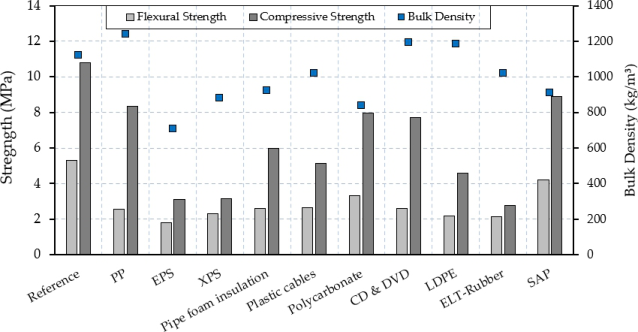
Regarding the use of plastic waste in gypsum composites, several researchers have addressed many possibilities in this field. Figure 3 shows different results found in the literature. The results present mechanical resis- tance to bending and compression, as well as the final apparent density of the final compounds.
Figure 3: Mechanical strength and bulk density of gypsum composites with plastic waste. In the figure: reference is a plaster with HDPE/water ratio 0.7 by weight.
Dosages and Sample Preparation To conduct this study, original plaster material was progressively replaced by HDPE granular waste. This partial substitution was conducted in percentages of 2-4-6-8-10% by volume, as shown in Table 3. The nomenclature used for naming the samples is: P0.65–(%), where P refers to the binder (Plaster); 0.75 refers to the water/plaster ratio by weight, and; (%) refers to the percentage of substitution of the original compound by recycled HDPE material.
Multicriteria Analysis for the Design of Interactive Public Spaces 365
Production process starts with the manual dry mixing of the plaster pow- der with the polyethylene residue. After that, the kneading process begins by pouring the material into water and following the guidelines set out in the UNE-EN-13279-2:2014 standard (Islam & Huda, 2019). Once samples are hardened, they are kept for a week in laboratory conditions (temperature 23 ± 2
C and relative humidity 50 ± 5%). Finally, the process concludes placing the samples to heat for 24 h in a drying oven at a temperature of 45
C ± 1
C.
Table 1. Dosages used: quantities by weight and by volume.
Table available in the original PDF paper.
Weight (g) Volume Percentage (%) Sample Concrete- 210kg/cm2 Water HDPE Concrete- 280kg/cm2. Water HDPE
Materials developed have been subjected to physical and mechanical characterization tests, aiming to determine the viability of their use in prefab- ricated materials for building. Two series of three samples of each proposed dosage have been prepared.
METHODOLOGY
Decisión-Making and Multi-Criteria Design The first phase of the methodological study analyzes the feasibility of the materials to be chosen and generates guidelines for their arrangement and ranking of each recycled material, understanding its physical and mechanical properties.
The AHP method (Analytic Hierarchy Process) is a decision-making tool used to determine priorities among different criteria, subcriteria and alterna- tives organized using the TOPSIS technique of multivariable criteria (Naito & Tanaka, 2017). The Technique of Order of Preference by Similarity to the Ideal Solution (TOPSIS) is a multicriteria decision analysis method.
ELECTRE (i), family of multicriteria decision analysis that means elimi- nation and choice translating reality. It is composed of two main parts in an ELECTRE application: first, the construction of one or several overcoming relationships, which aims to comprehensively compare each pair of actions; secondly, an exploitation procedure that develops the recommendations obtained in the first phase.
The matrices used in the Analytical Hierarchy Process (AHP) compile expert knowledge as pairwise comparisons between various criteria and alter- natives in decision-making problems. Usually, many items are considered in the same comparison process, so the judgment is not entirely consistent, and
sometimes the level of consistency may be unacceptable. An effective tool to deal with complex decision-making and with multiple variations around time and space as occurs marked by its changes throughout its development.
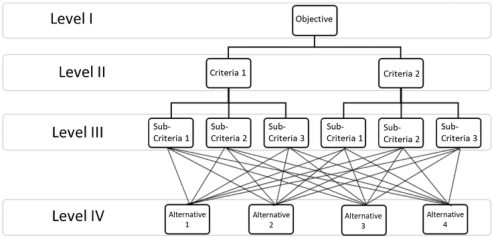
In the first place, the decomposition consists of structuring the problem at a hierarchical level, where the objective occupies the first level, the attributes occupy intermediate levels, and the last level presents the alternatives to be judged. Figure 4 illustrates a generic hierarchical structure with four levels, where the objective is related to alternatives through criteria and sub-criteria as linking dynamics that address the decision-making alternatives.
The final development of the methodology was based on decision making and study of materials for the urban design of interactive public space focused on local development.
RESULTS
The results are based on laboratory experimentation, decision-making scheme using multiple choice matrices of variables and the design of pro- totypes for interactive public space.
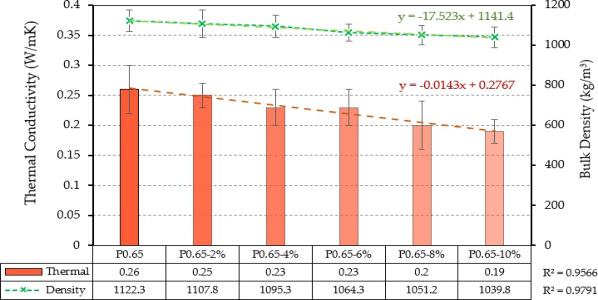
Physical and Mechanical Characterization In Figure 5 it can be seen how the incorporation of HDPE waste as a partial replacement produces a reduction in both the apparent density and thermal conductivity values compared to the reference material P 0.75. Therefore, the apparent density in sample P0.75-10% has decreased by up to 7.35% com- pared to the reference. A similar behavior was observed when incorporating polypropylene residues in substitution percentages of 5-7.5-10% by weight (Dick et al., 2019).
Similarly, the thermal conductivity with the highest amount of recycled raw material is 0.19 W/m·K, which represents a reduction of 26.7% compared to sample P0.75. This improvement in the thermal behavior of cement compos- ites with the addition of plastic waste has already been observed by previous researchers, incorporating polycarbonate waste they managed to reduce the conductivity of cement and cementin composites by up to 30% (Ferrández
Multicriteria Analysis for the Design of Interactive Public Spaces 367
et al., 2019), which incorporate remains of crushed cables, obtaining con- ductivities close to 0.25 W/m·K (Allaix et al., 2022). Finally, it should be noted that for all physical properties, a linear trend has been observed in the decrease in bulk density and thermal conductivity with increasing HDPE content in cement and structural cement (concrete) composites.
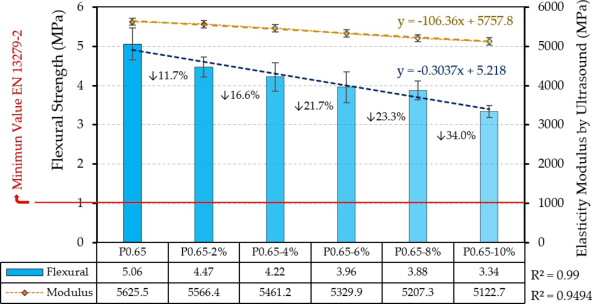
Figure 5: Results for thermal conductivity and bulk density.Figure 6: Results for flexural strength and dynamic modulus of elasticity by ultrasonics.
It is shown how the flexural strength in plates decreases as the content of HDPE waste increases, according to the tests carried out on standardized RILEM samples shown in Figure 6. The UNE-EN 14246 standard requires a minimum resistance of 0.18 kN to guarantee the optimal performance of the furniture used outdoors. The main advantage of recycled materials and the use of cement is its versatility and application possibilities (Fadai & Stephan, 2023). It is a workable material with an aesthetic finish, which makes it an optimal solution to create different configurations in buildings (Kagermanov et al., 2017). The results obtained in the materials designed in this research allow the creation of specific configurations that provide other benefits such
as aesthetic vision and the possibility of combining it with other elements (Santiago, 2022).
Decision Radar These results were obtained on the Decision Radar platform that uses artifi- cial intelligence to synthesize and evaluate data on mathematical estimates of the interrelation of criteria and variables With the use of the Decision Radar mathematical application, the AHP-TOPSIS calculations can be affected by designating objective options (first level objectives), evaluation criteria or subcriteria to obtain relevant alternatives of results to obtain a clear decision-making process. decisions around the established problems. For the hierarchical analytical process, 3 types of order analysis and a multicriteria verification system based on TOPSIS preferences were considered.
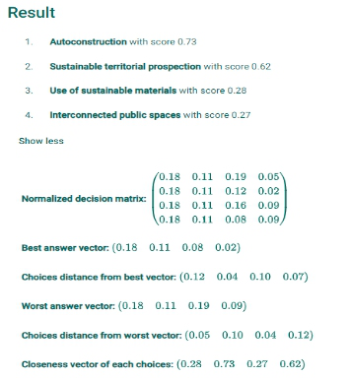
For the initial analysis of TOPSIS, 4 variables were qualitatively ana- lyzed for the prioritization of criteria that contribute to local development established as key indicators: use of sustainable materials, self-construction, interconnected public spaces and sustainable territorial prospection (see Fig. 7). The full spectrum of results demonstrates that the best response vector maintains an acceptable alternative distance.
Figure 7: TOPSIS analysis - decision matrix.
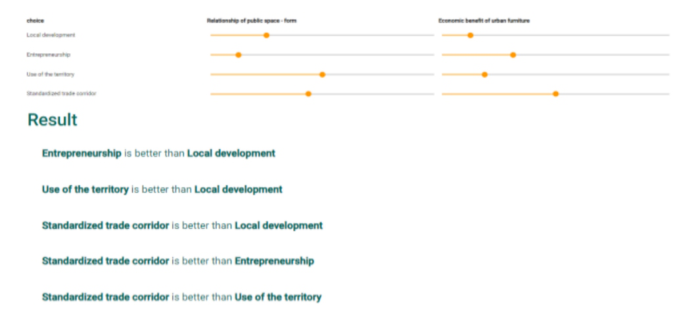
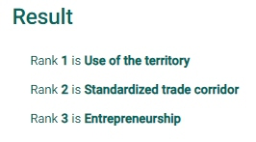
In the ELECTRE analysis, a multi-criteria and multi-variable relationship is reflected to determine the causes and preferences for local development, included as a variable to obtain a comparative trend of better decisions around a result based on data obtained by users of the sector. The results are presented to the enterprises framed in the good use of the territory through the creation of a standardized commercial corridor that promotes better local development with a degree of agreement of 59%.
As a final feature of decision-making according to the linear assignment, to obtain better results for local development, the use of the territory must
Multicriteria Analysis for the Design of Interactive Public Spaces 369
first be changed to obtain a standardized commercial corridor that integrates ventures based on the development of self-built furniture and its use within and outside the territory.
Prototypes and Interactive Public Spaces Planning It allows the regeneration of public spaces and promotes social interactiv- ity between communities. It includes all cultures and topologies, working with neutral and modular forms that are highly adaptable to different spaces from urbanizations and public squares to schools and shopping centers.
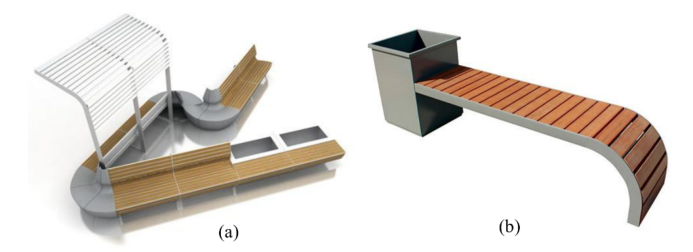
The adaptation of the material with the prototype is related to the type, shape and arrangement of the furniture, so there are two proposals, one devel- oped with combinations of cement and HDPE (a) and wood with plastic alloys and HDPE (b). See Figure 10.
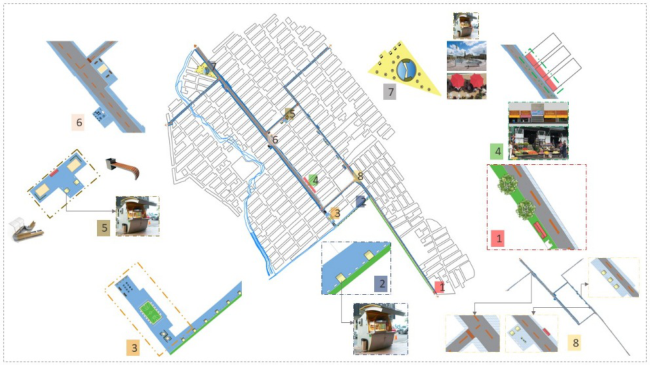
The interactive public spaces were planned in an interconnected manner, influencing the economic, social, and environmental aspects to conceive a local development corridor structured in 8 parts that demarcate the entire study area from south to north.
Figure 10: Urban furniture prototypes.Figure 11: Planned design of interactive public space as a territorial computer. (1) Safe and arboreal intervention. (2) Furniture and business area. (3) Furniture and sports area. (4) Local market development coupled with the ventures of the standardized local corridor. (5) Civic spaces and rest areas. (6) Security and interaction spaces. (7) Massive public space for interaction and entrepreneurship. (8) Pedestrian conti- nuity and connectivity.
DISCUSSION AND CONCLUSION The choice of recycled materials was adopted as an alternative of choice since in the study area a high level of plastic pollution is generated, taking care of landfills or plastic processing plants, which is why the feasibility of the operation of plastic processing is discussed, which is why it is proposed. a processing equipment for the development of this material on a large scale since HDPE has a higher waste content showing better properties for con- struction applications. It is worth highlighting the P0.75-10% compound, which would be optimal for use in situations that require greater thermal insulation, however, its flexural resistance did not exceed the limits of the standard. Regarding this point, it must be considered that prefabricated plas- terboard for false ceilings usually have an outer sheet of paper and sandwich configurations, which gives them greater mechanical resistance.
Multicriteria Analysis for the Design of Interactive Public Spaces 371
In conclusion, it is obtained that the development of a design plan for interactive public spaces is managed under an exhaustive analysis of decision- making to obtain coherence with the territorial needs and projections that contribute to the development of more inclusive proposals and with a view to a better analysis of both economic, social, and environmental factors.
The analysis of variables and comparison with dependent criteria con- tributed to more effective decision making and to the fact that the devel- opment of furniture designs increases the capacity for local development through the creation of spaces for ventures, thus consolidating the capacity for local development through of the creation of spaces for entrepreneurship. including the creation of interactive public spaces that connect the territory and promote the sustainable growth of the territory, increasing by 7 m2. per inhabitant the amount of green area the economic development of 30% of the population with the focus on enterprises developed in commercial corridors under land use change regulations. The final result is the interconnection of the territory and traceability through pedestrian routes and boulevards that improve the quality-of-life conditions of the inhabitants.
ACKNOWLEDGMENTS
A special thanks to the group of researchers that make up this team, where it has been possible to obtain a concise, coherent investigation and with a level of experimentation through decision-making, qualitative analysis of the place and quantitative analysis to development of the proposal. Thanks to the Faculty of Architecture and Urbanism for its management, employment of student and teaching team in its facilities, to achieve such valuable results.
REFERENCES
Abu Hassan, N. A., Ahmad, S., Chen, R. S., Shahdan, D., & Mohamad Kassim, M.
H. (2023). Tailoring lightweight, mechanical and thermal performance of PLA/re- cycled HDPE biocomposite foams reinforced with kenaf fibre. Industrial Crops and Products, 197. https://doi.org/10.1016/J. INDCROP.2023.116632 Allaix, D. L., Vliet, A. B. Van, Visser, J., & Valcke, S. (2022). Challenges in the Design of Concrete Structures With Reclaimed Elements. Fib Symposium, 1917–1925. Anderson, P. M. L., Avlonitis, G., & Ernstson, H. (2014). Ecological outcomes of
civic and expert-led urban greening projects using indigenous plant species in Cape Town, South Africa. Landscape and Urban Planning, 127, 104–113. https://doi. org/10.1016/j.landurbplan.2014.03.007 Awasthi, A., Omrani, H., & Gerber, P. (2018). Investigating ideal-solution based multicriteria decision making techniques for sustainability evaluation of urban mobility projects. Transportation Research Part A: Policy and Practice, 116, 247–259. https://doi.org/10.1016/j.tra.2018.06.007 Dick, S., Hechavarría Hernández, J. R., & Forero, B. (2019). Systemic Analysis of
Bioclimatic Design of Low-Income State-Led Housing Program “Socio Vivienda” at Guayaquil, Ecuador. Advances in Intelligent Systems and Computing, 876, 647–651. https://doi.org/10.1007/978-3-030-02053-8_99 Fadai, A., & Stephan, D. (2023). Resource-efficient materialization | sustainability future trends. 13th World Conference on Timber Engineering, WCTE 2023, 7, 4604–4610. https://doi.org/10.52202/069179-0600
Ferrández, D., Saiz, P., Morón, C., Dorado, M. G., & Morón, A. (2019). Inductive method for the orientation of steel fibers in recycled mortars. Construction and Building Materials, 222, 243–253. https://doi.org/10.1016/J. CONBUILD- MAT.2019.06.113 Franco, L. C., Mendes, J. C., Costa, L. C. B., Pira, R. R., & Peixoto, R. A. F. (2019).
Design and thermal evaluation of a social housing model conceived with bio- climatic principles and recycled aggregates. Sustainable Cities and Society, 51. https://doi.org/10.1016/j.scs.2019.101725 Gebremariam, A. T., Di Maio, F., Vahidi, A., & Rem, P. (2020). Innovative technologies for recycling End-of-Life concrete waste in the built environment. Resources, Conservation and Recycling, 163. https://doi.org/10.1016/J. RESCONREC.2020.104911 I. Marrero Guillamón, J. B. M. (2008). La producción del espacio público: Fundamentos teóricos y metodológicos para una etnografía de lo urbano. Diposit. Ub. Edu, 2(1), 10–20. Islam, M. T., & Huda, N. (2019). Material flow analysis (MFA) as a strategic tool
in E-waste management: Applications, trends and future directions. In Journal of Environmental Management (Vol. 244, pp. 344–361). Academic Press. https: //doi.org/10.1016/j.jenvman.2019.05.062 Jafari, H. (2022). Investigating environmental and economic aspects of sustainability by recycling PET plastic bottles: A game-theoretic approach. Clean Technologies and Environmental Policy, 24(3), 829–842. https://doi.org/10.1007/S10098-021- 02216-7 Kagermanov, A., Ceresa, P., Morales, E., Poveda, J., & O’Connor, J. (2017). Seismic
performance of RC buildings during the MW7.8 Muisne (Ecuador) earthquake on April 2016: field observations and case study. Bulletin of Earthquake Engineering, 15(12), 5167–5189. https://doi.org/10.1007/S10518-017-0182-Y Kumar, A., & Aggrawal, P. (2023). A Novel Application of Waste Polythene in Concrete. Iranian Journal of Science and Technology - Transactions of Civil Engineering, 47(4), 2007–2016. https://doi.org/10.1007/S40996-022-01032-3 Kung, C. C., Lee, T. J., & Chen, L. J. (2021). Economic growth and environmen-
tal sustainability from renewable energy applications. Energy Exploration and Exploitation, 39(2), 531–535. https://doi.org/10.1177/0144598720964207 Lai, W. L., Sharma, S., Roy, S., Maji, P. K., Sharma, B., Ramakrishna, S., & Goh, K.
L. (2022). Roadmap to sustainable plastic waste management: a focused study on recycling PET for triboelectric nanogenerator production in Singapore and India. Environmental Science and Pollution Research, 29(34), 51234–51268. https://do i.org/10.1007/S11356-022-20854-2 Li, S., Li, Q., Jiang, H., Zhang, H., & Zhang, L. (2017). Experimental Research on Seismic Performance of a New-Type of R/C Beam-Column Joints with End Plates. Shock and Vibration, 2017, 1–11. https://doi.org/10.1155/2017/3823469 Mulliner, E., Malys, N., & Maliene, V. (2016). Comparative analysis of MCDM
methods for the assessment of sustainable housing affordability. Omega (United Kingdom), 59, 146–156. https://doi.org/10.1016/j.omega.2015.05.013 Naito, K., & Tanaka, K. (2017). Proposal of a bus location system based on participatory sensing with BLE devices and smartphones. WMSCI 2017 - 21st World Multi-Conference on Systemics, Cybernetics and Informatics, Proceedings, 1, 105–110. Nassar, D. M., & Elsayed, H. G. (2018). From Informal Settlements to sustainable
Multicriteria Analysis for the Design of Interactive Public Spaces 373
Pang, M. M., Choo, H. L., & Buys, Y. F. (2022). Plastics in Food Packaging. Encyclopedia of Materials: Plastics and Polymers, 1–4, 178–186. https://doi.org/10.1016/ B978-0-12-820352-1.00074-2 Sánchez Padilla, M. L., Hechavarría Hernández, J. R., & Portilla Castell, Y. (2021).
Systemic Analysis of the Territorial and Urban Planning of Guayaquil. Lecture Notes in Networks and Systems, 271, 411–417. https://doi.org/10.1007/978-3- 030-80624-8_51 Sandhu, M., & Dann, M. R. (2023). Life-Cycle Analysis for Upgrading Residential Buildings to Optimize Energy Consumption. Lecture Notes in Civil Engineering, 247, 619–629. https://doi.org/10.1007/978-981-19-0968-9_50 Santiago, P. (2022). Achieving Sustainability in Construction Through Digitally
Informed Decisions. Structural Integrity, 20, 247–269. https://doi.org/10.1007/ 978-3-030-82430-3_11 Siqueira-Gay, J., & Sánchez, L. E. (2019). Mainstreaming environmen- tal issues into housing plans: the approach of Strategic Environmen- tal Assessment. Environmental Impact Assessment Review, 77, 145–153. https://doi.org/10.1016/J. EIAR.2018.12.005 Smith, M., Beetge, J., Souliman, M. I., & Bastola, N. R. (2023). Modification of Asphalt Binders with Ocean Plastic Waste: Characterization of Binder Performance. 47–59. https://doi.org/10.1061/9780784484906.005 Tippner, J., Milch, J., Sebera, V., & Brabec, M. (2022). Elasto-plastic material model
of oak at two moisture content levels. Holzforschung, 76(10), 886–896. https: //doi.org/10.1515/HF-2022-0008 Xanthopoulou, E., Chrysafi, I., Polychronidis, P., Zamboulis, A., & Bikiaris, D.
N. (2023). Evaluation of Eco-Friendly Hemp-Fiber-Reinforced Recycled HDPE Composites. Journal of Composites Science, 7(4). https://doi.org/10.3390/JC S7040138 Yun, M. J., Sim, Y. H., Lee, D. Y., & Cha, S. I. (2022). Reliable Lego®-style assembled stretchable photovoltaic module for 3-dimensional curved surface application. Applied Energy, 323. https://doi.org/10.1016/J. APENERGY.2022.119559 Zorpas, A. A. (2020). Strategy development in the framework of waste management.
Science of the Total Environment, 716. https://doi.org/10.1016/j.scitotenv.2020. 137088
LISTED IN THE AHFE DIGITAL BOOKSTORE CATALOGUE
Explore the complete digital volume
Human-Centered Design and User Experience
Read this individual research paper free through the original publisher, or explore the full digital proceedings book.
ISBN 978-1-958651-90-2
Explore this ISBN in the AHFE Bookstore ↗Listed in the July 2026 bookstore catalogue; search by ISBN to confirm current availability · Digital book purchase optional