Masayoshi Tanishita, Michiko Ohkura (2023). Evaluation of unpleasant green environment based on biological reaction and contingent valuation. In: Human-Centered Design and User Experience. AHFE Open Access, vol. 114, pp. 263–271. https://doi.org/10.54941/ahfe1004243
Green environment such as parks and woods have been maintained as having healing and relaxing effects. These effects have been evaluated by biological reactions and contingent valuation method. Most previous studies are focusing on green environments where maintenance is done. On the other hand, there are many unmaintained green environments such as abandoned detached houses and woods. There is a possibility that people feel uncomfortable with these problems, such as increasing anxiety about crime prevention and disasters and deteriorating the local image. However, to the best of our knowledge, no research has been conducted that focuses on the discomfort of unmaintained green environment. Therefore, in this study, we investigate subjects' biological reactions (cerebral blood flow and heart rate) and willingness to pay (WTP) for the improvement, presenting images of abandoned detached houses and woods as unmaintained green environment, and analyze the relationship between biological reactions and WTP.59 subjects joined this experiment. After a 60-second rest period, each subject sees the 4 unmaintained greenery image and 4 maintained greenery images, 5 seconds each. In order to consider the order effect, the order of unmaintained and maintained greenery images was alternated by half for each subject. In addition, data showing large fluctuations or trends during breaks were excluded from the analysis.As a result, 1) in case of abandoned detached house, the heart rate tended to increase when they see the "unmaintained greenery", and in case of abandoned woods, the heart rate tended to decrease when they see the "maintained greenery". 2) The heart rate variation differ by gender and presentation order of images. Females showed greater variation. Interestingly, there was a contrasting change in whether the maintained images were viewed first or later in both abandoned detached house and woods. 3) We cannot find the difference in cerebral blood flow. 4) There was no relationship between the presence or absence of changes in biological reactions and WTP. Though we need further investigation, we show the possibility of biological reactions to evaluate unpleasant green environment.
The health benefits of greenspace exposure are significant enough for prac- titioners and policymakers to recommend spending more time in nature (Jones et al., 2021). For example, forest bathing (or Shinrin-yoku) is an expe- rience in a forest atmosphere and considered as a type of preventive medicine (Kondo et al., 2018). Greenspace interventions reduce the physiological bur- den of stress across an individual’s lifespan by reducing cortisol production. A recent scoping review of 20 trials and 732 participants who engaged in
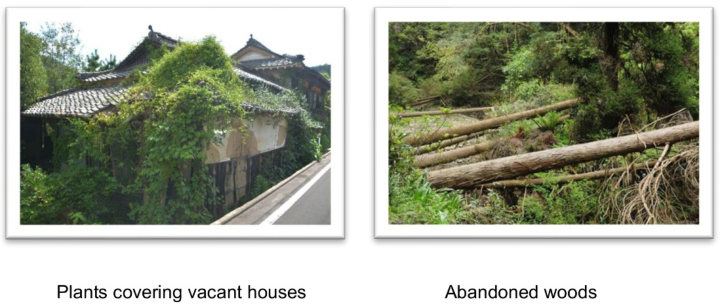
forest bathing found that their blood pressure significantly decreased com- pared to those who experienced a non-forest environment (Ideno et al., 2017). Therefore, green spaces are considered desirable. However, the assumption is of well-maintained greenery. In contrast, this study focuses on “unmain- tained” greenery, such as plants covering vacant houses and abandoned woods (Figure 1). We ask: Do people feel uncomfortable with these green spaces?
Figure 1: Example of unpleasant greenery.
Typically, subjective evaluations, based on questionnaires, are used to assess the green environments. However, in recent years, biological reac- tions and Contingent Valuation Methods (CVM) have been used for objective evaluation.
The biological reaction method focuses on the physiological stress response to stimuli, and examines the saliva and heart rates. While questionnaire surveys are subject to various biases, such as responding according to the intention of the questioner, biological reactions may provide informa- tion on unconscious reactions without such an intention. For example, Kozaki et al. (2007) reported a decrease in blood pressure, an increase in vagal nerve activity, and a decrease in salivary cortisol concentration in a forest environment. Hosono et al. (2017) found increased prefrontal cor- tex activity and eye movement stopping points when viewing vegetation at a highway rest facility. However, these studies focus on greenery that brings pleasure.
Meanwhile, CVM is a method of creating a virtual market for unpriced goods and services, and conducting monetary valuation. Green environments are not typically priced. As such, CVM has been used to determine the worth of the green environment. Essentially, it sets up a hypothetical market for a priceless good or service, and directly asks consumers’ willingness to pay (WTP) for it. For example, Nagura et al. (2014) showed that the WTP for the maintenance and management of urban green areas was 2,401 yen (18 USD) per household. Shoji et al. (1998) found that the average WTP for the management of natural parks is 1,761 yen (13 USD) as a cooperation fee.
Evaluation of Unpleasant Green Environment Based on Biological Reaction 265
Notably, most of the greenery that has been evaluated are “maintained” green environments. However, to the best of our knowledge, no study has evaluated how unmaintained greenery generates discomfort using biologi- cal reactions or the WTP. In addition, the relationship between biological reactions and WTP remains unclear.
Using biological reactions (cerebral blood flow and heart rate) and con- tingent valuation, this study evaluates whether people feel unpleasant when they see images of an “unmaintained green environment.” We use images of vacant houses and abandoned woods to represent unmaintained green environments. We then analyze whether biological responses and WTP are correlated. Essentially, we propose the following two hypotheses: H1. The cerebral blood flow decreases and heart rate increases when one is looking at an unmaintained green environment. H2. WTP correlates with the presence or absence of changes in biological responses.
First, regarding cerebral blood flow, Yanagisawa and Tsunashima (2015) reported a decrease in subjects’ oxy-Hb when they were shown uncomfort- able images. Asano et al. (2011) also reported that the amygdala, which controls emotions such as discomfort, is hyperactive while viewing unpleas- ant images, and that cerebral blood flow in the prefrontal cortex decreases. On the heart rate, Mori and Saijo (1982) reported increased heart rate while viewing unpleasant images. As such, we hypothesized that biological responses similar to those reported in these previous studies would occur. Yanagisawa and Tsunashima (2015) reported similar trends in the biological response characteristics and subjective evaluations. Finally, we considered that the WTP would be higher for subjects who showed changes in their biological responses.
MATERIALS AND METHODS
We presented two types of images, maintained and unmaintained green, to the subjects. Then, their biological responses to the images were measured and a CVM questionnaire was administered.
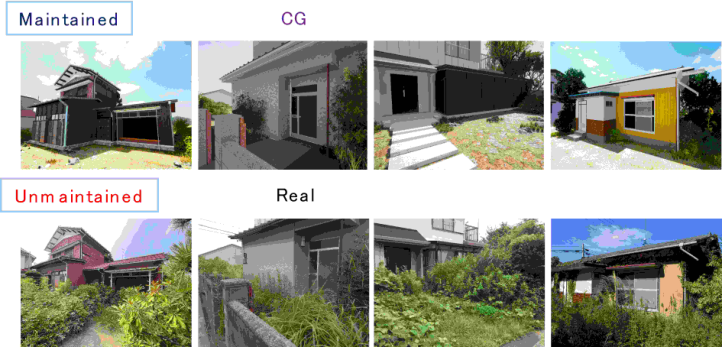
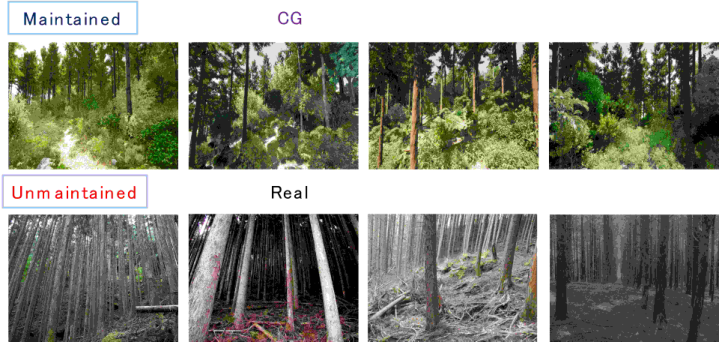
Images Used for the Experiments Two types of greenery are presented: “well-kept green “ and “unkept green.” Furthermore, the “unmaintained green” image was a live-action image, and the “well-maintained green” image was a CG image created using Sketchup and Twinmotion based on the “unmaintained green”image. This was done to ensure that factors other than greenery in the image (e.g., houses and weather) would not affect the evaluation. Examples of presented images are shown in Figures 2 and 3.
The assigned images were presented using a SHARP PN-U553 (H 1080 × W1980 display). Each subject was instructed to gaze at the screen at a distance of 2.5 meters.
266 Tanishita and Ohkura
Figure 2: Images of maintained and unmaintained detached houses.Figure 3: Images of maintained and unmaintained woods.
Biological Reaction Measurement Devices This study used two biological responses: cerebral blood flow and heart rate. Cerebral blood flow was measured using “near infrared spectroscopy” using the Hot-2000 (NeU). Heart rate was measured using the M430 (Polar Japan). Left-right cerebral blood flow and body movements were recorded in 0.1 second increments, while the heartbeats were recorded in 1 second increments.
Experiment Flow A cerebral blood flow meter was attached to the head, a heart rate monitor was attached to the arm opposite the dominant hand, and the images were presented. The experimental protocol was in four blocks, with one block having a 60-second for “rest” and 20 seconds for four “tasks,” each being
Evaluation of Unpleasant Green Environment Based on Biological Reaction 267
5 seconds long. To account for order effects, the order of “well-maintained green” and “unmaintained green” images was randomized.
CVM Questionnaires In each question for vacant houses and abandoned forests, we first described the current problem and hypothetical situation (a situation where the exami- nee is surrounded by an unmaintained green environment). Second, we asked subjects to answer questions on WTP, surrounding environment (for the vacant house question), and experience (for the abandoned forest question). Third, they were asked to answer questions on personal characteristics, such as age, gender, annual income, living arrangements, and place of residence.
Subjects In total, 60 subjects participated in the study, including 10 male and female students each, working adults, and seniors. The study protocol was formu- lated in accordance with the university’s ethical review committee. Subjects only participated in the study after they received an explanation of the exper- iment and gave their consent. Incidentally, one person (elderly, female) was absent on the day of the experiment; therefore, 59 people actually performed the measurements and analyses. The experiment was conducted between November 14 and December 14, 2022, between 10:00 and 16:00.
Methods The purpose of this study was to examine biological responses during image presentation. Therefore, data with unstable cerebral blood flow and heart rate at rest before and after image presentation were excluded. For individu- als who were stable at rest, we set the average of 30 seconds at rest to zero and arranged the fluctuations for 20 seconds after the start of the experiment. This information was aggregated for all members, and the average and stan- dard errors were calculated. We then tested the significant difference at the time when the difference between managed and unmaintained greenery was at its maximum. If a significant difference is found, further detailed analysis on differences by gender and order of presentation were performed.
Regarding the relationship with WTP, we divided the group into three groups: subjects with (Group 1) significant differences in heart rate between managed and unmaintained greenery, (Group 2) with no difference, and (Group 3) who could not be measured. We performed an analysis of variance to see if there was a significant difference in the WTP of the three groups.
RESULTS
Screening Approximately 20% of the left-right cerebral blood flow and approximately 35% of the heart rate data were excluded. In total, 196 data points for left cerebral blood flow, 191 data points for right cerebral blood flow, and 154 data points for the heart rate were used in the final analysis.
268 Tanishita and Ohkura
Biological Reaction
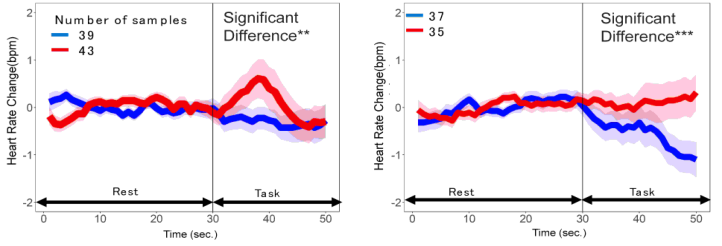
Figure 4 shows the changes in heart rate. For vacant houses, “main- tained green” showed no changes in heart rate, while “unmaintained green” increased it. Meanwhile, for woods, the heart rate declined for “maintained green,” but exhibited no change for “unmaintained green.” Finally, cerebral blood flow between the left and right sides did not significantly differ.
Figure 4: Change in heart rate for maintained (blue) and unmaintained (red) greenery.
Effect of Gender
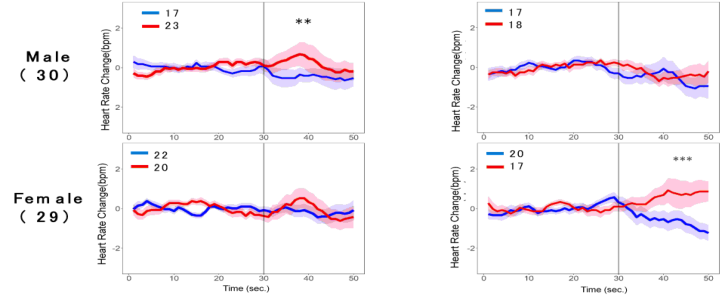
Figure 5 shows the changes in heart rate by gender. The heart rate increased with the image of “unmaintained greenery” of vacant houses for males. Meanwhile, it decreased with the image of “maintained greenery” and increased with “unmaintained greenery” of woods for females.
Figure 5: Change in heart rate for maintained (blue) and unmaintained (red) greenery by gender.
Evaluation of Unpleasant Green Environment Based on Biological Reaction 269
Order Effect
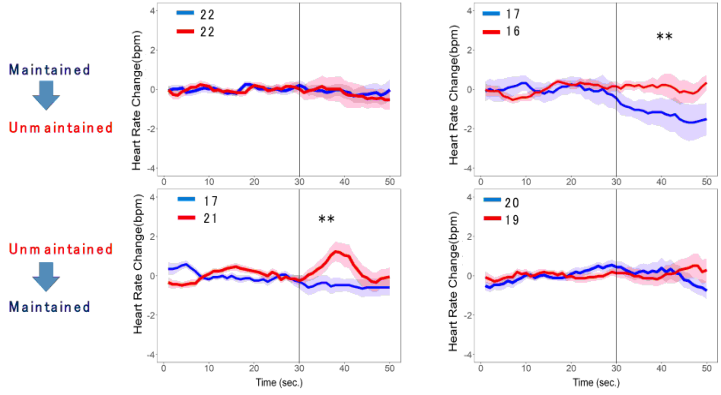
Figure 6 shows the change in heart rate by order of image presentation. In vacant houses, when “unmaintained green” was presented first and “main- tained green” was presented second, the heart rate significantly changed. Meanwhile, in woods, when “maintained green” was presented first and “unmaintained green” was presented second, the heart rate was significantly different.
Figure 6: Order effect: Change in heart rate for maintained (blue) and unmaintained (red) greenery.
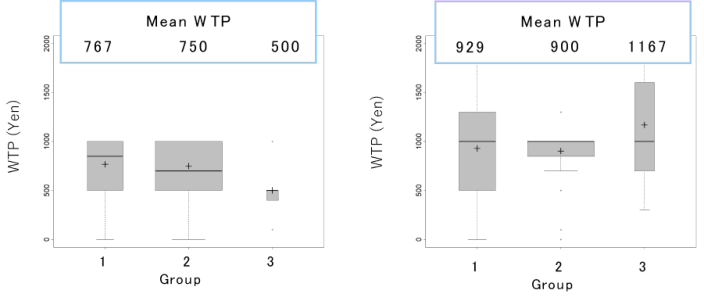
Relationship Between Biological Reaction and WTP The average WTPs for the maintenance of vacant houses and abandoned forests were 729 (standard deviation: 479 yen) and 950 yen (standard devi- ation: 438 yen), respectively. Biological responses and WTP were not related (Figure 7).
Figure 7: Boxplot of WTP.
270 Tanishita and Ohkura
DISCUSSION
In the case of abandoned houses, “unmaintained greenery” increased the heart rate. Meanwhile, in the case of woods, “maintained greenery” decreased the heart rate. This may be due to the ease of imaging: “I don’t understand the image of the greenery in the abandoned forest” and “I think that the vacant house that is being maintained is indistinguishable from an ordinary house”.
Biological responses differed by gender. Taylor (2002) reported that males were aggressive under stress, while females exhibited parenting behavior. In our study, it is possible that men felt stressed when they saw greenery in an unmaintained empty house, whereas women felt comfortable and relaxed when they saw a maintained forest.
Order effects are also observed. First, for vacant houses, heart rate variability did not differ when maintained greenery was first presented, fol- lowed by unmaintained greenery. However, when unmaintained greenery was presented first, the heart rate increased significantly. This may simply be a situation in which time had passed and there was no sense of dis- comfort. This suggests that unpleasant images may be determined by first impressions.
In the case of woods, the heart rate significantly decreased when main- tained greenery was presented first; however, the heart rate did not decrease when unmaintained greenery was presented first. This may be because in the latter case, the image of the dark woods remained in subjects’ mind and the maintained greenery did not have a good impression. Alternatively, when an image of maintained greenery was shown first, the subsequent image of an empty house with an unmaintained but large amount of greenery may have affected the original impression.
Finally, biological responses and WTP were not related. Thus, decision- making based on WTP may be determined by a mechanism different from biological reactions. However, because the sample size was small and the residential area of the sample was limited to the Kanto region, we would like to examine the validity of this as a future issue.
CONCLUSION
We used biological responses (cerebral blood flow and heart rate) and CVM to evaluate discomfort in an unmaintained green environment. We find: First, Unmaintained greenery significantly increased heart rate in vacant houses. For woods, “manicured greenery” significantly decreased heart rate, while “unmaintained greenery” had no effect. Second, these effects differed by gender and presentation order. Third, there was no relation- ship between the presence or absence of changes in biological responses and WTP.
Future work should improve the presented images. This study presented some CG images, which may have affected biological reactions. Further, heart rate variability (HRV) may also be a good indicator for detecting unpleasant- ness (Kim et al., 2018). Finally, researchers should also evaluate using stimuli other than green vision (e.g., sound and smell).
Evaluation of Unpleasant Green Environment Based on Biological Reaction 271
ACKNOWLEDGMENT
The authors acknowledge Mr. Yoshitaka Chida (Katahira & Engineers Inc.) for executing the experiments.
REFERENCES
Asano, H, Hiroshige, A. and Ide H. (2011) Evaluation of the brain activity using the functional Near-Infared spectroscopy while having stimulated by pleasant and unpleasant Music, IEEJ Transactions on Electronics, Information and Systems, 131 (1), 70–75 (in Japanese). Hosono, T., Sato, S. Wakabayashi, Y. and Matsumoto, N. (2017) Physiological and
psychological effects of trees at spaces of a highway-rest-area. Landscape Research Japan Online, 10, 31–36 (in Japanese). https://doi.org/10.5632/jilaonline.10.31 Ideno, Y., Hayashi, K., Abe, Y., Ueda, K., Iso, H., Noda, M., Lee, JS, and Suzuki, S. (2017). Blood pressure-lowering effect of Shinrin-yoku (forest bathing): a systematic review and meta-analysis. BMC Complement Altern Med., 17(1), 409. https://doi.org/10.1186/s12906-017-1912-z Jones, R., Tarter, R., and Ross, AM. (2021). Greenspace interventions, stress
and cortisol: a scoping review. Int J Environ Res Public Health. 18(6), 2802. https://doi.org/10.3390/ijerph18062802 Kim HG, Cheon EJ, Bai DS, Lee YH, and Koo BH. (2018) Stress and Heart Rate Variability: A Meta-Analysis and Review of the Literature. Psychiatry Investig. 15(3): 235–245. https://doi.org/10.30773/pi.2017.08.17 Kondo MC, Fluehr JM, McKeon T, and Branas CC. (2018). Urban green space
and its impact on human health. Int J Environ Res Public Health. 15(3), 445. https://doi.org/10.3390/ijerph15030445 Kozaki, T., Ishibashi, K., Horinouchi, K., Noguchi, J., Hashitomi, K. and Yasukouchi, A. (2007). Effects of basking in the forest on physiologi- cal responses. Japanese Journal of Biometer, 44(4), 105-110 (in Japanese). https://doi.org/10.11227/seikisho.44.105 Mori, H. and Saijo, K. (1982) The effects of phonation on heartbeat and pulse waves,
Bulletin of defectology, 6 (2), 127–132. Nagura, A. and Nakano, M. (2014). Evaluation of social value in urban green spaces.
Thesis or Dissertation, Keio University, 183. (in Japanese) Shoji, Y. (1998) Approach using contingent valuation method for management of natural parks. Journal of The Japanese Institute of Landscape Architecture, 62(5), 699–702. https://doi.org/10.5632/jila.62.699 Taylor, S. E. (2002). The tending instinct: how nurturing is essential to who are and
how we line, Henry Holt and Company, New York, 2002. Tsujimura, Y. and Toyoda, K. (2013). Physical and mental reactions to forest relaxation video - Studies on Gender Differences. Nippon Eiseigaku Zasshi (Japanese Journal of Hygiene), 68, 175–188 (in Japanese). https://doi.org/10.1265/jjh.68.175 Yanagisawa, K. and Tsunashima, H. (2015). Evaluation of pleasant and unpleas-
ant emotion with visual stimulus using NIRS. Transactions of Japanese Society for Medical and Biological Engineering, 53 (Supplement), S164_01-S164_01 (in Japanese).
LISTED IN THE AHFE DIGITAL BOOKSTORE CATALOGUE
Explore the complete digital volume
Human-Centered Design and User Experience
Read this individual research paper free through the original publisher, or explore the full digital proceedings book.
ISBN 978-1-958651-90-2
Explore this ISBN in the AHFE Bookstore ↗Listed in the July 2026 bookstore catalogue; search by ISBN to confirm current availability · Digital book purchase optional