Michiko Ohkura, Yosuke Yamasaki (2021). Evaluation of Kawaii Size by Measuring ECG. In: Advances in Affective and Pleasurable Design. AHFE Open Access, vol. 14. https://doi.org/10.54941/ahfe100550
Kawaii, which represents an affective value, includes such positive meanings as cute, lovable, and small. In the 21st century, the affective values of industrial products are becoming more important. However, since few studies have focused on kawaii attributes, we are systematically analyzing kawaii products themselves: the kawaii feelings evoked by the shapes, colors, sizes, textures and tactile sensations caused by the materials of such products. In this paper, we refocused on kawaii sizes and performed experiments using both Augmented Reality and Virtual Reality to evaluate a virtual object’s kawaii sizes by questionnaires and electrocardiograms (ECGs).
In Japan, the cute aesthetic is exploited by many organizations and for many purposes, including police mascots and warning signs for dangerous areas. Such Japanese kawaii characters as Hello Kitty and Pokemon have become popular all over the world. Although using cute to motivate and inform people might seem strange, Cheok et al. argued that Japanese kawaii does offer potential because it embodies a special kind of cute design, which reduces fear and makes dreary information more acceptable and appealing (Cheok et al., 2008). However, since few studies have focused on kawaii attributes, we are systematically analyzing the kawaii interfaces themselves: kawaii feelings caused by such attributes as shapes, colors, and materials. Our aim is to clarify a method for constructing a kawaii interface from our research results. Since kawaii might be an important kansei value for future interactive systems and the industrial products of Asian industries, we experimentally obtained interesting tendencies about such kawaii attributes as shapes (Ohkura, Konuma, Murai, and Aoto, 2008), colors (Komatsu and Ohkura, 2011), and sizes (Ohkura, Goto, Higo and Aoto, 2010).
Although questionnaires are the most common method of affective evaluation, they suffer from the following demerits:
- linguistic ambiguity; - possibility of confusing the experimenter and/or participant intentions in the results; - interruption in the system’s input/output stream of information.
Thus, to compensate for these questionnaire shortcomings, we examined biological signals because they offer the following merits:
- can be measured as physical quantities; - resistant to the influence of experimenter and participant intentions; - can be measured continuously without interruption.
Some studies have focused on emotions using biological signals. However, most dealt with mental stress or simulator sickness, which are considered negative sensations (e.g., Ishii et al. 2008, Collet, Averty, and Dittmara 2009, Webb et al., 2010). Some studies on nonnegative sensations addressed relaxation or comfort (e.g., Poessel, Ahrens, and Hautzinger, 2005, Kawashima, 2006, Orini et al., 2010), which are more static than such dynamic feelings as excitement. Thus, since scant previous research exists on dynamic and positive feelings such as excitement, we experimentally evaluated such affective feelings using biological signals (Ohkura et al., 2009, Aoto and Ohkura, 2007, Ohkura et al., 2010, Ohkura, 2010) and utilized them to evaluate kawaii feelings (Ohkura, Goto, Higo and Aoto, 2010).
In this study, we refocused on kawaii sizes to obtain new knowledge using Augmented Reality. In our experiment, we compared the virtual and real environment results of virtual objects employing questionnaires and ECGs.
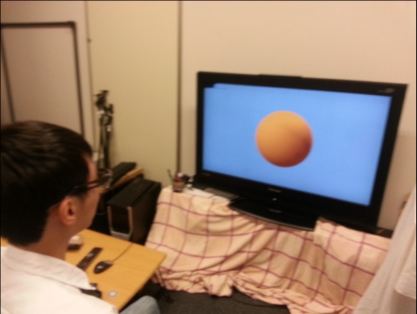
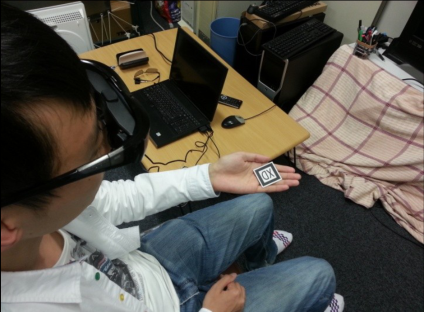
EXPERIMENTAL METHOD In our experimental setup, we employed a 42-inch LCD 3D monitor (Hyundai Corp.) and polarized glasses to stereoscopically show virtual objects in a virtual environment (VR) (Figure 1). The distance between the monitor and each participant was 1.0 m. In a real environment, we employed 3D see-through glasses (Wrap920AR, Vizix Corporation) to stereoscopically show the virtual objects (AR) (Figure 2). We set the marker for the AR display in each participant’s left hand. The distance between the participants and their hands was 0.5 m.
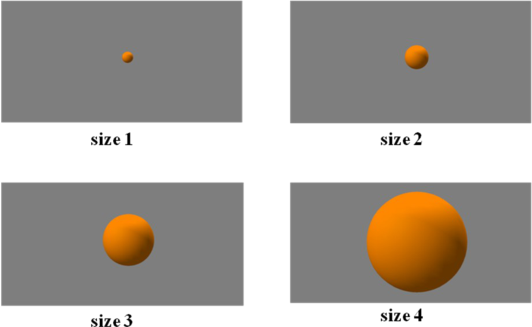
Participants watched an object in VR or AR and evaluated its kawaii score. Each object’s shape was set as a cube and its color as red-yellow (orange) based on the results of our previous experiments (Ohkura, Konuma, Murai, and Aoto, 2008) (Komatsu and Ohkura, 2011). Each object’s size, which implies a particular visual angle, was set to one of four (Table 1) both in VR and AR again based on our previous work (Ohkura, Goto, Higo and Aoto, 2010). Figures 3 and 4 display virtual objects in VR and AR. We randomly showed these four objects to our participants, who evaluated the kawaii scores for each on a seven-point Likert scale: -3: extremely not kawaii, 0: neutral, +3: extremely kawaii.
We measured the ECGs both before and while observing the objects using RF-ECG (Wireless Vital Sign Sensor from Micro Medical Device, Inc.) (Micro Medical Device, Inc., 2014). ECGs must be measured before observing them to normalize the heart rate averages while observing them for each participant.
Monitor
Participant
Figure 1. VR setup
Marker
Participant
Figure 2. AR setupTable 1: Visual angles of virtual objects both in VR and AR Number 1 2 3 4Figure 3. Displays of virtual objects in VRFigure 4. Displays of virtual objects in AR
EXPERIMENTAL RESULTS AND DISCUSSION Our experiments were performed with eight female and eight male student volunteers in their twenties.
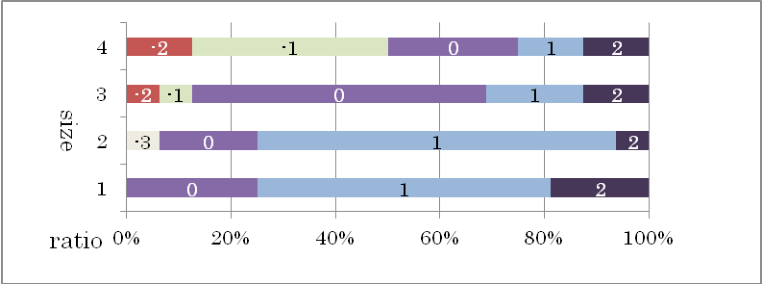
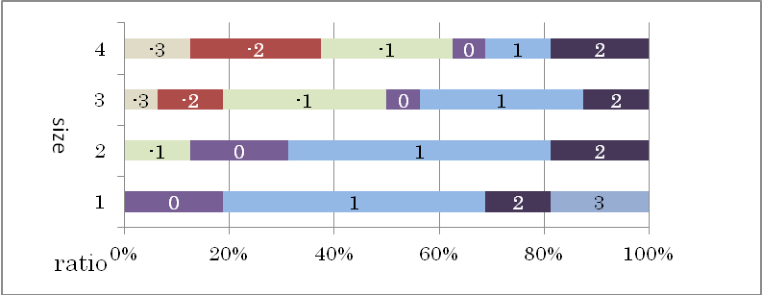
Figure 5 exhibits the questionnaire results, where the horizontal axis shows the ratios of the kawaii scores and the vertical axis shows each object’s size in VR. The averaged scores for the kawaii scores show that smaller objects tend to be perceived as more kawaii in VR, which is the same result as in a previous experiment (Ohkura, Goto, Higo and Aoto, 2010). The results of a two-factor analysis of variance for VR show that the main effect of size is significant at the 1% level, but not the main effect of gender.
Figure 6 shows the questionnaire results for AR. The averaged scores for the kawaii scores in AR show the same results as in VR. The results of a two-factor analysis of variance for AR show that the main effect of size is significant at the 1% level, but not the main effect of gender.
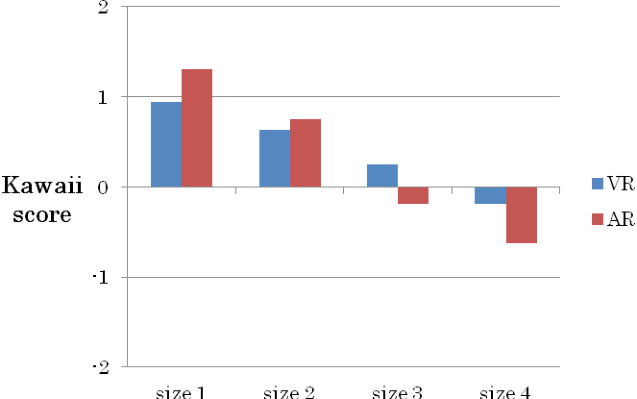
Figure 7 compares the averaged kawaii scores for each size between VR and AR, where the vertical axis shows the averaged kawaii scores. The correlation coefficients between object sizes and kawaii scores are higher in AR than VR, implying that the AR result is stronger than the VR result.
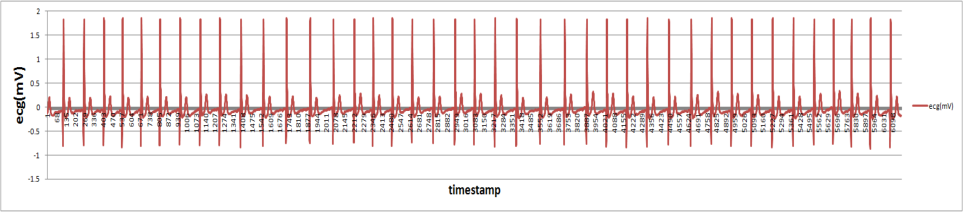
Figure 8 shows an example of a recorded ECG in our experiment. The R-R interval is defined as the time interval between the two R waves of the ECG. In this experiment, we computed the R-R interval from an ECG measured at a sampling rate of 100 Hz. The heart rate (HR), which is defined as the number of heart beats per minute, was computed as the inverse of the R-R interval. HR was normalized to cancel the individual differences by subtracting the averaged values before watching for each participant.
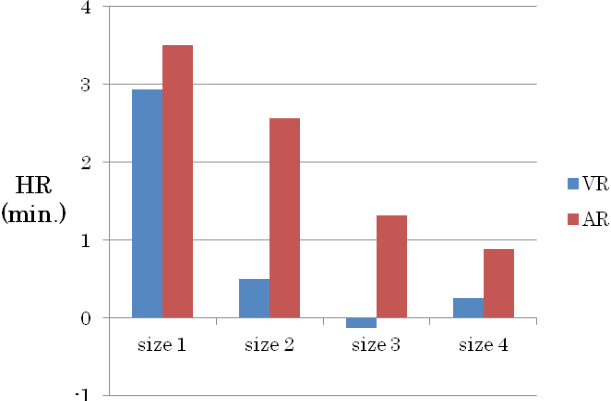
In addition, we divided the normalized HR data into the following two groups: the kawaii group with kawaii scores above 0 and the non-kawaii group whose scores were below 0. The data with 0 scores were omitted from our analysis. From the unpaired t-test results of the differences between the mean values of the two groups, the normalized HR showed a significant difference at the 1% level in AR, but no difference in VR; the heart rates of the kawaii group were significantly faster than those of the non-kawaii group in AR, suggesting that looking at a kawaii object is more exciting than looking at a non-kawaii object. This result resembles our previous research related to biological signals (Ohkura et al., 2010, Ohkura, 2010).
Figure 5. Questionnaire results for VRFigure 6. Questionnaire results for ARFigure 7. Comparison between VR and AR of averaged questionnaire scoresFigure 8. Example of ECGFigure 9. Comparison between VR and AR of normalized HR averages
CONCLUSIONS
We experimentally clarified the relation between kawaii sizes and ECGs both in VR and AR. Our results suggest that smaller objects are more kawaii in both environments. In addition, the kawaii scores and heart rates for each object’s size are more strongly related in AR than that in VR.
We have already performed another experiment to determine the optimum size of kawaii objects and concluded that there a limit size exists for objects, even if the smaller object is more kawaii in general (Ohkura and Yamasaki, 2014).
REFERENCES
Aoto, T. and Ohkura, M. (2007) “Study on Usage of Biological Signal to Evaluate Kansei of a System”, in: Proceedings of the 1st International Conference on Kansei Engineering and Emotion Research (KEER2007), Sapporo, Japan, L-9. Cheok A. et al., (2008). “Designing Cute Interactive Media” Innovation, Volume 8 No.3, pp. 8-9. Collet, C., Averty, P., Dittmara, A. (2009), “Automatic nervous system and subjective ratings of strain in air-traffic control”,
Applied Ergonomics, Volume 40 No.1, pp. 23-32. Ishii, Y., Ogata, H., Takano, H., Ohnishi, H., Mukai, T., Yagi, T. (2008), “Study on mental stress using near-infrared spectroscopy, electroencephalography, and peripheral arterial tonometry”, in: Proceedings of the 30th Annual International Conference of the IEEE on Engineering in Medicine and Biology Society (EMBS 2008), Vancouver, BC, pp. 4992-4995. Kawashima, T. (2006), “Development of Active Rocking Chair with Changing Swing According to Heartbeat Fluctuation”,
JSME International Journal Series C, Volume 49 No. 3, pp. 814-820. Komatsu, T., Ohkura, M. (2011), “Study on Evaluation of Kawaii Colors Using Visual Analog Scale”, In: Human Interface, Part I, HCII 2011, M. J. Smith and G. Salvendy (Eds.), pp. 103-108. Berlin Heidelberg: Springer-Verlag. Micro Medical Device, Inc. (2014) http://www.mmdevice.co.jp/english/goods_01.html Ohkura, M. (2010) “Measurement of Wakuwaku Feeling of Interactive Systems Using Biological Signals”, Chap.18, in:
Emotional Engineering, Fukuda, Shuichi (Ed.). pp. 327-343 Ohkura, M. et al. (2009) “Evaluation of Comfortable Spaces for Women using Virtual Environment -Objective Evaluation by Biological Signals-”, Kansei Engineering International, Volume 8 No. 1, pp. 67-72. Ohkura, M. et al. (2010) “Measurement of “wakuwaku” feeling generated by interactive systems using biological signals”, in:
Proceedings of the Kansei Engineering and Emotion Research International Conference 2010 (KEER2010), pp. 2293-2301, Paris, France. Ohkura, M., Goto, S., Higo, A. and Aoto, T. (2010), “Relation between Kawaii Feeling and Biological Signals”, in: Proceedings of the 3rd International Conference of Applied Human Factors and Ergonomics 2010, Miami, USA. Ohkura, M., Konuma, A., Murai, S. and Aoto, T. (2008), “Systematic Study for “Kawaii” Products (The Second Report):
Comparison of “Kawaii” Colors and Shapes”, in: Proceedings of SICE Annual Conference 2008, pp. 481-484. Chofu,
Tokyo: The University of Electro-Communications. Ohkura, M. and Yamasaki, Y. (2014) “Evaluation of kawaii size using augmented reality”, in: Proceedings of the international confenrence on kansei engineering and emotion research, to appear Orini, M. et al. (2010) “A method for continuously assessing the autonomic response to music-induced emotions through HRV
analysis”, Medical & biological engineering & computing, Volume 48 No. 5, pp. 423-433. Poessel, P., Ahrens, S., and Hautzinger, M. (2005), “Influence of cosmetics on emotional, autonomous, endocrinological, and immune reactions”, International Journal of Cosmetic Science, Volume 27 No. 6, pp. 343-349. Webb, H. E., et al. (2010), “Cardiorespiratory responses of firefighters to a computerized fire strategies and tactics drill during
physical activity”, Applied Ergonomics, Volume 41 No.3, pp. 376-381.
LISTED IN THE AHFE DIGITAL BOOKSTORE CATALOGUE
Explore the complete digital volume
Advances in Affective and Pleasurable Design
Read this individual research paper free through the original publisher, or explore the full digital proceedings book.
ISBN 978-1-4951-2109-8
Explore this ISBN in the AHFE Bookstore ↗Listed in the July 2026 bookstore catalogue; search by ISBN to confirm current availability · Digital book purchase optional