“Kawaii” is a Japanese word that represents an emotional value; it has positive meanings, such as cute, lovable, and small. In the 21st century, the emotional value accounts for a large part of consumers’ preference. The kawaii feeling might become a key factor for creating affective and pleasurable designs. In a behavior of watching photos, we have subjective, intuitive and strong preference based on our emotional values. In this study, as a study on the kawaii feeling, we conducted experiments to examine whether physiological responses of the brain can be measured when participants get the kawaii feeing in watching photos by the event-related potential (ERP) technique. We measured electroencephalogram of the participants while they were shown kawaii photos, uninteresting photos, and mosaic images. We found that event-related potentials were elicited in response to showing the kawaii photos and the uninteresting photos, while the mosaic photos did not elicit a particular response. ERPs elicited by the kawaii photos had the positive deflection in comparison with ones evoked by the uninteresting photos after about 300-400 msec from onsets of presenting the photos. We concluded that the physiological responses of the brain can be measured when participants get kawaii feeing in watching photos.
“Kawaii” is a Japanese word that represents an emotional value; it has positive meanings, such as cute, lovable, and small. In the 21st century, the emotional value accounts for a large part of consumers’ preference. The kawaii feeling might become a key factor for creating affective and pleasurable designs. Thus, investigation on the kawaii feeling is important.
In previous studies on the kawaii feeling, systematic analyses on kawaii objects and kawaii interfaces revealed that the kawaii feeling is caused by attributes such as shapes, colors, materials, and combinations of the attributes (Ohkura and Aoto, 2010). The studies further revealed that physiological responses such as changes in heart beat or changes in electroencephalogram (EEG) were evoked by the kawaii feeling (Ohkura, Goto, Higo, and Aoto, 2011).
In our daily life, we get the kawaii feeling when we find kawaii objects or the kawaii attributes in common scenery. Especially in a behavior of watching photos, we have subjective, intuitive and strong preference based on our emotional values. Thus, as a progress of the studies on the kawaii feeling, it is valuable to investigate the kawaii feeling occurred in watching photos. We have reported that physiological changes in heart beat were evoked by the kawaii feeling (Yanagi, Yamasaki, Yamariku, Takashina, Hirayama, Horie, and Ohokura, 2013).
In this study, we conducted experiments to examine whether physiological responses of the brain can be measured when participants get the kawaii feeing in watching photos. As the physiological responses, we measured event- related potentials (ERPs) which directly reflects the response of the brain.
MATERIALS AND METHOD Visual Stimuli Subjectively Selected by Participants
Two volunteers of twenties participated in the experiments. The participants subjectively selected five photos with which they had kawaii feeling (kawaii photos). They also selected five photos with which they did not had the feeling (uninteresting photos). The photos were collected from the internet. Photos of animals, faces of humans, cartoon characters or objects were typically selected for the kawaii photos. Photos of tools, furniture, buildings, or scenery were typically selected for the uninteresting photos. The photos were converted to monochrome images and edited to fit within the 720 (W) x 540 (H) pixel frame. Mosaic images composed of 24(W) x 18(H) blocks were generated by shuffling segments of the five kawaii photos and ones of the five uninteresting photos.
Presenting the Visual Stimuli in the Oddball Paradigm We measured EEG of the participants while they were shown the kawaii photos, the uninteresting photos, and the mosaic images. The participants were comfortably seated. The visual stimuli were presented on a screen of a laptop computer (the 1366 (W) x 768 (H) pixel frame in a 15.6 inches screen) situated in front of the subjects. The three types of visual stimuli were presented in random order as the oddball paradigm, in which the kawaii photos and the uninteresting photos appeared infrequently as deviant stimuli while the mosaic images appeared frequently as standard stimuli. In the sequence of the visual stimuli, each of the five kawaii photos and the five uninteresting photos appeared twice, and the 343 mosaic images appeared. Each of the visual stimuli, embedded in the center of a black background, was presented for one second. A red cross was superimposed in the center of the screen to restrict eye movements across the screen. The participants watched the sequence of the visual stimuli passively. The top-left corner of the visual stimuli flickered for each visual stimulus to provide trigger signals for onsets of presenting the visual stimuli. The onsets were detected by a light detector sensor and used for alignment of ERPs.
EEG Recordings and ERP Derivation Electrodes were attached on the participants’ scalps at the sites of Fz, Cz, Pz, and C4 of the international 10-20 system. Vertical and horizontal electrooculograms (EOGs) were recorded from electrodes below the left eye (VE) and outer canthus of the right eye (HE). All electrodes were referenced to a right mastoid. Impedance at each electrode site was less than 5k ohms. The EEG was amplified by a DC amplifier (Melon Technos Co. Ltd., 8ch amplifier) with a 0.16-100Hz band pass filter and a 50Hz notch filter, and sampled continuously at 1000Hz in 16 bits by a data recorder (NF Corporation, EZ7510).
The EEG signals were divided into epochs beginning at 200 msec before the onset of presenting the visual stimuli and ending at 1000 msec after the onset. Trials with artifacts were eliminated by visual inspection of the EOG and EEG recordings. For each type of visual stimuli, the epochs of EEG signals were aligned from the onset with 200 msec pre-onset baselines and averaged to detect ERP waveforms. The ERP waveforms were smoothed for plotting.
RESULTS
We found that ERPs were elicited in response to showing the kawaii photos and the uninteresting photos, while the mosaic images did not elicit a particular response. The ERPs elicited by the kawaii photos and ones elicited by the uninteresting photos had different waveforms. The waveforms of the ERPs were varied across the participants. It is a common tendency across the participants and notable that the difference between the ERPs elicited by the kawaii photos and ones evoked by the uninteresting was found after about 400 msec from the onsets of presenting the photos. We show results of the two participants in Figures 1-12. Note that the results of the two subjects were typical across results of preliminary experiments, which were conducted with another two participants.
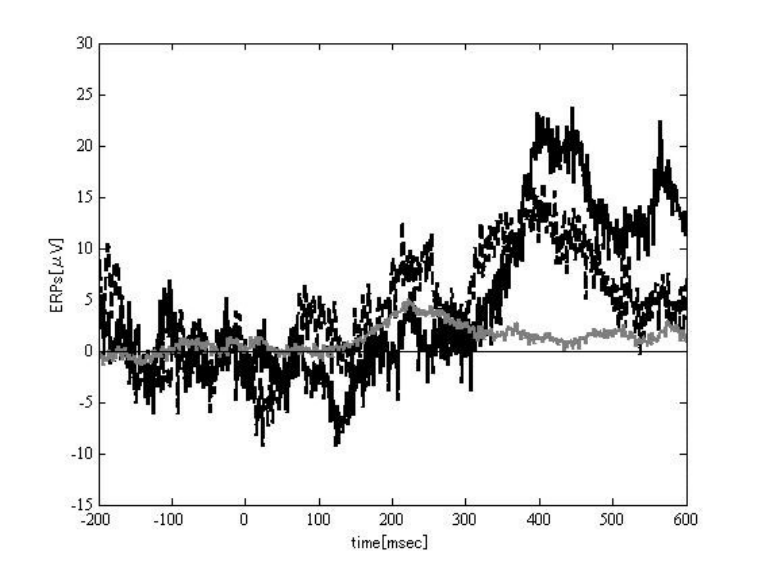
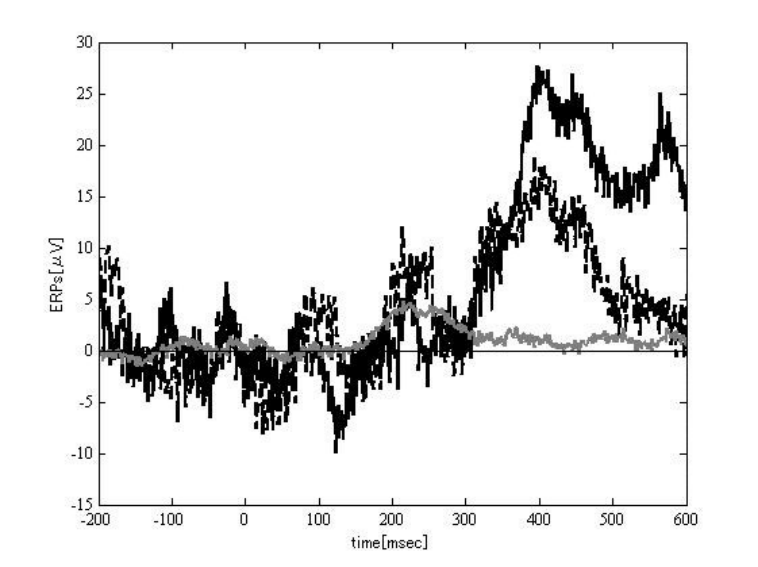
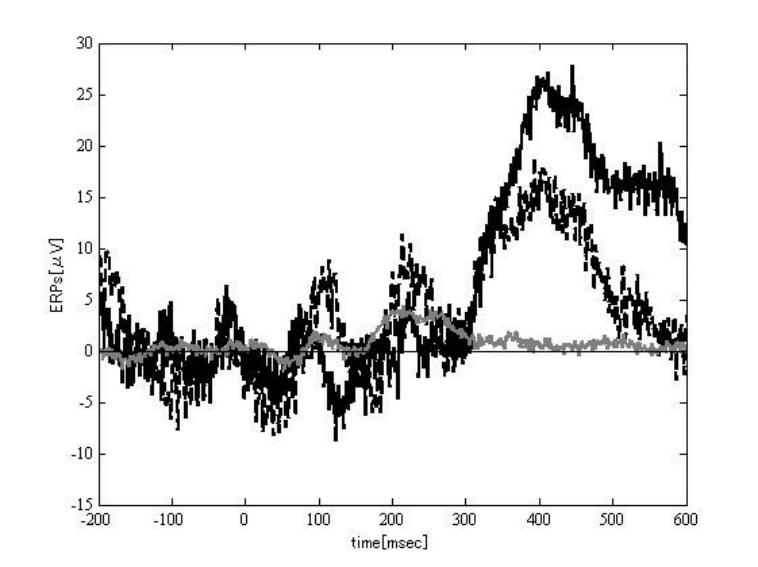
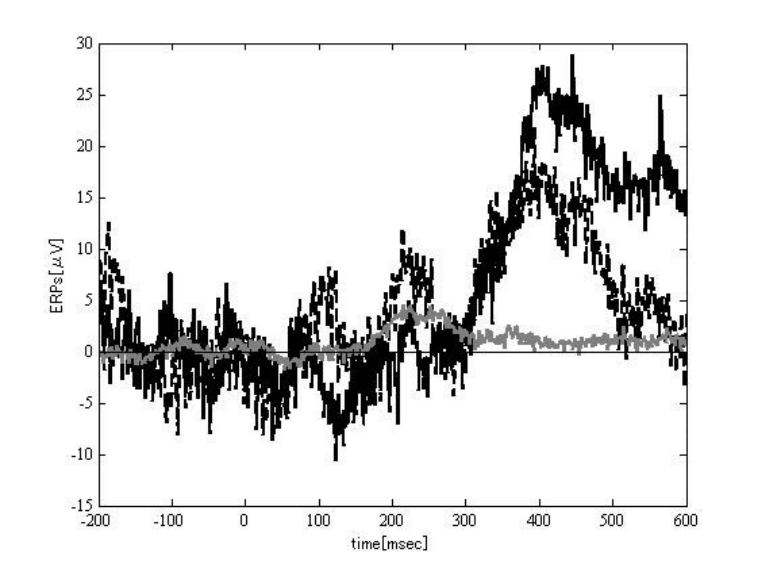
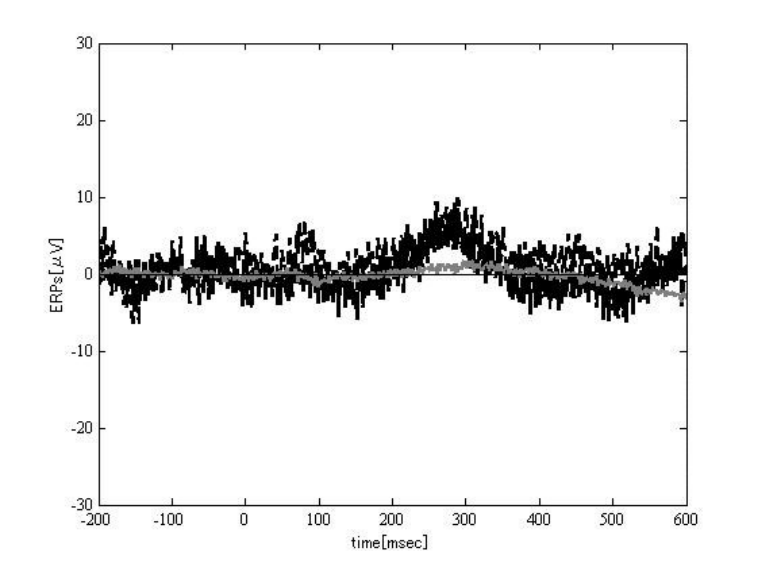
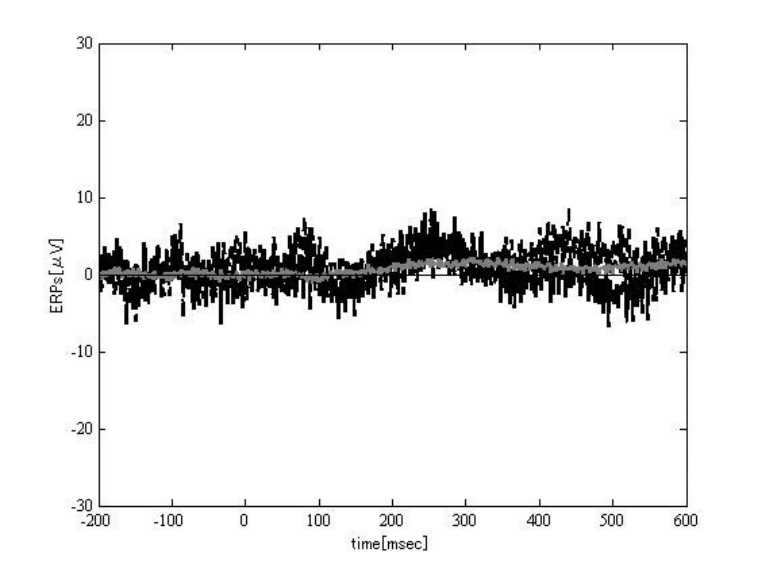
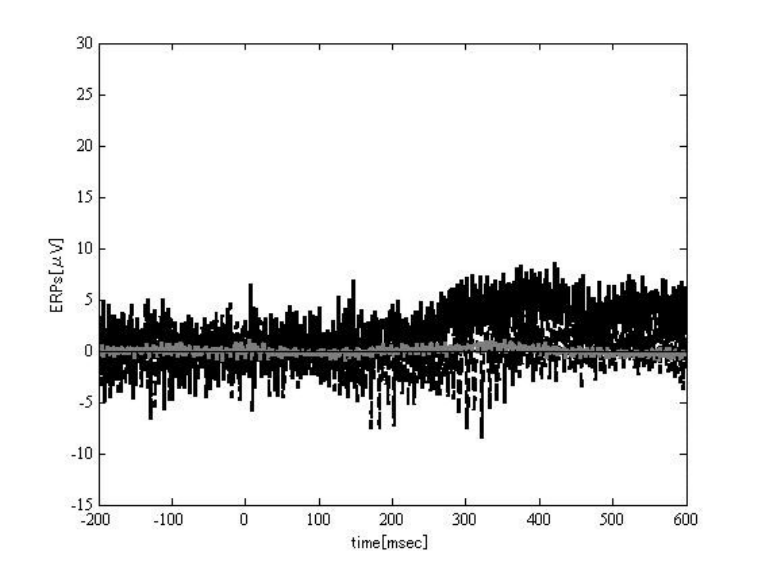
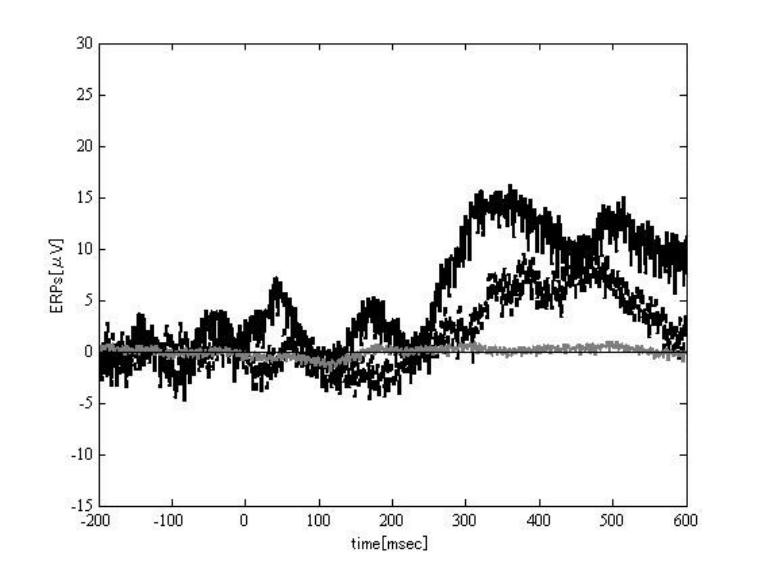
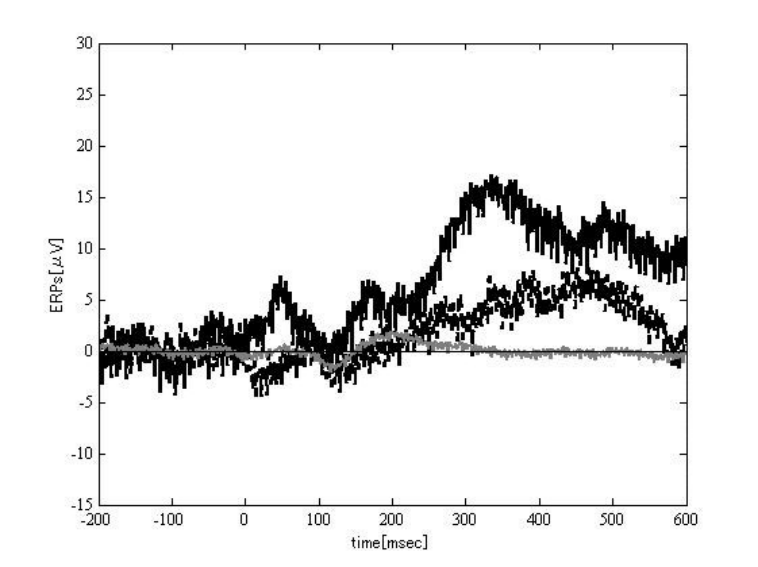
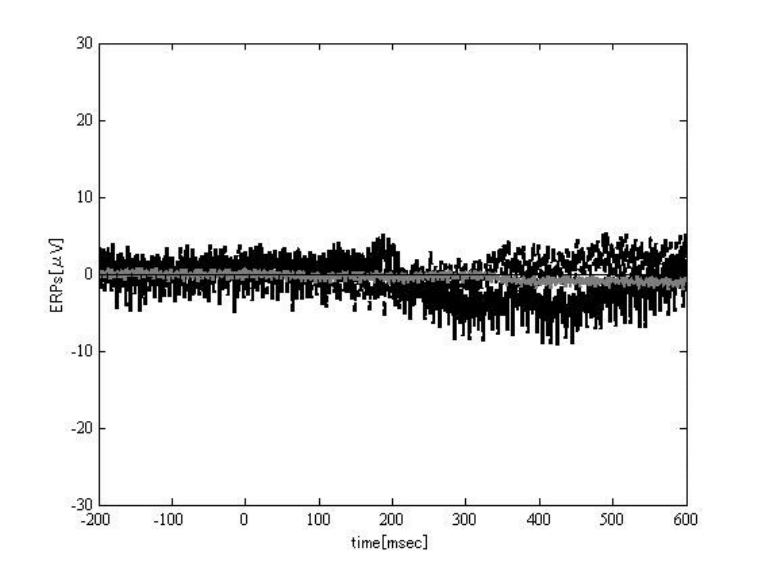
Participant A Results of a participant (participant A) are shown in Figures 1-6. After the artifact rejection, numbers of remaining epochs of the kawaii photos, ones of the uninteresting photos, and ones of the mosaic images were 9, 8, and 235 respectively at all of the electrodes. Figures 5 and 6 show trials with eye artifacts were successfully eliminated. Figures 1-4 compares the ERP waveforms from the three conditions, the condition of the kawaii photos (kawaii condition), one of the uninteresting photos (uninteresting condition), and one of the mosaic images (mosaic condition) at each electrode site. X-axis and Y-axis represent time [msec] and amplitude of ERPs [μV] respectively. 0 msec on the x-axis represents the onset of presenting the visual stimuli.
Differences between the kawaii condition and the mosaic condition are characterized by a positive component. In the response, a peak of positive deflection appeared at about 400 msec after the onset in the kawaii condition. The positive deflection in the kawaii condition decayed slowly. Differences between the uninteresting condition and the mosaic condition are also characterized by a positive component. The amplitude of the positive component appeared in the uninteresting condition was smaller than one in the kawaii condition, and decayed immediately. Consequently, differences between the kawaii condition and the uninteresting condition are characterized by a positive deflection in the kawaii condition in comparison with the uninteresting condition. The differences appeared after about 400 msec from the onset. The results were commonly appeared at all of the electrode sites.
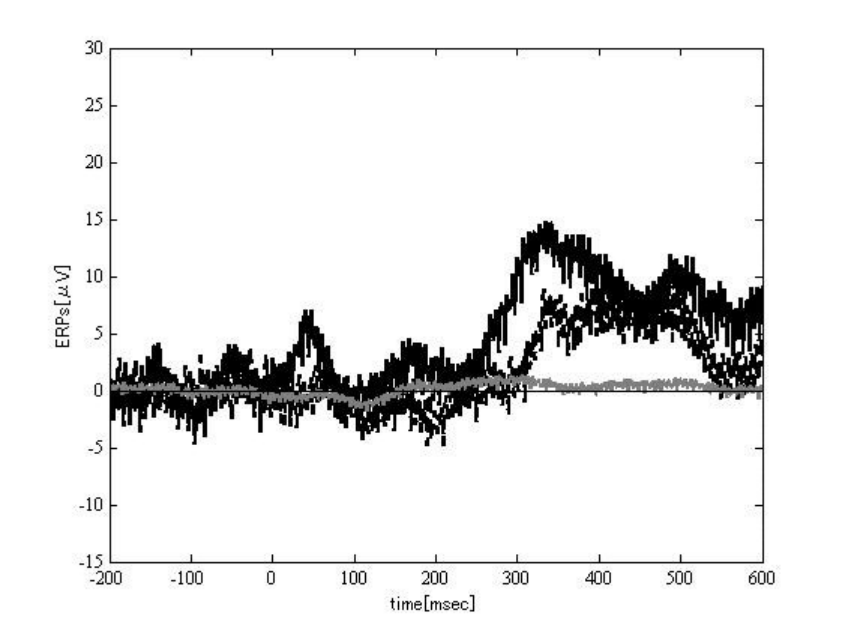
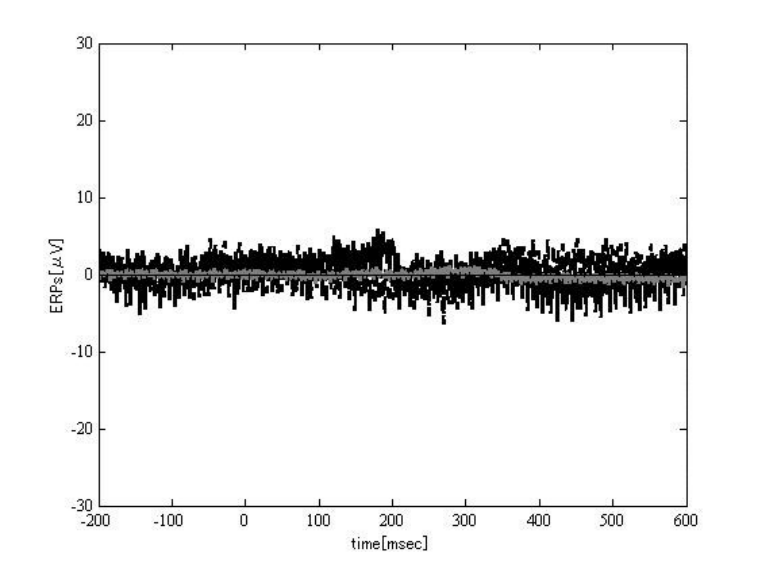
Participant B Results of a participant (participant B) are shown in Figures 7-12. After the artifact rejection, numbers of remaining epochs of the kawaii photos, ones of the uninteresting photos, and ones of the mosaic images were 8, 10, and 274 respectively at all of the electrodes. Figures 11 and 12 show trials with eye artifacts were successfully eliminated. Figures 7-10 compares the ERP waveforms from the three conditions at each electrode site. Axes in Figures 7-12 are same with ones of Figures 1-6.
Differences between the kawaii condition and the mosaic condition are characterized by a positive component. In the response, a peak of positive deflection appeared at 300-400 msec after the onset in the kawaii condition. The positive deflection in the kawaii condition decayed slowly. Differences between the uninteresting condition and the mosaic condition are also characterized by a positive component. The amplitude of the positive component appeared in the uninteresting condition was smaller than one in the kawaii condition, appeared later than the positive component in the kawaii condition, and decayed immediately. Consequently, differences between the kawaii condition and the uninteresting condition are characterized by a positive deflection in the kawaii condition in comparison with the uninteresting condition. The differences appeared after about 300 msec from the onset. The results were commonly appeared at all of the electrodes.
DISCUSSION
It was revealed that both the kawaii photos and the uninteresting photos elicited the positive component in the two participants. We suspect that the positive component may reflect attention to appearing the photos. The mosaic images had no information of original images. Thus, infrequent appearance of both the kawaii photos and the uninteresting photos might elicit a brain response to pay attention to the photos. It has been well studied that paying attention caused P300 responses (Dujardin, Derambure, Bourriez, Jacquesson, and Guieu, 1993). Thus, we assume the positive component observed in this study to be a type of the well-known P300 responses, although these latencies were slightly later than P300.
It was revealed that the differences in the brain response between the kawaii condition and the uninteresting condition appeared after about 300-400 msec from the onsets of presenting the photos. Though timings of appearing the differences were varied across the participants, the positive deflection in the kawaii condition in comparison with the uninteresting condition was common across the participants. We suspect that the differences in ERPs after about
300-400 msec from the onset may reflect differences in emotional responses between the kawaii condition and the
Figure 1. ERPs elicited by the kawaii photos (a black solid line), the uninteresting photos (a black dashed line), and the mosaic images (a gray solid line) at the electrode site of Fz in the participant A.Figure 2. ERPs elicited by the kawaii photos (a black solid line), the uninteresting photos (a black dashed line), and the mosaic images (a gray solid line) at the electrode site of Cz in the participant A.Figure 3. ERPs elicited by the kawaii photos (a black solid line), the uninteresting photos (a black dashed line), and the mosaic images (a gray solid line) at the electrode site of Pz in the participant A.Figure 4. ERPs elicited by the kawaii photos (a black solid line), the uninteresting photos (a black dashed line), and the mosaic images (a gray solid line) at the electrode site of C4 in the participant A.Figure 5. EOGs elicited by the kawaii photos (a black solid line), the uninteresting photos (a black dashed line), and the mosaic images (a gray solid line) at the electrode site of HE in the participant A.Figure 6. EOGs elicited by the kawaii photos (a black solid line), the uninteresting photos (a black dashed line), and the mosaic images (a gray solid line) at the electrode site of VE in the participant A.Figure 7. ERPs elicited by the kawaii photos (a black solid line), the uninteresting photos (a black dashed line), and the mosaic images (a gray solid line) at the electrode site of Fz in the participant B.Figure 8. ERPs elicited by the kawaii photos (a black solid line), the uninteresting photos (a black dashed line), and the mosaic images (a gray solid line) at the electrode site of Cz in the participant B.Figure 9. ERPs elicited by the kawaii photos (a black solid line), the uninteresting photos (a black dashed line), and the mosaic images (a gray solid line) at the electrode site of Pz in the participant B.Figure 10. ERPs elicited by the kawaii photos (a black solid line), the uninteresting photos (a black dashed line), and the mosaic images (a gray solid line) at the electrode site of C4 in the participant B.Figure 11. EOGs elicited by the kawaii photos (a black solid line), the uninteresting photos (a black dashed line), and the mosaic images (a gray solid line) at the electrode site of HE in the participant B.Figure 12. EOGs elicited by the kawaii photos (a black solid line), the uninteresting photos (a black dashed line), and the mosaic images (a gray solid line) at the electrode site of VE in the participant B.
uninteresting condition. Long lasting potentials, especially in positivity, appearing when participants attend to emotional pictures has been well studied in emotional research (Olofssona, Nordina, Sequeirab, and Polichc, 2008; Simola, Torniainen, Moisala, Kivikangas, and Krause, 2013). Our results showed variability in timings of appearing the positive deflection. Variety in how individuals evaluate the kawaii feeling has been reported (Ohkura, Komatsu, Tivatansakul, Settapat, and Charoenpit, 2012). Thus, we suspect that the variability in timings of appearing the positive deflection may be caused by the individual differences in the kawaii feeling to the kawaii photos. In general, a brain response occurred after about 300-400 msec from an onset of a stimulus represents higher cognitive processes for the stimulus rather than early perceptual processes for the stimulus. In sum, our results suggested that the higher cognitive functions might be involved in the emotional responses of the kawaii feeling in the brain when we watching photos, and the involved cognitive functions might vary across individuals.
CONCLUSIONS
In this study, we conducted experiments to examine whether physiological responses of the brain can be measured when participants get the kawaii feeing in watching photos by using the ERP technique. We found that ERPs were elicited in response to showing the kawaii photos and the uninteresting photos, while the mosaic photos did not elicit a particular response. It is a common tendency across the participants and notable that the difference between the ERPs elicited by the kawaii photos and ones evoked by the uninteresting was found as the positive deflection in the kawaii condition in comparison with the uninteresting condition after about 300-400ms from onsets of presenting the photos. We discussed that the observed ERP waveforms were characterized by the positive component, which may reflect paying attention to the photos, and the positive deflection appearing after about 300-400 msec from the onsets of showing the photos, which may reflect emotional responses of the kawaii feeling. In sum, we concluded that the physiological responses of the brain can be measured in ERPs when participants get kawaii feeing in watching photos. Statistical evaluation of ERPs is required in our future work. Our results further suggested that we might be able to identify when we get kawaii feeling in watching photos, based on the physiological responses. The identification of getting kawaii feeling can be applied for the implementation of emotion driven digital camera (Takashina, Yanagi, Yamariku, Hirayama, Horie, and Ohokura, 2014).
REFERENCES
Dujardin, K., Derambure, P., Bourriez, J. L., Jacquesson, J. M., Guieu, J.D. (1993), “P300 component of the event-related potentials (ERP) during an attention task: effects of age, stimulus modality and event probability”, Int. J. Psychophysiol., Volume 14, No. 3, pp. 255-67 Ohkura, M., Aoto, T. (2010), “Systematic study of kawaii products: relation between kawaii feelings and attributes of industrial
products”, Proc. IDETC/CIE 2010, pp. 587-594 (DETC2010-2818) Ohkura, M., Goto, S., Higo, A., Aoto, T. (2011), “Relation between kawaii feeling and biological signals”, Transactions of Japan Society of Kansei Engineering, Volume 10, No. 2, pp.109-114 Ohkura, M., Komatsu, T., Tivatansakul, S., Settapat, S., Charoenpit S. (2012), “Comparison of evaluation of kawaii ribbons
between gender and generation”, in: Advances in Affective and Pleasurable Design, Yong Gu Ji (Ed.). pp. 59-68 Olofssona, J. K., Nordina, S., Sequeirab, H., Polichc, J. (2008), "Affective picture processing: An integrative review of ERP findings", Volume 77, Issue 3, pp. 247–265 Simola, J., Torniainen, J., Moisala, M., Kivikangas, M., Krause, C.M. (2013), "Eye movement related brain responses to
emotional scenes during free viewing", Front. Syst. Neurosci., Volume 7, Article 41, pp.1-16 Takashina, T., Yanagi, M., Yamariku, Y., Hirayama, Y., Horie, R., Ohokura, M. (2014), “Toward practical implementation of emotion driven digital camera using EEG”, Proc. Augmented Human 2014, to be published. Yanagi, M., Yamasaki, Y., Yamariku, Y., Takashina, T., Hirayama, Y., Horie, R., Ohokura, M. (2013), “Relation between kawaii
feeling in watching photos and heart beat”, 15th Annual Conference of Japan Society of Kansei Engineering, proceedings, B12, in Japanese
LISTED IN THE AHFE DIGITAL BOOKSTORE CATALOGUE
Explore the complete digital volume
Advances in Affective and Pleasurable Design
Read this individual research paper free through the original publisher, or explore the full digital proceedings book.
ISBN 978-1-4951-2109-8
Explore this ISBN in the AHFE Bookstore ↗Listed in the July 2026 bookstore catalogue; search by ISBN to confirm current availability · Digital book purchase optional