Yasushi Kyutoku, Mitsuru Yamashina, Masayoshi Tanishita, Hidetsugu Nanba, Satoshi Fukuda, Hiroko Shoji (2023). Depth of information processing rather than its content affects proactive behavioral intentions towards risk. In: Kansei Engineering. AHFE Open Access, vol. 101, pp. 42–51. https://doi.org/10.54941/ahfe1002990
Increasing incidences of climate-change-related extreme weather is known to cause risk perception and anxiety. When these psychological reactions lead to proactive behaviors such as an intention to purchase a disaster insurance policy, the psychological reactions are regarded as adaptive. According to the deficit model, information contents should strongly affect psychological reactions and proactive behaviors. However, the causal model postulates that the processing depth of information should affect psychological reactions and proactive behaviors. These models led to an examination of the deficit model in Study 1 and of the causal model in Study 2. In Study 1, 505 participants, who did not have disaster insurance at the time of the study, were randomly assigned to either the informative or less informative condition. Then, they responded to an online questionnaire which included items for demographics, risk perceptions regarding climate-change-related disasters, efficacy in dealing with climate-change-related disasters, anxiety about climate-related disasters, absence of worry about a climate-related disasters, and intention to buy disaster insurance. The results revealed no significant difference between the informative and less informative conditions, implying that the deficit model was not supported. In Study 2, 445 participants, who did not have disaster insurance at the time, were randomly assigned to shallower or deeper processing conditions, and all participants responded to the same questionnaires used in Study 1. The results indicated that risk perception and insurance purchase intentions were higher in the deeper processing condition, implying that the deficit model is partially supported. Taken together, manipulating the manner in which information is processed can be an effective way to promote proactive behavior.
We have been experiencing increasing incidences of extreme weather associ- ated with climate change (Howe et al., 2013). For instance, the number of floods around the world each year has been skyrocketing since the 1990s
Depth of Information Processing Rather Than Its Content 43
(The OFDA/CRED International Disaster Database). Our perceptual expe- riences of extreme weather lead to psychological reactions such as risk perception, worry, and climate anxiety (Van der Linden, 2014; Damasio, 1994). When these psychological reactions lead to proactive behaviors such as intention to purchase disaster insurance, the psychological reactions are regarded as adaptive (Xie et al., 2019). The way perceptions of climate change relate to psychological reactions and proactive behaviors has yet to be elucidated. Previously, Van der Linden (2014) quantitatively modeled the association among personal experiences of climate change, risk perce- ption, and negative affect. His study supported the dual processing model of risk perception where information from external stimuli influences affect and cognitive appraisal, and, in turn, affect and cognitive reactions affect each other (see Figure 1). According to the deficit model, information con- tent should strongly affect psychological reactions and proactive behaviors (Hershey & Shoemaker, 1980); however, the causal model postulates that the processing depth of information should affect psychological reactions and proactive behaviors (Fernbach et al., 2013). The purpose of the current two- fold study was to examine the effect of information content on the variables in the causal model (Study 1) and the effect of depth of information processing on the variables in the hypothesized model (Study 2).
Psychological Responses and Behavioral Intentions Risk with regard to climate change is the perception of future stochastic events, rather than an existing threat, which occur over an extended period of time (Solomon et al., 2007). Responses to stochastic threats differ among individuals, unlike responses to an emergent risk that requires each individual to produce an instantaneous fight, flight, or freeze response for survival. The risk with regard to climate change is perceived in conjunction with a negative affect according to Van der Linden (2014) (see Figure 1). Risk perception is accounted for by personal experience related to climate change while a nega- tive affect is accounted for by knowledge of the causes of climate change. This risk-perception model was expanded by Xie et al. (2019), who encompassed pro-environment behavioral intention.
Content of Information vs. Depth of Processing Information There are two opposing theories regarding the effect of information on deci- sion making with regard to purchasing insurance (Bodomer report, 1985).
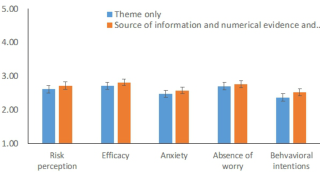
Figure 1: Effect of information content. Note: Error bars = standard error.
According to the deficit model, the content of relevant information affects behavior. Specifically, a shortage of information is though to cause misun- derstanding between the transmitter and receiver of a message. Indeed, it is known that information strongly affects the consumer’s decision to purchase insurance (Hershey & Shoemaker, 1980). Fernbach et al. (2013) explored the minimum amount of information required to attract a consumer’s attention. On the other hand, detailed information, including the source of the infor- mation, is known to affect consumers’ trust of a product (Fernbach et al., 2013). In contrast to the deficit model, the causal model postulates that the depth of information processing, rather than the contents of the information, affe- cts behavior. In other words, how a consumer processes information alters their behavior. For instance, Fernbach et al. (2013) reported that when people realized their understanding of a political issue was superficial, they tended to be more open to accepting others’ opinions. Specifically, participants were asked to explain why they rejected a political opinion which was in oppo- sition to their personal views. In this condition, they only had to retrieve information from long term memory, meaning they were utilizing a relati- vely shallow cognitive process. Participants were subsequently asked to point out the potential consequences of not supporting the political opinion. In this condition, they had to imagine potential consequences that had not yet occurred, forcing them to utilize a deeper cognitive process, which resulted in many of them changing their opinion. This change is thought to be caused by lowered self-efficacy caused by processing information in a cognitively deep manner.
Purpose of the Study The current two-fold study was conducted to examine and compare the deficit model (Study 1) and the causal model (Study 2).
STUDY 1 The effects of information content on model variables were examined based on the deficit model.
METHOD
Participants and Procedure Characteristics of participants are presented in Table 1. A survey com- pany (ASMARQ Co. Ltd., Tokyo, Japan, Nparticipant pool > 16 million at the time of measurement) was contracted to collect online responses. Criteria for recruiting were Japanese adults (age over 20 years at the time of measurement) who had no disaster experience and who had no disaster insurance. Also, participants without any anxiety were elimina- ted because they were not the target population. Invitations were ran- domly sent for the screening study, and six hundred respondents voluntarily agreed to participate in the online-questionnaire study. Five hundred and five participants were retained for Study 1 after eliminating participants
Depth of Information Processing Rather Than Its Content 45
Table 1. Socio-demographic profiles of study 1 & 2 participants.
Table available in the original PDF paper.
Characteristic Category Study 1 Study 2 n n Gender Male 321 288 Female 184 157 Employment status Unemployed/retired 83 84 Self-employed 44 29 Full-time 237 209 Part-time 45 49 Other 96 74 Marital status Not married/widowed 101 106 Married 365 339 No reply 39 0 Has child(ren) Yes 303 306 No 202 139 Annual household <200 40 26 income (in million yen) 200∼299 40 46 300∼399 54 50 400∼499 61 50 500∼599 44 41 600∼699 48 28 700∼799 39 35 800∼999 52 59 1000∼1500 60 41 >1500 15 18 No reply 52 51
Note: One U.S. dollar was equivalent to 143 Japanese yen at the time of the study.
who did not exhibit any climate-related anxiety and outliers (Z > |3.29|). First, participants were randomly assigned to a high information content con- dition which included the source of the information, quantitative evidence, and the overall theme or a low information condition which only provided the theme. The theme of the information focused on extreme weather such as unreasonable changes in temperature and precipitation related to climate change (see Appendix). The questionnaires and items in the questionnaires were presented in a random order to avoid an order effect. Participants were compensated in the research company’s points. The entire procedure took about 15 minutes. The current study was approved by the institutional review board at Chuo University, Tokyo, Japan.
Measures The responses to the self-report questionnaires described below were used for analyses for the current study. Each scale’s reliability (Cronbach’s α > 0.70) was examined based on the classical testing theory (Nunnaly & Bernstein, 1994). The unidimensionality of each scale was examined using parallel analysis (principal factor analysis). Back-translation procedures between English and Japanese were conducted based on the WHO guidelines (acces- sed in 2022). All responses were given on a 5-point Likert scale (1 = “strongly disagree” and 5 = “strongly agree”).
Demographic items. Socio-demographic questions (see Table 1) were asses- sed in the screening study, encompassing both Study 1 and Study 2 partici- pants, and included age (continuous), sex (dichotomous), resident prefecture (categorical), marital status (dichotomous), existence of child (dichotomous), employment status (5 categories), and income level (11 categories).
Risk perception and efficacy. Four items from Miao et al. (2020) were used to measure the extent of perception of risk caused by a disaster and self-efficacy in coping with disaster risk. Two items that were related to a sense of relief from disaster risk and from anxiety about a disaster were excluded from the study. Of the remaining four items, two were interpreted as self-efficacy in coping with disaster risk and the other two were interpre- ted as risk perception. For the current study, there were no problems with reliability (Cronbach’s α = 0.80) or unidimensionality for risk perception. However, scale reliability should be improved in future studies by modifying and adding items for efficacy (Cronbach’s α = 0.44).
Anxiety about climate-related disasters. Five out of six items from the Anxious Specifier Interview (Zimmerman et al., 2017) were used to measure the extent of anxiety caused by climate-related disaster risk. The items’ sub- jects were modified from “the individual” to “I” to adapt to the self-report questionnaire. One item, which indicated extreme symptoms (“Feeling that that I might lose control of myself”), was eliminated from the study. There were no problems with reliability (Cronbach’s α = 0.94) or unidimensionality for risk perception.
Absence of worry about climate-change-related disasters. Three items from Ruedy et al. (2013) were used to measure the extent of relief from a disa- ster. There were no problems with reliability (Cronbach’s α = 0.90) or unidimensionality for risk perception.
Behavioral intentions. Three items from Fink et al., (2020) were used to measure the extent of proactive behavior based on the intention to buy an insurance policy for a potential disaster. There were no problems with reliability (Cronbach’s α = 0.97) or unidimensionality for risk perception.
Data Analyses A one-way between MANOVA was conducted to examine the effect of information contents (source of information, numerical evidence, and theme vs. theme only) on risk perception, risk efficacy, anxiety about climate- related disasters, absence of worry about climate-change related disasters, and behavioral intentions. If the deficit model adequately reflects consumers’ responses to disaster risk, there should be significant differences between conditions.
RESULTS AND DISCUSSION
A one-way between MANOVA was conducted as described above. There were no significant differences between the two conditions, indicating that the deficit model was not supported, F(5, 499) = 1.42, p = 0.22, η2 = 0.01 (see Figure 1).
Depth of Information Processing Rather Than Its Content 47
STUDY 2 The effects of depth of information processing on risk perception, risk efficacy, anxiety about climate-related disasters, absence of worry about climate-change-related disasters, and behavioral intentions were examined based on the causal model.
METHOD
Participants and Procedure Characteristics of participants are presented in Table 1. Survey method and inclusion criteria for the participants were identical to those of Study 1. Four hundred and forty-five participants were randomly assigned to one the fol- lowing three conditions. In the first condition, the participants were asked why they did not have a disaster insurance policy. Thus, they only had to use a shallow cognitive process to retrieve the reason for not buying a policy based on their own past experience. In the second condition, participants were asked to describe the good points about not purchasing an insurance policy in as much detail as possible and in a sequential manner. In this con- dition, participants had to anticipate future events. In the third condition, participants were asked to describe the bad points about not purchasing an insurance policy in as much detail as possible and in a sequential manner. In this condition, participants had to consider future risk.
Measures Risk perception and efficacy. For the current study, there were no problems with reliability (Cronbach’s α = 0.79) or unidimensionality for risk perce- ption. However, scale reliability should be improved in future studies by modifying and adding items for efficadcy (Cronbach’s α = 0.43).
Anxiety about climate-related disasters. There were no problems with reliability (Cronbach’s α = 0.91) or unidimensionality for risk perception.
Absence of worry about climate-change-related disasters. There were no problems with reliability (Cronbach’s α = 0.96) or unidimensionality for risk perception.
Behavioral intentions. There were no problems with reliability (Cron- bach’s α = 0.95) or unidimensionality for risk perception.
Data Analyses A one-way between MANOVA was conducted to examine the effect of the depth of information processing (reason of decision vs. expectations of nega- tive consequences considered in a sequential manner) on risk perception, risk efficacy, anxiety about climate-related disasters, absence of worry about climate-change-related disasters, and behavioral intentions. If the causal model adequately reflects consumers’ responses to disaster risk, there should be significant differences between conditions.
RESULTS AND DISCUSSION
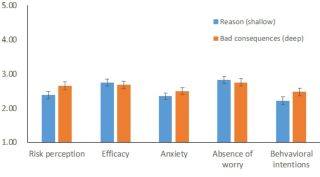
A one-way between MANOVA was conducted as described above, iden- tifying significant differences, F(5. 439) = 4.17, p < 0.001, η2 = 0.05. There were significant differences between conditions for risk perception (F(1, 443) = 15.10, p < 0.001, η2 = 0.033), anxiety (F(1, 443) = 5.39, p < 0.021, η2 = 0.012), and behavioral intentions (F(1, 443) = 14.23, p < 0.001, η2 = 0.031), indicating that the causal model was partially supported for the current type of information processing (see Figure 2).
Figure 2: Effect of the depth of information processing. Notes: Error bars = standard error.
CONCLUSION
Unlike an existing threat that requires an immediate response, including the fight, flight, or freeze response, to survive, climate-change-related risk is a stochastic event (Solomon et al., 2007) that causes psychological respon- ses to climate-change that include risk perception and negative affect (Van der Linden, 2014) (see Figure 1). Further, both psychological reactions and behavioral intentions are indispensable in order to distinguish adaptive and maladaptive reactions (Xie et al., 2019). Thus, it is important to elucidate how to communicate disaster risk to the general population. It has been shown that information strongly affects the consumers’ decision to purchase or not purchase insurance (Hershey & Shoemaker, 1980). In fact, there are two competing theories that both postulate the effect of information on deci- sion making as it pertains to purchasing insurance (Bodomer report, 1985). First, according to the deficit model, the content of information affects beh- avior. However, the causal model postulates that the depth of information processing, rather than its contents, affects behavior. The purpose of the cur- rent study was to examine the effect of information content in Study 1 (the deficit hypothesis; Hershey & Shoemaker, 1980) and the effect of depth of information processing in Study 2 (the causal model; Frenbach et al., 2013).
Taken together, the results indicate that deeper processing leads to heigh- tened risk perception, anxiety, and behavioral intentions, indicating partial support for the causal model. Because behavioral intention was enhanced due to deeper processing, heightened risk perception and anxiety seemed to be adaptive psychological reactions to flood risk (Xie et al., 2019). Thus, the information content (source of information, numerical evidence, and theme vs. theme only) did not create any differences between dependent measu- res. This indicates that the deficit model, which postulates that a shortage
Depth of Information Processing Rather Than Its Content 49
of information would cause misunderstanding between the transmitter and receiver of a message (Hershey & Shoemaker, 1980), was not supported. On the other hand, the causal model, which postulates that the depth of cogni- tive processing needed to cause an individual to realize their own lack of knowlege would affect psychological responses (Frenbach et al., 2013), was partially supported. In other words, it is important for consumers to ade- quately process information regarding disasters by actively considering the consequences that could be caused by their decisions about proactive beha- vior such as purchasing disaster insurance. Thus, regardless of the transmitted contents of certain information, our psychological responses and behavioral intentions appear to remain intact with adequate cognitive processing. That is to say, the way we process information potentially affects the personal consequences of a disaster through our adaptive responses.
Although the current two-fold study elucidated a part of adaptive psycho- logical responses to disaster-related information, we have not yet elucidated the psychological process underlying the current findings. Future studies will add to the literature and create a holistic theoretical picture of psychological responses to disaster-related information.
APPENDIX
Contents of Information Used in Study 1 High information condition (source of information, quantitative evidence, and theme). According to data from the Japan Meteorological Agency, the annual average temperature in Japan has increased by 1.19
C over the last 100 years, and the number of extremely hot days per year has also increased. According to the Ministry of the Environment, if global warming counterme- asures are not taken, the annual average temperature is expected to increase by 4.4
C between 2080 and 2100, and the number of midsummer days will increase by approximately 53 days. Even with strict global warming countermeasures, the average annual temperature is expected to increase by 1.1
C, and the number of midsummer days is expected to increase by about 12 days. In addition, according to the Cabinet Office, “the atmosphe- ric temperature is summarized as increasing due to the progression of global warming. This is believed to increase the amount of water vapor in the atmo- sphere, which in turn increases the intensity of precipitation”. Indeed, many studies predict a 10∼30% increase in precipitation. As a result, there are fears that heavy rains will become more frequent and that large-scale flood damage will occur every year. The importance of flood insurance is highlighted on the website of the General Insurance Association of Japan.
Low information condition (Theme only). The average annual temperature in our country is getting higher. Even with global warming countermeasures, it is believed that global warming will further increase. It is feared that rainfall will increase, leading to a higher frequency of torrential rains and large-scale floods every year. Therefore, the importance of flood insurance and flood countermeasures is being highlighted.
ACKNOWLEDGMENT
This research was funded by the Chuo University Grant for Research Clu- ster Formation. We also appreciate Melissa Noguchi for her dedicated and thorough English proofreading.
REFERENCES
Akaike, H. (1987). Factor analysis and AIC. Psychometrika 52: 317–332. Bentler, P. (1988). Comparative fit indexes in structural models. Psychological Bulletin 107: 238–246. Bodmer, W. F., (1985). Understanding statistics. Presidential Address to the Royal
Statistical Society. Bozdogen, H. (1987). Model selection and Akaike’s information criteria (AIC): the general theory and its analytical extensions. Psychometrika 52: 345–370. Centre for Research on the Epidemiology of Disasters (CRED).EM-DAT: The OFDA-
/CRED International Disaster Database. Brussels, Belgium: Catholic University of Leuven. (Accessed 2022/1/22). Damasio, A. (1994). Descartes’ error: Emotion, rationality and the human brain.
New York: Putnam 352. Dunlap, R. E. (2013). Climate change skepticism and denial: An introduction.
American Behavioral Scientist 57(6), 691–698. Fernbach, P. M., Sloman, S. A., Louis, R. S., and Shube, J. N. (2013). Explanation friends and foes: How mechanistic detail determines understanding and preference. Journal of Consumer Research 39(5), 1115–1131. Fink, M., Koller, M., Gartner, J., Floh, A., and Harms, R. (2020). Effective entre-
preneurial marketing on Facebook–A longitudinal study. Journal of Business Research 113, 149–157. Frederick, S. (2005). Cognitive reflection and decision making. Journal of Economic Perspectives 19(4), 25–42. Hershey, J. C. and Schoemaker, P. J. (1980). Prospect theory’s reflection hypothesis:
A critical examination. Organizational Behavior and Human Performance 25(3), 395–418. Howe, P. D., Markowitz, E. M., Lee, T. M., Ko, C.-Y., and Leiserowitz, A. (2013).
Global perceptions of local temperature change. Nature Climate Change 3(4), 352–356. Hull, C. L. (1943). Principles of behavior: An introduction to behavior theory. New York: Appleton-Century. Kyutoku, Y., Tada, R., Umeyama, T., Harada, K., Kikuchi, S., Watanabe, E.,... and
Dan, I. (2012). Cognitive and psychological reactions of the general population three months after the 2011 Tohoku earthquake and tsunami. PloS One 7(2), e31014. McDonald, R. I., Chai, H. Y., and Newell, B. R. (2015). Personal experience and the ‘psychological distance’ of climate change: An integrative review. Journal of Environmental Psychology 44, 109–118. Mertler C., Vanatta R. (2008). Advanced and multivariate statistical methods (3rd
ed.). Glendale: Pyrczak Publishing. Miao, P. (2020). Decreasing consumers’ risk perception of food additive by knowledge enhancement in China. Food Quality and Preference 79. 103781. Notebaert, L., Tilbrook, M., Clarke, P. J., and MacLeod, C. (2017). When a bad bias
can be good: Anxiety-linked attentional bias to threat in contexts where dangers can be avoided. Clinical Psychological Science 5(3), 485–496.
Depth of Information Processing Rather Than Its Content 51
Nunnally, J., and Bernstein, I. (1994). Psychometric Theory (3rd ed.). MacGraw-Hill, New York. Ruedy, N. E., Moore, C., Gino, F., and Schweitzer, M. E. (2013). The cheater’s high:
The unexpected affective benefits of unethical behavior. Journal of Personality and Social Psychology 105(4), 531. Solomon, S., Manning, M., Marquis, M., and Qin, D. (2007). Climate change 2007the physical science basis: Working group I contribution to the fourth assessment report of the IPCC (Vol. 4): Cambridge University Press. Tabachnik B., Fidell L. (2007). Using multivariate statistics. New York: Allyn and
Bacon. Tanaka J., Huba G. J. (1989). A general coefficient of determination for covariance structure models under arbitrary GLS estimation. Br J Math Stat Psychol 42: 233–239. Trope, Y. and Liberman, N. (2010). Construal-level theory of psychological distance.
Psychological Review 117(2), 440. Van der Linden, S. (2014). On the relationship between personal experience, affect and risk perception: The case of climate change. European Journal of Social Psychology 44(5), 430–440. World Health Organization. Translation and linguistic evaluation protocol and
supporting material. https://terrance.who.int/mediacentre/data/WHODAS/Guide lines/WHODAS%202.0%20Translation%20guidelines.pdf. (accessed Nov. 10, 2022). Xie, B., Brewer, M. B., Hayes, B. K., McDonald, R. I., and Newell, B. R. (2019).
Predicting climate change risk perception and willingness to act. Journal of Environmental Psychology 65, 101331. Zimmerman, M., Clark, H., McGonigal, P., Harris, L., Hoslt, C. S., and Martin, J.
(2017). Reliability and validity of the DSM-5 anxious distress specifier interview. Comprehensive Psychiatry, 76, 11–17.
LISTED IN THE AHFE DIGITAL BOOKSTORE CATALOGUE
Explore the complete digital volume
Kansei Engineering
Read this individual research paper free through the original publisher, or explore the full digital proceedings book.
ISBN 978-1-958651-77-3
Explore this ISBN in the AHFE Bookstore ↗Listed in the July 2026 bookstore catalogue; search by ISBN to confirm current availability · Digital book purchase optional