1 Graduate School of Science and Engineering Chuo University, 1-13-27 Kasuga, Bunkyo-ku, Tokyo 112-8551, Japan ↗
2 Undergraduate School of Science and Engineering Chuo University, 1-13-27 Kasuga, Bunkyo-ku, Tokyo 112-8551, Japan ↗
3 Artificial Intelligence Research Center, National Institute of Advanced Industrial, Science and Technology (AIST), 2-4-27 Aomi, Koto-ku, Tokyo 135-0064, Japan ↗
4 Human Augmentation Research Center, National Institute of Advanced Industrial, Science and Technology (AIST), 6-2-3 Kashiwanoha, Kashiwa, Chiba 277-0882, Japan ↗
5 Faculty of Science and Engineering Chuo University, 1-13-27 Kasuga, Bunkyo-ku, Tokyo 112-8551, Japan ↗↗
To improve sleep habits, we will create messages to raise awareness of sleep and examine the effects of messaging on sleep habits. Japanese people, especially children, and workers, sleep less than their counterparts, both men and women, in other countries. As a result, some people "sleep in on weekends," getting a lot of sleep on weekends to secure more sleep. Then, the rhythm becomes disturbed, and it becomes challenging to re-synchronize with the schedule. Therefore, it is necessary to improve sleeping habits to secure a certain amount of sleep. This study will utilize a messaging approach, gain/loss-framing messages. Then, we will investigate which message is more effective for sleep habits according to each participant's values about sleep. This experiment first administered a questionnaire to 130 college students and adults to assess their attitudes and values toward sleep. We conducted an exploratory factor analysis of 83 items of the questionnaire. As a result, factor scores were calculated for each respondent, and a total of six clusters were determined by cluster analysis. For the experiment, a total of 10 participants (college students in their 20s), five each with high factor scores, were selected from the "sleep-oriented" and "sleep-unoriented" types. The selected participants wore wristwatch-type terminals and went to bed after checking the messages sent to them. Participants received each of seven different kinds of gain/loss-framing messages per week. In questionnaires on 14 different messages, participants responded to the acceptability of the messages and changes in their attitudes toward sleep, such as going to bed early, getting up early, and reviewing their daily rhythms. A two-way ANOVA was conducted at the 5% significance level on the change in sleep awareness after confirmation of the sent message and on the evaluation of the acceptability of the sent message. We identified significant differences in sleep awareness in the main effects between clusters and in the interaction between clusters and message type. Sleep-oriented types tended to report more change in sleep awareness with loss-framing messages. In comparison, sleep-unoriented types tended to report more change in sleep awareness with gain-framing messages. Mean sleep time (minutes) during each period was calculated for each participant, and a two-way ANOVA was performed with message content and clusters as factors at a 5% significance level. We didn't find significant differences between clusters, message types, or interactions. However, sleep-oriented types tended to sleep longer than sleep-unoriented types. Furthermore, in both clusters, sleep duration tended to be longer in weeks when they received loss-framing messages than in weeks when they received gain-framing messages. The interventions in this study produced changes in sleep attitudes, but these changes differed across clusters. On the other hand, all clusters showed a trend toward longer sleep duration for loss-framing messages. In other words, changes in sleep attitudes may not be directly reflected in behavior, and we need to investigate this in the future.
Our study investigated the effectiveness of messaging using framing tech- niques to improve awareness of sleep habits. Furthermore, we classified participants based on variations in their values towards sleep and conducted messaging interventions tailored to each group.
Japanese people, especially children, and workers, have been found to sleep the least hours in the world (Ministry of Health, Labour and Welfare). In par- ticular, the significant burdens of household chores and childcare contribute
to women having even shorter sleep durations than men, often leading to a state of chronic sleep deprivation regardless of weekdays or weekends. To address such weekday sleep deficits, some individuals catch up on sleep on weekends, aiming to accumulate more (Ministry of Health, Labour and Welfare, 2014). However, Crowley et al. demonstrated that when the dis- crepancy in sleep timing between weekdays and weekends grows, it disrupts the circadian rhythm, intensifying daytime sleepiness (Crowley et al., 2010). Furthermore, they also mentioned that as disruptions in the rhythm become more pronounced, readjusting one’s schedule becomes more challenging. Therefore, cultivating a consistent sleep duration, regardless of weekdays or weekends, is essential.
Against this background, efforts are being made in Japan to improve the health of the population in the field of sleep. In 2014, the “Sleep Guidelines for Health Promotion 2014” were formulated, which set forth “12 articles on sleep” for comfortable sleep. These guidelines suggest scientific findings on sleep, prevention, and health guidance methods.
Japan is working on health promotion through various information media, not only in the field of sleep, with the aim of providing easy-to-understand information. Messaging is one of the most effective ways to provide such information to the target population. Latimer et al. point out the impor- tance of messaging as a method to increase the motivation and adherence of the target population (Latimer et al., 2010). They also identify three spe- cific strategies for messaging. The first is ‘tailoring,’ in which information is offered to the target individual. The second is ‘targeting,’ in which infor- mation is provided according to the characteristics and needs of the target group. The third is ‘framing,’ which is ‘framing,’ which involves presenting information using phrases that highlight the benefits of a certain behavior or the losses incurred by not adopting it.
Framing is a phenomenon described as “the way a problem is presented having an irrational impact on thinking and selection” (Tversky et al., 1986). Currently, there are many studies on messaging using framing. Rothman et al. suggest that in health behavior change, using either ‘gain-frame’ (emphasizing benefits) or ‘loss-frame’ (emphasizing losses) phrases can affect the partici- pant’s attitude toward behavior change, despite having the same information (Rothman et al., 1997).
Kawamura et al. created a Regulatory Focus Questionnaire specific to health behaviors and clarified an association between the patterns and rat- ings for four types of messages (combinations of (exercise or eating) and (gain or loss)) (Kawamura et al., 2019). They identified clusters as the ‘promotion-prevention’ type, which focuses on better health and seeks to avoid undesirable diseases; the ‘indifferent’ type, which has no interest in health; and the ‘promotion’ type, which focuses on better health but has a low orientation toward disease prevention.
The results of the participant’s evaluation of each message indicated that the gain-framed message scored higher in all clusters for the ‘acceptability’ of the message. On the other hand, the message type that scored higher in ‘intention’ to carry out the message content differed among the clusters. Specifically, the ‘promotion/prevention’ and ‘promotion type’ who were con- scious of their health showed more change in their awareness of exercise
Effects of Gain/Loss Messages on Reinforcing Motivation to Sleep 335
with the gain-framed message, while the ‘indifference type’ who were less conscious of their health showed more change in their awareness of exercise with the loss-frame. In addition, the ‘promotion/prevention’ and ‘promotion’ types tended to score higher than the ‘indifference’ type in the evaluation scores for both messages.
Many studies on framing-based messaging have focused on physical activ- ity and eating behavior, but few researches have focused on sleep. There also are few studies that intervene with framed messages in real-life situations and observe their behaviors. In this study, we created a gain-loss message target- ing sleep and examined its effects. We categorize the participants according to their values toward sleep and compare the messages that lead to improvement in sleep awareness and to securing sleep time for each group.
METHOD
Based on Grandner’s questionnaire (Grandner et al., 2014), we administer an 83-item questionnaire to assess individuals’ attitudes and values toward sleep. After the questionnaire survey, we cluster the participants according to their values toward sleep and conduct messaging and sleep time measurement experiments on the participants selected from each cluster. To measure sleep- ing hours, participants wear a wristwatch-type terminal - Fitbit Versa 3. LINE Official Account Manager sends messages to the participants. We adopt this tool because we think it can automatically send messages at set times, and it is a familiar tool for the participants to be aware of the notifications.
We prepare seven different gain-loss messages and send them with different contents each day (Table 1). Participants receive these messages randomly in order to consider the order effect.
Table 1. Gain-framed and loss-framed messages for the experiment.
Table available in the original PDF paper.
Gain framed message Loss framed message Getting enough sleep helps regulate the autonomic nervous system, leading to stress relief.
Sleep deprivation disrupts the balance of the autonomic nervous system, leading to the onset of depression. Getting enough sleep promotes metabolism, contributing to a body less prone to gaining weight.
Sleep deprivation lowers metabolism, contributing to the development of a tendency to gain weight. Getting enough sleep triggers hormone secretion, leading to improved immune function.
Sleep deprivation disrupts hormone balance, leading to a weakened immune function. Getting enough sleep aids in the recovery of fatigue, resulting in enhanced daytime concentration and decision-making abilities.
Sleep deprivation impairs the ability to recover from fatigue, resulting in reduced daytime concentration and decision-making abilities. Getting enough sleep helps establish a healthy daily rhythm, leading to beauty benefits and improved skin quality.
Sleep deprivation disrupts the daily rhythm, leading to skin problems and premature aging. Getting enough sleep reduces the risk of hypertension and obesity, preventing lifestyle-related diseases.
Sleep deprivation can cause hypertension and obesity, contributing to the development of lifestyle-related diseases. Getting enough sleep allows the brain to organize information, leading to better memory consolidation and improved cognitive abilities.
Sleep deprivation impairs brain function, leading to a decline in memory capabilities.
The duration of the experiment is three weeks. Selected participants wear Fitbit Versa 3 and go to bed after checking the transmitted messages. The number of days for gain-/loss-framed messages, and no messages is one week each. The system sent these messages one hour before the participant’s tar- get sleep time. After the experiment, we administer a subjective evaluation questionnaire that asks about changes in sleep quality, impressions of each message, and so on. The participants answer whether the 14 messages are “acceptable” or not and whether they have “changed their attitude” toward sleep, such as going to bed early or reviewing their daily rhythm, using a 5-point scale (not at all applicable - very applicable).
RESULT
In this study, we obtained valid responses from a total of 130 respondents (59 males and 71 females), consisting of 123 undergraduate and gradu- ate students in the fields of science and engineering and 7 working adults. Exploratory factor analysis was conducted on 83 questions with Promax rotation.
We classified all 83 questions into seven factors. We extracted the five questions with the highest factor loadings and clarified the type of each factor based on the content and characteristics of the questions. There were seven factors as follows: Factor 1: “Type who thinks that lack of sleep causes problems in life,” Factor 2: “Type who thinks that lack of sleep causes problems in the body,” Factor 3: “Type who gives up sleep when unable to sleep,” Factor 4: “Type who cares about getting sleep,” Factor 5: “Type who becomes sleep deprived due to stress,” Factor 6: “Type who takes some action when unable to sleep” and Factor 7: “Type who is easily affected in the body by lack of sleep.” The cumulative contribution ratio was 0.34. Next, we calculated the factor scores for each respondent from the factor loadings of each question. The factor scores were calculated by multiplying the factor loadings by the total score of the 5-point scale selected by the respondents.
We performed a cluster analysis of each respondent from the calculated factor scores, using the Ward method. The height is set to 50 and the number of clusters is set to 3. The number of persons in Groups 1 to 3 was 17, 17, and 96, respectively. However, the number of persons in each cluster varied greatly, making it difficult to determine the characteristics of each cluster. Therefore, we further divided Group 3, which had the largest number of participants, into four groups, creating a total of six groups.
The six groups were divided into as follows: Group 1 : people who are indifferent to sleep, Group 2 : people attaching importance on sleep, Group 3-1: people trying to sleep, Group 3-2: people having poor sleep, Group 3-3: people underestimating value of sleep, and Group 3-4: people who are healthy without sleep. The numbers of participants were 17, 17, 31, 20, 25, and 20. We identified Factors with high and low mean factor scores within each group and deter- mined the characteristics of the six groups based on the questions in the
Effects of Gain/Loss Messages on Reinforcing Motivation to Sleep 337
Factors. The group with contrasting characteristics was used for participant selection. The groups selected this time are Group 2, ‘important to sleep,’ and Group 3-3, ‘unimportant to sleep.’ We selected 10 participants (males: 3, females: 7), five college students in their 20s each with the highest factor scores among these groups, as participants in the messaging experiment.
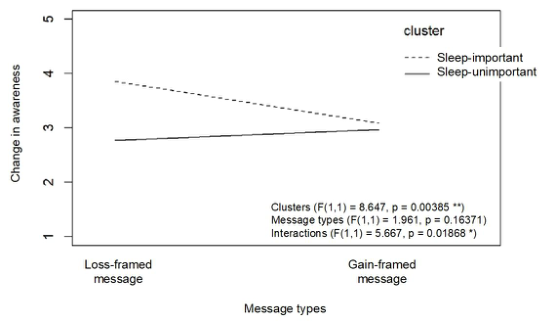
We conducted a two-way ANOVA (significance level of 5 %) on the change in sleep awareness after confirming the sent message, using the message con- tent and clusters as factors based on the ratings given by the respondents. Significant differences were found in the main effects among clusters and in the interaction between group and message type (Fig. 1). In other words, the loss-framed messages tended to produce a change in consciousness among the sleep-important types. Sleep-unimportant types tended to change their consciousness more for gain-framed messages.
Figure 1: Differences in sleep awareness changes through messaging.
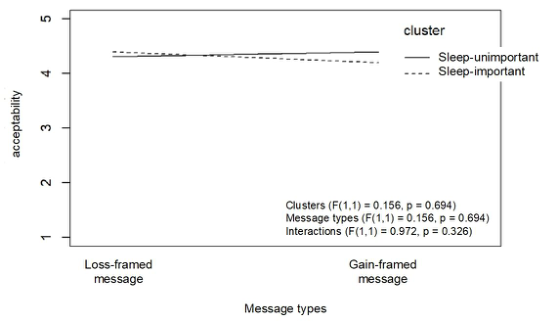
We then analyzed the ‘acceptability’ of a total of 14 outgoing messages in the same way (significance level of 5%). No significant differences were found between clusters, message types, or interactions (Fig. 2).
Figure 2: Differences in the acceptability of messages.
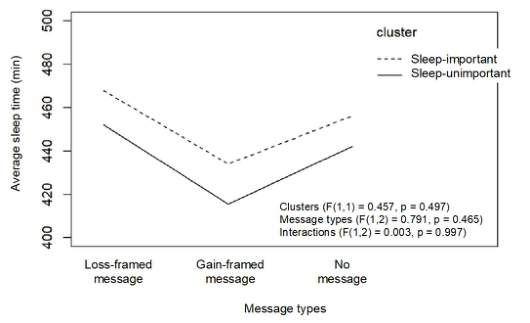
Finally, we calculated the average sleep time (minutes) for each participant over seven days for gain-framed messages, loss-framed messages, and no mes- sages, respectively, and analyzed them in the same way (significance level of 5%). No significant differences were found between clusters, message types, or interactions (Fig. 3).
Figure 3: Differences in average sleep time (minutes).
DISCUSSION
In this study, we categorized the participants into six groups according to their personal values of sleep. As a result, the cumulative contribution ratio is 0.34, which is quite low. In addition, cluster analysis shows that it is difficult to identify the characteristics. We think the reason for this is the bias in the selection of the participants. About 95% of the partici- pants in this study are undergraduate and graduate students of science and engineering. Ishihara et al. found that the sleep state of science and engineer- ing undergraduates worsens from the beginning to the end of the semester (Ishihara et al., 2017). In other words, it is possible that many of the exper- imental participants in this study also do not lead a regular life in terms of sleep. Therefore, we think there is a bias in their values and attitudes toward sleep. Takeuchi et al. also developed a sleep habit scale for university students and classified their sleep patterns into six groups (Takeuchi et al., 2000). In other words, we believe it is necessary to create messages based on a scale that matches the characteristics of the target population in the future. Further- more, we think the questionnaire used in this study should be administered to a wide range of age groups to take a more comprehensive approach.
We also investigated the differences in the impact of framed messages on different attitudes and values toward sleep. We found significant dif- ferences among the clusters and in the interaction effects for ‘change in awareness.’ Sleep-important types responded that the loss-framed messages had a greater effect on their attitudes toward sleep. On the other hand, the sleep-unimportant type tended to report that the gain-framed messages were more effective in changing their attitudes toward sleep. In Kawamura et al.’s study, clusters with high health awareness had a change in awareness toward
Effects of Gain/Loss Messages on Reinforcing Motivation to Sleep 339
exercise with gain-framed messages, while clusters with low health aware- ness had a change with loss-framed them (Kawamura et al., 2019). Thus, the results suggest there are contrasting message effects for sleep and exercise. Since sleep is a daily behavior, whereas exercise for health is not an essential behavior in a day, we think the difference in the message effect was caused by the difference in the importance of each behavior. In addition, there were no significant differences in “acceptability” among clusters, message types, and interactions. We think all the messages are acceptable since the mean value of the evaluation is high for all the clusters and message types.
In the sleep measurements, we did not find a statistically significant differ- ence in sleep duration. Thus, even if messaging raises awareness, it is unlikely to lead to actions to secure sleep. We discuss the reasons for the change in awareness but not action from two perspectives: the content of the message and the timing of its transmission.
The first point is the content of the messages. The messages used in this study do not include suggestions for specific actions. Brawley et al. describe the elements of effective messaging that are addressed in the guidelines for physical activity implementation. They also state that to motivate individu- als, in addition to guidelines, messages that communicate why and how to achieve the recommended activity level are necessary (Brawley et al., 2007). For example, in the study by Kawamura et al., the gain-framed message for physical activity is exercising at least twice a week for at least 30 minutes at a time is useful for maintaining and improving physical fitness such as gen- eral endurance and muscle strength. To expect behavioral change through messaging, it is necessary to include specific behaviors in the messages and to evaluate them in terms of axes that lead to behavioral change. The evaluation axes include self-efficacy (the degree to which people think they can put the message into practice) and intention (the degree to which people think they will put the message into practice). The Sleep Guidelines for Health Promo- tion 2014 of Ministry of Health, Labour and Welfare (2014) recommends, for example, having at least one hour of doing nothing before going to bed. In other words, in this study, we think it is necessary to consider creating a message that emphasizes the gains and losses of sleep and includes content regarding specific actions.
The second point concerns the timing of sending messages. Gold et al. conducted a study on effective elements of messaging for the prevention of sexually transmitted diseases, pointing out the importance of message deliv- ery methods and timing (Gold et al., 2010). Ono et al. also created an information recommendation system that estimates the participant’s schedule and activity level and recommends exercise at the right time for the individ- ual (Ono et al., 2022). They suggest that recommendations at times that are suitable for the participant to exercise are effective in presenting the informa- tion. In this study, we set the timing of sending the messages to be one hour before the target bedtime. However, we believe that this timing of sending the message may not provide enough time to prepare for bedtime. Sleep time is easily influenced by the schedule of the day and the next day, the amount of activity during the day, and the degree of fatigue. In other words, we think messaging should consider the individual’s daily schedule and activity level. We also think that such an approach can encourage bedtime readiness.
CONCLUSION
In our study, we developed a gain-loss framed message for sleep to improve awareness of sleep habits and verified the effectiveness of the message by using it in real-life situations. We also categorized the participants according to their values toward sleep and compared the messages among the groups to see which messages would improve their sleep awareness and help them get more hours of sleep. As a result of the messaging, we found that the loss messages tended to cause changes in sleep consciousness in the sleep- important type, while the gain messages tended to cause changes in the sleep-unimportant. However, this did not lead to changes in behavior. We believe that, to encourage behaviors that improve sleep week, it is neces- sary to estimate the individual’s situation and condition and include content about specific behaviors. We think our study will contribute to improving awareness of lifestyle habits such as sleep.
ACKNOWLEDGMENT
This research is partially supported by the JSPS Grant-in-Aid for Scientific Research (C) 20K11314, JST-Mirai, and the Research Project of the Institute of Science and Engineering, Chuo University.
REFERENCES
Brawley, L. R., & Latimer, A. E. (2007). Physical activity guides for Canadians: Messaging strategies, realistic expectations for change, and evaluation. Applied Physiology, Nutrition and Metabolism, 32, 170–184. Crowley, S. J., & Carskadon, M. A. (2010). Modifications to weekend recovery sleep
delay circadian phase in older adolescents. Chronobiology international, 27(7), 1469–1492. Gold, J., Lim, S. C., Hellard, M. E., Hocking, J. S., & Keogh, L. (2010). What’s in a message? Delivering sexual health promoting to young people in Australia via text messaging. BMC Public Health, 10, 792. Grandner, M. A., Jackson, N., Gooneratne, N. S., & Patel, N. P. (2014). The devel-
opment of a questionnaire to assess sleep-related practices, beliefs, and attitudes. Behavioral sleep medicine, 12(2), 123–142. Ishihara, Y., Kato, T., Kimura, K., & Koga, H. (2017). Survey on sleep in university students of science and technology. Bulletin of Tokyo Denki University, arts and sciences, 15, 79–87. Kawamura, N., Uechi, H., & Honda, Y. (2019). Developing health messages for pro-
moting health behavior. Journal of Health Psychology Research, 31(Special_issue), 277–284. Latimer, A. E., Brawley, L. R., & Bassett, R. L. (2010). A systematic review of three approaches for constructing physical activity messages: what messages work and what improvements are needed? International journal of behavioral nutrition and physical activity, 7(1), 1–17. Ministry of Health, Labour and Welfare, e-healthnet. Suimin to Seikatsu Shukan
Byou tono Fukai Kankei. https://www.e-healthnet.mhlw.go.jp/information/heart /k-02-008.html. Ministry of Health, Labour and Welfare. (2014). Kenko Zukuri no tame no Suimin Shishin 2014. (in Japanese): https://www.mhlw.go.jp/file/06-Seisakujou hou-10900000-Kenkoukyoku/0000047221.pdf.
Effects of Gain/Loss Messages on Reinforcing Motivation to Sleep 341
Physical-exercise recommendation system based on individual daily schedule. In 2022 Joint 12th International Conference on Soft Computing and Intelligent Systems and 23rd International Symposium on Advanced Intelligent Systems (SCIS&ISIS), 1–3. Rothman, A. J., & Salovey, P. (1997). Shaping perceptions to motivate healthy behavior: the role of message framing. Psychological bulletin, 121(1), 3. Takeuchi, T., Inugami, M., Ishihara, K., & Fukuda, K. (2000). Construction of sleep-
hygiene scales and classification of sleep patterns in undergraduates. Japanese journal of educational psychology, 48, 294–304. Tversky, A., & Kahneman, D. (1989). Rational choice and the framing of decisions.
In Multiple criteria decision making and risk analysis using microcomputers. Berlin, Heidelberg: Springer Berlin Heidelberg, 81–126.
LISTED IN THE AHFE DIGITAL BOOKSTORE CATALOGUE
Explore the complete digital volume
Artificial Intelligence, Social Computing and Wearable Technologies
Read this individual research paper free through the original publisher, or explore the full digital proceedings book.
ISBN 978-1-958651-89-6
Explore this ISBN in the AHFE Bookstore ↗Listed in the July 2026 bookstore catalogue; search by ISBN to confirm current availability · Digital book purchase optional