Olfactory stimuli are strongly linked to human memory. This paper examines the effects of very short scent stimuli on video advertisements to make audiences remember products. We especially focused on effect of semantic consistency (or inconsistency) between product and scent, and we observed trends of their effects over three weeks. Forty-six university students viewed four fictional beverage commercials (10 seconds each). Four conditions were tested: 1) scent matched to product, 2) mismatched scent, 3) rosemary, and 4) an odorless control. Memory of products was assessed using recognition tests one week and three weeks later. After one week, only the matched scent condition significantly enhanced memory compared to the control, highlighting the importance of semantic consistency for short-term retention. After three weeks, all scent conditions showed higher memory scores than the control, suggesting that olfactory stimulation functions as a contextual retrieval cue over time. Interestingly, the scent inconsistently matched to product got better memory result in three weeks later, implying that its incongruity or novelty may enhance cognitive engagement. These findings indicate that very short olfactory stimuli influence memory differently depending on retention stage and offer practical implications for multisensory advertising design.
In contemporary media environments, audiences are exposed to large amounts of visual information, often resulting in reduced attention to video advertisements. It is worth exploring multisensory design approaches that can enhance memory retention under strict time constraints.
Olfactory stimuli are promising in this context because olfaction is deeply involved in emotional and mnemonic processing due to its direct neural connections with the limbic system (Gottfried, 2006).
In marketing research, engaging multiple sensory modalities has been shown to influence perception and judgment, leading to deeper cognitive engagement with content (Krishna, 2012).
Despite this potential, the application of olfactory stimuli to video advertising remains limited, particularly in cases where scents are presented only for a very short duration.
Effect of Adding Scent Stimuli on Commercial Videos to Enhance Memory 207 Our study aims to examine whether very short olfactory stimuli synchronized with video advertisements can enhance product memory retention. Specifically, this study focuses on the consistency between scent and product image, as well as temporal changes in memory performance measured one week and three weeks after exposure. By investigating both short-term and longer-term memory effects, this research seeks to clarify the cognitive role of instantaneous olfactory stimulation in audiovisual advertising contexts.
We also have a research question on effect of dissimilarity between scent and image. According to prior research, memory is strengthened, if a scent has relationship to the object in the image. It is, however, still unclear whether incongruent or unexpected scents weaken memory vice versa.
Addressing this gap, our study experimentally compares 1) congruent scents, 2) incongruent scents, 3) a rosemary scent known for its reported memory-related effects, and 4) a no-scent condition.
Based on these objectives, the following hypotheses were formulated:
1. Memory enhancement through congruent scents: Video advertisements accompanied by scents congruent with the product image will result in higher memory retention than advertisements without scent. 2. Memory impairment through incongruent scents: Video advertisements accompanied by scents incongruent with the product image will result in lower memory retention than advertisements without scent. 3. Specific effect of rosemary scent: Video advertisements accompanied by rosemary scent will influence memory retention regardless of scent– image congruency. 4. General memory enhancement through olfactory stimulation: Differences in memory retention between scented and non-scented conditions will be observed both one week and three weeks after viewing. 5. Effect of subjective congruency on memory: Higher subjective congruency between scent and product image will be associated with higher memory scores.
RELATED STUDIES Previous research has shown that olfactory stimulation can influence cognitive performance and memory. For example, rosemary aroma has been reported to enhance memory performance in healthy adults, suggesting that scent can function as an effective cognitive cue (Moss, 2003). In addition, studies on sensory marketing have demonstrated that multisensory stimulation enhances perception and information processing, supporting the use of scent in advertising contexts (Krishna, 2012).
However, most existing studies have focused on continuous or prolonged olfactory exposure. Experimental research examining ultra-short olfactory stimuli synchronized with specific visual events remains limited. Moreover, the effects of scent–image congruency on delayed memory retention have not been sufficiently investigated. The present study addresses these gaps by examining how instantaneous olfactory stimulation in video advertisements influences product memory over time.
METHODS
Overview of the Experiment This study examined the effects of adding olfactory stimuli to video advertisements on product memory. An experiment was conducted using commercial videos (CMs) for beverage products. Participants viewed multiple CMs presented under different scent conditions and completed impression ratings immediately after viewing. Product memory was assessed one week and three weeks later.
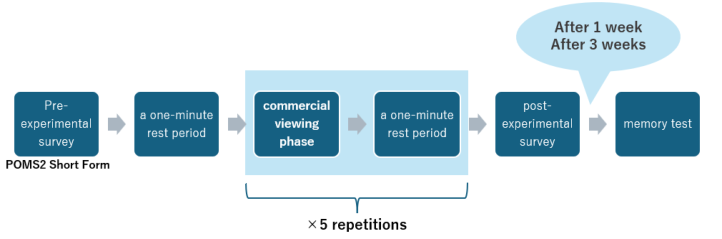
Four scent conditions were used: (1) a scent congruent with the product image, (2) a scent incongruent with the product image, (3) rosemary scent, and (4) no scent. Scents were presented in real time during video viewing. In addition to these predefined conditions, participants’ subjective evaluations of scent–product image congruency were measured and analyzed in relation to memory performance. The experimental procedure is illustrated in Figure 1.
Figure 1: Overview of the experimental procedure.
Stimulus Videos for Measuring Product Memory The stimulus materials consisted of commercial-style videos created for fictitious beverage products. To avoid the influence of prior knowledge, all products were fictional, and the videos were newly generated using the AI video generation model Sora.
Four beverage CMs were prepared: orange juice, hot lemon, black tea, and roasted green tea (hojicha). All videos were standardized to 10 seconds to minimize differences in length and information content. Each CM included a clear view of the product and a scene depicting consumption to ensure consistency across stimuli.
To further control overall impressions, all videos depicted scenes involving warm beverages, reducing the influence of temperature-related cues on scent perception and memory. Package designs were also controlled by assigning different colors to each product to avoid confounding effects of color–scent associations. Product memory was defined as memory for the product as a whole, including its packaging.
Scent presentation was synchronized with scenes showing the product and drinking actions, allowing visual and olfactory information to be processed simultaneously.
Effect of Adding Scent Stimuli on Commercial Videos to Enhance Memory 209 Scent Conditions Based on Product Image Congruency
Four scent conditions were defined: a congruent scent, an incongruent scent, rosemary scent, and no scent. Congruent and incongruent scents were selected based on a preliminary congruency evaluation experiment. Participants rated the perceived congruency between each beverage and multiple candidate scents. For each beverage, the highest-rated scent was defined as congruent and the lowest-rated scent as incongruent.
Participants in the preliminary experiment did not participate in the main experiment, ensuring independence between scent selection and evaluation. The resulting scent assignments are shown in Table 1.
Rosemary was included because previous studies have reported its potential effects on memory, allowing examination beyond image congruency. The no-scent condition served as a control.
Each participant viewed all four beverage CMs and experienced each scent condition once. The assignment of scent conditions to beverages was counterbalanced across participants to minimize order and learning effects. Examples of the assignments are shown in Table 2.
Scent Presentation Method Scents were presented using an aroma shooter device capable of rapidly emitting liquid fragrances for short durations. Because scents dissipate quickly after emission, residual effects between conditions were minimized, making the device suitable for experiments requiring synchronized audiovisual– olfactory presentation.
Scents were delivered at two points within each CM: during scenes showing consumption and scenes displaying the entire product. Each presentation lasted approximately two seconds. Pilot testing confirmed that the scents were clearly perceivable without being excessively strong. Presentation timing and duration were standardized across all conditions.
Participants A total of 44 university students (22 males and 22 females, aged 20–24 years) participated. All participants reported normal or corrected-to-normal vision and no significant olfactory impairments. Informed consent was obtained prior to participation.
Evaluation Measures Product memory was assessed one week and three weeks after viewing. Participants were shown product images and rated whether they believed they had seen the corresponding CM using a five-point Likert scale (1 = “definitely did not see,” 5 = “definitely saw”). These ratings were used as memory scores. Dummy product images were included to reduce guessing based on familiarity.
Immediately after viewing each CM, participants rated how well the scent matched the product image on a five-point Likert scale. These ratings were treated as subjective congruency scores and analyzed in relation to memory performance.
After the experiment, participants rated how much they liked each product using a five-point Likert scale to examine the influence of preference on memory retention.
Data Analysis Repeated-measures two-way ANOVA was conducted to account for the within-subject design. The factors were scent condition (congruent, incongruent, rosemary, no scent) and evaluation time (one week, three weeks), or subjective congruency, with memory score as the dependent variable.
When significant main effects or interactions were found, post hoc comparisons were performed using Tukey’s HSD test. The significance level was set at p < .05. These analyses were used to statistically examine the effects of scent conditions and scent–product relationships on long-term product memory.
RESULTS
Effects of Scent Conditions on Memory Retention
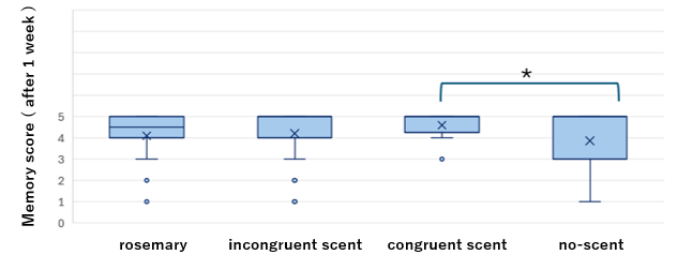
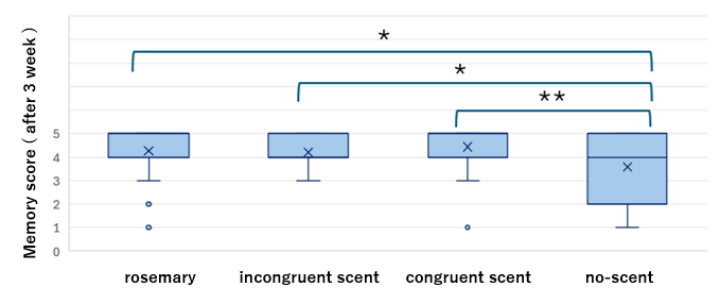
Figure 2, 3 illustrate the relationship between scent conditions and memory retention. Error bars represent standard errors, and asterisks indicate significant differences (* p < .05, ** p < .01).
For memory scores measured one week after viewing, a significant main effect of scent condition was observed (F(3,123) = 3.22, p = .025). Post hoc comparisons revealed that the congruent scent condition produced significantly higher memory scores than the no-scent condition (p = .015), as shown in Figure 2. In contrast, no significant differences were found between the incongruent scent condition and the no-scent condition, nor between the rosemary condition and the no-scent condition at this time point.
For memory scores measured three weeks after viewing, the main effect of scent condition was also significant (F(3,172) = 5.43, p = .001). As shown in Figure 3, post hoc analyses indicated that all scented conditions resulted in higher memory scores than the no-scent condition. Specifically, memory scores in the congruent scent condition were significantly higher than those in the no-scent condition (p = .001). Similarly, the incongruent scent condition (p = .034) and the rosemary condition (p = .014) also showed significantly higher memory scores compared with the no-scent condition. These results suggest that while only congruent scents enhanced memory retention in the short term, multiple scent conditions contributed to improved memory retention over a longer interval.
Figure 2: Relationship between scent conditions and memory retention (one week later). (* p < .05, ** p < .01).Figure 3: Relationship between scent conditions and memory retention (three weeks later). (* p < .05, ** p < .01).
Psychological Measures
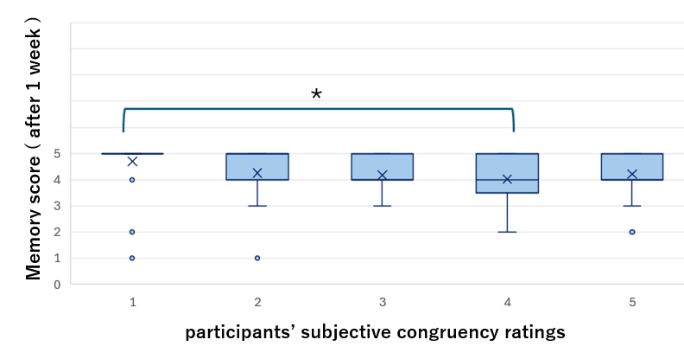
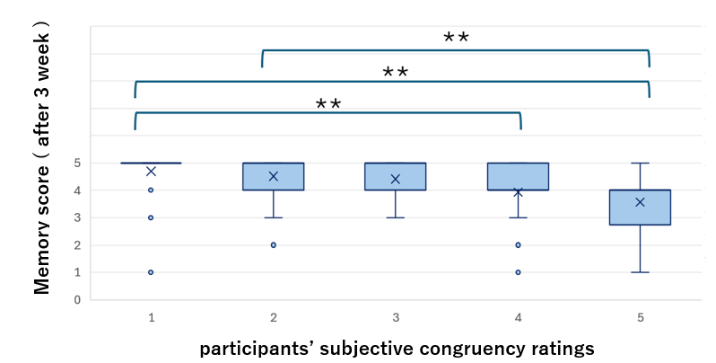
Figure 4, 5 show the relationship between participants’ subjective congruency ratings and memory scores.
For memory scores measured one week after viewing, no significant main effect of subjective congruency was found. However, post-hoc comparisons revealed a significant difference between congruency level 1 and congruency level 4 (p = .049), as shown in Figure 4. In this comparison, memory scores
were significantly higher for congruency level 1 than for level 4. No other significant differences were observed among the remaining congruency levels.
In contrast, for memory scores measured three weeks after viewing, the main effect of subjective congruency was significant (F(5,660) = 5.66, p = .0003). Post hoc analyses indicated a systematic trend, as shown in Figure 5: conditions with lower subjective congruency were associated with higher memory scores. This result suggests that scents perceived as less congruent with the product image led to stronger long-term memory retention.
Overall, these findings indicate that the relationship between scent and product memory changes over time. While congruent scents were particularly effective in enhancing short-term memory, both the presence of scent and lower subjective congruency were associated with enhanced memory retention after a longer delay.
Figure 4: Relationship between participants’ subjective congruency ratings and memory retention (one week later).Figure 5: Relationship between participants’ subjective congruency ratings and memory retention (three weeks later).
DISCUSSION
Evaluation of the Hypotheses This study proposed five hypotheses regarding the effects of scent-added video advertisements on memory retention. Based on the results in Chapter 3, their validity is discussed below.
Hypothesis 1, predicting that scent congruent with the product image would enhance memory compared to a no-scent condition, was supported. The congruent scent condition produced significantly higher memory scores at both one and three weeks. Notably, after one week, only the congruent condition showed a significant advantage, highlighting the importance of semantic consistency for short-term retention.
Hypothesis 2, which predicted that incongruent scents would impair memory, was not supported. No significant difference was found after one week, and after three weeks the incongruent condition showed significantly higher memory than the no-scent condition. This suggests that incongruent scents do not hinder memory and may facilitate long-term retention.
Hypothesis 3 examined the effect of rosemary scent and was partially supported. Although no effect was observed after one week, memory was significantly higher than the control after three weeks. Unlike prior studies reporting pharmacological effects under prolonged exposure, the present study used brief scent presentations. Thus, the long-term effect likely reflects cognitive rather than physiological mechanisms.
Hypothesis 4, predicting differences across scent conditions at both time points, was supported; however, the pattern differed over time. After one week, congruency was critical, whereas after three weeks the presence of scent itself appeared more influential than scent type.
Finally, Hypothesis 5, predicting a positive relationship between subjective congruency and memory, was rejected. After three weeks, lower perceived congruency was associated with higher memory, revealing an inverse relationship.
Differences in the Role of Scent Over Time Comparing the results at one week and three weeks after viewing reveals that the role of scent in memory formation changes over time. One week after viewing, only the congruent scent condition significantly enhanced memory retention relative to the no-scent condition. This suggests that congruent scents may support comprehension and impression formation during encoding, thereby facilitating short-term memory.
In contrast, three weeks after viewing, all scented conditions—including congruent, incongruent, and rosemary scents—resulted in higher memory scores than the no-scent condition. This pattern indicates that, over longer intervals, whether a scent was present becomes more important than what the scent was. Scent may function as a retrieval cue linked to the overall viewing experience rather than to specific semantic content.
This interpretation aligns with characteristics of olfactory memory, which is known to be strongly associated with episodic experiences and contextual
information. Rather than being stored independently, olfactory information tends to be encoded as part of a holistic experience, making the presence of scent itself a powerful mnemonic cue over time.
Interpretation of the Inverse Effect of Subjective Congruency One notable finding was that lower subjective congruency was associated with stronger memory retention after three weeks, suggesting that incongruity or unexpectedness may enhance long-term memory.
When scent and product image do not match, viewers may experience surprise or mild discomfort, prompting additional cognitive processing. This deeper encoding may strengthen memory traces and improve long-term retention. In contrast, highly congruent combinations may be processed fluently and leave a positive immediate impression, but they may not remain distinctive over time.
Because scent presentation was brief, pharmacological effects were likely minimal. Rather, the sudden and uncommon sensory experience itself may have increased attentional capture, especially under incongruent conditions, leading to stronger encoding.
Overall, the results suggest that incongruity and novelty play an important role in long-term memory formation in multisensory advertising.
Significance of the Study This study contributes to the literature by examining scent-enhanced video advertisements from a temporal perspective. By systematically comparing congruent scents, incongruent scents, rosemary scent, and no-scent conditions, and by incorporating subjective congruency ratings, the study provides nuanced insights into how scent influences memory over time.
The results challenge the simplistic assumption that congruency alone determines memory effectiveness. Instead, they demonstrate that the optimal use of scent depends on the intended retention period and that moderate incongruity may be beneficial for long-term recall.
Limitations and Future Directions Several limitations should be noted. First, the participants were limited to university students, which may restrict generalizability. Future studies should include a broader range of age groups and backgrounds.
Second, only beverage products were examined. Effects may differ for other product categories or services, particularly those with stronger emotional associations.
Third, technical constraints of the scent delivery device limited the number of available scents and required frequent capsule replacement. Advances in scent presentation technology may enable more flexible and scalable applications.
Additionally, individual differences in scent preference may have influenced the results. Incorporating scent preferences as a covariate or pre-screening participants could help address this issue.
Effect of Adding Scent Stimuli on Commercial Videos to Enhance Memory 215 Finally, future research should explore bidirectional memory cues, such as whether scents alone can trigger recall of visual content, and should directly examine emotional responses alongside memory retention.
CONCLUSION
This study investigated how scent-enhanced video advertisements influence product memory and how the relationship between scent and product image affects memory retention over time.
Using four scent conditions—congruent scent, incongruent scent, rosemary scent, and no scent—memory retention was measured one week and three weeks after viewing. The results demonstrated that congruent scents enhanced short-term memory retention, whereas long-term retention was influenced more by the presence of scent itself and by lower subjective congruency.
These findings suggest that incongruity and novelty can strengthen long-term memory, challenging conventional assumptions about sensory congruency in advertising.
From a practical perspective, advertisers should consider not only whether scents match product images but also how long they wish the advertisement to be remembered. Strategically incorporating unexpected or moderately incongruent scents may enhance long-term recall.
Overall, this study highlights the importance of viewing scent-enhanced advertising not merely as sensory decoration but as a form of memory design. Scent can function as a powerful temporal bridge, shaping how experiences are remembered long after exposure.
ACKNOWLEDGMENT
The authors are grateful to Ms. Mai Yanagawa of KANSEI Design Limited for her valuable guidance and constructive suggestions regarding the research content.
REFERENCES
Gottfried, J. A., “Smell: Central nervous processing,” Advances in Oto-Rhino- Laryngology, Vol. 63, pp. 44–69, 2006. https://pubmed.ncbi. nlm.nih. gov/16733332/ Krishna, A., “An integrative review of sensory marketing: Engaging the senses to
affect perception, judgment and behavior,” Journal of Consumer Psychology, Vol. 22, No. 3, pp. 332–351, 2012. https://psycnet.apa.org/record/2011-22844-001 Moss, M., “Aromas of rosemary and lavender essential oils differentially affect cognition and mood in healthy adults,” International Journal of Neuroscience, Vol. 113, No. 1, pp. 15–38, 2003. https://pubmed.ncbi.nlm.nih.gov/12690999/ Olofsson, J. K., “Smell-based memory training: Evidence of olfactory learning and
transfer to the visual domain,” Chemical Senses, Vol. 45, No. 8, pp. 593–600, 2020. https://pubmed.ncbi.nlm.nih.gov/32645143/
LISTED IN THE AHFE DIGITAL BOOKSTORE CATALOGUE
Explore the complete digital volume
Affective and Pleasurable Design
Read this individual research paper free through the original publisher, or explore the full digital proceedings book.
ISBN 978-1-964867-80-9
Explore this ISBN in the AHFE Bookstore ↗Listed in the July 2026 bookstore catalogue; search by ISBN to confirm current availability · Digital book purchase optional