Siyu Zhu, Toshikazu Kato, Takashi Sakamoto, Mihoko Niitsuma, Jiawei Pan, Yankuan Liu, Pei-Luen Patrick Rau (2026). The Relationship between Avatar Social Attributes and Advice Acceptance in PCIT: A Cross-Cultural Study Using Cognitive and Neuroscience Approaches. In: Neuroergonomics and Cognitive Engineering. AHFE Open Access, vol. 207, pp. 172–182. https://doi.org/10.54941/ahfe1007406
The rapid development of artificial intelligence and embodied interaction technologies has promoted the use of avatar-based coaching systems in education and behavioral intervention. Although avatar appearance influences trust and compliance, the cognitive and neural mechanisms through which avatar social attributes shape advice acceptance remain unclear, particularly across cultures. Grounded in Parent–Child Interaction Therapy (PCIT), which distinguishes supportive “Do Skills” from critical “Don’t Skills,” this study examined how avatar social roles and communication tones jointly affect advice acceptance at behavioral and neural levels in Chinese and Japanese university students. Using a within-subject design, participants received avatar-delivered advice in three university scenarios (Game Playing, Academic Writing, Career Planning). Avatars represented Mother, Teacher, or Robot roles and communicated in rational or critical tones (18 conditions). Functional near-infrared spectroscopy (fNIRS) recorded oxygenated hemoglobin (Oxy-Hb) changes in prefrontal and temporal regions. Participants also rated advice acceptance. Across cultures, rational tone consistently elicited higher acceptance and stronger prefrontal activation than critical tone, supporting PCIT principles that explanatory communication enhances cognitive engagement and reduces reactance. A stable avatar hierarchy emerged (Robot/Teacher > Mother), with the Mother avatar showing reduced prefrontal activation and minimal tone differentiation, suggesting emotional interference in adult advisory contexts. Cross-cultural differences were observed. Japanese participants consistently preferred robots while females showing higher acceptance of robots than males. Chinese participants demonstrated context-dependent preferences favoring teachers in leisure contexts and robots in academic tasks. These findings extend PCIT to adult avatar interaction and highlight culturally adaptive design principles for coaching systems.
Advances in generative AI and embodied interaction technologies have rapidly integrated avatars into advisory and coaching contexts. Equipped with natural language generation, adaptive dialogue, and visual embodiment, avatars now deliver guidance and behavioral interventions across education, healthcare, and skill training. Their scalability positions them as viable complements—or alternatives—to human instructors.
In traditional advisory settings, effectiveness depends not only on message content but also on advisor characteristics, including perceived authority, legitimacy, relational closeness, and communication tone. Social psychology demonstrates that individuals attribute human-like traits such as intentionality and credibility to media agents, a phenomenon described by the Media Equation framework (Reeves & Nass, 1996). In immersive environments, avatars function as social actors whose persuasive impact depends on appearance and interaction style (Bailenson & Blascovich, 2004). Attributes such as realism, gaze, and vocal tone systematically influence trust and compliance, while meta-analytic evidence indicates that social presence and anthropomorphic cues enhance persuasion and motivation (Schroeder et al., 2018). However, most existing studies rely primarily on self-report measures, leaving the cognitive and neural mechanisms of avatar-based advice processing insufficiently understood.
Parent–Child Interaction Therapy (PCIT) provides a structured framework for examining communication style and relational appropriateness. Originally developed as an evidence-based parent training intervention (Eyberg & Robinson, 1983), PCIT distinguishes supportive, autonomy-enhancing “Do Skills” (e.g., praise, reflection) from directive or critical “Don’t Skills” (e.g., commands, criticism). This distinction emphasizes how delivery style shapes emotional regulation, autonomy, and engagement. Although rooted in parent–child contexts, the underlying mechanisms align with broader theories of social influence and feedback processing (Cialdini & Goldstein, 2004). Research on adult feedback similarly demonstrates that tone and perceived legitimacy critically influence motivation and learning outcomes (Hattie & Timperley, 2007). Moreover, technology-assisted PCIT suggests that structured communication principles can be preserved in digital formats, though relational warmth and authority perception may shift (Comer et al., 2017; Gurwitch et al., 2020). Despite this theoretical alignment, PCIT has not been systematically applied to avatar-based coaching in adult populations, nor have its neural correlates been examined.
Social role theory further suggests that advice processing depends on the congruence between advisor identity and communicative behavior (Eagly & Wood, 2012). Even in AI-mediated instruction, adults remain sensitive to communication tone and perceived authority (Baylor & Kim, 2005). Avatars, which combine social cues with artificial agency, therefore represent a unique test case for examining how role identity and tone jointly influence advice acceptance.
Cultural context adds further complexity. Although both China and Japan are often characterized as collectivistic societies, they differ in educational norms, power distance, and attitudes toward authority (Hofstede, 2001).
China tends to emphasize hierarchical clarity and role legitimacy, whereas Japan prioritizes relational harmony and context-sensitive authority. Cross- cultural research suggests that routinized authority systems may produce more automatic processing of hierarchical cues, whereas relationally contingent systems may heighten sensitivity to communication tone (Eagly & Wood, 2012). In human–robot interaction, Japanese users frequently demonstrate relatively high acceptance of robotic advisors (Bartneck et al., 2009; Nomura et al., 2015). Whether such differences extend to neural responses during avatar-mediated advice processing remains unclear.
RESEARCH OBJECTIVE To address these gaps, the present study investigates how avatar social attributes influence advice acceptance within a PCIT-informed coaching framework, integrating behavioral and neurophysiological evidence. Specifically, it examines the joint effects of avatar social role (mother, teacher, robot) and communication tone (rational vs. critical) on acceptance among Chinese and Japanese university students. Using subjective evaluations and fNIRS measures of prefrontal and temporal activation, the study aims to distinguish culturally universal mechanisms of advice processing from culture- specific patterns shaped by authority norms and relational expectations, thereby informing culturally adaptive avatar-based coaching design.
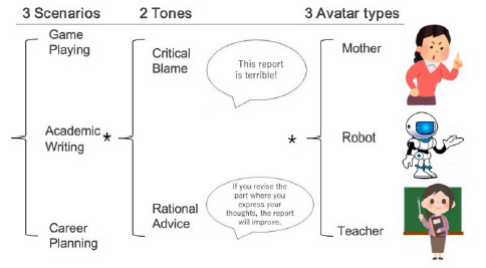
EXPERIMENTAL METHODS In this research we conducted a 3 Task Scenarios (Game Playing / Academic Writing / Career Planning) * 2 Communication Tones (Critical Blame / Rational Advice) * 3 Avatar Types (Mother / Robot / Teacher) within-subject design. Each participant experienced all 18 combinations of conditions (see Figure 1). 3 Scenarios were presented as three separate blocks. The order of the three blocks and the six conditions in each block was balanced among participants. Each participant was required to complete two stages of the experimental tasks:
Stage 1: fNIRS Recording During Stimulus Presentation. Participants first read a brief university-life scenario and imagined themselves as the protagonist. Six static images were then presented sequentially, each showing an avatar delivering advice in either a rational or critical tone. Participants silently read and reflected without responding. Each trial included a 29-s rest, 1-s fixation, and 10-s stimulus presentation, repeated twice per stimulus. Prefrontal hemodynamic activity was recorded using fNIRS, with oxygenated hemoglobin (Oxy-Hb) as the neural index. To account for the hemodynamic delay, analyses used a window beginning 5 s after stimulus onset.
Stage 2: Post-Task Evaluation. After scanning, participants rated their Acceptance of each piece of advice on a 10-point Likert scale (1 = strongly disagree, 10 = strongly agree).
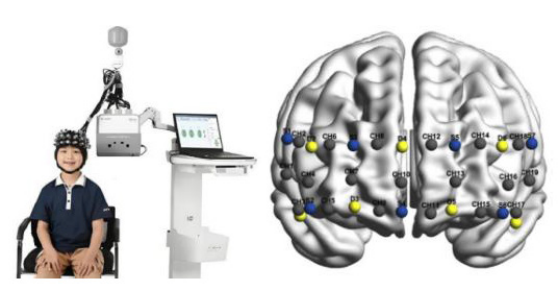
Hemodynamic data were recorded using a 19-channel NirSmart-3000S fNIRS system (11 Hz; 730/850 nm), with optodes arranged in a 2 × 7 grid over bilateral prefrontal and temporal regions (see Figure 2). Oxy-Hb changes
The Relationship Between Avatar Social Attributes and Advice Acceptance in PCIT 175 served as the index of cortical activation, focusing on areas associated with cognitive control and social processing. Signals were band-pass filtered (0.007–0.8 Hz), motion-corrected, and smoothed (1-s moving average). Blocks exceeding ±0.3 mM·mm were excluded (Liu et al., 2023).
RESULTS AND INTERPRETATIONS We conducted parallel experiments in Japan and China. The Japanese sample comprised 25 participants (14 males, age M = 24.50, SD = 1.32). The Chinese sample consisted of 24 participants (12 males, age M = 24.79, SD = 1.89).
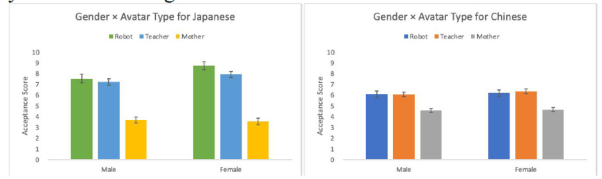
Subjective Ratings on Response Acceptance 1) Gender × Avatar Type ANOVA Results (see Figure 3) A mixed-design analysis of variance (ANOVA) was conducted to examine the effects of Gender (male, female) and Avatar Type (Mother, Robot, Teacher) on participants’ response acceptance ratings. Gender was treated as a between-subjects factor, and Avatar Type as a within-subjects factor. For Japanese participants, Avatar Type showed a significant main effect (p < .001; Robot > Teacher > Mother). Gender was not significant (p = .085), but the interaction was significant (p < .05). Bonferroni tests indicated that
females rated the Robot avatar higher than males (8.75 vs. 7.56, p < .01); no gender differences emerged for Teacher or Mother. For Chinese participants, Avatar Type was significant (p < .001; Robot and Teacher > Mother), whereas Gender (p = .592) and the interaction (p = .813) were not significant. Thus, avatar type consistently influenced acceptance in both cultures, with Mother rated lowest. A gender effect appeared only in Japan for the Robot avatar, suggesting culture-specific gender sensitivity to non-human agents.
Figure 3: Gender × Avatar Type for Japanese and Chinese.
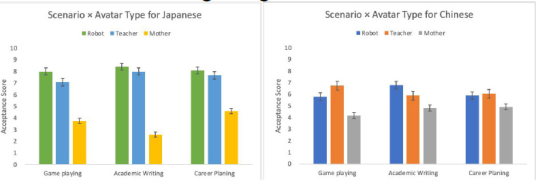
2) Scenario × Avatar Type ANOVA Results (see Figure 4) A repeated-measures analysis of variance (ANOVA) was conducted to examine the effects of Scenario (Game Playing, Academic Writing, Career Planning) and Avatar Type (Mother, Robot, Teacher) on participants’ response acceptance ratings. Both factors were treated as within-subjects variables. For Japanese participants, Scenario was not significant (p = .280), but Avatar Type was (p < .001; Robot > Teacher > Mother). The interaction was significant (p < .001). The Robot avatar showed no scenario differences; Teacher was rated higher in Academic Writing than Game (p < .01); Mother remained lowest, especially in Academic contexts. For Chinese participants, Scenario was not significant (p = .510), while Avatar Type (p < .001) and the interaction (p < .001) were significant. In Game contexts, Teacher > Robot (p < .01); in Academic Writing, Robot > Teacher (p < .05); no difference appeared in Career Planning. Mother remained consistently low. Overall, cross-cultural differences were also evident: in Japan, the robot avatar consistently elicited the highest acceptance across contexts. In China, however, the relative effectiveness of robot and teacher avatars varied by task—the robot was more favorably received in academic tasks such as essay writing, whereas the teacher was better accepted in entertainment-related interaction contexts such as gaming.
Figure 4: Scenario × Avatar Type for Japanese and Chinese.
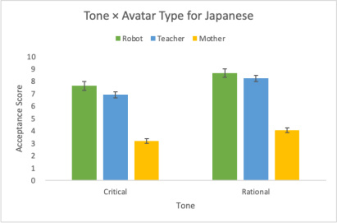
3) Tone × Avatar Type ANOVA Results (see Figure 5) A repeated-measures analysis of variance (ANOVA) was conducted to examine the effects of Communication Tone (Critical Blame, Rational Advice) and Avatar Type (Mother, Robot, Teacher) on participants’ response acceptance ratings. Both factors were treated as within-subjects variables. For both cultures, Tone showed a strong main effect (p < .001), with Rational > Critical. Avatar Type was also significant (p < .001). Notably, the mother avatar paired with a critical tone received the lowest acceptance ratings overall. In Japan, the interaction was not significant (p = .253), indicating stable Robot > Teacher > Mother across tones. In China, the interaction was significant (p < .01). Under Rational tone, Teacher > Robot (p < .01); under Critical tone, Robot > Teacher (p < .05). The Mother avatar showed the largest improvement from Critical to Rational tone (p < .001). Overall, Rational tone consistently enhanced acceptance than Critical tone—a pattern consistent with core principles of PCIT. Tone effects were more differentiated across avatar types in China, robot avatars tended to receive slightly higher acceptance than teachers under critical conditions, whereas teacher avatars showed higher acceptance than robots under rational conditions.
Figure 5: Tone × Avatar Type for Japanese and Chinese.
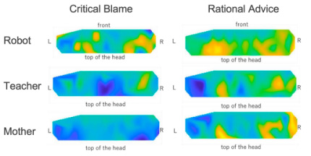
Neural evidence by fNIRS measurements (see Figure 6) 1) Image-Based Activation Patterns Topographical maps of oxygenated hemoglobin (Oxy-Hb) concentration were examined to compare neural response patterns across Tone × Avatar Type conditions, regions marked in orange indicate strong neural activation, whereas blue regions indicate minimal activation.
The processing of different stimuli by Japan and China revealed common neural activity patterns. Robot avatars elicited broader prefrontal activation, suggesting cognitively driven processing. Teacher avatars activated language and social-cognitive regions, consistent with instructional role expectations. Mother avatars showed reduced and undifferentiated activation, possibly reflecting emotional interference or reduced engagement. Rational tone induced broader prefrontal and temporal activation, whereas Critical tone showed reduced PFC engagement, particularly for the Mother avatar. These neural patterns aligned with behavioral findings. Together, these image- based neural patterns complement the behavioral findings by suggesting that
communication tone and avatar social identity shape not only acceptance judgments but also the qualitative organization of neural processing.
Figure 6: Neural activity imaging from fNIRS for Japanese (left) and Chinese (right).
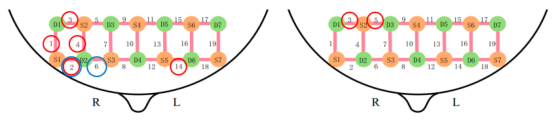
2) Channel-Level Contrast Analysis: Rational vs. Critical (see Figure 7) To further examine localized neural differences between communication tones, paired-sample t tests were conducted comparing rational versus critical tone conditions for each of the 19 fNIRS channels, separately for each avatar type.
For Japanese participants, significant tone differences emerged primarily for the Robot avatar (ch1–4, ch14; PFC regions), and to a lesser extent for Teacher (ch2, ch6; temporal areas). No significant differences were found for Mother. For Chinese participants, tone differences appeared only for the Robot avatar (ch3, ch5; right PFC). No significant effects were found for Teacher or Mother.
Notably, the neural response patterns were broadly similar across Chinese and Japanese participants. However, Japanese participants exhibited a greater number of channels showing significant tone-based differentiation compared to their Chinese counterparts. This cross-cultural difference may reflect relatively reduced sensitivity to communicative tone among Chinese participants, potentially stemming from cultural socialization that emphasizes hierarchical role expectations and greater habituation to authority-directed communication.
Figure 7: Locations of differential channels for Japanese (left) and Chinese (right).
DISCUSSIONS This study examined how avatar identity (Mother, Teacher, Robot) and communication tone (Rational vs. Critical) jointly influence acceptance and neural processing in Chinese and Japanese participants. Extending PCIT to adult digital contexts, we integrated behavioral and fNIRS data to identify universal and culture-specific patterns.
Common Finding 1: Universal Tone Effect (Rational > Critical) For both cultures, rational tone consistently produced higher acceptance than critical tone, regardless of avatar or scenario. This supports PCIT’s distinction between supportive “Do Skills” and critical “Don’t Skills,” suggesting that autonomy-supportive communication generalizes to adult AI-mediated instruction. Neurally, rational tone elicited relatively greater prefrontal and temporal activation, whereas critical tone showed reduced prefrontal engagement, consistent with cognitive control and conflict-monitoring models. Together, findings indicate that rational tone facilitates cognitive engagement, while critical tone induces defensive or disengaged processing. This effect was culturally invariant, suggesting a universal design principle.
Common Finding 2: Stable Avatar Hierarchy Across Cultures Across cultures, acceptance followed a stable pattern: Robot and Teacher > Mother. The Mother avatar consistently received the lowest ratings, especially in academic contexts, and showed minimal neural differentiation. This likely reflects role incongruence in adult settings, where maternal authority may activate affective schemas rather than task-focused evaluation. Robot avatars showed clearer tone-related modulation in right prefrontal regions associated with cognitive control, suggesting more analytic, less emotionally biased processing. Teacher avatars produced intermediate effects. Thus, avatar identity shapes both subjective acceptance and neural organization of advice processing.
Cross-Cultural Difference 1: Gender Effects in Robot Acceptance Gender differences were observed only in the Japanese sample, where female participants showed significantly higher acceptance of robot avatars than males. No gender differences emerged in the Chinese sample. One interpretation is that in Japan, exposure to socially assistive and care-related robots may be more gender-differentiated, leading to greater emotional familiarity among women (Bartneck et al., 2009). In contrast, Chinese participants may experience more gender-neutral technology education and evaluation standards, resulting in convergence of technology attitudes across genders. This finding indicates that gendered socialization may interact with cultural narratives about robots, but such effects are not universal across East Asian contexts.
Cross-Cultural Difference 2: Robot vs. Teacher Preference Patterns Japanese participants consistently preferred Robot avatars across scenarios, suggesting that technical systems may be perceived as stable, context- independent authorities. This pattern aligns with prior evidence that Japanese users display relatively high acceptance of robotic agents in social roles (Bartneck et al., 2009). Chinese participants, however, demonstrated context- dependent preferences. In the Game scenario, Teacher > Robot; in the Essay scenario, Robot > Teacher. This divergence likely reflects sociocultural scripts surrounding educational authority. Teachers historically regulate gaming behavior in China, enhancing their legitimacy in leisure-control contexts. Conversely, academic pressure associated with teachers may trigger self-esteem
protection mechanisms, making robot-delivered academic advice more acceptable due to its perceived objectivity and reduced psychological threat.
Cross-Cultural Difference 3: Neural Sensitivity Differences At the neural level, Japanese participants exhibited broader channel- level differentiation across avatars and tones. Robot conditions activated multiple prefrontal channels; Teacher conditions showed limited language/ social activation; Mother conditions showed none. Chinese participants displayed fewer significant channel differences. Only two right prefrontal channels showed tone-related differences for the Robot avatar; no significant differentiation emerged for Teacher or Mother. This reduced neural sensitivity among Chinese participants may reflect higher familiarity with pedagogical authority and more routinized processing of hierarchical cues (Hofstede, 2001). In other words, advice from authority-related roles may be processed more automatically, resulting in attenuated modulation by tone or avatar identity. In contrast, Japanese participants may evaluate advisor roles more contingently, producing stronger neural differentiation.
RESEARCH IMPLICATIONS This study extends PCIT to adult advisory intervention contexts, demonstrating that the universal advantage of rational over critical tone reflects domain- general mechanisms of cognitive control and reduced psychological reactance. By integrating social role theory, the findings show that avatar identity shapes advice processing through role congruence effects, while robots elicit more analytic and tone-sensitive neural responses than human-like avatars, suggesting that perceived artificiality modulates social schema activation. Right prefrontal modulation further implicates cognitive control networks in evaluative processing, with cultural variation influencing both explicit judgments and neural sensitivity.
Practically, rational, explanatory communication should be prioritized in avatar-based coaching systems. Robot avatars function as culturally adaptable defaults, particularly in Japan where robot-first and gender-sensitive personalization may enhance engagement. In China, scenario-dependent role calibration (e.g., teacher vs. robot) may better align with contextual authority expectations, supporting culturally adaptive system design.
LIMITATIONS AND FUTURE DIRECTIONS Several limitations must be acknowledged. The sample included only university students, limiting generalizability. Scenarios were restricted to academic contexts. Avatars were static, reducing ecological validity. fNIRS captured cortical but not subcortical affective processes.
Future research should extend this work in several strategic directions: Extend comparisons beyond East Asia; Use interactive, conversational avatars; Test longitudinal learning and behavioral outcomes; Conduct field experiments in real-world AI platforms; Develop computational models integrating culture, role schema, and tone.
CONCLUSION
This study provides a cross-cultural neuroscientific investigation of avatar- mediated advice acceptance grounded in PCIT principles. Across Chinese and Japanese university students, rational communication universally enhanced acceptance and prefrontal engagement, confirming that constructive guidance constitutes a fundamental design principle in digital advisory systems.
A stable avatar hierarchy emerged, with Robot and Teacher avatars consistently outperforming Mother avatars. However, cultural moderation shaped gender patterns, role–context calibration, and neural sensitivity to tone. Japanese participants demonstrated broader neural differentiation and a robot-first preference, whereas Chinese participants exhibited context- dependent role selection and reduced neural modulation to authority cues.
By integrating behavioral ratings with fNIRS evidence, this research demonstrates that avatar social identity influences not only subjective trust but also the neural architecture of cognitive control. The findings extend PCIT theory to adult digital interaction, refine social role theory within artificial-agent contexts, and reveal culturally embedded mechanisms of authority processing.
As AI tutors and avatar-based coaching systems become increasingly integrated into global education and mental health infrastructures, culturally adaptive design grounded in cognitive and neuroscientific evidence will be essential. Rational communication and context-sensitive avatar selection represent foundational principles for developing intelligent, scalable, and psychologically sustainable human–AI advisory systems.
ACKNOWLEDGMENT
This research was collaboratively conducted by Chuo University (Japan) and Tsinghua University (China). The authors declare no commercial or financial relationships that could be construed as potential conflicts of interest and have no relevant financial or non-financial interests to disclose. All procedures involving human participants were conducted in accordance with institutional and national ethical standards and the 1964 Helsinki Declaration and its later amendments. Written informed consent was obtained from all participants for data collection and publication of anonymized results.
REFERENCES
Bailenson, J.N. and Blascovich, J. (2004) ‘Avatars’, in Bainbridge, W.S. (ed.)
Encyclopedia of human-computer interaction. Berkshire: Berkshire Publishing Group, pp. 64–68. Bartneck, C., Kanda, T., Mubin, O. and Al Mahmud, A. (2009a) ‘Does the design of a robot influence its animacy and perceived intelligence?’, International Journal of Social Robotics, 1(2), pp. 195–204. Bartneck, C., Kulić, D., Croft, E. and Zoghbi, S. (2009b) ‘Measurement instruments
for the anthropomorphism, animacy, likeability, perceived intelligence, and perceived safety of robots’, International Journal of Social Robotics, 1(1), pp. 71–81.
Baylor, A.L. and Kim, Y. (2005) ‘Simulating instructional roles through pedagogical agents’, International Journal of Artificial Intelligence in Education, 15(1), pp. 95–115. Botvinick, M.M., Cohen, J.D. and Carter, C.S. (2004) ‘Conflict monitoring and cognitive
control’, Psychological Review, 108(3), pp. 624–652. https://doi.org/10.1037/0033- 295X.108.3.624 Cialdini, R.B. and Goldstein, N.J. (2004) ‘Social influence: Compliance and conformity’, Annual Review of Psychology, 55, pp. 591–621. https://doi.org/10.1146/annurev. psych.55.090902.142015 Comer, J.S. et al. (2017) ‘Internet-delivered, family-based treatment for early-onset
OCD: A pilot randomized trial’, Journal of Consulting and Clinical Psychology, 85(2), pp. 178–186. https://doi.org/10.1037/ccp0000155 Eagly, A.H. and Wood, W. (2012) ‘Social role theory’, in Van Lange, P.A.M., Kruglanski, A.W. and Higgins, E.T. (eds.) Handbook of theories of social psychology. Vol. 2. London: Sage Publications, pp. 458–476. Eyberg, S.M. and Robinson, E.A. (1983) ‘Dyadic parent-child interaction coding
system: A manual’, Psychological Documents, 13, p. 24. Gurwitch, R.H., Salem, H., Nelson, M.M. and Comer, J.S. (2020) ‘Leveraging parent– child interaction therapy and telehealth capacities during the COVID-19 public health crisis’, Cognitive and Behavioral Practice, 27(4), pp. 443–454. https://doi. org/10.1016/j.cbpra.2020.05.001 Hattie, J. and Timperley, H. (2007) ‘The power of feedback’, Review of Educational
Research, 77(1), pp. 81–112. https://doi.org/10.3102/003465430298487 Hofstede, G. (2001) Culture’s consequences: Comparing values, behaviors, institutions and organizations across nations. 2nd edn. Thousand Oaks, CA: Sage Publications. Kluger, A.N. and DeNisi, A. (1996) ‘The effects of feedback interventions on performance:
A historical review, a meta-analysis, and a preliminary feedback intervention theory’, Psychological Bulletin, 119(2), pp. 254–284. https://doi.org/10.1037/0033- 2909.119.2.254 Liu, B., Yu, J., Wu, J., Qin, Y., Xiao, W. and Ren, Z. (2023) ‘Runners with better cardiorespiratory fitness had higher prefrontal cortex activity during both single and exercise-executive function dual tasks: An fNIRS study’, Frontiers in Physiology, 14, 1246741. Markus, H.R. and Kitayama, S. (1991) ‘Culture and the self: Implications for
cognition, emotion, and motivation’, Psychological Review, 98(2), pp. 224–253. https://doi.org/10.1037/0033-295X.98.2.224 Nomura, T., Suzuki, T., Kanda, T. and Kato, K. (2006) ‘Measurement of negative attitudes toward robots’, Interaction Studies, 7(3), pp. 437–454. https://doi. org/10.1075/is.7.3.14nom Reeves, B. and Nass, C. (1996) The media equation: How people treat computers,
television, and new media like real people and places. Cambridge: Cambridge University Press. Schroeder, N.L., Adesope, O.O. and Gilbert, R.B. (2018) ‘How effective are pedagogical agents for learning? A meta-analytic review’, Journal of Educational Psychology, 110(8), pp. 1149–1171. https://doi.org/10.1037/edu0000249 Thomas, R., Abell, B., Webb, H.J., Avdagic, E. and Zimmer-Gembeck, M.J. (2017)
‘Parent–child interaction therapy: A meta-analysis’, Pediatrics, 140(3), e20170352. https://doi.org/10.1542/peds.2017-0352
LISTED IN THE AHFE DIGITAL BOOKSTORE CATALOGUE
Explore the complete digital volume
Neuroergonomics and Cognitive Engineering
Read this individual research paper free through the original publisher, or explore the full digital proceedings book.
ISBN 978-1-964867-83-0
Explore this ISBN in the AHFE Bookstore ↗Listed in the July 2026 bookstore catalogue; search by ISBN to confirm current availability · Digital book purchase optional