Brandon Cuffie (2023). From Handicrafts to Habitat: Investigating Terite's Applications in Space. In: Human Systems Engineering and Design (IHSED 2023): Future Trends and Applications. AHFE Open Access, vol. 112, pp. 235–244. https://doi.org/10.54941/ahfe1004134
The challenges associated with prolonged human space exploration missions require sustainable and innovative approaches to ensure the health and well-being of astronauts. Many indigenous plants around the world can potentially serve as valuable resources for long-duration space missions. The raw material Ischnosiphon Axouma commonly known as (Terite) is indigenous to the island of Trinidad. Before the 15th century, terite was used in weaving by the island's indigenous inhabitants to make household items, such as baskets for fishing, jewelry, and utensils that lasted a lifetime. Some of the weaving techniques used have been passed on to generations and are present today. The terite is cut from the stalk and split into equal widths to extract the raw material strands. The roots are left intact to ensure continuous growth; they self-replenish. The strands produce eco-friendly craft items such as; tabletops, lampshades, book covers, plates, teacup holders, and more. The leaves have the potential to be used to make sanitary plates and bowls. The inner part of the stalk is used as a natural fertilizer for plants. Thus most of the Terite plant can be utilised with minimum wastage. In this paper, a design thinking approach is outlined to help us identify and evaluate potential experiments that could yield innovative solutions to the challenges of space habitation. It also identifies the areas of study and the considerations that are necessary to long-duration space travel and the potential for the development of space tourism within the Caribbean region.In this paper, we propose potential experiments to begin to explore terite as a sustainable and multifunctional resource in space. The experiments are as follows:(1) Cultivation and processing: Experiments done in this area would focus on optimizing the cultivation and processing of Terite in space habitats and other planets. This would involve testing the feasibility of growing Terite in different conditions, including various lighting and temperature settings. Additionally, we would investigate the best methods for processing Terite, such as drying and extracting its fibres, to maximize its usefulness as a resource.(2) Construction Application: these experiments would examine Terite's potential applications as a material for construction in space habitats. We would test its mechanical properties, such as its tensile strength, elasticity, and toughness, to determine its suitability for different engineering applications and astronaut personal items to survive under space conditions. Additionally, we would investigate its compatibility with other materials commonly used in space habitats, such as metals and plastics.(3) Reinforced 3D printing: the experiment would aim to determine whether Terite fibers can be a useful and sustainable reinforcement for 3D printing in space, providing additional strength and durability to printed objects while reducing the need for synthetic materials.By taking a design thinking approach, we can not only explore the potential of Terite as a valuable resource for space exploration and long-duration space missions but also uncover new opportunities for innovation and collaboration across different fields and disciplines. Ultimately, this approach can help us design more sustainable, efficient, and user-centred solutions for the challenges of space habitation.
Space exploration over prolonged periods presents a multitude of challenges, including the necessity for innovative and viable approaches to safeguard the well-being and medical necessities of astronauts. These missions are heav- ily criticized for their high risk, high expense, and low return characteristics (Piantadosi, 2012). The manifestation of empirical evidence and thorough investigation attests to the paramount importance of prioritizing human space exploration. Creating sustainable solutions is necessary. Space mis- sions require careful management of resources, including food, water, and air; thus, sustainable approaches can help conserve these resources, mak- ing them last longer and reducing the need for resupply missions. By utilizing locally accessible resources and lowering the requirement for expensive mate- rials and equipment, these novel ideas have the potential to lower the cost of
space missions. It is within the realm of possibility that this effort could also enhance the prolonged viability of human space exploration by reducing the impact on natural resources and promoting the use of renewable resources.
Indigenous plants are a significant potential source of renewable and sus- tainable benefits. Primarily, the flora in question can confer a self-sufficient sustenance reserve for astronauts; an indispensable factor during prolonged expeditions where resupply from Earth is unfeasible. Some plants possess the ability to generate life-sustaining oxygen via photosynthesis, a vital function in maintaining human existence within an enclosed setting. Additional flora could potentially serve as sources for organic pigments or textile materials, which may be fashioned into garments and other essential goods required within a given environment. Moreover, certain vegetation may possess thera- peutic attributes that have the potential to be advantageous in treating illness or injury. An inherent benefit of utilizing native vegetation lies in their intrin- sic adaptation to the surrounding landscape, affording them the ability to flourish with minimal human influence. This means that they require less energy, water, and other resources than other plants. It is possible to uti- lize the unrepeatable qualities of these plants and adjust them according to spatial parameters in order to construct effective, sustainable resolutions that guarantee human life in space while minimizing the impact on the environment.
DESIGN THINKING APPROACH As we explore the potential of Terite as a multi-functional resource for space exploration, a design thinking approach can help us identify and evaluate potential experiments that could yield innovative solutions to the challenges of space habitation. As a practical approach to creativity and innovation in design, our design approach begins by identifying the user’s needs and under- standing the problem that needs to be solved (Meinel & Leifer, 2018). The astronaut has many physical and psychological challenges with long-duration space missions. The role of the astronaut, the user in question, pertains to addressing a pressing issue, namely, developing resource options that are both forward-thinking and reliable for extensive expeditions into space.
Figure 1: Design thinking approach applied to investigating Terite (adapted from Cuffie et al., 2018).
From the information gathered from the empathy phase, it was identi- fied that there is a need for sustainable and innovative approaches to ensure the health and well-being of astronauts on long-duration space missions.
From Handicrafts to Habitat: Investigating Terite’s Applications in Space 237
We also recognized the potential for indigenous plants, such as Ischnosiphon obliquus, to serve as valuable resources in space habitats.
The crucial questions of “What is a possible solution?” and “What to test?” were answered based on the synthesis of empathizing. and the prob- lem statement. Based on our ideation brainstorming sessions and research, an assortment of ideas and solutions were considered to optimize the cultiva- tion and processing of Ischnosiphon obliquus in space habitats and on other planets. Terite was also considered for its potential applications as a material for construction in space habitats and its suitability as a reinforcement for 3D printing.
TERITE AS A SUSTAINABLE RESOURCE One plant that, from initial observations, has shown potential for space exploration is Ischnosiphon obliquus, commonly known as Terite (Nielson, 1966). It is an indigenous plant to the island of Trinidad. It has been used for centuries by the island’s early inhabitants for weaving handicrafts
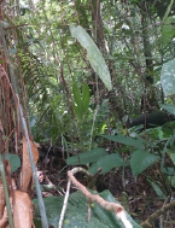
It typically grows to a height of two to three meters and has long, narrow leaves and a cylindrical stem or rod (Figure 2). The terite plants grow in clus- ters, and you can harvest fully grown plants at any time of the year (Fern, 2022). The plants to be harvested are selected if they have seven or more leaves. The plant is known for its strong and durable fibres, which have been used for centuries to create a variety of woven items, including baskets, mats, and clothing.
Figure 2: (LEFT) a Terite stem (rod) with leaves found in the forest; (RIGHT) Terite strands after cultivation, drying, and preparation for weaving.
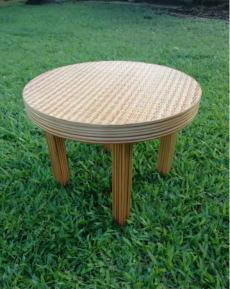
The raw material is extracted by cutting the stalk and splitting it into equal widths to obtain strands that can be used for weaving. They are then placed in the sun to dry for three to four days to get brown; the terite rods were orig- inally green (Figure 2). The roots are left intact to ensure continuous growth, making it a sustainable resource. The strands are then woven into different items such as cabinets, lamps, and shades, even a coffee table (Figure 3); basically, anything that can be imagined.
Additionally, the leaves have the potential to be used to make sanitary plates and bowls, and the inner part of the stalk is used as a natural fertilizer for plants, making it a multifunctional resource with minimum waste.
238 Cuffie
Figure 3: (LEFT) a coffee table made from terite strands; (RIGHT) a coffee table and serving tray made from terite.
Moreover, terite exhibits immense promise as an eco-friendly alternative for space expeditions. Its fibres possess the capability to produce a range of essentials required during long-duration missions, such as housing com- ponents and personalized articles utilized by astronauts. Terite is a resilient and eco-friendly plant that also has the possibility to thrive in various envi- ronmental conditions, making it a very promising candidate for use in space habitats or on other planets
PROPOSED EXPERIMENTS A. Cultivation and Processing
For long-duration missions, astronauts want to bring plants for both aesthetic and practical reasons (Growing Plants in Space, 2021). They are good for psychological well-being while being critical for keeping astronauts healthy. It will be important for the crew to reliably grow plants in altered microgravity conditions.
To optimize the cultivation and processing of Terite in different condi- tions, we can design experiments that focus on determining the ideal growth conditions for the plant, such as lighting and temperature settings, and soil compositions. This could involve testing the growth of Terite in different sim- ulated environments that mimic conditions found in space habitats or other planets.
Additionally, to investigate processing methods for maximizing Terite’s usefulness as a resource, we can conduct experiments to test the best ways to extract and process the plant’s weavable fibres. This could include test- ing diverse drying methods to determine the optimal moisture content for the fibres. Similarly, examining different techniques and tools (either cur- rent or to be designed) for extracting fibres can be conducted to ensure that they are of the highest quality and strength. A similar approach can be taken for all functional parts of the plant, including the leaves and interior stalk fibres.
From Handicrafts to Habitat: Investigating Terite’s Applications in Space 239
Table 1. List of experiments and procedures that can be developed for cultivation and processing.
Table available in the original PDF paper.
Experiment Procedure Data Collection Cultivation of terite under different light conditions The growth rate, plant height, and weight of Terite plants will be measured regularly to compare the effects of different light conditions on terite growth.
Terite plantlings (or seeds) will be transplanted into different containers, and each container will be placed under different light conditions (low, medium, and high). The containers will be placed in a controlled environment with the same temperature and humidity level.
Cultivation of Terite under different temperature conditions
Terite plantlings (or seeds) will be transplanted into different containers, and each container will be placed under different temperature conditions (low, medium, and high). The containers will be placed in a controlled environment with the same light and humidity levels
The growth rate, plant height, and weight of Terite plants will be measured regularly to compare the effects of different temperature conditions on Terite growth. Investigation of processing methods for maximizing Terite’s usefulness as a resource
The quality of terite fibres and materials produced using different processing methods will be assessed based on factors such as strength, durability, and suitability for various applications.
Different processing methods for terite will be investigated, including drying and extracting its weavable fibres. Terite plants will be harvested and processed using different methods, and the resulting materials will be tested for their quality and usefulness in different applications.
B. Construction Application Advancements in technology and construction methods are making it pos- sible to accomplish more space development than ever before (NASA Tech- nology Innovation 17.1, n.d.). NASA has been developing technologies and practices to build structures on the surface of other planets using “in-situ” or on-site resources (Leach, 2014), Thus, to overcome the challenges of space construction, it’s important to use the right materials and tools, which are achieved with rapidly developing tools and technology (“Space Construction: The Industry’s New Frontier,” 2020).
As we explore the multifunctional potential of terite for long-duration space missions, it is crucial to assess its mechanical properties and compat- ibility with other materials commonly used in space habitats. This would begin with the examination of terite’s mechanical properties for different engineering applications and astronaut personal items. These applications require a series of tests to determine the material’s tensile strength, elasticity, and toughness.
The second series of tests would set out to determine how terite interacts with other materials, such as metals and plastics, commonly used in space habitats.
The data collected from the first tests can be used to assess the suitability of terite for different engineering applications. These include building struc- tures, personal equipment, and protective gear for astronauts. Additionally, the data can inform the development of standards and guidelines for using terite in space missions.
240 Cuffie
Table 2. A list of experiments and procedures that can be developed for construction applications.
Table available in the original PDF paper.
Experiment Procedure Data Collection Examination of Terite’s mechanical properties for different engineering applications and astronaut personal items Tensile strength data (in units of force per unit area) Elasticity data (in units of strain per unit stress) Toughness data (in units of energy absorbed per unit volume) Variations in mechanical properties with temperature and humidity changes Prepare a sample of terite with standard size and shape. Conduct tensile testing to determine the material’s tensile strength. Conduct bending testing to determine the material’s elasticity. Conduct impact testing to determine the material’s toughness. Repeat the above tests under different conditions, such as temperature and humidity variations. Analyze the test results and determine the material’s mechanical properties for different engineering applications and personal items.
Investigation of compatibility with other materials used in space habitats
Observation of physical changes Chemical composition and surface morphology analysis Compatibility assessment with other space habitat materials under different conditions.
Prepare a sample of terite and other common space habitat materials, such as metals and plastics. Conduct compatibility testing by exposing the materials to different conditions, such as temperature and humidity variations. Observe and record any physical changes, such as warping or cracking. Conduct material analysis, such as chemical composition and surface morphology, to determine any chemical reactions or adhesion between materials. Repeat the above tests with different combinations of materials. Analyze the test results and determine the compatibility of terite with other materials used in space habitats.
The data collected from the second set of tests can be used to determine the optimal conditions for using terite in conjunction with other materials in space habitats. Also, the data can be used in the development of guidelines for the use and storage of terite in space habitats to minimize any potential interactions or negative effects.
C. Reinforced 3D Printing Fiber-reinforced polymer (FRP) composites have been widely used in vari- ous industrial fields, such as building materials, auto parts, and electronic
From Handicrafts to Habitat: Investigating Terite’s Applications in Space 241
components, due to their superior properties and versatility (Yuchao et al., 2022). FRP products are usually required to be dedicated and customized in practical applications.
To determine terite strands’ or fibres’ usefulness and sustainability as a reinforcement for 3D printing in space, the fibres will be tested for their com- patibility with other materials used in space habitats, such as polymers and metals.
Table 3. A list of experiments and procedures that can be developed for use in reinforced 3D printing.
Table available in the original PDF paper.
Experiment Procedure Data Collection Determining Terite fibres’ usefulness and sustainability as a reinforcement for 3D printing in space Preparation of Terite fibres: Terite stalks will be cut and split into equal widths to extract the raw material strands. The extracted strands will then be processed and dried to optimize their usefulness as a resource. 3D printing with Terite fibres: The 3D printing experiment will aim to test Terite fibres’ suitability as a reinforcement for 3D printing in space. The 3D printing process will be carried out with a 3D printer that can handle the Terite fibres. The printing will be done with different proportions of Terite fibres and other printing materials to determine the optimal ratio for maximum strength and durability.
The weight of the Terite fibres before and after processing will be recorded to determine the percentage of weight loss during processing. The strength and durability of the printed objects will be measured by subjecting them to mechanical testing. The data collected will include the maximum load the object can handle, the deformation under load, and the ultimate tensile strength. The compatibility of Terite fibres with other printing materials will be assessed by observing any changes in the physical and mechanical properties of the printed objects after exposure to different environmental conditions. Potential for reducing the need for synthetic materials
The physical and mechanical properties of Terite fibres and the synthetic materials commonly used in space habitats will be recorded. The performance of Terite fibre-reinforced objects will be assessed by subjecting them to the same types of mechanical testing as the synthetic material objects. The amount of synthetic materials that can be replaced with Terite fibers in different types of objects will be recorded to determine the potential for reducing the need for synthetic materials in space habitats.
Identification of synthetic materials: The synthetic materials commonly used in space habitats will be identified, and their properties will be recorded. These properties include the materials’ strength, durability, and resistance to different types of stress. Comparison of Terite fibres with synthetic materials: The properties of Terite fibres will be compared to those of the synthetic materials commonly used in space habitats. This will be done by subjecting both materials to the same types of mechanical testing under different environmental conditions. Experimentation: The Terite fibres will be used as a reinforcement material for different types of objects commonly used in space habitats. These objects include utensils, personal items, and structural components. The performance of the Terite fibre-reinforced objects will be compared to that of similar objects made from synthetic materials.
The potential for terite to reduce the need for synthetic materials in space exploration is significant. Synthetic materials are often costly to transport and difficult to recycle, making them an unsustainable option for prolonged
242 Cuffie
space missions. In contrast, terite can be sustainably cultivated and processed, positioning it as an environmentally friendly alternative.
LIMITATIONS Conducting these experiments may face challenges due to the limitations of resources, equipment, and the complexity of the space environment.
Table 4. A list of some limitations for each experiment group.
Table available in the original PDF paper.
Experiment Limitations A. Cultivation and Processing:
The availability of resources and equipment for the culti- vation and processing of terite in space may be limited.
The impact of the space environment on the growth and development of Terite needs to be considered.
The experiment may be time-consuming and require fre- quent monitoring. B. Construction Application:
The mechanical properties of terite may not be suitable for all engineering applications in space.
The compatibility of terite with other materials used in space habitats needs to be thoroughly investigated before application.
The experiment may require sophisticated equipment and tools for testing mechanical properties. C. Reinforced 3D Printing:
The sustainability and long-term durability of Terite fibres as a reinforcement for 3D printing in space need to be evaluated.
The experiment may require special 3D printing equipment that can incorporate Terite fibres.
The effectiveness of Terite fibres as a reinforcement mate- rial needs to be compared to existing reinforcement mate- rials.
Nonetheless, these limitations can be overcome with innovative solutions and interdisciplinary collaborations.
CONCLUSION
In conclusion, the design thinking approach is a valuable tool for explor- ing Terite’s potential in space exploration. By identifying user needs and problems, researchers can ideate and develop experiments and procedures that optimize Terite’s cultivation, processing, mechanical properties, and sus- tainability as a reinforcement for 3D printing. These experiments present opportunities for collaboration and innovation across fields and disciplines, bringing together experts in agriculture, engineering, materials science, and astronautics to create user-centred and sustainable space habitation solutions. In Table 5, we can observe several potential endeavours and investigations that will derive from the outcomes of these preliminary trials.
From Handicrafts to Habitat: Investigating Terite’s Applications in Space 243
Table 5. Potential experiments that could be conducted with Terite.
Table available in the original PDF paper.
# Future Potential Experiments 1 Exploration of the potential of Terite as a resource for space tourism, including its use in handicrafts and other souvenirs for visitors. 2 Study of the effects of cosmic radiation and other space hazards on Terite fibers and their potential degradation over time. 3 Study of the effects of microgravity on Terite growth and processing. 4 Study of the potential of Terite as a source of medicine or other bioactive compounds in space. 5 Testing the biodegradability of Terite fibers in space and their potential use in composting systems. 6 Investigation of Terite’s potential as a material for insulation in space habitats.
The triumphant development and implementation of terite in space could reduce our reliance on synthetic materials while facilitating more eco-friendly and efficient space exploration. With continued exploration and experimen- tation, Terite’s potential as a versatile and sustainable resource for space exploration may hold exciting possibilities for the future.
ACKNOWLEDGEMENTS
The author is grateful for the support of the Assistant and Senior Conservator of Forests of the Forestry Division of the Ministry of Land, Agriculture, and Fisheries, of Trinidad and Tobago for the wealth of information given, and for giving access to their vast libraries and to the protected forested areas.
The author would also like to thank the Training and Development Man- ager and Staff at Export Centres Company Limited (ECCL) Trinidad; Susan Narine, Shane Pantin, Chinasa Begg, Ann Gillian Monsegue, Dell Thomas, Lisa Downes, Abigail Joefield, and Terite expert Margaret Hospedales. That team and I are the key players in the project Embryo: Re-engineering, Explor- ing, and Expanding the Craft Sector, which focuses on research and support, including the acquisition and processing of terite, product development, the creation of innovative technology, and quality production for export.
REFERENCES
Cuffie, B., Bernard, T., Kaya, M., Scott, W., & Stephane, L. (2018). “Proposed Architecture of a Sensory Enhanced Suit for Space Applications”, in AIAA Space and Astronautics Forum and Exposition 2018, Orlando, FL. pp. 1066–1075. Curran Associates, Inc. Fern, K. (2022, July 20). Ischnosiphon obliquus. Useful Tropical Plants Website:
https://tropical.theferns.info/viewtropical.php?id=Ischnosiphon+obliquus Growing Plants in Space. (2021, July 12). NASA Website https://www.nasa.gov/content/growing-plants-in-space Leach, N. (Ed.). (2014). Space Architecture: The New Frontier for Design Research: Wiley. Meinel, C., & Leifer, L. (Eds.). (2018). Design Thinking Research: Looking Further:
Design Thinking Beyond Solution-Fixation: Springer International Publishing.
244 Cuffie
NASA Technology Innovation 17.1. (n.d.). NASA website: https://www.nasa.gov/sites/default/files/atoms/files/nasatech_17_1_tagged.pdf Nielson, A. (1966). Development Possibilities for Small-Scale Industries in Specific Fields of Industrial Activity, United Nations Economic and Social Council. Piantadosi, C. A. (2012). Mankind Beyond Earth: The History, Science, and Future
of Human Space Exploration: Columbia University Press. Space Construction: The Industry’s New Frontier. (2020, March 24). BigRentz website: https://www.bigrentz.com/blog/space-construction Yuchao, W., Li, C., Chen, T., Qiu, R., & Liu, W. (2022) “Photo-curing 3D printing
of micro-scale bamboo fibers reinforced palm oil-based thermosets composites”, in: Composites Part A: Applied Science and Manufacturing Volume 152.
LISTED IN THE AHFE DIGITAL BOOKSTORE CATALOGUE
Explore the complete digital volume
Human Systems Engineering and Design (IHSED 2023): Future Trends and Applications
Read this individual research paper free through the original publisher, or explore the full digital proceedings book.
ISBN 978-1-958651-88-9
Explore this ISBN in the AHFE Bookstore ↗Listed in the July 2026 bookstore catalogue; search by ISBN to confirm current availability · Digital book purchase optional