Shoko Miyagawa, Young Ah Seong, Zebing Mao, Tatsuhiro Horii, Hiroyuki Nabae, Shingo Maeda, Toshinori Fujie, Kenjiro Tadakuma, Hideyuki Sawada, Koichi Suzumori (2023). What To Do When The Requirements Are Unknown? - Development of a Simulator for Excretory Care. In: Human Systems Engineering and Design (IHSED 2023): Future Trends and Applications. AHFE Open Access, vol. 112, pp. 205–211. https://doi.org/10.54941/ahfe1004131
1 Faculty of Nursing and Medical Care, Keio University, Kanagawa, Japan ↗
2 Faculty of Engineering and Design, Hosei University, Tokyo, Japan ↗
3 School of Engineering, Tokyo Institute of Technology, Tokyo, Japan ↗
4 Living Systems Materialogy (LiSM) Research Group, International Research Frontiers, Initiative (IRFI), Tokyo Institute of Technology, Kanagawa, Japan ↗
5 School of Engineering, Tokyo Institute of Technology, Tokyo, Japan; Living Systems Materialogy (LiSM) Research Group, International Research Frontiers Initiative (IRFI), Tokyo Institute of Technology, Kanagawa, Japan ↗
6 Living Systems Materialogy (LiSM) Research Group, International Research Frontiers Initiative (IRFI), Tokyo Institute of Technology, Kanagawa, Japan; School of Life Science and Technology, Tokyo Institute of Technology, Kanagawa Japan ↗
7 Graduate School of Information Sciences, Tohoku University, Miyagi, Japan ↗
8 Faculty of Science and Engineering, Waseda University, Tokyo, Japan ↗
We developed a simulator to practice the digital disimpaction technique, a kind of excretory care that is commonly performed by home-care nurses in Japan. The key point of this study is that the requirements for creating a simulation model were not known in advance, so we adopted a rapid prototyping method, in which product development is carried out by repeatedly creating and testing simple prototypes and a user-participatory design method, where feedback is obtained directly from users. We proceeded with the development of the simulator and the definition of requirements simultaneously, repeating the process of creation, trial use, and feedback from interviews with skilled nurses. Digital disimpaction is a complex procedure involving interaction with a living body, in which a finger stimulates the rectum and facilitates the excretion of feces leveraging the rectum's natural biological response. Digital disimpaction is performed primarily by a nurse. Since digital disimpaction is an embarrassing and sometimes painful procedure for the patient, a smooth and comfortable technique is desirable. On the other hand, only a limited set of circumstances are provided to learn the digital disimpaction technique. The requirement for a "procedure requiring non-visible interaction," such as digital disimpaction, is hard to acquire through a simple interview because it is performed based on subjective sensation. Further, while the movement of the finger within the body is crucial, it is essentially impossible to learn through observation of a skilled nurse as it is not visible from the outside. For this reason, we created a simple rectal model as a first prototype. We improved the model by extracting requirements from observations and feedback on actual trial use by skilled nurses. From the first user experience of the simple 3D printed model, requirements were extracted regarding the texture of the rectum, the interaction between finger movement and rectal response, and the characteristics of the feces. A rectal model with a mucosal structure and a fecal model was created based on the obtained requirements. Through the second user experience, the process was repeated, where requirements were again extracted regarding the shape of the rectal model, the characteristics of the mucosa, and the rectal response with the finger movement. We redesigned the model to meet these refined requirements and developed a buttock model covering the rectal model.The results of the third user experience confirmed that the simulator mostly reproduced the intestinal setting as perceived by the nurses during the actual digital disimpaction procedure. This study suggests that the combination of rapid prototyping and user-participatory design can be used to systemize subjects for which requirements are hard to define in advance, such as care procedures based on tacit knowledge.
Japan has a rapidly aging population. Many aged people who need nurs- ing care continue to live in their homes and receive necessary care services through home visit nursing, as an alternative to live in care facilities. The number of users of home visit nursing services doubled from 259,200 in 2009 to 542,700 in 2019. In addition, among the users of home visit nursing ser- vices, 27.5% are at care level 4 or 5, which requires extensive care. In terms of nursing procedures related to medical treatment, the proportion of “ene- ma/digital disimpaction,” “prevention of pressure ulcers,” and “management of gastrostomy” increases as the level of care increases (MHLW, 2020).
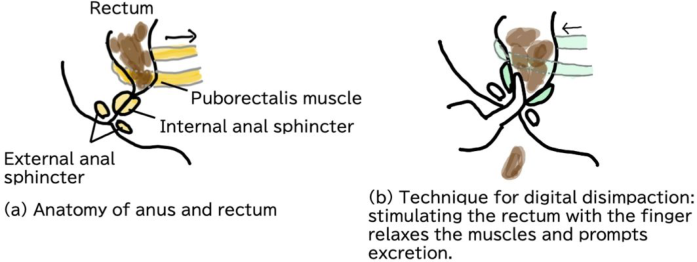
Digital disimpaction is one of the most frequently performed care proce- dures performed by home-visit nurses. It is the procedure to remove stool from the anus using a finger and is performed when the stool in the bowel is hard and difficult to defecate even after enemas or other measures are given, or when the patient has difficulty defecating on their own due to factors such as prolonged bed rest. Digital disimpaction is a complex procedure that not only involves inserting a finger through the anus and scraping out the stool but also involves interaction with the body, stimulating the rectum with the finger and using the rectum’s response to promote excretion of the stool. Since digital disimpaction is an embarrassing and sometimes painful procedure for the patient, a smooth and comfortable technique is desirable. However, it is not easy for nurses to improve their skills in digital disimpaction, because they cannot see from the outside how the fingers move inside the body and how the body’s responses are used to facilitate excretion. This is true not only for nurses and other professionals but also for the families of patients who may perform digital disimpaction at home. The difficulty in mastering the technique makes families anxious about home care. To make matters worse, the actual improper practice of care may lead to compounding problems such as refusal of care by the patient.
Despite the fact that digital disimpaction is frequently performed in home care, the environment for learning the proper technique for disimpaction is not sufficient. Maekawa et al. found that only 24% of all nurses learned digital disimpaction techniques at nursing educational institutions. To fur- ther note, 51% of nurses acquired the technique through clinical on-the-job training rather than prior training, and 29% of nurses acquired the technique through self-study (Maekawa et al., 2015).
Figure 1: Anatomy of the anorectal area and technique of digital disimpaction.
DEVELOPING A DIGITAL DISIMPACTION SIMULATOR A simulator is a necessary piece of equipment for acquiring digital disim- paction skills. Several types of simulators are currently available in Japan for continence care training, but the following problems exist:
(1) Failure to reproduce the texture of the rectum (2) No movement of rectal and anal muscles (3) No feedback on whether the finger movements and application of force are correct.
What to Do When the Requirements Are Unknown? 207
We aim to develop a new digital disimpaction simulator to solve these problems and to realize an environment in which nurses can easily acquire the technique of digital disimpaction (Miyagawa et al., 2022)(Mao et al., 2022). Soft-robotics technology, consisting of soft materials, smooth movements, and flexible control, is expected to help realize such simulators. In this study, we focus on issue 1 and define and develop the requirements for a simulator that can reproduce the texture of the rectum.
METHODS
In order to develop a digital disimpaction simulator, it is necessary to objec- tively describe the shape, tactile sensation, and movement of the rectum as perceived by the nurse performing the disimpaction. Until now, we have not found any existing studies that objectively describe the digital disim- paction technique. We, therefore, adopt a user-participatory design approach and collect simulator requirements through interviews with nurses who are experts in digital disimpaction. It is difficult to obtain information based on sensitivity, such as the feeling inside the rectum, only through verbal nar- ratives of interviews. For this reason, we decided to use rapid prototyping methods, which involve having skilled people try out the actual developed product, obtain feedback, and improve the product based on that feedback. By combining the rapid prototyping method and the user-participatory design method, where feedback is obtained directly from users, it is possible to develop simulators at high speed while extracting requirements.
RESULTS
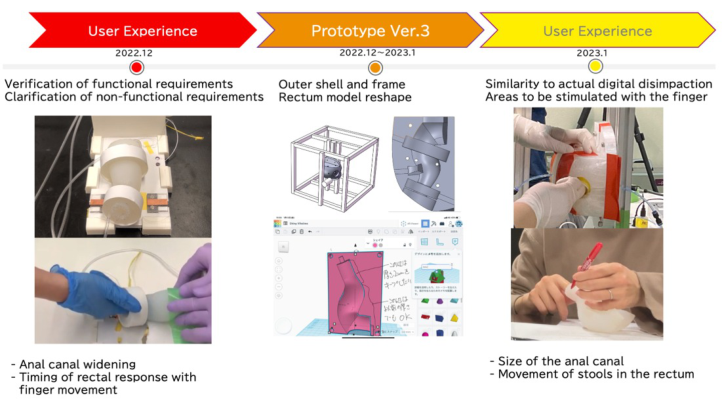
In this study, the requirements for the creation of a simulator were defined and implemented through repeated trial runs of the prototype with skilled nurses, interviews, elicitation of requirements from the interviews, and refinement of the prototype. The overall process is shown in Figure 2.
1. Understanding digital disimpaction through workshops To help the engineering and design researchers participating in this study understand digital disimpaction, a workshop was conducted by a univer- sity faculty member specializing in nursing skills. The workshop included a briefing on what digital disimpaction is performed for, when it is performed, how it is performed, and an introduction to existing disimpaction simulators. Engineering and design researchers who were not familiar with nursing care could now understand the procedures and challenges of performing digital disimpaction in a clinical setting.
2. Creation of a simple model A simple rectal model was created using a 3D printer. We also made a hard stool model using polymer clay, and a normal stool model using flour clay.
3. First user experience and interview Six nurses who routinely perform digital disimpaction in the home nursing service were interviewed about the shape and textures of the rectum, the tech- nique of digital disimpaction, the interaction with the living body that occurs during the procedure, and the difficulties they experience when performing
the disimpaction. The nurses explained the technique using the rectal and stool models we had created.
4. Extraction of requirements from interviews and improvement of simulator The results of the interviews provided insight into the tactile sensations inside the rectum, finger movements during the practice of digital disimpaction, the perceived response of the anus and bowel to massage, and the condition of the stools. Based on these insights, a structure with a gel-like mucous membrane layer inside a silicon rectal model was designed and implemented.
Figure 2: Overall process of developing a rectal model for digital disimpaction simulator.
5. Second user experience and interview The improved prototype was used by six nurses, and feedback was obtained. As for the mucosa, they commented that it was similar to the feel of a living body and that there was no sense of discomfort. On the other hand, the
What to Do When the Requirements Are Unknown? 209
length of the anal canal and the width of the anus were mentioned as areas for improvement.
6. Extraction of requirements from the second interview and improvement of the simulator The anal canal portion of the rectal model was redesigned with reference to the interview results and anatomical references (Takano et al., 1978). A buttock model covering the rectal model was designed to make the setting more similar to a real human body.
7. Third user experience and interviews The results confirmed that the simulator mostly reproduced the intestinal setting as perceived by the nurses during the actual digital disimpaction pro- cedure, except that the opening of the anus and sphincter muscles was not entirely satisfactory.
DISCUSSION
Despite the fact that the procedure of digital disimpaction is frequently per- formed in care settings, there are few previous studies on it. Existing studies on digital disimpaction techniques deal mainly with the subjective narratives of nurses who perform digital disimpaction (Miwa et al., 2009). There are previous studies on stool movement and changes in bowel movement and pressure in the bowel (Davenport, 1978) (Matsuda et al., 2006) (Stokes et al., 2017). However, no study on digital disimpaction was found to the authors’ knowledge that numerically analyzed the technique and the bowel movements.
To the authors’ knowledge, no existing digital disimpaction practice sim- ulators exist that have the ability to facilitate bowel movement with finger movements, which is the subject of this study. In a simple plastic simulator, the rectum is stiffer, and the anus is narrower than the human body. The relaxation of the external anal sphincter by anal massage and the relaxation of the internal anal sphincter by massage inside the rectum, which are per- formed in digital disimpaction procedure, cannot be learned as a technique with a simple plastic simulator. Rather, learning by using such simulators may lead to the risk of acquiring inappropriate and painful procedures. Therefore, the development of a simulator that mimics the texture of the actual rectum would be effective in acquiring the correct skills.
The simulator which has been developed in this study does not aim to faithfully reproduce the physical properties and physiological characteristics of the bowel itself, which have been obtained as numerical values in existing studies. The silicone gel used to create the simulator has physical properties that are essentially different from those of the mucosa and muscles that make up the rectum. Furthermore, physiological characteristics such as intestinal fluid secretion and absorption, which are difficult to reproduce in simulators, influence the mechanism of defecation. Therefore, we seek not physiological accuracy, but tactile accuracy, i.e., what feels “plausible” to skilled nurses. The combination of user-participatory design methods and rapid prototyp- ing development methods used in this study is considered suitable for such kansei-based product development.
Collaboration between nurses and engineers/designers is considered use- ful as a method to address unmet needs in clinical settings, but it has been pointed out that many medical institutions have not established such a route for collaboration (Andrews et al., 2020). This study contributes to the development of one methodology for collaboration between nurses and designers/engineers.
CONCLUSION
In developing a digital disimpaction simulator, a product whose requirements were hard to define, we chose to combine user-participatory design and rapid prototyping development methods.
Through three iterations, we were able to create a shape and feel of a rectal model that is comfortable for the nurse performing the digital disimpaction.
In order to put the simulator developed in this study into practical use, the following further soft-robotics-related challenges are necessary: 1. imple- mentation of a mechanism that senses finger movements, 2. implementation of actuators that realize rectal and anal muscle movements, and 3. implemen- tation of a system that mimics biological responses by moving actuators in response to finger movements.
Through this research, we have obtained narratives about finger move- ments and biological responses. From the analysis of this narrative, we will extract the requirements for a sensing and movement system and implement it, aiming to develop a training environment for the digital disimpaction tech- nique and to construct a system to collect objective numerical data on digital disimpaction.
ACKNOWLEDGMENT
This work was supported by JSPS KAKENHI under grant no. JP18H05465.
REFERENCES
Andrews, R. et al. (2020) ‘Collaboration for clinical innovation: a nursing and engineering alliance for better patient care’, Journal of Research in Nursing, 25(3), pp. 291–304. Davenport, H. W. (1978) Digest of Digestion. Chicago: Year Book Medical Pub. Maekawa A. et al. (2015) ‘Digital disimpaction performed by home care nurses on
homebound patients (in Japanese)’, Journal of Japanese Society of Stoma and Continence Rehabilitation, 31(1), p. 130. Mao, Z. et al. (2022) ‘Development of Digital Disimpaction Simulator (in Japanese)’, RSJ2022, The Robotics Society of Japan. Available at http://t2r2.star.titech.ac.jp/ cgi-bin/publicationinfo.cgi?q_publication_content_number=CTT100881980. Matsuda, N., Funayama, Y. and Takahashi, K. (2006) ‘Development of Anal Stretch-
ing Tensionmeter’, Nippon Daicho Komonbyo Gakkai Zasshi, 59, pp. 427–430. Available at: https://doi.org/10.3862/jcoloproctology.59.427. Ministry of Health, Labour and Welfare (2020) ‘Material for the 182nd Subcommittee on Long-Term Care Benefits of the Council on Social Security (web confer- ence)’, Available at: https://www.mhlw.go.jp/stf/newpage_13021.html (Accessed: 26 April 2023).
What to Do When the Requirements Are Unknown? 211
Miwa, M. et al. (2009) ‘Developing and Testing a Nursing Care Model to Prevent Fecal Incontinence after Digital Extraction’, Japanese Journal of Nursing Art and Science, 8(1), pp. 84–92. Miyagawa, S. et al., (2022) ‘Development of a rectal model for digital disimpaction
practice with mucous membranes (in Japanese)’, Poster presented at The 10th Annual Meeting of Nursing Science and Engineering, Oct. 16th, 2022, Tokyo. Stokes, W. E. et al. (2017) ‘A physical simulation to investigate the effect of anorectal
angle on continence’). 2017 13th IASTED International Conference on Biomed- ical Engineering (BioMed), pp. 168–175. Available at: https://doi.org/10.2316/P. 2017.852-046. Takano, M. et al. (1978) ‘Measurement of Anal Canal in Japanese’, Nippon Daicho Komonbyo Gakkai Zasshi, 31(3), pp. 226–229, 301. Available at: https://doi.org/ 10.3862/jcoloproctology.31.226.
LISTED IN THE AHFE DIGITAL BOOKSTORE CATALOGUE
Explore the complete digital volume
Human Systems Engineering and Design (IHSED 2023): Future Trends and Applications
Read this individual research paper free through the original publisher, or explore the full digital proceedings book.
ISBN 978-1-958651-88-9
Explore this ISBN in the AHFE Bookstore ↗Listed in the July 2026 bookstore catalogue; search by ISBN to confirm current availability · Digital book purchase optional