Jan Kiesewetter, Fara Semmelies, Barbara Saravo, Martin R. Fischer, Birgit Wershofen (2021). Collaboration Expertise in Health Care - Mapping the Mosaic of Shared Work Experience, Transactive Memory System and Performance. In: Advances in Human Aspects of Healthcare. AHFE Open Access, vol. 13. https://doi.org/10.54941/ahfe100528
In all domains teams knowledge of the others team members’ expertise is of high importance and has been named transactive memory system (TMS). Especially in healthcare, where teams are often formed ad-hoc and the performance directly reflects patients’ wellbeing, the relationship between TMS, shared collaborative experience and performance needs to be examined. This study examines this relationship in the context of nursing. Knowledge about the teammate’s domains of expertise should only have a performance-critical impact in tasks innate to the own profession, while general collaboration tasks should not benefit from a strong TMS. 52 nurses of which about half had working experience together filled out a TMS questionnaire. Two groups of dyads (with and without prior shared work experience) performed one task of their own profession and one domain-general task. The results could show that performance in the working-domain specific task was higher in the group with shared experience than in the group without shared experience. No difference could be found in the domain-general task. This study adds evidence to the body of literature that collaboration is a domain-specific skill and that performance depends on it. Methodological implications to possibly improve TMS and collaboration expertise in teams are discussed.
Effective collaboration, and teamwork is increasingly in demand and indispensable for numerous industries. In order to deal with a growing complexity of daily tasks, organizations frequently need the expertise of several people to solve problems, make decisions in shared responsibility, and realize tough challenges. Working in a team is acknowledged to be a beneficial method in the professional domain (Fitzgerald & Theilheimer, 2013) and, in the healthcare domain, the collaboration of care providers is an important component to patient welfare and successful outcomes (King et al., 2006). In fact, in the World Health Organization (WHO) framework for 21st century healthcare, collaboration is advocated as the key component for improved health outcomes and healthcare professionals are called on to improve their collaboration skills (Gilbert & Yan 2010).
It could be found that the products of interacting individuals can be even more positive than the sum of individual work (Tziner & Eden, 1985). Collaborative learning investigations demonstrate that building a collaborative knowledge base is possible, enabling group members to create knowledge and skills together that are more robust and less likely to be constructed by an individual member (e.g. Scardamalia & Bereiter, 1994).
Despite the evidence and advocacy of collaboration in healthcare there is little research regarding the knowledge of collaborators, their shared experience in relation to the performance. One reason might be that collaboration expertise is not easy to study as poorly defined content domains in which the collaboration takes place (i.e. the domain of nursing, the domain of surgery) are uncontrolled research settings. To systematize our research question we define that collaboration is a construct practiced within a team and a task context. Over time the team builds a collaborative knowledge base, called the transactive memory system (TMS; Wegner, 1987). Consequently, the more a team collaborates, the higher amounts of shared team experience exist, the better developed the transactive memory system should be (Hollingshead, 2000). This knowledge base does then have a direct impact on the performance-relevant actions of the team (Michinov et al., 2008). In this study, the relation between shared collaborative experience the transactive memory system and performance in nurses is examined.
Collaboration in the context of healthcare professionals
There is general agreement that collaboration of health professionals is important and leads to a safe and high quality of care (Hughes & Fitzpatrick, 2010; Lyndon et al., 2013; Neir et al., 2011; Rosenstein & O’Daniel; 2005, Zwarenstein et al., 2009). The most studies about collaboration in the healthcare context are focused on nurse- physician relationship, addressed to identify the attitudes about collaboration (Hojat et al., 2003; Hughes & Fitzpatrick, 2010; Tang et al., 2013; Thomson, 2007), to detect barriers or facilitators to work as effective team (Michalec et al., 2014; O’Brien et al., 2009; Skei, 2008; Tang et al., 2013). Rarely attention is on the cognitive aspect why experienced healthcare teams perform better.
Prerequisites for successful teamwork among healthcare providers were identified: “(1) expertise in the application of disciplinary knowledge; (2) significant shared knowledge and expertise in the areas in which collaboration is required, and (3) the commitment and the personal social skills necessary to facilitate ongoing information exchange and shared learning among collaborators” (Armstrong, 2009, p. 777). The cognitive site of collaboration is an important part of collaborative work. Consequently, to actually collaborate well, people need to have proficient knowledge in their own domain (called the content domain; cf. Kiesewetter, Fischer & Fischer, 2013) and also need to have knowledge on how to collaborate.
This dualism in theory about the practice of collaboration has made systematic empirical investigations very challenging, and there only exist a few. Kiesewetter and colleagues (2013) showed their participants (novice and expert physicians) pictures and video sequences each for five seconds of collaborative situations within their own medical context (own domain) and another picture and video of collaborative situations in a social science context (other domain). After each picture or video, they asked what the participants saw on the stimuli. All answers were anonymously coded according to a coding scheme assessing collaborative knowledge (i.e. collaboration scripts; cf. Kollar, Fischer & Hesse, 2006). The results showed that the knowledge of experts and novices regarding collaboration differed regarding their experience, but only in their own domain. Experts were not able to retrieve their superior collaborative knowledge when confronted with stimuli in the other domain. One of the limitations of this work was that the relationship between collaboration and actual performance has not been investigated.
To further verify the effects regarding collaborative expertise many different contexts are thinkable. The authors chose the profession of nurses for the following reasons. (1) Collaboration is an incremental part of nursing. Nursing is a traditional health profession, where collaboration has found its way into the definition by the international council of nurses: “Nursing encompasses autonomous and collaborative care of individuals of all ages, families, groups and communities, sick or well and in all settings“ (ICN, 2010). (2) Nursing has a theory of proficiency. Nursing has a clear definition of skills acquisition from novice skill to expertise skills (Benner, 1984). (3) Nursing skills vary in different caring contexts. While there might be certain transferable skills from unit to unit, there are certainly skills which have to be adapted to any kind of new working unit (cf. ibid). This enables the authors to separate the general proficiency level form the task level and subject it to empirical investigation. One level of nursing proficiency in Germany is the practical instructor training, which is a formal education course, which includes parts regarding collaborative nursing work and is completed, two or three years after formal nursing examination. Human Aspects of Healthcare (2021)
Transactive memory system A more advanced approach regarding the cognitive interplay of team members has focused on shared mental models. Shared mental models are defined as a “knowledge structure held by members of a team that enables them to form accurate explanations and expectations for the task, and in turn, to coordinate their actions and adapt their behavior to demands of the task and other team members” (Cannon-Bowers, Salas, & Converse, 1993, p. 228). Shared mental models enable work groups to achieve effectiveness (Mathieu, Heffner, Goodwin, Salas, & Cannon- Bowers, 2000). Based on a similar idea of the shared mental model, Wegner and colleagues (1991) formulated the transactive memory system (TMS). Familiar groups, for example partners in intimate relationships, are found to serve each other as external memory aids. Through time the partners have developed a “shared system for encoding, storing, and retrieving information” (Wegner, Erber, & Raymond, 1991, p. 923). Each individual partner contains organized knowledge about the memory of the other partner, which is developed in the transactive processes the partners are in (i.e. my partner knows the financial aspects of our car sale) (Wegner, Giuliano, & Hertel, 1985). It has been shown that as well the processes in working teams can be described by this collaborative cognitive system (e.g. Hollingshead, 1998b). Domain-related knowledge and meta-memory about group members’ knowledge, which is potentially shared, makes this system relevant for team dynamics as well as for wider access to information (Moreland, 1999). Evidence of encoding, storing and retrieving information collectively is provided for dyads, groups, and even organizations (e.g. Moreland & Argote, 2003; Moreland, 1999; Wegner, 1987).
Hollingshead (2000) investigated simulated learning processes among coworkers with a sample of clerical office workers and a memorization task that involved learning work-related information. This information concerning work-related expertise was learned and recalled to a greater extent when the partner had different work-related expertise. Outside the domain, this effect is reversed with regard to recall of information; that is, more information from the non-expert category is recalled when participants believed their partners had the same expertise as themselves. The author recommends examining actual coworkers working on tasks intrinsic to their everyday work, which will be addressed in this study.
In the context of the healthcare professions Michinov et al. (2008) examined the impact of transactive memory system on performance in anesthesia teams. 77 anesthetist nurses and 74 anesthetists were asked to complete a scale, developed by Lewis (2003) to measure the transactive memory system. The perceived team effectiveness was rated by the healthcare professionals through one item with a 10-point Likert scale. The result showed a strong positive correlation of transactive memory system and team effectiveness.
Research question and hypotheses The main research question aims to clarify how shared experience affects the Transactive Memory System in team dyads with similar expertise in the working-domain and in collaboration. To answer the research question several more specific research questions are formulated, which are subsequently leading to hypotheses.
(I) Is there a relationship between shared experience and the Transactive Memory System in nurses?
Nurses who come from the same unit have shared experience and they are familiar with each others’ capabilities. Since in this study, nurses will be examined based on their experience in collaboration as well as in nursing-work, it is assumed that shared experience would influence nurses’ TMS, even if they have that similar background.
(H1) Nurses with shared experience have developed a stronger transactive memory system than nurses without shared experience.
(II) What is the impact of shared experience on collaborative performance in nurses?
Although boundaries might occur (e.g. Ren, Carley, & Argote 2006), research on performance that is attributable to transactive memory has broadly shown positive effects in performance (e.g. Hollingshead, 1998a, 1998b; Lewis, 2003; Liang, Moreland, & Argote, 1995; Moreland, Argote, & Krishnan, 1996; Wegner et al., 1991).
Teams Stronger developed TMS were found to have a positive influence on performance. Thus, the expectation for a task that is associated with nurses’ daily work (working-domain task) would be that it induces higher performance quality in nurses with shared experience.
(H2) Nurses with shared experience perform a working-domain task better than nurses without shared experience.
Hollingshead (1998a) showed that communication can be a hindrance for familiar work groups when performing a memorization task. Since the task performed was not typical for the working-domain, one would expect the same effect in people with the same working background performing a general collaboration task. Also, collaborative knowledge is rather domain-specific. Therefore, collaborative performance might as well depend on this knowledge, cf. Kiesewetter, Fischer & Fischer (2013).
(H3) There is no difference in performance of a general collaboration task between nurses with shared experience and nurses without shared experience.
METHOD
Sample The participants in this study were chosen arbitrarily; 52 nurses were recruited from various departmental units (angiology, cardiology, general outpatient, neurology, gastroenterology intensive care, internal medicine, and rheumatology) of four clinics in Bavaria, Germany. There were 45 female participants (86.5 %) and seven male participants. The fact that the larger part of the subjects consists of women closely corresponds to the gender distribution in this profession of about 86:13. The participants averaged 43.1 years in age and had an average of 22.2 years of work experience. 30 of the participants were from the same departments and shared an average of 4.7 work experience. A total of ten care areas have been specified.
Design The quasiexperiment was designed as a two-group comparison with the factor shared experience divided into no shared experience (NSE group) and with shared experience (SE group). Two nurses from a unit form a nursing dyad. With shared experience refers to nurses who come from the same departmental nursing unit and therefore, from the same working team. Without shared experience refers to nurses who come from different departmental units; they were randomly assigned to form a dyad.
Practical instructor training was integrated in analysis as a possible covariate. It refers to the answer given in the questionnaire whether practical instructor training is already completed in yes or no. When the dyads were formed, the practical instructor training participants were equivalently distributed among the NSE and SE group.
Tasks Teams consisting of two people each (dyads) have been examined accomplishing two different kinds of tasks. One task is a general problem-solving task to work cooperatively on a paper tower (general collaboration task). The other one has been a working-domain-specific task (nursing-task). The sequence of the two tasks was balanced between the dyads in order to avoid possible ordering effects. The tasks were provided in written form.
In the general collaboration task (tower-task), subjects tried to build a tower on the condition of that it exceeds a height of 50cm using only a few simple materials. The tower was supposed be able to stand freely on the ground or a desk without outside support. The material that was used for this purpose consisted of two 21.0 × 29.7 centimeter sheets (equivalent to DINA 4 German standard) and two standard paper clips. The building time started when the material was touched by at least one of the participants, and ended when the tower has been finished and both participants had no hand at the tower. The tower-task has been chosen as many collaborative skills come into play (like communication, cleverness), but it can be ensured that working-domain knowledge does not play a role In the working-domain-specific task (nursing-task), subjects were supposed imagine that a new colleague is joining their department. The subjects were told to brainstorm within their team while one of them was supposed take notes about their considerations. The role of the person who wrote the notes down was decided among the team members themselves. The nursing-task was chosen as performance depends on high domain-specific knowledge in combination with the ability to retrieve equal knowledge from the other person, skills highly important in nursing (cf. Benner, 1984).
Procedure The nursing management was informed and asked for permission that surveys and the video recordings could take place within the clinic. The first task that they could read for themselves was given. Simultaneously, the video recording was started. Participants were also allowed to ask questions during the tasks. For both tasks, participants had ten minutes, which they did not need in most cases. All participants were able to solve the tower-task.
After accomplishing both tasks, participants were asked to fill out a questionnaire individually. The questionnaire involved a German translation of the TMS scale by Lewis (2003) which has been validated by Ellwart and Konradt (2007). Additionally, the individuals’ demographic data were requested and questions about the profession were posed. The questions about the profession included information on the nursing field, nursing experience and the potential amount of shared years of work experience with the individual team partner in the same department.
Measures Transactive memory system
The transactive memory system item scale established by Lewis (2003) allows to draw inferences about the development of TMS during tasks and is proven to be a valid instrument in the field. The scale consists of three subscales: specialization, credibility, and coordination. The subscales include five items each and can be accumulated to form one measurement of TMS. Specialization is excluded from the analyses because of participants’ similar nursing background. The assumption that this subscale is not appropriate for the purposes of this study is statistically supported. The internal consistency measured by Cronbach’s alpha for the scale revealed Cronbach’s α = -.04. The subscale coordination revealed Cronbach’s α = .83 and the subscale credibility Cronbach’s α = .74. Coordination and credibility are therefore sufficiently reliable to assume potentially developed TMS.
Dyad performance Both in the general collaboration task and in the working-domain-specific task, performance was measured. Performance in the general collaboration task was measured by the time needed to build the paper tower. Thus, speed served as an indicator for the performance in the general collaboration task. The less time was needed, the higher the performance.
In the working-domain-specific task performance was measured through a scoring system developed by an approved nursing expert. The nursing expert works as nurse educator and is experienced in the practical and theoretical education in nursing schools.
The scoring system refers to the notes made by the dyads during the task. When developing and analyzing the scoring system, the nursing expert was blind to the dyads’ group membership. The solution was a categorical coding system, which is based on Mayring’s (2000) qualitative content analysis. The categories of each group were counted and thus resulted in quantitative scores. Aspects of information that are mentioned in the notes and matched the best- practice are accounted as single points. This includes for example greeting, providing information and materials, etc.. Double information was not accounted for.
Statistical analysis The data used for the analyses were tested for the assumption of normality as well as for the assumptions of homogeneity. All analyses were calculated with a 95% confidence interval. The TMS scale by Lewis (2003) includes three subscales. As recommended, the subscales can be aggregated into one TMS measurement. For each hypothesis, two subscales were included: credibility and coordination (see section Materials). In hypotheses 2 – 3 (performance), variables were measured in dyads and as a consequence, the results apply for the team dyads. N=52 is therefore reduced for each dyad into n=26. When the same data was used in inferential tests Bonferroni correction was applied.
RESULTS
(H1) Nurses with shared experience have developed a stronger transactive memory system than nurses without shared experience.
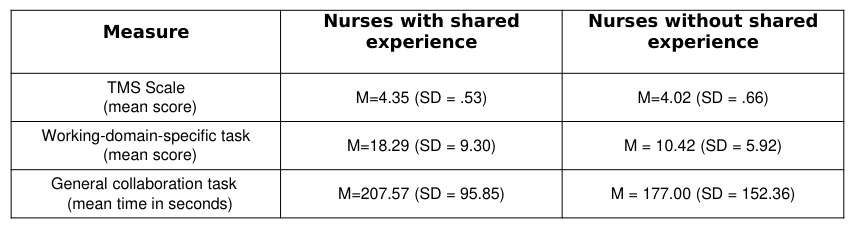
The mean value of the TMS scale rated by nurses with shared experience was 4.35 (SD = .53), the mean value rated by nurses without shared experience was 4.02 (SD = .66). The descriptive data shows that there is a trend of higher ratings in the TMS scale for nurses with shared experience, as predicted. The independent t-test revealed t (50) = 1.99, n.s.. The difference in TMS for the aggregated subscales credibility and coordination was not significant. When practical instructor training was included as possible covariate in the analysis, ANOVA revealed a significant main effect of shared experience on TMS (F(1, 48) = 6.91, p < .05, partial η2 = .13).
(H2) Nurses with shared experience perform a working-domain task better than nurses without shared experience.
Descriptive statistics show for performance in the working-domain specific task that there is a higher mean of 18.29 (SD = 9.30) in the SE group than in the NSE group (M = 10.42, SD = 5.92) for performance in the working-domain specific task.
T-test-analysis revealed a significant difference of performance in shared experience (t(24) = 2.52, p < .05, d = 1.03). Nursing dyads with shared experience performed the working-domain specific task better than nursing dyads without shared experience. The analysis yielded a high effect size regarding this difference (Cohen, 1988).
(H3) There is no difference in performance of a general collaboration task between nurses with shared experience and nurses without shared experience.
Descriptive statistics show for performance in the general collaboration task, that there is a higher time-related mean of 18.29 (SD = 9.30) in the SE group than in the NSE group (M = 10.42, SD = 5.91). The performance was measured by the amount of seconds, fewer seconds indicate higher performance in the general collaboration task. Therefore, nursing dyads without shared experience show higher averaged performance values than nursing dyads with shared experience. The subsequent t-test showed that nursing dyads with shared experience showed no significant difference compared to nursing dyads without shared experience with respect to performance in the general collaboration task (t(24) = .62, n.s.). The analyses could confirm the assumption for the third hypothesis that there is no difference between nurses with or without shared experience in the general collaboration task.
Table 1: Descriptive statistics of both groups
DISCUSSION
The results indicate, that shared experience have an effect on stronger developed TMS as well as better performance in nurses, but only for tasks innate to the nursing profession. The theoretical implications of each of the findings according to the hypotheses are now being discussed.
The first hypothesis could not be confirmed through a significant difference between nurses with and without shared experience concerning the development of TMS. However, nurses who shared some years of experience with their working partners tend to rate higher values on the TMS scale, suggesting that they tend to have a more strongly developed TMS than nurses without shared experience.
Studies that investigated the difference between couples and strangers regarding the TMS (e.g. Giuliano &Wegner, 1985; Hollingshead, 1998ab; Wegner, Erber, & Raymond, 1991) found a stronger developed TMS in couples. Only a tendency has been found for the difference between nurses with and without shared experience. According to the ratings in the subscales credibility and coordination, which are above average, nurses might trust each other’s expertise due to their shared working background. It might have affected the self-assessment in nurses without shared experience. Therefore, people with the same profession can feel more connected to each other. The high level of collaboration experience in nurses could have also affected the perception of good coordination. King and colleagues (2006) stated that health care workers are generally confronted with tasks that require coordination. It can be assumed that nurses have good practice in coordination and therefore perceive good coordination in the tasks. Practical instructor training influenced a difference in the development of a TMS. When included in the analyses, the difference concerning shared experience was mediated to be significant. Practical instructor training did not interfere with shared experience. This result can be interpreted in terms of an advantage in knowledge among nurses with shared experience. As mentioned above, practical instructors can serve as relevant sources of information in health care, which is why they are likely to be regarded as more credible and better able to coordinate the process. Thus, the role of a practical instructor who is known among the nurses with shared experience could have influenced the perception of better coordination and credibility, and as a result, leading to the difference in TMS development. Results for the second hypothesis could confirm the assumption of higher quality performance in nurses with shared experience compared to nurses without shared experience. The effects of better performance in more familiar dyads (couples or workgroups) could be replicated in this study (e.g. Hollingshead, 1998a, 1998b; Lewis, 2003; Moreland, Argote, & Krishnan, 1996; Wegner et al., 1991). However, better performance in nurses with shared experience cannot be the only factor for a superior TMS.
As predicted, the results of the third hypothesis indicate that nurses did not differ in performance due to shared experience in the general collaboration task. Similar to the findings by Hollingshead (1998a), who showed that communication can be a hindrance for familiar work groups in performing a memory task, in this kind of general collaboration task there also might have occurred an analogous incident. Nurses who did not share experience could have compensated the possible disadvantage of lower TMS via communication.
Collaborative expertise including the knowledge of the teammate’s competencies seems to be limited to a domain and does not transfer into other expertise domains (cf. Feltovich, Prietula, Ericsson, 2006). This finding implicates that nursing education should emphasize on explicit training initiatives of domain-specific collaborative education. This does not mean that to date initiatives of interprofessional education are all for nothing. On the contrary, it means that we should focus our efforts in research, and practice on the complex and real life challenges that nurses face every day instead of a to broad and superficial training initiatives. Another implication of the current study is the important link between collaborative work experience and performance. In a hospital often shifts are changed and nurses frequently change wards. We should focus on if, when and how all these changes lead to decreased performance, and furthermore what can be done within healthcare providers and education to limit this impact to a minimum.
LIMITATIONS According to the TMS development, only the subscales credibility and coordination were included, since specialization is not assumed among nurses because of their similar expertise background. The low reliability of the subscale specialization indicates that rating patterns have varied too much among the participants, so specialization could not have been measured accurately. Overlapping knowledge in contrast to specialization could be specifically important to authentic tasks and also professions like health care. This was shown for example in terms of backup behavior as one of the competencies relevant to health care collaboration (Salas, 2005). Thus, (non-) specialization could be the key factor in detecting TMS in authentic working teams with shared experience and high collaboration experience.
There is also a constraint in the measurement of performance. Gupta and Hollingshead (2010) suggested that speed and quality can be relevant for performance and both should be included. Accordingly, both in the general collaboration task as well as in the working-domain specific task it might have been beneficial to integrate speed and quality for control. However, it might also be difficult to integrate an authentic task that allows one to measure both features.
Due to the large amount of time required for developmental work in this study, the number of subjects was limited. A greater number of subjects would likely have shown a clearer pattern results. Although slightly controlled, actually, there was variation in participants’ age as well as in work experience and shared experience.
CONCLUSIONS
The results of this study can be regarded as representative for professionals with a high amount of collaboration experience. The fact that the difference in TMS development due to shared experience has not been turned out clearly can be interpreted in a way that shared experience as a single factor does not influence TMS. Differences in TMS might have become more evident in subjects with lower collaboration experience or at artificial memorization tasks.
Shared experience has an impact on performance in the working-domain task. Established teams show a higher performance than newly formed groups when confronted with a task of their own domain. It seems that both, shared experience and team context, have impact through collaborative expertise on performance.
A consolidated view indicates that shared experience can affect the collaboration progress. It appears in a stronger developed transactive memory system and higher performance in the working-domain. Thus, collaboration expertise relies at least partially on a superior domain in which it is practiced. There is need for further research on various levels of experience in collaboration in order to investigate the manner of collaboration expertise.
REFERENCES
Armstrong, F. (2009). Individual and organizational collaborations: A roadmap for effective advocacy. In M. C. Roberts, R. G.
Steele (Eds.), Handbook of pediatric psychology (4th ed.) (pp. 774-784). New York, NY US: Guilford Press. Benner, P. (1984) From Novice to Expert. Menlo Park: Addison-Wesley Publishing Company. Booher, H.R., Minninger, J. (2003), “Human systems integration in army systems acquisition”, in: Handbook of human systems integration, Booher, Harold (Ed.). pp. 663-698 Cannon-Bowers, J. A., Salas, E., & Converse, S. A. (1993). Shared mental models in expert team decision making. . In N. J.
Castellan (Ed.), Curent issues in individual and group decision making (pp. 221-146). Hillsdale, NJ: Lawrence Erlbaum. Chapanis, A. (1996), “Human factors in systems engineering”. Wiley Series in Systems Engineering and Management. Andrew Sage, series editor. Hoboken, NJ: Wiley. Cohen, J. (1992). A power primer. Psychological bulletin, 112(1), 155. Ellwart, T., & Konradt, U. (2007). Wissensverteilung und Wissenskoordination in Gruppen. Zeitschrift für Arbeits-und
Organisationspsychologie A&O, 51(3), 128-135. Feltovich, P. J., Prietula, M. J., & Ericsson, K. A. (2006). Studies of Expertise from Psychological Perspectives. Fitzgerald, M. M., & Theilheimer, R. (2013). Moving toward Teamwork through Professional Development Activities. Early Childhood Education Journal,41(2), 103-113. Folds, D. Gardner, D., Deal, S. (2008). “Building Up to the Human Systems Integration Demonstration”, INCOSE INSIGHT
Volume 11 No. 2. Friedenthal, S. Moore, A. Steiner, R. (2008), “A Practical Guide to SysML: The Systems Modeling Language”, Morgan Kaufmann; Elsevier Science. Gilbert, J. H., & Yan, J. (2010). Framework for Action on Interprofessional Education & Collaborative Practice. Geneva: World
Health Organization. Gupta, N. & Hollingshead, A. B. (2010). Integrated vs. differentiated transactive memory effectiveness: It depends on the task.
Group Dynamics: Theory, Research, and Practice. 14(4), 384-398. Hagstrom, W. O. (1964). Traditional and Modern Forms of Scientific Teamwork. Administrative Science Quarterly, 9(3), 241-
263. Hojat, M., Gonnella J. S., Nasca, T. J., Fields, S. K., Cicchetti, A., Lo Scalzo, A., Taroni, F., Amicosante, A. M, V., Macinati, M., Tangucci, M. Liva, C., Ricciardi, G., Eidelman, S., Admi, H., Geva, H., Mashiach, T., Alroy, G. Alcorta-Gonzalez, A.,
Ibarra, D., Torres-Ruiz, A. (2003). Comparisons of American, Israeli, Italian and Mexican physicians and nurses on the total and factor scores of the Jefferson scale of attitudes toward physician-nurse collaborative relationships. International Journal of Nursing Studies, 40, 427-435. Hollingshead, A. B. (1998b). Distributed expertise and communication processes in groups. In E. A. Mannix, M. A. Neale, & D.
H Gruenfeld (Eds.), Research on managing groups and teams (Vol. 1, pp. 105–125). Greenwich, CT: JAI Press. Hollingshead, A. B. (2000). Perceptions of Expertise and Transactive Memory in Work Relationships. Group Processes & Intergroup Relations, 3(3), 257-267. Hughes, B., & Fitzpatrick, J. J. (2010). Nurse-physician collaboration in an acute care community hospital. Journal of
Interprofessional Care, 24(6), 625-632. ICN (International Council of Nurses) (2010). Definition of nursing. Retrieved from http://www.icn.ch/about-icn/icn-definitionof-nursing/ John-Steiner, V. (2000). Creative collaboration. New York, NY US: Oxford University Press. King, H. B., Battles, J., Baker, D.
P., Alonso, A., Salas, E., Webster, J., & ... Salisbury, M. (2006). TeamSTEPPS(™): Team Strategies and Tools to Enhance Performance and Patient Safety. Kiesewetter, J., Fischer, M. R. G., & Fischer, F. (2013). Is there evidence for expertise on collaboration and if so, is it domainspecific or domain-general? Paper presented at the European Association Research of Learning and Instruction, Munich. King, H. B., Battles, J., Baker, D. P., Alonso, A., Salas, E., Webster, J., & ... Salisbury, M. (2006). TeamSTEPPS(™): Team
Strategies and Tools to Enhance Performance and Patient Safety. Kollar, I., Fischer, F., & Hesse, F. W. (2006). Collaboration scripts–a conceptual analysis. Educational Psychology Review, 18(2), 159-185. Liang, D., Moreland, R., & Argote, L. (1995). Group versus individual training and group performance: The mediating factor of
transactive memory. Personality And Social Psychology Bulletin, 21(4), 384-393. doi:10.1177/0146167295214009 Lyndon A., Zlatnik, M. G., Maxfield, D. G., Lewis, A., McMillan, C. & Kennedy, H. P. (2014). Contributions of clinical disconnections and unresolved conflict to failures in intrapartum safety. JOGNN, 42(1), 2-12. Mathieu, J. E., Heffner, T. S., Goodwin, G. F., Salas, E., & Cannon-Bowers, J. A.(2000). The influence of shared mental models
on team process and performance. Journal of Applied Psychology, 85, 273–283. Mayring, P. (2004). Qualitative content analysis. A companion to qualitative research, 266-269. Michalec, B., Reinhold N., Dressler, R., Laskowski-Jones, L., Adarve, L. & Elliott, D. (2014). Barriers to and Facilitators of Interprofessional-Interdepartmental Interventions: Unearthing Departmental Culture. American Journal of Medical Quality, 1-9. Moreland, R. L., Argote, L., & Krishnan, R., (1996). Socially shared cognition at work: Transactive memory and group
performance. In J. L. Nye & A. M. Brower (Eds.), What’s social About social cognition? Research on socially shared cognition in small groups: 57-84. Thousand Oaks, CA: Sage. Moreland, R. L. (1999). Transactive memory: Learning who knows what in work groups and organizations. In L. L. Thompson, J. M. Levine, & D. M. Messick (Eds.), Shared cognition in organizations: The management of knowledge: 3-32. Mahwah, NJ: Erlbaum. Moreland, R. L., & Argote, L. (2003). Transactive memory in dynamic organizations. In R. S. Peterson, E. A. Mannix (Eds.) ,
Leading and managing people in the dynamic organization (pp. 135-162). Mahwah, NJ US: Lawrence Erlbaum Associates Publishers. Nair, D. M., Fitzpatrick J. J., McNulty, R., Click, E. R. & Glembocki, M. M. (2011). Frequency of nurse-physician collaborative behaviors in an acute care hospital. Journal of Interprofessional Care. O'Brien, J. L., Martin D. R., Heyworth, J. A. & Meyer, N. R. (2009). A phenomenological perspective on advanced practice
nurse-physician collaboration within an interdisciplinary healthcare team. Journal of the American Academy of Nurse Practicioners, 21, 444-453. Qureshi, S., & Keen, P. (2005). Activating Knowledge Through Electronic Collaboration: Vanquishing the Knowledge Paradox.
IEEE Transactions On Professional Communication, 48(1), 40-54. doi:10.1109/TPC.2005.843296 Ren, Y., Carley, K. M., & Argote, L. (2006). The contingent effects of transactive memory: When is it more beneficial to know what others know? Management Science, 52, 671-682. Rosenstein, A. H., & O'Daniel, M. (2005). Disruptive behavior and clinical outcomes: perceptions of nurses and physicians. The
American Journal of Nursing, 105(1), 54-65. Salas, E., Sims, D. E., & Burke, C. (2005). Is there a "Big Five" in teamwork?. Small Group Research, 36(5), 555-599.
doi:10.1177/1046496405277134 Scardamalia, M., & Bereiter, C. (1994). Computer Support for Knowledge-Building Communities. Journal Of The Learning Sciences, 3(3), 265. Skei, K. (2008). Collaboration at risk: registered nurses' experiences on orthopaedic wards. Journal of Clinial Nursing, 17, 1907-
1914. Tang, C. J., Chan S. W., Zhou, W. T. & Liaw, S. Y. (2013). Collaboration between hospital physicians and nurses: an integrated literature review. International Nursing Review, 60, 291-302. Taubman, P. (2008), Top Engineers Shun Military; Concern Grow. The New York Times Website:
http://www.nytimes.com/2008/06/25/us/25engineer.html Thomson, S. (2007). Nurse-physician collaboration: a comparison of the attitudes of nurses and physicians in the medicalsurgical patient care setting. MEDSURG Nursing, 16(2), 87-104.
Tziner, A., & Eden, D. (1985). Effects of Crew Composition on Crew Performance: Does the Whole Equal the Sum of Its Parts?.
Journal Of Applied Psychology, 70(1), 85-67. Wenger, E. (1998). Communities of practice: Learning as a social system. Systems thinker, 9(5), 2-3. Wegner, D. M., Giuliano, T., & Hertel, P. 1985. Cognitive interdependence in close relationships. In W. J. Ickes (Ed.), Compatible and incompatible relationships. 253-276. New York: Springer. Wegner, D. M. 1987. Transactive memory: A contemporary analysis of the group mind. In B. Mullen & G.R. Goethals (Eds.),
Theories of group behavior: 185-208. New York: Springer-Verlag. Wegner, D. M., Erber, R., & Raymond, P. (1991). Transactive memory in close relationships. Journal of Personality and Social Psychology, 61, 923–929. Wheelan, S. A., Burchill C. N. &Tilin, F. (2003). The link between teamwork and patients' outcomes in intensive care units.
American Journal of Critical Care, 12, 527-534. Zwarenstein, M., & Reeves, S. (2006). Knowledge translation and interprofessional collaboration: Where the rubber of evidencebased care hits the road of teamwork. The Journal of Continuing Education in the Health Professions, 26, 46-54. Zwarenstein, M., Goldman J. & Reeves, S. (2009). Interprofessional collaboration: effects of practice-based interventions on
professional practice and healthcare outcomes. (1469-493X (Electronic)).
LISTED IN THE AHFE DIGITAL BOOKSTORE CATALOGUE
Explore the complete digital volume
Advances in Human Aspects of Healthcare
Read this individual research paper free through the original publisher, or explore the full digital proceedings book.
ISBN 978-1-4951-2093-0
Explore this ISBN in the AHFE Bookstore ↗Listed in the July 2026 bookstore catalogue; search by ISBN to confirm current availability · Digital book purchase optional