Marie Sjölinder, Olov Ståhl, Elisabeth Rydwik, Simon Torikka (2023). Design of an mHealth application for optimizing preoperative physical function. In: Human Interaction & Emerging Technologies (IHIET 2023): Artificial Intelligence & Future Applications. AHFE Open Access, vol. 111, pp. 756–764. https://doi.org/10.54941/ahfe1004083
Limited physical reserve capacity in older people might be a risk factor for further functional decline and complications after surgery (Griffiths et al., 2014). A shift in cancer care in Sweden toward standardized and enhanced care processes, has led to that time between diagnosis and surgery has been shortened. Therefore, it has become important to focus on the effects of a short exercise program with high intensity and frequency. Recent qualitative studies have shown that patients with cancer need personalized support to perform preoperative exercises and that they prefer to do it at home or close to home (Beck et al., 2020). It is also important with a design that is tailored to the patient's needs, and goal setting, performance feedback, self-monitoring and reminders are all known facilitators for motivation and adherence to physical activity interventions (Michie et al., 2011).Development of the application: In a previous study, physiotherapists visited patients in their homes and supported them in conduction physical exercises during their preoperative phase. In the next step we developed a digital application consisting of, among other things, exercises, support and motivational features.The detailed features of the application were defined together with users during a co-creation process in workshops. Two workshops were conducted together with five patients. During the first workshop the participants discussed experiences from the previous intervention, factors they deemed relevant for adhering to the protocol and motivational aspects. During the second workshop the participants gave input on features and functionalities. One workshop was held together with five physiotherapists. In these workshops, experiences with the previous intervention, support needed for the patients and functionalities and interface for remote support were discussed. Further meetings and workshops were also conducted iteratively during the development phase.Content and interaction with the application: The specific aim of the application is to support the creation and tailoring of exercise programs with high intensity and frequency. The application consists of two parts, one used by the physiotherapists and one used by the patients. Physiotherapists are able to create individual exercise programs by selecting exercises from an exercise library, and then choosing settings for the exercises (e.g., numbers of sets and repetitions) based on a patient's needs and abilities. New types of exercises can be created by the physiotherapist and added to the library. The application allows the physiotherapist to monitor the patient's progress (based on data reported by the patient) and the exercise program can be adjusted if needed. The application also provides support for conveying a sense of presence and encouragement to the patient by allowing physiotherapist to write comments and to give the patient ”likes” on reported exercises, which will then be visible in the patient's part.The patient part of the application allows patients to see which exercises they are supposed to do each day, and to report to which extent the exercises have been completed. During reporting, the application will ask the patient to input data about how and when the exercise was performed (e.g., number of sets and reps, time of day, etc), and how the patient experienced the effort. All reported data are automatically gathered in a training diary section of the application, giving the patient access to the whole training history for later inspection. Any comments or likes sent by the physiotherapist also appears in the diary. The application includes different features for supporting and increasing the motivation to conduct the exercises. For example, rewards in the form of medals are given based on how well the patient follows the exercise program. Also, information about why this kind of training is important for improving the recovery after the surgery is provided in a theory section, to further strengthen the motivation to follow the exercise program. In the workshops patients had expressed the importance of this kind of information since it will be a reminder of how they can contribute to the best outcome as possible.ReferencesGriffiths R et al. Peri-operative care of the elderly 2014 Association of Anaesthetists of Great Britain and Ireland. Anaesthesia 2014;69:81-98. Beck A et al. Investigating the experiences, thoughts, and feelings underlying and influencing prehabilitation among cancer patients: a qualitative perspective on the what, when, where, who, and why. Disabil Rehabil. 2020 May 13:1-8.Michie S et al. A refined taxonomy of behaviour change techniques to help people change their physical activity and healthy eating behaviours: the CALO-RE taxonomy. Psychol Health 2011;26:1479-98.
Due to improved and less invasive surgical treatment alternatives, older peo- ple undergo cancer surgery to a higher extent today. Moreover, the limited physical reserve capacity in older people might be a risk factor for further functional decline and complications after surgery (Griffiths et al., 2014). Since chronological age has been recognized as less important, the comple- xity in older peoples’ health and physical function is more in focus today (Lin et al., 2016). A shift in cancer care in Sweden toward standardized and enh- anced care processes, has led to that time between diagnosis and treatment (i.e., surgery) has been shortened. Thus, a period of three weeks is set as a standard for colorectal and liver surgery. Therefore, it has become important to focus on the effects of a short exercise program with high intensity and frequency.
Recent qualitative studies have shown that patients with cancer need perso- nalized support to perform preoperative exercises and that they prefer to do it at home or close to home (Beck et al., 2020; Karlsson et al, 2020). Therefore, developing tools for personalized support is of utmost importance. Based on current research on web-based interventions of cancer survivors, the impor- tance of a design that is tailored to the patient’s needs has been highlighted (Corbett et al., 2018). It should be delivered at the right stage in the cancer trajectory and emphasize user involvement in the developmental phase. Goal
Design of an mHealth Application for Optimizing Preoperative Physical Function 757
setting, performance feedback, self-monitoring and reminders are all known facilitators for motivation and adherence to physical activity interventions (Locke and Latham, 2002; Michie et al., 2011). These components are well suited for a digital tool to optimize and personalize the preoperative exercises, and previous research has found that mHealth solutions are well perceived by older adults if the technology is easy to use and does not replace personal interactions (Matson et al., 2018).
DEVELOPING AN APPLICATION FOR PREOPERATIVE TRAINING In a previous study, physiotherapists visited patients in their homes and sup- ported them in conduction physical exercises during their preoperative phase. In the next step we developed a digital application consisting of, among other things, exercises, support, and motivational features.
The detailed features of the application were defined together with users during a co-creation process in workshops. Two workshops were condu- cted together with five patients. During the first workshop the participants discussed experiences from the previous intervention, factors they deemed relevant for adhering to the protocol and motivational aspects. During the second workshop the participants gave input on features and functionalities. One workshop was held together with five physiotherapists. In these work- shops, experiences with the previous intervention, support needed for the patients and functionalities and interface for remote support were discussed. Further meetings and workshops were also conducted iteratively during the development phase.
VALUES AND IMPORTANT FEATURES TO INCLUDE IN THE APPLICATION The outcome of the three workshops could be divided into four categories. One was on a high level consisting of important values to consider when deve- loping a tool like this. Two were related to functionalities to include, one with functionalities to include in this application for preoperative training and one category for functionalities that could be included in an extended version that also would support postoperative training. The last category consisted of important aspects to consider regarding interaction with the application.
Important Values to Consider The patients described the exercise program as an important break during a period in life that was chaotic due to the recently received diagnosis. They also pointed out that it was important to feel that you have done everything that you can do to gain the best possible output of the surgery. Knowledge and experience of the physiotherapist was also mentioned as important, and continuity with the same physiotherapist during the entire exercise program.
Functionalities to Include for the Preoperative Training Functionalities suggested for the preoperative training application were pos- sibilities to communicate with the physiotherapist and to be able to use
video communication. The patients also wanted to be able to book mee- tings and follow-ups with the physiotherapist. Further, the patients suggested instruction videos with an instructor or a character that they could identify with.
With respect to the exercises, the patients wanted a clear overview of what should be done and when. The physiotherapists expressed a need for having database of exercises to choose from and the importance of easy access without being forced to switch between different applications.
Direct feedback was described as useful since it could give you information about if an exercise was performed correct without risk of getting injured. The possibility to be able to follow what has been done and what is left to do was described as useful. However, reminders about what is left to do needs to be given in a positive manner. Support and encouragement could be given when the exercise program has been well performed, but general encoura- gement and support was also mentioned as meaningful feedback. However, functionalities like that must be optional and different individuals need dif- ferent kinds of encouragement. Further, the patients discussed possibilities to set both short-term and long-term goals, and possibilities to get feedback on progress. Being able to show progress to people around you was also menti- oned as an advantage. The possibility to being able to follow what has been achieved and how the different training occasions have been perceived trough self-ratings was described as valuable. Self-monitoring in terms of a training diary could be useful. However, it must be possible to skip this if you do not want to fill this in after every time you have conducted the exercise program.
In general, the importance of personalization was brought up, both with respect to which extent the preoperative training is digital vs physical toge- ther with a physiotherapist and with respect to how the exercise programs are designed. Personalization was also described as important regarding interaction with the application and with respect to how information is visualized.
In the workshops with the physiotherapists, it was discussed how the gath- ered data could be used. It was suggested that the data could be used as a basis for increasing the level of the exercises. Further, the gathered data could be used in the discussion/follow-up between the patient and the physiothera- pist. Data from sensors could be used to provide the patient with real-time feedback, both in terms of achievement and if an exercise has been correct conducted.
Inclusion of general information was discussed in terms placing the preope- rative training in a larger context. Explanations about why physical activity in general are important, but also why you have received this training program. The information package could also consist of information about healthy food and risks related to smoking and alcohol.
Functionalities to Include for the Postoperative Training In the workshops it was also discussed how the application could be used later for postoperative training as well. In this discussion the patients sugge- sted possibilities to support a lifestyle change and to be able to set long term
Design of an mHealth Application for Optimizing Preoperative Physical Function 759
goals. For a more long-term usage, social functionalities were suggested. This in terms of being able to use the technology to communicate with other people in the same situation and to be able to conduct exercises together. Suggestions for different activities and getting in touch with other patients living nearby was also mentioned as possible functionalities. Finally, the patients suggested the possibility to be able to include relatives in the usage so that they could support and encourage. However, it was pointed out that all these functiona- lities must be optional and possible to set depending on what kind of person you are.
Interaction With the Application With respect to interaction with the application the patients pointed out the need for large text and clear pictures. There should not be too much text and the text should be easy to understand and not consist of complicated technical expressions. If the system uses additional devices and/or sensors, these should be easy to put on and use.
CONTENT AND INTERACTION WITH THE APPLICATION The application system consists of two separate end user applications, one web application for physiotherapists, and one mobile (tablet) application for patients. The system also includes a backend where data about e.g., accounts, patients and exercises are saved.
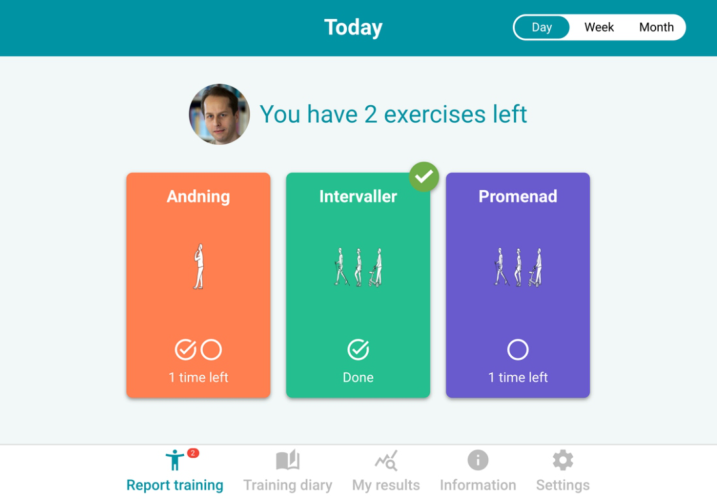
The Patient Application The patient application allows patients to see which exercises they are sup- posed to do each day, and to report to which extent the exercises have been completed. Exercises are represented by colored cards (Figure 1), showing the name of the exercise and how many times it should be performed on a particular day. The cards are updated as exercises are reported, and there is also a textual message that summarizes how many daily exercises are left to be completed. This makes it easy for the patients to keep track of their daily training status and what is still left to do, e.g., if they start and quit the application several times each day.
By clicking an exercise card, the patient is presented with more detailed exercise settings, specifying exactly how the exercise should be performed the current day. This may include the number of sets and repetitions, duration, intensity, and so on, depending on the type of the exercise. The patient also has access to general instructions on how the exercise should be performed, which may be shown as a combination of text, images and even videos.
After reading the settings, and possibly looking at the instructions, the patient performs the exercise without help from the application. We plan to add support for exercise support or guidance in future versions, but currently patients have to perform the exercises on their own. Later, when the patient is finished, they go back to the application and report that the exercise is com- pleted. This can be done at any time, and even on a different day, to make it as convenient for the patient as possible. During reporting, the application
Figure 1: The patient app showing (three) coloured cards representing exercises to be performed.
will ask the patient to input data about when and how the exercise was per- formed (e.g., time of day, number of sets and repetitions, etc.), and how the patient experienced the exertion level. The reported data is then uploaded to the system’s backend and saved in a database.
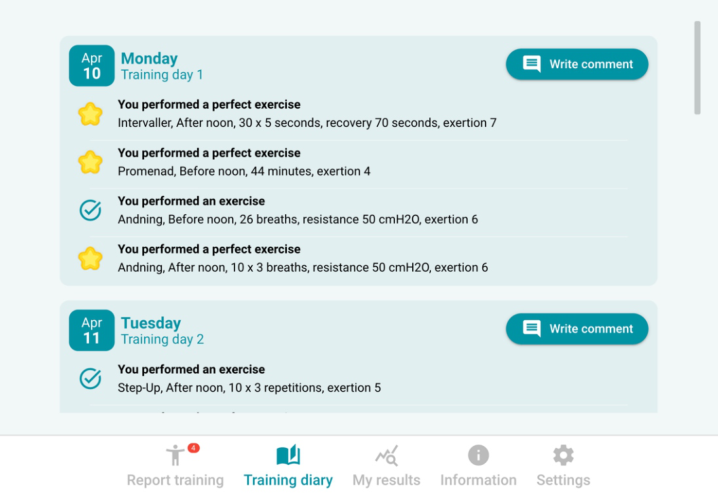
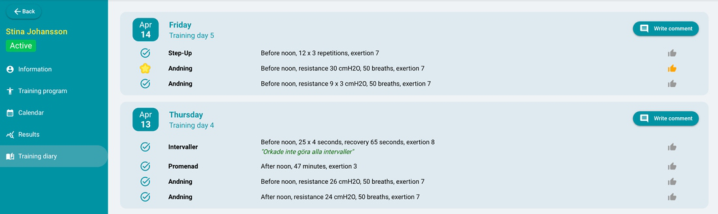
All reported exercise data are automatically gathered in a training diary section of the application, giving the patient access to the whole training history for later inspection. The diary is a log of training related events (e.g., reported exercises) which is populated automatically as the patient is follow- ing their training program over time. The diary lists entries (events) per day in a chronological order (see Figure 2). The patients can also make notes in the diary if they like, i.e., explaining for instance how they felt on a particu- lar day or if they had problems performing an exercise. The diary content is accessible to the physiotherapist, who is also able to give likes (thumbs up) or comment on individual diary entries, as a way of giving feedback to the patient.
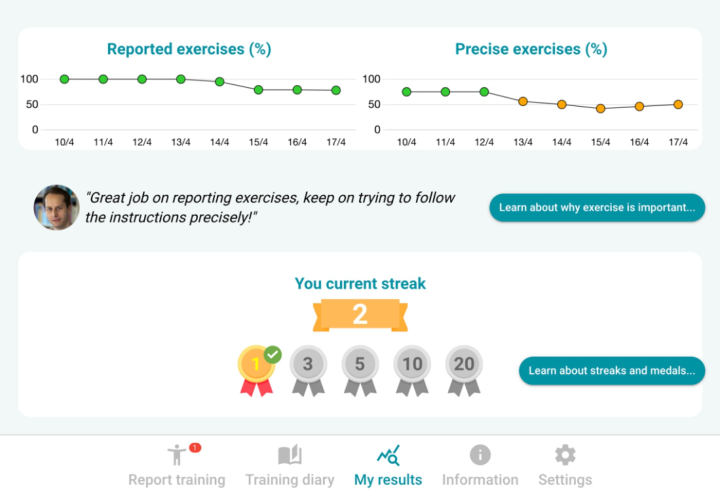
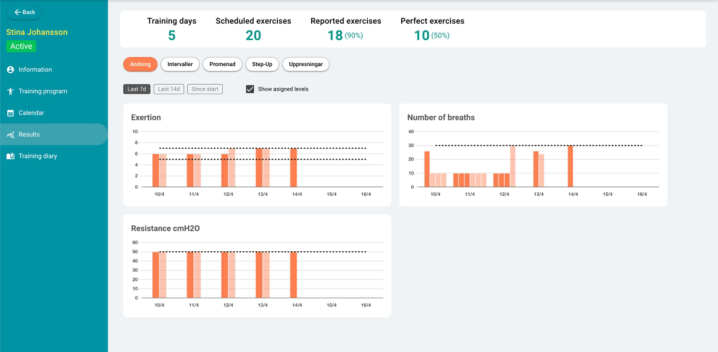
The patients can follow their training progress in several ways. The daily report section (Figure 1) is focused on the daily progress, while the diary also provides a historical view on the progress in the past. There is also a results section where progress graphs are used to visualize the progress (e.g., the percentage of completed exercises or reported exercise parameter values) in an overview fashion, see example in Figure 3. On this page the patient can also see a textual feedback message that summarizes their progress the last few days in an easy-to-understand manner. This message is generated auto- matically by the application, based on the patient’s results, but is presented
Design of an mHealth Application for Optimizing Preoperative Physical Function 761
Figure 2: The patient’s training diary.Figure 3: The patient application result section.
next to an image of the physiotherapist to give the impression that it origina- tes from him or her. This is to make the message more personal and to keep the connection between the patient and physiotherapist strong, something that was requested in meetings with user groups. Ideally the message should
have been written by the physiotherapist, but as they often have limited time to give feedback in the system, we choose to use these kinds of auto-generated messages instead.
The patient application includes features for supporting and increasing the motivation to conduct the exercises. For example, rewards in the form of medals are given based on how well the patient follows the exercise program, both in terms how many exercises the patient reports, but also how well they follow the settings of each exercise, e.g., the assigned number of repetitions or time duration. The patient can see their medals on the result section in the application (Figure 3), and information about acquired medals is also automatically logged in the training diary. The liking or commenting on diary entries by the physiotherapist can also increase the patient’s motivation as it can create a sense one’s efforts being acknowledged and appreciated by someone else. This kind of social features could be extended even further, to allow for instance patients to, if they wish, making their diaries available also to friends and family, and even other patients. In addition to medals and social feedback, the app also provides an information section where patients read about for example why preoperative training is important, to further strengthen the motivation to follow the exercise program.
The Physiotherapist Application The physiotherapist application allows physiotherapists to create individua- lized training programs for their patients, and then to monitor the progress of those patients as they start performing their exercises.
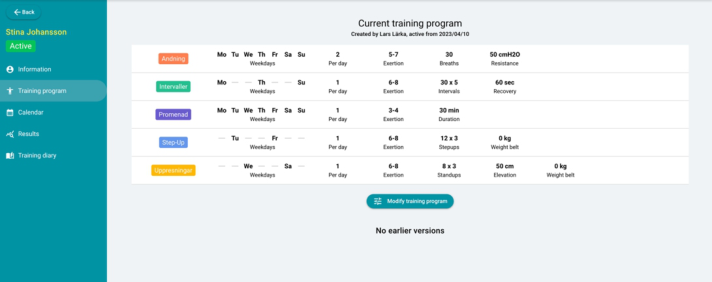
When creating a training program for a particular patient, the physioth- erapist first selects which exercises to include from an exercise library. The physiotherapist then adjusts the settings of each exercise, to suit the pati- ent’s needs and abilities. Depending on the exercise type, this may include on which weekdays the exercise should be performed, how many times per day, the recommended exertion level, number of repetitions, duration, and so on (see Figure 4). Once the physiotherapist is done, the exercise program can be saved and uploaded to the backend, thus making it active for the patient.
Figure 4: The training program of a patient, each row represents a particular exercise with settings that can be adjusted individually.
Design of an mHealth Application for Optimizing Preoperative Physical Function 763
As patients use their tablet app to report completed exercises, the physio- therapist can monitor the results. A results page makes it possible to see, for each exercise type, graphs showing reported data for different exercise para- meters (e.g., exertion reported by the patient). Based on the reported data, the physiotherapist can then determine whether it seems that the patient is able to perform the exercises as intended, or if some exercise settings need to be adjusted. Adjustment of the exercise program can be done by selecting an exercise row (Figure 5) and then entering new values for one or several parameters. It’s also possible to add new exercises, or even to remove existing ones entirely. Saving the updated program will upload a new version to the backend, which will then be available for the patient on the following day.
The physiotherapist also has access to the patient’s training diary (Figure 6). As the diary lists entries (events) per day in a chronological order, it allows the physiotherapist to get a more day centric view of the patient’s progress (what happened on a particular day), compared to the results page. The diary page also allows the physiotherapist to give feedback to the patient, e.g., by “likeing” entries (give a thumbs up) or by writing comments. Such feedback is immediately visible to the patient in their training diary and may be a motivator for the patient to keep up their training.
Figure 5: Various graphs showing a patient’s reported data for a particular exercise.Figure 6: The physiotherapist view of the patient’s training diary.
DISCUSSION AND CONCLUSION The development of the described application is an ongoing work, however based on the initial collaboration with the patients some insights have been made. One important motivational aspect that was pointed out by the pati- ents was that it could contribute to the feeling of having done everything that you can do to gain the best possible output of the surgery. The impor- tance of personalization was described as important. On a high level it was discussed with respect to which extent the preoperative training should be digital or physical together with a physiotherapist. Further, possibilities with making the exercise programs personalized was pointed out by the patients. Finally, interaction with the application and with respect to how information is visualized was also described as an important aspect of the personalization. However, there are several parameters related to each exercise that must be gathered and visualized. This in turn makes it even more important with a clear and easy interaction with the application.
In the forthcoming work, the project will continue to develop the applica- tion together with the patients, and as a final step of the project effects on postoperative complications and postoperative recovery will be evaluated.
ACKNOWLEDGMENT
The authors would like to thank the patients that has participated in the work with the application.
REFERENCES
Beck A. et al. (2020). Investigating the experiences, thoughts, and feelings underlying and influencing prehabilitation among cancer patients: a qualitative perspective on the what, when, where, who, and why. Disabil Rehabil. 2020 May 13: 1–8. Corbett T. et al. (2018). Understanding acceptability of and engagement with Web-
based interventions aiming to improve quality of life in cancer survivors: A synthesis of current research. Psycho-Oncol, 2018; 27: 22–33. Griffiths R. et al. (2014). Peri-operative care of the elderly 2014 Association of Anaesthetists of Great Britain and Ireland. Anaesthesia 2014;69: 81–98. Karlsson E. et al. (2020). Older patients’ attitudes towards, and perceptions of, pre-
operative physical activity and exercise prior to colorectal cancer surgery-a gap between awareness and action. Supportive Care Cancer. 2020;28: 3945–53. Lin H. S. et al. (2016). Frailty and post-operative outcomes in older surgical patients: a systematic review. BMC Geriatrics 2016. 16. Locke E. A., Latham G. P. (2002). Building a practically useful theory of goal setting
and task motivation - A 35-year odyssey. Am Psychol, 2002; 57: 705–17. Matson T. E. et al. (2018). Acceptability of a sitting reduction intervention for older adults with obesity. BMC Public Health, 2018. 18. Michie S. et al. (2011). A refined taxonomy of behaviour change techniques to help
people change their physical activity and healthy eating behaviours: the CALO-RE taxonomy. Psychol Health 2011;26: 1479–98.
Read this individual research paper free through the original publisher, or explore the full digital proceedings book.
ISBN 978-1-958651-87-2
Explore this ISBN in the AHFE Bookstore ↗Listed in the July 2026 bookstore catalogue; search by ISBN to confirm current availability · Digital book purchase optional