Xolile Mashwama, Siyabulela Dywili, Gift Phaladi, Clinton Aigbavboa (2023). The learning curve and benefit of artificial intelligence for the built environment. In: Human Interaction & Emerging Technologies (IHIET 2023): Artificial Intelligence & Future Applications. AHFE Open Access, vol. 111, pp. 251–261. https://doi.org/10.54941/ahfe1004031
Artificial intelligence (AI) technology has the power to unlock the challenges faced in construction projects such as poor efficiency issues, design errors, and accidents on-site. Therefore, this paper is aimed to evaluate the benefit of implementing AI on South African construction projects. The quantitative approach was adopted for this study. Well-structured questionnaire surveys were disseminated to built environment stakeholders such as quantity surveyors, project managers, construction project managers, contractors and architects. A total of 260 questionnaire surveys were distributed and 223 were received back with an 86% response rate. The findings revealed the learning curve benefit of AI is improved quality of work post-construction, reduces budget overruns, saves time, overcomes shortages of experienced labors, improves performance on construction work, improves the health and safety of the construction projects, elicits faster information exchange, improves productivity, reduces construction risks such as on-site accidents, reduces construction errors, improves customer relations, improves profitability and saves cost. However, the study has indicated that the implementation of AI technology in the built Environment in South Africa is still at an early development stage. The study would hopefully contribute to the body of existing knowledge of AI technology. In Addition, it could assist construction industry professionals to advance their workplaces and organizations.
Built environment projects remain one of the key sectors in driving econo- mic growth. Furthermore, built environment projects are considered to be successful if they are delivered on time, within budget, and of good quality, which satisfies the client’s needs (Luvara et al., 2018). However, numerous factors affect the timely delivery of construction projects, such as constru- ction delays, cost and time overruns, accidents on-site and design errors. As a result, they affect productivity growth of the built environment pro- jects (Lopes et al., 2011). According to Jarkas (2010), the main reasons for poor productivity in the built environment are the employment of unskil- led workers and the slow development of adopting the latest technologies.
According to Gotthardt et al., (2019), the adoption and implementation of AI in built environment projects will enhance the learning curve for the built environment and mitigate the poor productivity issues faced by the indu- stry. The adoption of technologies such as AI on built environment projects does not only solve productivity issues but can also improve the visualization of problem areas, expose inefficiencies, and improve construction planning accuracy. Moreover, infusing AI into the learning curve will also prevents accidents on site, as well as cost, and time overruns. Project performance is defined as “the achievement of fitness for purpose in the construction and the absolute realization of client’s satisfaction” (Phaladi et al., 2021). Furth- ermore, developing countries are affected economically because of the lack of growth in construction performance (Chauke et al., 2021). Construction project performance has been drastically affected by poor productivity.
ARTIFICIAL INTELLIGENCE AND THE LEARNING CURVE A learning curve is a graphical representation of a repetitive task that when done on a continuous basis, leads to a reduction in activity dura- tion, resources and costs (Caruso et al., 2002). The learning curve portrays the cost and benefits of experience when performing routine or repetitive tasks. Furthermore, learning curves are also known as experience curves, cost curves, efficiency curves and productivity curves (Chamber, Stuart & Johnson, 2000). In the broader frame, the ‘learning curve’ has come to mean that every new activity requires the acquisition of knowledge and skill. It takes time (and therefore money) to master new jobs and new fields, however, later knowledge provides efficiency and leverage, hence the integration of AI in the built environment projects will improve the learning curve (Anzanello & Fogiliatto, 2011). AI in built environment projects will improve the lear- ning curve through the increase in communication, customer involvement, allocating people to the right task, cost savings, and delivery of the pro- ject on time. Furthermore, it will eliminate cost and time overruns, reduce poor quality, and reduce absenteeism of labour and wastage (Anzanello & Fogiliatto, 2011). Hence, the integration of AI into the learning curve in the built environment would assist the application of knowledge, skills, tools, and techniques in project activities to meet project requirements since it is the core major fundamental activity to achieve. Understanding the concept of learning curves in the built environment would help each employee to par- ticipate in projects and improve project performance, leading to improved productivity on a daily basis (Maley, 2012 & Richardson, 2010).
ARTIFICIAL INTELLIGENCE (AI) AND LEARNING CURVE FOR THE BUILT ENVIRONMENT Underwood and Khosrowshahi (2012), stated that infusing AI in the built environment projects would indeed improve and add value to the learning curve business processes as many managers globally have realized the bene- fits associated with it, especially in developed nations. The learning curve for
The Learning Curve and Benefit of Artificial Intelligence for the Built Environment 253
AI is demonstrated to increase the competitiveness of companies by distribu- ting information in a safer way for better decision-making on construction projects. Ballan and EL-Diraby (2011) backed this up, who said it does not matter if the construction firm is medium or large-sized, the AI benefits will be experienced as long as the technologies are implemented well and corre- ctly understood by the users. Following are the learning curve benefits for the implementation of AI. Adopting technologies offered by the 4IR such as AI and robots can save time, especially when preparing monthly claims to pay contractors. Technological software such as virtual reality, robots, and intel- ligent machines being adopted on construction projects can save time, and productivity growth can be enhanced (Ballan and El-Diraby, 2011). Contra- ctors will be able to make more profit because of the proper application of AI on construction projects (Khosrowshahi and Underwood, 2012).
The construction industry especially in undeveloped nations experiences communication issues due to the slow adoption of the latest technology (Rivard et al., 2014). Spending more on the latest technologies will speed up companies to improve their productivity and communication methods. (Bal- lan and El-Diraby, 2011). Therefore, if the communication tools and latest technologies are correctly used communication will improve (Agbevade, 2017). Customer relations can be enhanced when the project participants exchange crucial information more often for AI systems to learn quickly and be able to make better decisions (Underwood and Khosrowshahi, 2012). Construction projects have been impacted by low productivity, which has caused poor project performance, resulting in abandonment, penalties being charged, and poor-quality standards of the project (Phaladi et al., 2021). Learning curve infused with AI will mitigate delays and poor project per- formance such as design errors, accidents on site and shortages of labourers. Implementing smart machines on the projects would improve their perfor- mance and ensure timely delivery of the project. The introduction of AI software would lead to effectiveness and efficiency in carrying out the work by reducing the time taken for the processing of data (Chauke et al., 2021).
RESEARCH METHODOLOGY The research was conducted in Gauteng Province, South Africa. Targeted areas for the collection of data include Midrand, Sandton, and Randburg which are under the Johannesburg Metropolitan Municipality. The targe- ted participants were the built environment stakeholders such as contractors, quantity surveyors, architects, construction project managers, construction managers, electrical engineers, mechanical engineers, and civil engineers. A convenience sampling technique was adopted for the study. The reason for choosing convenience sampling was that it saves time and targets partici- pants who are willing to participate in the questionnaire survey (Etikan et al., 2016). This study adopted a questionnaire survey as a method of collecting data from the targeted participants as a primary method of collecting data. In addition, the secondary method of collecting data was through the analysis of published conference papers, dissertations, and journal articles. A total of 260 questionnaires were disseminated to participants and 223 were returned
with an 86% response rate. The five-point Likert scale was used to determine the benefits of the learning curve for AI in the built environment. MIS values were ranked starting from the highest to the lowest based on the factors identified under each question. The standard deviation was used to rank the variables that had the same mean item scores. The Cronbach Alpha (CA) was adopted to test consistency and reliability. Humaidi and Said (2011), indica- ted, “Cronbach Alpha aims to determine the level of correction of items in a set”. The CA was calculated using the Statistical Package for Social Sci- ence (SPSS). The Cronbach Alpha for artificial intelligence infused in the learning curve was 0.702, which is acceptable. Humaidi and Said (2011) further postulated that a CA value of less than one implies that the relia- bility test is accepted. Exploratory factor analysis (EFA) can be defined as the “statistical method adopted to decrease a large number of variables to a small number of factors/components reflecting that the cluster of variables is common” (Hadi et al., 2016). The study has adopted EFA for the analysis of the data collected. The testing of the data set was completed with the usage of sample size and strength of the variables between indicators. Furthermore, the Kaiser Meyer Olkin (KMO) test and Bartlett’s test of sphericity were con- ducted for the study. KMO tests were conducted to measure the suitability of a sampling whilst Bartlett’s test was conducted to measure the strength of the relationship between the variables. KMO value is sufficient when is larger than 0.5 (Field, 2000). A KMO between the interval of 0.7 and 0.8 is good, values between 0.8 and 0.9 are greater and values above 0.9 are excellent (Pallant, 2013).
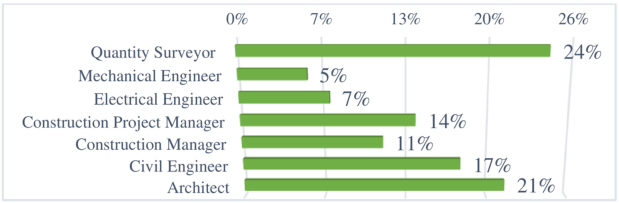
FINDINGS The highest qualifications of the respondents were 34% of the respondents held a bachelor’s degree, 24% of the respondents had a diploma, 22% had an honours degree, 15% hold a master’s degree whilst 5% held matric certificates. The questionnaire was answered by respondents who had an understanding of artificial intelligence in the built environment. Figure 1 below indicates respondents’ profession. The results show that 24.1% were quantity surveyors, 21% of the respondents were Architects, 17.4% the respondents were civil engineers, 13.8% were construction project mana- gers, 11.2% were construction managers 7.1% were electrical engineers, and 5.4% were mechanical engineers.
Figure 1: Respondents’ profession.
The Learning Curve and Benefit of Artificial Intelligence for the Built Environment 255
ARTIFICIAL INTELLIGENCE FOR ENHANCED LEARNING CURVE Descriptive Analysis Results
Table 1 represents the AI benefits for enhanced learning curve for the built environment. The top five results are as follows: ‘improves quality of work post-construction’ with (MIS = 4.19, SD = 0.510, R = 1), ‘reduces bud- get overruns’ with (MIS = 4.08, SD = 0.545, R = 2), ‘saves time’ with (MIS = 4.01, 0.724, R = 3), ‘overcome shortage of experienced labourers’ with (MIS = 3.95, SD = 0.701, R = 4), ‘improves performance on constru- ction work’ with (MIS = 3.93, SD = 0.666, R = 5), ‘improves the health and safety of the construction projects’ with (MIS = 3.950, SD = 0.697, R = 5). The five lowest results which were ranked by respondents are: ‘impro- ves profitability’ with (MIS = 3.67, SD = 0.477, R = 11), ‘saves cost’ with (MIS = 3.75, SD = 0.456, R = 12), ‘improves communication amongst the project team’ with (MIS = 3.73, SD‘= 0.531, R = 13), ‘improves tracking and security’ with (MIS‘= 3.71, SD = 0.571, R = 14), and ‘facilitates improved decision making’ with (MIS = 3.58, SD = 0.556, R = 15).
Table 1. Benefits of AI infused in the learning curve.
Table available in the original PDF paper.
Rank Factors MIS SD CA if Item Deleted
3.93 0.699 0.715 5
Improves quality of work post-construction 4.17 0.510 0.703 1 Reduces budget overruns 4.08 0.545 0.700 2 Saves time 4.01 0.724 0.708 3 Overcomes shortages of experienced labors 3.95 0.701 0.712 4 Improves performance on construction work 3.93 0.666 0.711 5 Improves the health and safety of the construction projects Elicits faster information exchange 3.91 0.697 0.713 6 Improves productivity 3.84 0.377 0.685 7 Reduces construction risks such as on-site accidents 3.83 0.643 0.672 8 Reduces construction errors 3.81 0.655 0.682 9 Improves customer relations 3.78 0.615 0.656 10 Improves profitability 3.76 0.477 0.674 11 Saves cost 3.75 0.456 0.675 12 Improves communication amongst the project team 3.73 0.531 0.672 13 Improves tracking and security 3.71 0.571 0.652 14 Facilitates improved decision making 3.58 0.556 0.669 15
Equation reproduced from the original PDF.
Exploratory Factor Analysis Results
Table 2 indicates the correlation matrix for the benefits of AI-infused in the learning curve. A total of 16 factors were used during analysis and have a value of less than one which implies that the reliability test is accepted.
Table 3 displays the KMO measure of sampling adequacy and Bartlett’s test of sphericity. Results show that the KMO has a value of 0.825 which is above the recommended value of 0.5 of which is good. The recommended value for KMO must be 0.5 or above for the test to be acceptable (Field, 2000).
Table 2. Correlation matrix for the benefits of AI-infused in the learning curve.
Table available in the original PDF paper.
Table 3. KMO and Bartlett’s test the benefits of AI-infused in the learning curve.
Table available in the original PDF paper.
Kaiser-Meyer-Olkin Measure of Sampling Adequacy. 0.825 Bartlett’s Test of Sphericity Approx. Chi-Square 4364.285 Df 120 Sig. 0.000
Bartlett’s test has a significance value of 0.000 which is acceptable since it is less than the assumed value of 0.05.
Table 4 indicates the anti-image correlation matrix, which measures sam- pling adequacy for the AI benefits infused in the learning curve. All 16 factors were above the assumed value of 0.5, which is good and acceptable.
Table 5 displays the commonalities of a variable where 16 factors are above the recommended value of 0.3. Moreover, the PCA Analysis was adopted as the type of extraction method.
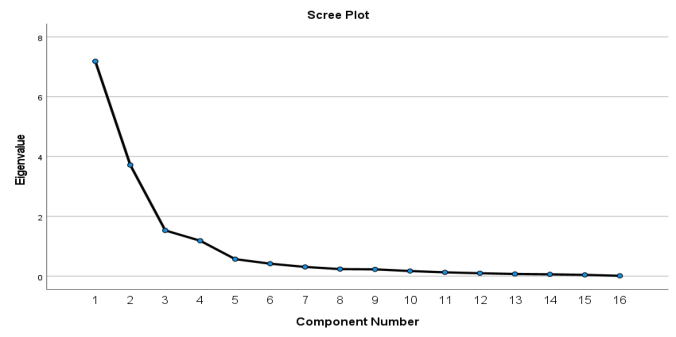
Table 6 displays the total explained variance for the AI benefits infused in the learning curve. Results show that there are four components with a total value of above one. Moreover, they are four factors to be extra- cted through the usage of the PCA method. The four to be extracted have 44.917%, 23.246%, 9.573%, and 7.417%, respectively with a cumulative percentage of 85.154% before extraction and rotation.
Table 7 displays the rotated component matrix. Results show that the com- ponent was extracted through the usage of the Principal Component Analysis method. Moreover, varimax with Kaiser normalization was adopted as a rotation method.
Reliability Tests for the Rotated Factors Four components were rotated. Component 1 has five (5) factors (BIAI-02, BIAI-06, BIAI-15, BIAI-07, BIAI-08,), Component 2 has four (4) factors (BIAI-14, BIAI-11, BIAI-16, BIAI-03), Component 3 has four (4) factors
The Learning Curve and Benefit of Artificial Intelligence for the Built Environment 257
Table 4. Anti-image correlation matrix for the benefits of AI-infused in the learning curve.
Table available in the original PDF paper.
Table 5. Communalities for the benefits of AI-infused in the learning curve.
(BIAI-5, BIAI-4, BIAI-13, BIAI-9), Component 4 has three (3) factors (BIAI- 10, BIAI-12, BIAI-1). Component 1 has a CA value of 0.757 with 1 factor (BIAI-16) deleted to boost the test.
Component 2 has a CA value of 0.905. Component 3 has a CA value of 0.854.
Table 6. Total explained variance for the benefits of AI-infused in the learning curve.
Table available in the original PDF paper.
Initial Eigenvalues Extraction Sums of Squared Loadings Cumulative %
Table 7. Rotated component matrixa for the benefits of AI-infused in the learning curve.
Table available in the original PDF paper.
Component
1 2 3 4
BIAI-02 0.938 BIAI-06 0.937 BIAI-15 0.926 BIAI-07 0.820 BIAI-08 0.794 BIAI-14 0.897 BIAI-11 0.822 BIAI-16 0.729 BIAI-03 0.706 BIAI-05 0.918 BIAI-04 0.819 BIAI-13 0.738 BIAI-09 0.650 BIAI-10 0.845 BIAI-12 0.747 BIAI-01 0.642 Extraction Method: Principal Component Analysis. Rotation Method: Varimax with Kaiser Normalization. a. Rotation converged in 5 iterations.
Component 4 has a CA value of 0.847. Four components extracted have CA values of above 0.70 which makes the results acceptable or good. This was further justified by Pallant (2013) who said that a CA value of above 0.70 implies the acceptability of the test. The naming of components for the AI benefits infused in the learning curve.
The Learning Curve and Benefit of Artificial Intelligence for the Built Environment 259
Figure 2: Scree plot diagram for the benefits of AI-infused in the learning curve.
Component 1 – Enhancement of Finance Factors for this component suggest that the implementation of AI systems and machines would enhance financial implications experienced on constru- ction projects since the adoption of AI would save costs and time, reduce construction design errors, improve profitability and eliminate shortages of experienced labourers. Again, AI improves performance on construction projects.
Component 2 – Improvement of Quality Standards The implementation of AI systems and intelligent machines would definitely improve health and safety on construction projects, and reduce budget over- runs which leads to makes some of the projects being abandoned owing to financial implications encountered. In addition, there will be a faster way of exchanging information amongst the project participants.
Component 3 – Reduction Factors suggest that there would be a reduction of construction risks, errors as well as improved customer relations and tracking and security on construction projects.
Component 4 – Improvements on the Construction Site Factors imply that they would be a significant improvement if AI is imple- mented effectively in construction projects. Moreover, there would be an improvement in productivity, decision making and communication amongst project team members.
CONCLUSION AND RECOMMENDATIONS The study has further revealed the benefits such as improved productivity and profitability, reduced budget overruns, reduced construction errors, and
faster information exchange. The findings of the study were backed by vari- ous researchers and scholars. Finally, the findings of the study will add significant value to the body of knowledge on infusing AI into the learning curve for improved service delivery of the built environment projects. The study is, therefore, recommending that government institutions and profes- sional regulatory bodies should encourage company owners to use the 4IR technologies. They should also support them financially, particularly in the case of small and medium firms.
REFERENCES
Agbevade, J., (2017). Assessing the effectiveness of communication in construction project team performance in selected metropolises in Ghana., Department of Construction and Wood Technology Education, Faculty of Technical Education, University of Education, Winneba, College of Technology Education, Kumasi, 1–137. Ballan, S., and El-Diraby, T. E., (2011). A value map for communication systems in
construction. Journal of Information Technology in Construction, 16: 745–760. Chauke, S., Mashwama, N., Aigbavboa, C. and Thwala, W., (2021) Investigating Employee Performance for Improved Learning Curve in the South African Con- struction Industry. In IOP Conference Series: Materials Science and Engineering (Vol. 1218, No. 1, p. 012028). IOP Publishing. Eadie, R., Odeyinka, H., Browne, M., McKeown, C., and Yohanis, M., (2014).
Building information modeling adoption: An analysis of the barriers to imple- mentation. Journal of Engineering and Architecture, 2(1): 95–101. Etikan, I., Musa, S. A., and Alkassim, R. S., (2016). Comparison of convenience sampling and purposive sampling. American Journal of Theoretical and Applied Statistics, 5(1): 1–4. Field, A., (2000). Discovering statistics using SPSS for windows. New Delhi: Sage
Publications. Gotthardt, M., Koivulaakso, D., Paksoy, O., Saramo, C., Martikainen, M. and Lehner, O. M. (2019). Current state and challenges in the implementation of robotic process automation and artificial intelligence in accounting and auditing. ACRN Oxford Journal of Finance & Risk Perspectives, 8: 31–46. Hadi, N. U., Abdullah, N. and Sentosa, I., 2016. An easy approach to explora-
tory factor analysis: Marketing perspective. Journal of Educational and Social Research, 6(1), p. 215. Humaidi, R., and Said, C., (2011). Construction industry productivity and the potential for collaborative practice. International Journal of Project Management, 32(2): 315–326. Jarkas, A. M., (2010). Buildability factors influencing micro-level formwork labor
productivity of slab panels in building floors, Architectural Engineering and Design Management, 6(3): 161–174. Lopes, S., Blackburn, R., and Rosen, B., (2011). Virtual team effectiveness: A proposed research agenda. Information Systems Journal, 9 (4): 249–269. Luvara G. M. V., Phoya, S., Tesha, D. N. G. A. K., and Lyimo K. S., (2018). Critical
factors causing delay and cost overrun in public building projects in Dar-Es- Salaam, Tanzania, in the PARIPEX. Indian Journal of Research, 7(7): 11–16. Retrieved from: https://www.worldwidejournals.com/paripex/file.php?val=July- 2018-1530787910-84.pdf on April 22, 2021.
The Learning Curve and Benefit of Artificial Intelligence for the Built Environment 261
Pallant, J., (2013). SPSS survival manual. A step-by-step guide to data analysis using SPSS, 4th ed. Retrieved from: www.allenandunwin.com/spss on April 25, 2021. Phaladi, M. G., Mashwama, X. N., Thwala, W. D. and Aigbavboa, C. O., (2021). A
Theoretical Assessment of the Implementation of Artificial Intelligence (AI) for an Improved Learning Curve on Construction in South Africa. In IOP Conference Series: Materials Science and Engineering (Vol. 1218, No. 1, p. 012003). IOP Publishing. Rivard, H., Froese, T., Waugh, L. M., El-Diraby, T., Mora, R., Torres, H., Gill, S. M., and O’Reilly, T., (2014). Case studies on the use of information techno- logy in the Canadian construction Industry. Journal of Information Technology in Construction, 1(9): 19–34. Underwood, J., and Khosrowshahi, F., (2012). ITC expenditure and trends in the
UK construction industry are facing the challenges of the global economic crisis. Journal of Information Technology in Construction (ITcon), 17: 25–42.
Read this individual research paper free through the original publisher, or explore the full digital proceedings book.
ISBN 978-1-958651-87-2
Explore this ISBN in the AHFE Bookstore ↗Listed in the July 2026 bookstore catalogue; search by ISBN to confirm current availability · Digital book purchase optional