Douglas Aghimien, Clinton Aigbavboa, Ayodeji Oke, Ahmad Taki (2023). Unearthing the outcome of construction digitalisation – a South African perspective. In: Sustainable Construction in the Era of the Fourth Industrial Revolution. AHFE Open Access, vol. 107, pp. 85–94. https://doi.org/10.54941/ahfe1003095
For most construction organisations in developing countries like South Africa, embracing digitalisation is constrained by the absence of evidence pointing to the outcome features of using digital technologies. This study, therefore, set out to unearth the potential outcomes of construction digitalisation by drawing from the perspective of construction professionals in diverse construction-related organisations across South Africa. The study adopted a post-positivism philosophical stance using quantitative research conducted through a questionnaire survey. Data were analysed using mean item score, Kruskal-Wallis H-Test and Confirmatory Factor Analysis (CFA). With good internal consistency, construct validity, and acceptable fit indices, CFA confirmed that an organisation's ability to deliver projects within the agreed schedule, quality and cost is improved with digitalisation, with better digital uptake and transformation achieved in the process. This implies that for a construction industry like South Africa, characterised by poor project performance due to the slow adoption of technological advancement, embracing construction digitalisation is a must in this current era of the fourth industrial revolution.
The construction industry in developing countries (South Africa inclusive) has been characterised by underperformance, especially in cost, time, qua- lity, and overall satisfaction of projects being delivered (Agarwal et al., 2016; Oshodi et al., 2017). It has been noted that it is unlikely for the dream of construction clients to come to a complete realisation (Emuze and Smallw- ood, l 2011). This is due to the poor performance of construction companies characterised by poor construction processes and projects delivered above budget. Several factors have been held accountable for these poor perfor- mances of the construction industry. One of these is the slow adoption of technologies (Alaloul et al., 2020). Despite the clamour for the embrace
of digital technologies offered by industry 4.0 (Argarwal et al., 2016; Ber- ger, 2016), the problem of slow adoption persists within the construction industry of developing countries, and the resultant effect is the lack of impro- vement experienced within their industries (Agarwal et al., 2016). If the construction industry is to improve its service delivery, organisations must be ready to jettison their old ways of service delivery for a more digitalised approach (Aghimien et al., 2018). Aghimien et al. (2019) described constru- ction digitalisation as the adoption of digital technologies in place of human effort to deliver construction services that are satisfactory to the client and for which the organisation can attain a competitive advantage over their competitors.
Since the advent of industry 4.0, studies have placed focus on the ado- ption, and challenges of digital technologies (Delgado et al., 2019; Oke et al., 2018), the application of these technologies to specific construction pro- blems (Sanni-Anibire et al., 2020), and the industry’s readiness to adopt these technologies (Maskuriy et al., 2019). However, for most construction orga- nisations in developing countries like South Africa, embracing digitalisation is constrained by the absence of evidence pointing to the outcome features of digital technologies. For some organisations, deciding on the right digital technology and implementation that will yield positive benefits and transfor- mation is challenging (Economic Intelligence Unit, 2017). Understanding the outcomes that construction digitalisation proposes might go a long way in ali- enating any doubt in owners and stakeholders of construction organisations regarding adopting these digital tools. This is necessary as a lack of awareness of the inherent benefits of digitalising business functions has been noted as one of the major barriers to construction digitalisation (Sawhney and Singhal, 2013). Based on this knowledge, this study explored the outcome features of construction digitalisation with a view to encouraging the digital transforma- tion of construction organisations in developing countries like South Africa. The study’s findings provide a basis for construction organisations to reshape their policies to accommodate the use of digital technologies in their service delivery.
CONSTRUCTION DIGITALISATION It has been noted that construction activities mostly depend on human input (Delgado et al., 2019). However, a significant burden can be lifted from the workers through digitalising mundane and routine tasks. With the use of robotics and automation, repetitive jobs done by employees are reduced, thus reducing overall project costs and time wastage (Kamaruddin et al., 2016). The application of digital technologies also promises momentous benefits to construction problems of delivering projects above budget, beyond the expected time, and below agreed specification (Delgado et al., 2019; Oke et al., 2018).
With digital technologies, more quality projects that meet the client’s requirements can be achieved, leading to improved client and stakeholder satisfaction. For instance, robotics and automation can bring about increased
Unearthing the Outcomes of Construction Digitalisation – A South African Perspective 87
productivity and client satisfaction as a more durable and precise constru- ction project can be achieved. Also, building information modelling (BIM) can help deliver value for construction clients’ money, thus leading to increa- sed client satisfaction (Delgado et al., 2019; Hashim et al., 2013; Kamaruddin et al., 2016). BIM offers high cost and time savings in the aspect of rew- ork as clashes and design errors are identified early in projects (Pärn et al., 2018). This saves the time wasted on the rework of construction works and its associated cost (Hashim et al., 2013).
Similarly, the use of machines can be enhanced with smart connected construction machinery where these machines will communicate with one another through the Internet of Things. With drone-powered solutions and robotics, sites can be three-dimensionally scanned. The information can be digitally captured and made available to the project managers immediately for planning purposes (Berger, 2016).
The social sustainability of construction projects, particularly in rela- tion to health and safety, can be addressed through the use of autonomous robots (Ruggiero et al., 2016). Also, with 3D printers, hazardous work is done by the printer leaving the less hazardous work to be carried out by humans (Sakin and Kiroglu, 2017). Furthermore, wearable devices with embedded sensors can help monitor workers’ health issues and detect pro- blems early. This is done by measuring and capturing the health data of workers. Early detection of issues around workers’ overworking, stress and subsequent absenteeism allows measures to be put in place before they affect the overall project outcome (Salento, 2017). Also, through the ado- ption of technologies, construction organisations can be more competitive (Kamaruddin et al., 2016).
METHODOLOGY
The study adopted a post-positivism philosophical stance using quantitative research conducted through a questionnaire survey. The questionnaire was designed in two sections, with the first section geared toward gathering the respondents’ background information. The second section sought answers to the outcome features of construction digitalisation. The respondents were asked to rate the extent to which 19 expected digitalisation outcomes could be achieved in construction organisations in the country using a 5-point Likert scale, with 5 being a very large extent, 4 being large extent, 3 being modera- tely extent, 2 being low, and 1 being no extent at all. The target population was construction professionals (architects, engineers, construction managers, and quantity surveyors) with at least five years of working experience and currently practising in South Africa. A survey of these construction professi- onals’ respective professional bodies’ databases revealed a total population of 40,188 members. Using Cochran’s sample size equation, a sample size of 546 was derived at a 90% confidence level and a ±7% margin of error with a 0.5 estimated proportion of the population. The snowball sampling technique was adopted as it was difficult to determine the exact number of professionals with the required years of experience and actively practising at the time of the research. At the end of the survey period, 222 construction
professionals participated in the survey. This retrieved sample represented a 40.5% response. In analysing the data gathered, the mean item score (X) was used to rank the different digitalisation outcomes as rated by the different professionals. Kruskal-Wallis H-Test (K-W) was conducted to determine the significant dif- ference in the respondents’ views based on the type of organisation they come from (i.e., contractors, consultants and government). Confirmatory Factor Analysis (CFA) was further conducted to confirm these variables as possible outcome features of construction digitalisation in the South African constru- ction industry. CFA was conducted using EQS 6.4, and the analysis gives the internal consistency, construct validity, Z-statistics, and diverse model fit indices.
FINDINGS AND DISCUSSION Background Information
The study’s respondents were professionals from eight of the nine pro- vinces in South Africa. No response was gotten from professionals in the Western Cape province. Quantity surveyors account for the highest participation with 32%. This is followed by Engineers (26.6%), Archi- tects (15.3%), construction managers (14.4%), and construction project managers (11.7%). Most of these respondents (51.8%) have a bachelor’s degree, while 27.5%, 17.1% and 3.6% have master, diploma and docto- rate degrees, respectively. The average years of working experience for all the respondents was calculated as 9.2 years which shows a conside- rably high number of years in the industry. These results imply that the target respondents of construction professionals for the study were adequ- ately represented, and they have a reasonable level of academic background to understand the questions of the research. Furthermore, these questi- ons were answered based on the vast wealth of experience working within the industry.
Outcomes of Construction Digitalisation in South Africa
Table 1 shows the overall X, chi-square (χ2) and significant p-value derived from the K-W test conducted. The result revealed that all the assessed possible outcomes had an overall X of well above the average of 3.0, thus implying that, to a large extent, they can be derived if construction digitalisation is properly implemented within the South African construction industry. Better project delivery on time (X = 4.49), better project delivery to cost (X = 4.47), increased productivity (X = 4.44), digitally transformed construction orga- nisation (X = 4.41), increased client satisfaction (X = 4.39), and overall project performance (X = 4.39) are the top expected outcomes. The result from K-W conducted revealed that out of the 19 assessed outcomes, there is no significant difference in the professionals’ view of 14 variables as they had a p-value of above 0.05. However, some statistically significant diffe- rences exist for better project delivery to cost, increased client satisfaction, effective data management, effective procurement system, and creation of
Unearthing the Outcomes of Construction Digitalisation – A South African Perspective 89
Table 1. Ranking of the outcomes of construction digitalisation in South Africa.
Table available in the original PDF paper.
Code Outcome features Overall K-W
4.41 4 0.131 0.937
X Rank χ2 p-value OD8 Better project delivery on time 4.49 1 4.705 0.095 OD7 Better project delivery to cost 4.47 2 6.030 0.049** OD14 Increased productivity 4.44 3 0.681 0.711 OD4 Digitally transformed construction organisation
OD11 Increased competitiveness in the local market
4.20 16 0.979 0.613
OD1 Improved digital culture 4.28 10 0.158 0.924 OD6 Effective data management 4.27 11 10.417 0.005** OD12 Increased innovativeness 4.27 11 0.377 0.828 OD3 Improved digital readiness 4.23 13 0.270 0.874 OD2 Improved digital uptake 4.22 14 0.345 0.841 OD17 Effective procurement system 4.21 15 10.922 0.004** OD10 Increased competitiveness in the global market
4.20 16 3.522 0.172
OD16 Better social sustainability in projects (H&S)
4.18 18 4.886 0.087
OD5 Better cyber security of organisation’s data
4.15 19 15.328 0.000**
OD13 Creation of digital employment opportunities Note: X = Mean item score; χ2 = Chi square, ** significant at p < 0.05
digital employment opportunities, as their p-value is less than the threshold of 0.05.
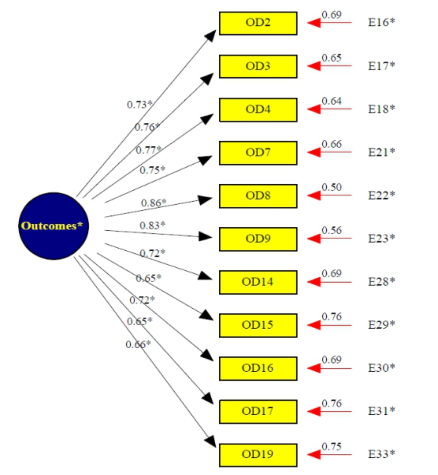
CFA conducted using EQS gave a standardised coefficient (λ) which is used to determine the construct validity, as well as the Cronbach alpha (α) and Rho alpha (ρA) for all the variables assessed. To determine the most appropriate outcomes, there is the need to eliminate factors with weak λ (Oke and Ogun- semi, 2016). In doing this, careful consideration was given to the impact of deleting or retaining these weak variables on the fit indices derived. Based on their weak λ of below 0.6, eight outcome features (OD1, OD5, OD6, OD10, OD11, OD12, OD13, OD18) were eliminated. Table 2 shows the eleven retained outcomes of construction digitalisation based on the stan- dardised λ derived, which ranged between 0.650 to 0.864 and showed good construct validity. For the internal consistency (reliability), Table 2 shows that the variables’ final evaluation gave an α-value of 0.929 and a ρA coef- ficient of 0.937, which were higher than the set threshold of 0.7, thereby implying good internal consistency (Bagozzi and Yi, 2012). Furthermore, the table shows that the eleven outcome features are significant as Z-values above
Table 2. Construct validity, internal consistency, and coefficient of determination.
1.96 (i.e., at 95% confidence level) were derived. However, the coefficient of determination (R2) revealed that better project delivery to time (OD8) and better project conformance to quality (OD9) have the highest possibility of occurrence as their R2 of 0.747 and 0.688 are higher than the rest.
To further confirm these variables’ appropriateness, several fit indices were evaluated, as seen in Table 3. Hu and Bentler (1999) have earlier suggested the use of the standardised root mean squared (SRMR) along with any sup- plemental fit index such as the Comparative Fit Index (CFI) or Root Mean Squared Error of Approximation (RMSEA) in determining model fitness. For the SRMR, a cut-off of ≤0.08 is considered adequate for an acceptable fit (Hu and Bentler, 1999). The result in Table 3 shows an SRMR value of 0.076, which implies an acceptable fit. The normed chi-square (S-Bχ2/Df) also gave an acceptable fit of 4.7, while the RMSEA gave a weak fit of 0.014. To make up for this weakness in the RMSEA, the CFI gave a more acceptable fit of 0.808. The non-normed fit index (NNFI) and the goodness of fit (GFI) both gave acceptable fits of 0.763 and 0.785, respectively. Therefore, looking at the acceptable fit derived from the SRMR fit together with the acceptable
Table 3. Fit indices.
Table available in the original PDF paper.
Fit indices Cut-offs Sources Value Remarks
4.7 Acceptable
S-Bχ2/ Df < 3 is good; < 5 is acceptable Hu and Bentler (1999)
0.076 Acceptable
SRMR ≤0.08 – acceptable fit Hu and Bentler (1999)
0.038 Good
RMR < 0.05 is good Hu and Bentler (1999)
0.763 Acceptable
NNFI 0.60 to 1.00 – acceptable fit Hu and Bentler (1999) GFI 0 to 1 (0 = no fit; 1 – perfect fit) Doloi et al. (2010) 0.785 Moderate CFI 0 to 1 (0 = no fit; 1 – perfect fit) Doloi et al. (2010) 0.808 Acceptable RMSEA 0.05 to 0.10 – acceptable fit Doloi et al. (2010) 0.014 Weak
Unearthing the Outcomes of Construction Digitalisation – A South African Perspective 91 fits from the S-Bχ2/Df, NNFI, GFI and CFI, as suggested by Hu and Ben- tler (1999), it can be concluded that the assessed variables are fit as the key outcomes features of construction digitalisation in South Africa.
Discussion of Findings CFA has revealed eleven crucial outcomes of construction digitalisation, as seen in Figure 1. These outcomes in the order of their R2 are (1) better project delivery to time, (2) better project conformance to quality, (3) digi- tally transformed construction organisation, (4) improved digital readiness, (5) better project delivery to cost, (6) improved digital uptake, (7) incre- ased productivity, (8) better social sustainability in a project, (9) overall project performance, (10) increased client satisfaction, and (11) effective procurement system.
Like most developing countries, South Africa has been noted for poor delivery of projects in terms of time, cost, and quality (Emuze and Smal- lwood, 2011). Construction digitalisation offers a solution to this age-old problem of the industry. This finding is in tandem with the submissions of Delgado et al. (2019) and Oke et al. (2018), who noted that the use of digital technologies in construction service delivery offers the opportunity to deliver a project on time within budget, and to customers’ determina- tions. Past studies have also noted that the construction industry, especi- ally in developing countries like South Africa, is the principal culprit of the slow adoption of technologies (Alaloul et al., 2020). With the ado- ption of appropriate digital tools, the construction industry will be digitally
Figure 1: Extracted outcome features of construction digitalisation.
transformed and ready to deliver construction projects like its counter- parts in developing countries, where digital technologies have been widely embraced.
While most construction projects in developing countries are being delive- red with significant client dissatisfaction (Oke and Aigbavboa, 2017), the issue of poor social sustainability, particularly with respect to health and safety, continues to reoccur (Okoye et al., 2017). Findings from this study reveal that construction clients can be satisfied with the projects they get through digital technologies, while safer projects can be delivered using seve- ral sensing and warning digital technologies available. This finding is in line with a past submission that has noted that through the use of digital tools, more efficient collaboration can be achieved among project stakeholders, and by extension, better project delivery to client satisfaction can be attained (Oke et al., 2018). It also corroborates the submission of past works that have noted that the use of digitally-driven technologies and smart wearables can significantly improve the construction industry’s health and safety nature (Aghimien et al., 2019; Sakin and Kiroglu, 2017; Salento, 2017).
CONCLUSION
Based on the findings, the study concludes that construction organisations and the entire industry stands to benefit from construction digitalisation as it promises significant improvement in the successful delivery of projects to time, cost, quality, client satisfaction and social sustainability. Furthermore, by adopting digital technologies, the industry can be digitally transformed, and better services that meet international standards can be delivered. There- fore, it is no longer a question of whether to adopt but when and how to adopt digital technologies, as digitalisation will continue to reshape and develop the global industrial landscape. Construction organisations’ owners and stakeh- olders within South Africa will do well to adopt policies that promote the use of digital technologies to derive the benefits therein. Furthermore, since the government is the major client of the industry, support can be given to the use of digital tools on public projects through the creation of incentives for construction organisations. Legislations and regulations that ensure digital technologies are available and used in project delivery must be created by the government and other construction professional bodies responsible for con- struction project delivery in the country. Based on the findings, construction organisations can understand the potential benefits they stand to derive from the adoption of construction digitalisation. Theoretically, the study gives an excellent background for future research exploring this aspect of construction digitalisation. However, the study’s findings are limited by the low response rate from some of the provinces in the country. This creates some imbalance in the response distribution across the country. Therefore, further studies can be conducted within these provinces that have low responses.
ACKNOWLEDGMENT
The authors would like to acknowledge the support from the Faculty of Arts, Design and Humanities, De Montfort University, Leicester.
Unearthing the Outcomes of Construction Digitalisation – A South African Perspective 93
REFERENCES
Agarwal, R., Chandrasekaran, S. and Sridhar, M (2016). “Imagining construction’s digital future”. Capital project and infrastructure, McKinsey and Company. Avai- lable on: https://www.mckinsey.com/industries/capital-projects-and-infrastructur e/our insights/imagining-constructions-digital-future Aghimien, D. O, Aigbavboa, C. O, and Oke, A. E. (2018). “Digitalisation for Effective
Construction Project Delivery in South Africa”. Contemporary Construction Con- ference: Dynamic and Innovative Built Environment CCC2018, Coventry United Kingdom, 5–6 July, pp. 3–10. Aghimien, D. O, Aigbavboa, C. O., and Oke, A. E., (2019). “Viewing digitalisation in construction through the lens of past studies”. Advances in ICT in Design, Con- struction and Management in Architecture, Engineering, Construction and Ope- rations AECO, Proceedings of the 36th CIB W78 2019 Conference, Northumbria University at Newcastle, United Kingdom, 18–20 September, pp. 84–93. Alaloul, W. S, Liew M. S, Zawawi, N. A. W. A, Kennedy, I. B, (2020). “Industrial
Revolution 4.0 in the construction industry: Challenges and opportunities for stakeholders”. Ain Shams Engineering Journal, Volume 11 No. 1, 225–230. Bagozzi, R. P.and Yi, Y. (2012). “Specification, evaluation, and interpretation of structural equation models”. Journal of the Academy of Marketing Science, Volume 40, 8–34. Berger, R. (2016). “Digitisation in the construction industry”. Think Act, 1–16. Delgado, J. M., Oyedele, L., Ajayi, A., Akanbi, L., Akinade, O., Bilal, M., and Owo-
labi, H. (2019). “Robotics and automated systems in construction: Understan- ding industry specific challenges for adoption”, Journal of Building Engineering, Volume 26, 1–11. Doloi, H., Iyer, K. C. and Sawhney, A. (2011). “Structural equation model for assessing impacts of contractor’s performance on project success”, International Journal of Project Management, Volume 29, 687–695. Economist Intelligence Unit, (2017). “Digital Refinement: C-Level Executives Hone
Their Transformation Skills”. Choosing the Right Technology Partner. Availa- ble on: https://eiuperspectives.economist.com/sites/default/files/Choosing_the_rig ht_technology_partner.pdf Emuze, F. A and Smallwood, J. (2011). “Improving Project Delivery in South African Construction: Engineers’ perspectives”. Proceedings 6 Built Environment Con- ference, Held at University of Johannesburg, South Africa, 31 July -2 August 2011. Hashim, N., Said, I., and Idris, N. H. (2013). “Exploring E-Procurement Value for
Construction Companies in Malaysia”, Procedia Technology, Volume 9, 836–845. Hu, L. T., and Bentler, P. M. (1999). “Cut-off criteria for fit indexes in covariance structure analysis: Conventional criteria versus new alternatives”, Structural Equation Modeling, Volume 6, No. 1, 1–55. Kamaruddin, S., Mohammed, M. F., Mahbub, E. (2016). “Barriers and Impact of
mechanisation and automation in construction to achieve better quality products, Malaysia”. Procedia – Social and Behavioural Sciences, Volume 222, 111–120. Maskuriy R., Selamat A., Maresova P., Krejcar O., and Oladipo D., (2019). “Industry 4.0 for the Construction Industry: Review of Management Perspective”. Economies, Volume 7, No. 3, 1–14. Oke, A. E., Aghimien, D. O., Aigbavboa, C. O., and Koloko N. (2018). Challenges
of Digital Collaboration in The South African Construction Industry. Procee- dings of the International Conference on Industrial Engineering and Operations Management Bandung, Indonesia, March 6-8, 2472–2482.
Oke, A. E., and Aigbavboa, C. O. (2017). “Sustainable Value Management for Construction Projects”, Springer International Publishing AG. Oke, A. E. and Ogunsemi, D. R. (2016), “Structural equation modelling of constru-
ction bond administration”, Journal of Financial Management of Property and Construction, Volume 21 No. 3, 192–211. Okoye, P. U, Okolie, K. C, and Ngwu, C. (2017). “Multilevel Safety Intervention Implementation Strategies for Nigeria Construction Industry”. Journal of Construction Engineering, 84–96. Oshodi, O. S., Ejohwomu, O. A., Famakin, I. O. and Cortez, O. (2017). “Comparing
univariate techniques for tender price index forecasting: Box-Jenkins and neu- ral network model”. Construction Economics and Building, Volume 17 No. 3, 109–123. Pärn, E. A., Edwards, D. J. and Sing, M. C. P. (2018). “Origins and probabilities of MEP and structural design clashes within a federated BIM model”. Automation in Construction, Volume 85, 209–219. Ruggiero, A., Salvo, S., and St. Laurent, C. (2016). “Robotics in construction”.
Worcester Polytechnic Institute. Sakin, M., and Kiroglu, Y. C. (2017). “3D Printing of Buildings: Construction of the Sustainable Houses of the Future by BIM”. Energy Procedia, Volume 134, 702–711. Salento, A. (2017). “Digitalisation and the regulation of work: Theoretical issues
and normative challenges”. Artificial intelligence and Society journal, Volume 33, 369–378. Sanni-Anibire, M. O., Zin, R. M., Olatunji, S. O., (2020). Machine learning model for delay risk assessment in tall building projects, International Journal of Construction Management, 1–10. Sawhney, A. and Singhal, P., (2013). “Drivers and barriers to the use of building infor-
mation modelling in India”. International Journal of 3-D Information Modeling (IJ3DIM), Volume 2 No. 3, 46–63.
LISTED IN THE AHFE DIGITAL BOOKSTORE CATALOGUE
Explore the complete digital volume
Sustainable Construction in the Era of the Fourth Industrial Revolution
Read this individual research paper free through the original publisher, or explore the full digital proceedings book.
ISBN 978-1-958651-83-4
Explore this ISBN in the AHFE Bookstore ↗Listed in the July 2026 bookstore catalogue; search by ISBN to confirm current availability · Digital book purchase optional