Ntebo Ncogbo, Clinton Aigbavboa, Douglas Aghimien (2023). Empirical scrutiny of the human resources management features for effective maintenance management of educational buildings. In: Sustainable Construction in the Era of the Fourth Industrial Revolution. AHFE Open Access, vol. 107, pp. 66–75. https://doi.org/10.54941/ahfe1003093
This paper presents the findings of an empirical assessment of human resources management features required for the effective maintenance of higher education institutions (HEIs) buildings in South Africa. This was done to improve the maintenance management of HEI buildings in the country for better performance of buildings. The study adopted a post-positivism philosophical perspective using a quantitative research approach with questionnaires as the instrument for data collection. The questionnaire survey was distributed to the users of academic buildings and head of maintenance departments in six HEIs in Gauteng, South Africa. Data collected was analysed using mean item score, Kruskal-Wallis H-test, and confirmatory factor analysis. The study found that the availability of skilled and experienced personnel, adequate staffing of the maintenance department, effective occupational health and safety practices of maintenance staff, and top management support for training are key to the effective maintenance of HEIs buildings. This study offers a theoretical contribution to the existing discourse on the maintenance of educational buildings by exploring the human resources management dimension – an aspect that has gained little attention in recent times.
Higher Education Institutions (HEIs) are often faced with the competing challenge of balancing increasing student enrolment with providing adequate facilities to cater to the new enrolment numbers. Mowoyo (2014) reported that the increase in student enrolment had created infrastructure constraints and inappropriate teaching spaces in some universities in South Africa. While the increase in student enrolment makes education accessible to more citi- zens, it can impact the quality of education (Mukhanji, Ndiku, and Obaki,
Empirical Scrutiny of the Human Resource Management Features for Effective Maintenance 67
2016). To improve this quality of education, the provision of adequate buil- ding infrastructure and the maintenance of these buildings is crucial. (Studies have shown that HEI buildings are diverse in nature and critical in supporting the core function of higher education: teaching, learning, and research (Sim- peh, 2018; Abisuga, Wang, and Sunindijo, 2020). The optimal functioning of the various spaces used by HEIs also affects staff and students’ productivity, health, and performance (Leung and Fung, 2005; Abisuga, Famakin, and Oshodi, 2016). According to Akinlolu, Ndihokubwayo, and Simpeh (2017), well-maintained university buildings enhance learning. Lateef (2010) sugge- sted that buildings are the second most important university assets after staff and students. Therefore, these buildings must be well maintained to provide a conducive teaching and learning environment. However, despite the importa- nce of building maintenance, more attention has always been placed on new construction projects instead of maintaining existing ones (Tan et al., 2014).
Academic buildings serve the needs of internal stakeholders, such as stu- dents and staff members, and external stakeholders, including government, alumni, accreditation bodies, and advisory committees (Shams and Belyaeva, 2017; Marshall, 2018). These stakeholders have a vested interest in the per- formance of HEIs as they can influence strategic objectives and the quality of teaching (Kettunen, 2015). The majority of university programs are sub- jected to external quality audits. For most programs, the condition of these buildings becomes critical as they contribute to the success of these audits. Odeyemi et al. (2019) submitted that accreditation bodies expect academic buildings to maintain a certain standard that supports conducive learning. Barrett, Davies, Zhang, and Barrett (2015) reported that students who study in a conducive learning environment perform better than their counterparts. Dilapidated buildings can lead to low morale for both students and staff, thereby negatively affecting the performance of students (Tschannen-Moran and Uline, 2007). Therefore, regular building maintenance becomes essential in HEIs (Olanrewaju et al., 2010; Olanrewaju, Idrus, and Khamidi, 2011).
Existing models and frameworks on maintenance management have high- lighted the importance of human resources management features in achieving successful maintenance management (Waeyenbergh and Pintelon, 2002; Fer- nández and Márquez, 2012; Macchi and Fumagalli, 2013; Idrus, Khamidi, and Abdul Lateef, 2014). Studies on maintenance management also men- tioned the important role that human resources play in achieving effective maintenance. In order to support the maintenance department, management should provide training for new employees where technical competency is required (Zawawi, Kamaruzzaman, Ali, and Sulaiman, 2010). This will, in turn, improve the rate of responsiveness to queries from the maintenance department (Oluwatobi, Alli-Johnson, Ayedun, and Akinjare, 2019).
These human resources management features identified in this study have not been extensively considered in the maintenance management of HEI buil- dings in South Africa. This is demonstrated by the scarcity of models and frameworks for maintenance management appropriate for HEI buildings. Therefore, this study assessed the critical human resource management featu- res required in South African HEIs to effectively manage their buildings. The next sections of this paper present a review of studies on human resource
management, the methodology used, and the research findings. Conclusions and recommendations drawn from these findings are also presented.
HUMAN RESOURCE MANAGEMENT IN THE MAINTENANCE OF BUILDINGS IN HIGHER EDUCATIONAL INSTITUTIONS Building maintenance is undertaken to retain the performance of buildings to the required standard, thus prolonging the life span of buildings (Akasah, Abdul, and Zuraidi, 2011; Besiktepe, Ozbek, and Atadero, 2020). According to Hauashdh, Jailani, Abdul Rahman, and AL-fadhali (2020), investment in building maintenance accounts for nearly half of the total turnover of construction worldwide. In the same vein, Tan, Shen, Langston, Lu, and Yam (2014) reported that although the maintenance of buildings continues to grow, very little attention is given to maintenance as the focus is pla- ced on the construction of new and large sophisticated projects. This often leaves some buildings vulnerable. Effective maintenance management of buil- dings used by HEIs is critical as it provides value to the staff, students, and other stakeholders (Olanrewaju, Khamidi, and Idrus., 2010; Olanrewaju and Abdul-Aziz, 2014). A conducive learning environment benefits students aca- demically, creates a positive work environment for staff members, and is required for programme accreditation by various audit bodies. According to Tschannen-Moran and Uline (2007), dilapidated educational buildings can lead to low morale for both students and staff, thereby negatively affecting the performance of students.
To ensure effective management of maintenance of these HEI buildings, careful consideration must be given to the management of human resources, among other factors. This study sees human resources management features as those features related to supporting the maintenance department by provi- ding necessary resources to assist them in effectively discharging their duties. These include ensuring the maintenance department has the relevant skills to undertake maintenance activities. Building maintenance is a resource-driven activity requiring a combination of technical and managerial capabilities (Cholasuke et al., 2004; Ali, Kamaruzzaman, Sulaiman, and Cheong Peng, 2010). Adamu and Shakantu (2016) identified technical skills as those related to the ability to assess building workmanship and the quality of materials and spare parts used. At the same time, managerial capabilities relate to the skills required to effectively manage projects and associated resources to ensure the smooth delivery of the maintenance function (Saghatforoush et al., 2011). In addition, maintenance managers must be able to balance the economic, envi- ronmental, and social considerations in building management by linking the strategic level with the operational level (Au-Yong, Ali, and Ahmad, 2017). The maintenance needs of academic buildings differ due to the diverse nature of program offerings and building usage. Maintenance departments within HEIs should be resourced with technical staff with the necessary compete- ncies to develop the maintenance plans and life-cycle costs for these diverse buildings (Sherwin, 2000).
The importance of human resources management features in supporting building maintenance in HEIs becomes critical in ensuring that the objectives
Empirical Scrutiny of the Human Resource Management Features for Effective Maintenance 69
of HEIs are realized. Additionally, building users prefer to be attended to by experienced staff who can provide the service they require (Abdul Lateef and Abdul-Aziz, 2015). Therefore, maintenance staff’s technical, operational, and managerial capabilities should be strengthened to effectively and efficiently deliver on maintenance needs (Sherwin, 2000). Where skills gaps exist, HEIs should equally invest in training maintenance staff as they do with academic staff (Olanrewaju and Abdul-Aziz, 2014). This investment in human resou- rces could improve personnel mindset and the maintenance culture, thereby contributing to better care and prolonged life of buildings (Pintelon and Gel- ders, 1992). Providing training for the maintenance department can result in cost savings, improved employee morale, and increased productivity as less supervision is required (Olanrewaju and Abdul-Aziz, 2014).
METHODOLOGY
To establish the important human resource management features in the effe- ctive maintenance management of HEI buildings, this study employed a post-positivism research approach through a quantitative research design, which informed the use of a questionnaire survey. The questionnaire was developed from an extensive review of existing literature on maintenance management. The questionnaire comprised two sections. The first section was designed to collect respondents’ background information. Information obtained from this section sought to understand the respondent’s suitability to answer the questions in the second section. The second section assessed the significance of 13 identified human resources management features. A five-point Likert scale, with one being ‘not important’ and five being ‘very important,’ was used to assess this section.
The questionnaire was distributed to users of academic buildings, library and study spaces, hot desk spaces, boardrooms, allocated office space, and research laboratories. These spaces were identified as critical spaces that sup- port teaching and learning. The respondents were drawn from the 19691 academic and non-academic staff members from various faculties across six HEIs in Gauteng Province in South Africa, as indicated by the Department of higher education and training (DHET) (DHET, 2021). Furthermore, the head of maintenance units in the six identified HEIs in Gauteng formed part of the target population. Cochran’s sample size calculation formula, with a confidence level of 90% and a margin of error of ±7%, was used to arrive at a sample size of 783. From a sample population of 19691, a sample size of 783 was derived. Data collection for this study adopted a combination of pur- posive and snowball sampling approaches. Purposive sampling was used to identify the initial set of study respondents as it allows for direct generaliza- tion of the study population and allows the researcher to select the population elements based on his or her own judgment (Deshpande and Girme, 2019). From the identified responses, snowball sampling was used to distribute the questionnaire to their networks, creating a chain of referrals.
Various statistical analyses were used to analyse the data gathered from the respondents. The background information of study respondents was analysed using percentage (%) and frequency (f), while Cronbach’s alpha (α) was used
to measure the questionnaire’s internal reliability. Based on previous studies, a cut-off of ≥0.7 was set as a threshold (Schumacker and Lomax, 2010), while 0.971 was obtained. Thus, confirming the reliability of the question- naire. The significance of each variable for the human resources management feature as rated by the respondents was ranked using the mean item score (X). The respondents for this study were grouped into academics, administra- tive support, others, heads of maintenance, and management. The significant difference in their rating was assessed using Kruskal-Wallis H-test (K-W).
FINDINGS AND DISCUSSIONS Background Information of Respondents
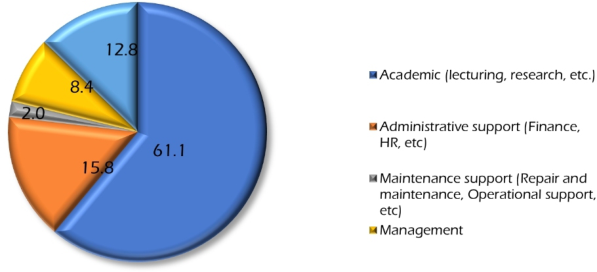
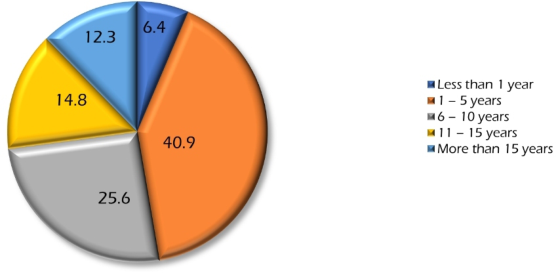
The background information of the respondents in Figure 1 revealed that most respondents were academics, administrative support, head of mainte- nance unit, management, and others such as post-doctoral fellows, laboratory technicians, interns, and librarians. In terms of working experience with the relevant institution, Figure 2 shows that 6.4% have less than one year, 40.9 % have 1–5 years, 25.6% have 6–10 years, 14.5% have 11–15 years, while12.3% have been with the institution for more than 15 years. It can be concluded from this feedback that most respondents are knowledgeable about the various facilities that they frequently use.
Figure 1: Role of respondents.Figure 2: Years of experience.
Empirical Scrutiny of the Human Resource Management Features for Effective Maintenance 71
Human Resource Management Features Influencing Maintenance Management of HEI Buildings in South Africa Based on the review of extant literature, models, and frameworks, 13 vari- ables were identified to assess the important human resource management features that will influence the maintenance management of HEI buildings in South Africa. Table 1 reveals the overall ranking of these human resou- rce management features by the respondents. Since these respondents have different roles, the K-W test was conducted to establish the significant diffe- rence in their views. The result in Table 1 shows that all the human resources management features assessed had a mean above the average rating of 3.0, indicating that the respondents view the assessed human resources features as significant in the maintenance management of buildings in HEIs. The avai- lability of skilled and experienced personnel in the maintenance department (X = 4.16, p-value = 0.159) had the highest rating, followed by adequate staffing of the maintenance department (X = 4.11, p-value = 0.640), and the effective occupational health and safety (OHS) practices of maintenance staff (X = 4.08, p-value = 0.885). Although head hunting of staff with rele- vant maintenance management skills and experience is ranked the least, it is still considered significant as a X of 3.61 and a p-value of 0.085was derived. therefore, institutions seeking effective management may want to consider this approach in getting the required skills within their management depar- tment. The result of the K-W test shown in Table 1 revealed some disparity in the views of the respondents regarding three of the thirteen variables asses- sed. These variables include top management support for training, budget
Table 1. Ranking of human resources features.
Table available in the original PDF paper.
Human Resources Management features Overall K-W
4.16 1 5.179 0.159
X Rank χ2 Sig. Availability of skilled and experienced personnel in the maintenance department
4.08 3 0.648 0.885
Adequate staffing of the maintenance department 4.11 2 1.687 0.640 Effective occupational health and safety (OHS) practices of maintenance staff
3.84 10 6.498 0.090
Top management support for training 4.01 4 7.872 0.049** Budget available for training 3.90 5 8.850 0.031** Maintenance staff desire for training 3.90 5 4.732 0.193 Performance evaluation of maintenance staff 3.90 5 3.018 0.389 Availability of clear technical requirements 3.87 8 4.619 0.202 Employee involvement and empowerment 3.86 9 8.507 0.037** Frequency of training and development of maintenance staff
3.61 13 6.615 0.085
Skills’ gaps analysis 3.75 11 4.178 0.243 Assessment of training outcomes 3.73 12 3.528 0.317 Head hunting of staff with relevant maintenance management skills and experience Note: ** significant at p< 0.05, X= Mean Score, K-W = Kruskal-Wallis H-test, χ2= Chi-square
available for training, and employee involvement and empowerment. The three variables have a p-value of 0.049, 0.031, and 0.037, respectively.
DISCUSSION
The importance of human resources management features in maintenance management has been highlighted in past studies (Cholasuke et al., 2004; Ali, Kamaruzzaman, Sulaiman, and Cheong Peng, 2010 Sheikhalishahi, Pintelon, and Azadeh, 2016). In HEIs, where the safety and health of the building users is critical, building safety is a highly important issue (Wang, Almassy, Wei, and Shohet, 2022). By prioritizing human resources, health and safety issues can be minimized (Ali et al., 2010).
Sheikhalishahi, Pintelon, and Azadeh (2016) reported that on-the-job training can improve the skill and knowledge of maintenance personnel. However, training alone is not enough if the maintenance department is not adequately resourced with the right skill (Cholasuke et al., 2004). Adequately staffing the maintenance department with the right skill was ranked second overall. This is in line with existing studies (Mohd-Noor et al., 2011; Vel- murugan and Dhingra, 2015) that highlighted the need for the maintenance department to be adequately resourced to execute their function effectively. Having enough staff with the right maintenance skills can result in a faster response rate and satisfied building users.
Maintenance is a budget-driven activity driven by top management (Sriva- stava et al., 2020). Most of the variables highlighted as important can only be achieved if there is financial support from management. Lack of resources to support maintenance management can result in a less effective maintenance department that cannot optimally function, which can eventually lead to the degradation of buildings and negatively impact user satisfaction (Raposo, De Brito, and Fonseca, 2013; Hamid and Alexander, 2016).
CONCLUSION AND RECOMMENDATIONS A review of existing literature and the survey results revealed that human resources management features are important in the maintenance manage- ment of HEIs buildings. To discharge their duties effectively, top management should support the maintenance department by adequately capacitating it with the right skills. Where necessary, HEIs should invest in developing main- tenance personnel skills through training. This will, in turn, benefit both the HEIs and the stakeholders.
Past studies reported that the physical state of buildings in HEIs and the effective maintenance of these buildings contribute significantly to the well- being of both staff and students. Therefore, supporting the maintenance department with resources and training and improving the way they con- duct business can result in improved outputs from this Department. More than human resources, maintenance management is a budget-driven activity. It is not always easy to allocate enough budget to this function as the scope of work can easily change when maintenance work starts. However, making
Empirical Scrutiny of the Human Resource Management Features for Effective Maintenance 73
the necessary provisions for planned maintenance during the annual budget planning is important.
The results of this study provide useful insight into how HEIs in South Africa might enhance building maintenance to improve building performa- nce. Theoretically, the findings of this study can serve as an excellent platform for future studies seeking to explore maintenance management in the HEI sector in South Africa and other countries where such studies have not been conducted. Because the study was conducted in one province, the results can- not be generalized. Future studies can be undertaken in other provinces that were not part of the study. Future studies can also adopt the use of diffe- rent research approaches to compare results, as this study used a quantitative research approach only.
ACKNOWLEDGMENT
The authors would like to acknowledge the support of HEIs who contributed to this study.
REFERENCES
Abisuga, A. O., Famakin, I. O., and Oshodi, O. S. (2016). Educational building conditions and the health of users. Construction Economics and Building, 16(4), pp. 19–34. Abisuga, A. O., Wang, C. C. and Sunindijo, R. Y. (2019). A holistic framework
with user-centred facilities performance attributes for evaluating higher education buildings. Facilities. 38(1/2), 132–160 Akasah, Z. A., Abdul, R. M. A. and Zuraidi, S. N. F. (2011). Maintenance management success factors for heritage building: A framework. WIT Transactions on the Built Environment, 118, 653–658. Ali, A., Kamaruzzaman, S., Sulaiman, R., and Cheong Peng, Y. (2010). Factors affe-
cting housing maintenance cost in Malaysia. Journal of Facilities Management, 8(4), 285–298. Au-Yong, C. P., Ali, A. S., and Ahmad, F. (2017). Competency and commitment of facilities managers: Keys to safeguard maintenance performance. Malaysian Construction Research Journal, 22(2), 35–46. Barrett, Davies, Zhang and Barrett. (2015). The impact of classroom design on
pupils’ learning: Final results of a holistic, multi-level analysis. Building and Environment, 89, 118–133. Besiktepe, D., Ozbek, M. E. and Atadero, R. A. (2020). Identification of the criteria for building maintenance decisions in facility management: first step to developing a multi-criteria decision-making approach. Buildings, 10(9), p. 166. Cholasuke, C., Bhardwa, R., and Antony, J. (2004). The status of maintenance mana-
gement in UK manufacturing organisations: Results from a pilot survey. Journal of Quality in Maintenance Engineering, 10(1), 5–15. Department of Higher Education and Training, South Africa (DHET) (2021). Post- School Education and Training Monitor: Macro-Indicator Trends. Available from: https://www.dhet.gov.za/Planning%20Monitoring%20and%20Evaluation%20C oordination/Post-School%20Education%20and%20Training%20Monitor%20- %20Macro-Indicator%20Trends%20-%20March%202021.pdf Deshpande, B., and Girme, A. (2019). Sampling techniques. Advances and Applica-
tions in Mathematical Sciences, 18(10), 1055–1062.
Dzulkifli, N., Sarbini, N., Ibrahim, I., Abidin, N., Yahaya, F., and Azizan, N. (2021).
Review on maintenance issues toward building maintenance management best practices. Journal of Building Engineering, (89), 40. Fernández, J. F. G., and Márquez, A. C. (2012). Defining maintenance management framework. In Springer Series in Reliability Engineering, 49, 127–147. Hamid, Y., and Alexander, K. (2016). The Cause and Effects of Deferred Mainte-
nance on higher education buildings. Journal of the University of Salford, 1(1), pp. 78–88. Hauashdh, A., Jailani, J., Rahman, I. A., and AL-fadhali, N. (2022). Strategic approaches towards achieving sustainable and effective building maintenance practices in maintenance-managed buildings: A combination of expert interviews and a literature review. Journal of Building Engineering, 45(August 2021), 103490. Idrus, A., Khamidi, F., and Sodangi, M. (2010). Maintenance management framew-
ork for conservation of heritage buildings in Malaysia. Modern Applied Science, 4(11). Jonsson, P. (1997). The status of maintenance management in Swedish manufacturing firms. Journal of Quality in Maintenance Engineering, 3(4), 233–258. Kettunen, J. (2015). Stakeholder relationships in higher education. Tertiary Educa-
tion and Management, 21(1), pp. 56–65. Lateef, O. A. (2010). Case for alternative approach to building maintenance management of public universities. Journal of Building Appraisal, 5(3), 201–212. Leung, M. Y. and Fung, I (2005). Enhancement of classroom facilities of primary
schools and its impact on learning behaviors of students. Facilities. Macchi, M., and Fumagalli, L. (2013). A maintenance maturity assessment method for the manufacturing industry. Journal of Quality in Maintenance Engineering, 19(3), 295–315. Mohd-Noor, N., Hamid, M. Y., Abdul-Ghani, A. A., and Haron, S. N. (2011). Buil-
ding maintenance budget determination: An exploration study in the Malaysia government practice. Procedia Engineering, 20, 435–444. Mowoyo, M. (2014). Student access and success: Issues and interventions in South African universities. Inyathelo: The South African Institute for Advancement. Mukhanji, J. M., Ndiku, J. M. and Obaki, S. (2016). Effect of increased student
enrolment on teaching and learning resources in Maseno University, Kenya. Odeyemi, S. O., Adeniyi, O. I., and Amoo, A. I. (2019). Assessment on building maintenance in Nigerian Universities: A case study of University of Ilorin. Nigerian Journal of Technology, 38(3), 566. Olanrewaju, A. L. and Abdul-Aziz, A. R. (2014). Building maintenance processes and
practices: The case of a fast-developing country. Springer. Olanrewaju, A. L. and Abdul-Aziz, A. R. (2015). Elements of the Proposed Value Maintenance Management Model—”Harmonising It All Altogether”!. In Buil- ding Maintenance Processes and Practices (pp. 259–292). Springer, Singapore. Olanrewaju, A. L., and Abdul-Aziz, A. R. (2015). Building maintenance processes,
principles, procedures, practices and strategies. In building maintenance processes and practices. (pp. 79–129). Springer, Singapore. Olanrewaju, A. L. A., Khamidi, M. F. and Idrus, A. (2010). Quantitative analysis of defects in Malaysian university buildings: Providers’ perspective. Journal of Retail & Leisure Property, 9(2), pp. 137–149. Oluwatobi, A. O., Alli-Johnson, V. A., Ayedun, C. A. and Akinjare, O. A., 2019,
August. Assessment of the effectiveness of maintenance management systems in delivering quality maintenance services in higher institutions. In Journal of Physics: Conference Series, 1299(1).
Empirical Scrutiny of the Human Resource Management Features for Effective Maintenance 75
Pintelon, L. M., and Gelders, L. F. (1992). Maintenance management decisionmaking. European Journal of Operational Research, 58(3), 301–317. Raposo, S., de Brito, J., and Fonseca, M. (2013). Planned Preventive Maintenance
Activities: Analysis of Guidance Documents. In Durability of Building Materials and Components (pp. 35–60). Springer, Berlin, Heidelberg. Riad Shams, S. M. and Belyaeva, Z. (2019). Quality assurance driving factors as antecedents of knowledge management: A stakeholder-focussed perspective in higher education. Journal of the Knowledge Economy, 10(2), 423–436. Saghatforoush, E., Trigunarsyah, B., Too, E. and Heravi Torbati, A. (2011).
Extending constructability concept to include operation and maintenance issues. In Proceedings of the 1st International Construction Business & Management Symposium (pp. 1–9). Universiti Teknologi Malaysia. Sheikhalishahi, M., Pintelon, L. and Azadeh, A. (2016). Human factors in maintenance: a review. Journal of Quality in Maintenance Engineering, 22(3), 218–237. Sherwin, D. (2000). A review of overall models for maintenance management.
Journal of Quality in Maintenance Engineering, 6(3), 138–164. Simpeh, F. (2018). Challenges faced by university hostel managers in the Greater Accra region of Ghana. In Mojekwu, J. N. et al. (eds). Proceedings of the 7th Applied Research Conference in Africa, Kenya, 1–3 August 2018, Nairobi: ARCA Academic: 39–49. Tan, Y., Shen, L., Langston, C., Lu, W., and Yam, M. C. H. (2014). Critical success
factors for building maintenance business: A Hong Kong case study. Facilities, 32(5), 208–225. Uline, C. and Tschannen-Moran, M. (2008). The walls speak: The interplay of quality facilities, school climate, and student achievement. Journal of educational administration, 46(1), 55–73. Velmurugan, R. S., and Dhingra, T. (2015). Maintenance strategy selection and its
impact in maintenance function: A conceptual framework. International Journal of Operations and Production Management, 35(12), 1622–1661. Waeyenbergh, G., and Pintelon, L. (2002). A framework for maintenance concept development. International Journal of Production Economics, 77(3), 299–313. Wang, K. C., Almassy, R., Wei, H. H. and Shohet, I. M. (2022). Integrated Building
Maintenance and Safety Framework: Educational and Public Facilities Case Study. Buildings, 12(6), 770. Zawawi, E. M. A., Kamaruzzaman, S. N., Ali, A. S. and Sulaiman, R., (2010).
Assessment of building maintenance management in Malaysia: Resolving using a solution diagram. Journal of Retail and Leisure Property, 9(4), 349–356.
LISTED IN THE AHFE DIGITAL BOOKSTORE CATALOGUE
Explore the complete digital volume
Sustainable Construction in the Era of the Fourth Industrial Revolution
Read this individual research paper free through the original publisher, or explore the full digital proceedings book.
ISBN 978-1-958651-83-4
Explore this ISBN in the AHFE Bookstore ↗Listed in the July 2026 bookstore catalogue; search by ISBN to confirm current availability · Digital book purchase optional