Shun Yin, Xinhe Lu, Xiuqing Zeng, Jiyao Wei, Shiyuan Zhang, Weiwei Yao (2023). Design Strategies of Bamboo Fiber-based Composites Pavillon under the dual-carbon background. In: Sustainable Construction in the Era of the Fourth Industrial Revolution. AHFE Open Access, vol. 107, pp. 26–34. https://doi.org/10.54941/ahfe1003089
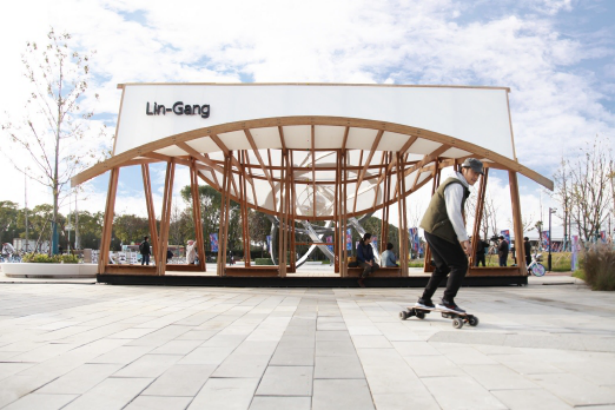
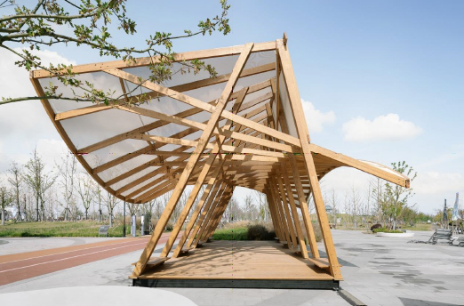
The "Pavillon System" is a means of urban renewal, a service facility with integrated functions such as aesthetic education, resting Shelter, outdoor furniture, etc. It is a kind of artistic urban infrastructure. In 2021, The author was invited by Shanghai Urban Public Space Art Season(SUSAS) to design and construct a "cycling pavillon " in the Lingang Future Community Sample Exhibition, as a demonstration project in the new area of Lingang, which aims at the low-carbon system of future living and green city construction. One of the demonstration projects in the new area of Lingang with the goal of a low-carbon system for future lifestyle and green city construction.This design attempts to reduce carbon emissions with bamboo structures from the beginning, and then considers low carbon green construction in the production and processing of materials, transportation of materials and equipment, the construction process and building operation. Bamboo matrix fiber composite is a new material with structural performance equivalent to FRP, higher outdoor weather resistance than preserved wood, and close to the price of preserved wood, which has the value of promotion.In the face of the completed site, the building foundation of the cycling pavillon adopts a minimal approach to the ground pavement to intervene in the site, abandoning the traditional need to pour concrete slabs on site for the foundation and using I-beams as the foundation anchored to the ground, reducing carbon emissions generated during the construction and material production process. This construction method allows the cycling pavillon shaded roof to withstand typhoons in the summer in the port area, and gives it the ability to be rebuilt off-site after demolition, a repeatable feature that extends the life of the structure in a rapidly growing urban area and reduces the carbon footprint of the demolition process.The construction process is highly efficient and can reduce carbon emissions by more than 40% over the life cycle of an assembled building, which is an important technological path to achieve "peak carbon" and "carbon neutrality" in the construction industry. The construction process also has a good dust reduction effect, saving water, electricity and other energy, while achieving the original purpose of building energy saving and environmental protection.The cycling pavillon is built in an assembled manner, enabling rapid construction in 60 hours. Thus, it is combined with the built-up site in a light intervention manner. Material utilization is improved through material optimization and reuse of components. With two types of parking, "interlocking" and "hanging", it can meet the different needs of daily use and professional cycling competition. The design concept of space-time movement stable structure is inspired by the trajectory of the wheels, and the mechanical movement of the bicycle in four-dimensional space-time is fixed in three-dimensional space to form a stable structure.The design of the cycling pavillon starts from the demand of urban public space life, in order to provide a possibility of public communication while solving the demand of small and micro space of public life. Through the distinctive artistic image of the space itself, the balance between artistry and practicality is achieved,More importantly, through the use of high-strength bamboo fiber materials, a low-carbon artful infrastructure construction model is explored
THE RESEARCH BACKGROUND AND PURPOSE With the continuous development of human society, human demand for energy continues to grow, and the massive use of fossil energy has posed serious challenges to the global ecosystem and environmental protection, resulting in climate change, which has become a global issue related to the fate of mankind and a major challenge to sustainable development in the 21st century. In order to prevent global climate change from posing a major threat
Design Strategies of Bamboo Fiber-Based Composites Pavillon Under the Dual-Carbon 27
to human society, more and more countries have elevated “carbon neutrality” to a national strategy, and 178 parties around the world have signed the Paris Agreement, which is a unified arrangement for global action to address cli- mate change after 2020. China has adopted a dual carbon national strategy since 2020, and the central government pointed out that “achieving carbon peak and carbon neutrality is a broad and profound economic and social systemic change”, and the opening of the dual carbon strategy will change the way each Chinese lives and work and transform our attitude towards the natural environment. As the construction industry accounts for 33% of global carbon emissions, we as designers should conduct innovative research and try to respond with low carbon design methods.
In the 2021 Shanghai Urban Space Art Season - Lingang Sample Exhibi- tion, As a design and research institute, A.C.R.E. Atelier was invited to design and build an “Art pavilion”. The exhibition organizers hope that the Lingang area will serve as a model for the “community of the future”and promote the creation of a 15-minute community living circle that is more oriented to daily life and the construction of a higher-quality public space. Facing the large- scale new city space in the core area of Lingang New District, we discussed with the curator that the best way to perceive Lingang is to ride through a cycling route, and to link the journey of spatial perception through a cycling route. As architects, we hope to adopt a new green material that echoes the “dual Carbon background”, so we conducted research and design of bamboo and wood structure materials.
INVESTIGATION The craftsmen adopted a standardized and prefabricated approach, taking into account the natural ventilation and lighting of the building, which is low- carbon and green in terms of materials, construction, and operation, and is well in line with the current dual Carbon strategy. In China, it is not possible to promote wood frame buildings and structures in large numbers because of the following three factors: 1. the structural strength of wood is not sufficient for structural materials; 2. the durability does not meet the 50-year life of buildings; 3. the fire resistance of pure natural bamboo wood is poor.
With the emergence of new materials, a bamboo fiber-based composite material has recently emerged. The strategy of fabricating high-performance bamboo steel with green and abundant natural bamboo as raw materials is highly attractive for the sustainable development of structural engineering materials.
The composite material is made of bamboo fiber curtain, which is hot (cold) pressed and glued in the direction of the grain, and is made of bamboo fiber and resin at high temperature and high pressure. The tensile strength of the material is three times that of steel of the same weight, and the life span can be up to 50 years, so it is called “bamboo steel”.
Structural Properties of Bamboo Steel The structural properties of the material are close to those of FRP, and due to the high strength and density of bamboo steel, all indicators have met or
Table 1. Main mechanical properties of reconstituted bamboo for structural use (Selfdrawn by the author).
Table available in the original PDF paper.
Technical specifications Unit Detection Standard Serial number value value
exceeded the performance index requirements of the blade base material and outdoor panels (Table 1).
Comparing the strength of bamboo steel with several of bamboo and wood material indicators in the Chinese code “Wood Structure Design Standard” GB50005-2017 (Table 2), it can be seen that the design indicators of this new material are significantly advanced compared to traditional wood-based structural materials.
Table 2. Comparison of design values for structural reconstituted bamboo and typical wood structural lumber (Self-drawn by the author).
Table available in the original PDF paper.
Strength design value(N/mm2)
Tree species flexural Compressio n Along-grain
Modulus of
tensile
Smooth grain shear
resistance with smooth
resistance
Cross grain compressio n resistance
Elasticity (N/mm2)
grain fm fc fr fv fc,90
56.91 32.88 43.16 5.15 6.89 27730
Recombinan t bamboo for cichlid structures
46.36 27.46 37.43 5.1 5.1 18360
Reconstitut ed bamboo for moso bamboo structures 27.9 23.2 17.9 - - 12500 Glued laminated wood TCT40
17 16 10 1.7 4.6 10000
Square wood TC17
26.5 15 12.9 1.9 5.5 14000
Structural materials imported from Europe
23.6 23.4 9.3 1.8 6 15200
New Zealand imported structural lumber
Design Strategies of Bamboo Fiber-Based Composites Pavillon Under the Dual-Carbon 29
Fire Resistance of Bamboo Steel “Bamboo steel” is tested to be organic material class B1 (non-combustible), which retains a certain strength for a certain period after burning and car- bonization, and has no smoke or toxic gas. The fire resistance level reaches the B1 level of Chinese material fire rating, that is, “difficult to burn”, which exceeds the B2 or C burning level of wood, making “bamboo steel” a more widely used scenario.
Green Properties of Bamboo Steel The main raw material of bamboo steel is Chinese bamboo, because of its small diameter and thin wall, the value of industrial use of bamboo is low, except for bamboo weaving and paper making, there is no other industrial use, resulting in a large number of idle resources. However, “bamboo steel” can be degraded after use, so the pollution to the environment is low.
The most important thing is that “bamboo steel” is a “carbon-negative” material in the whole production process (Table 3).
Table 3. Carbon emission properties of recombinant bamboo for structural use (Self-drawn by author).
Table available in the original PDF paper.
DESIGN STRATEGIES Reducing Carbon Emissions - a Low-Carbon System Led by Bamboo and Steel
As a cycling shelter station and one of the nodes of the urban furniture service system, the structural system of the cycling station is made of steel and wood structure from the beginning to reduce carbon emissions. Low carbon green construction is considered from the production and processing of main mate- rials, transportation of materials and equipment, construction process, and building operation.
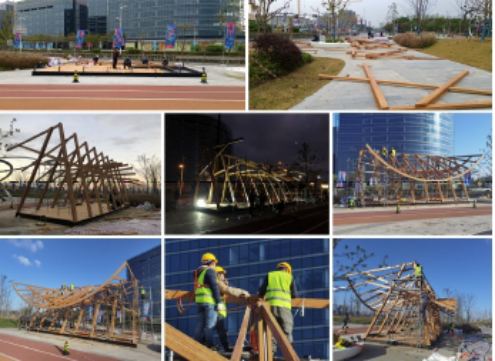
In the face of the completed site, the building foundation of the riding station adopts the smallest way to the ground pavement to intervene in the site, using 200MM I-beam as the foundation, which is fixed on the ground by 20MM anchor bolts. Abandoning the traditional need to pour concrete slabs on site to make the foundation. The construction process uses efficient assembly construction, with a site construction cycle of nearly 60 hours(see Figure 1), reducing the carbon emissions generated during construction and material production. The construction process also has a good dust reduction effect, saving water, electricity and other energy, while achieving the original purpose of energy-saving and environmental protection of the building (see Figure 2).
Figure 1: On-site installation of factory prefabricated assembled components (Author’s own photos).Figure 2: 60 hours to complete the cycling station (Author’s own photos).
Design Strategies of Bamboo Fiber-Based Composites Pavillon Under the Dual-Carbon 31
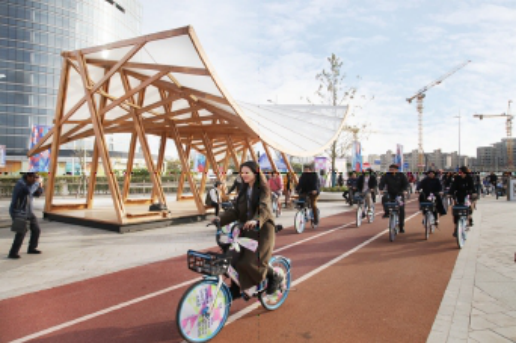
Light intervention of assembled bamboo and wood structures A.C.R.E. Atelier has been thinking about how to make the building adaptable to cities that need micro-renewal, integrating with the site with the lightest intervention within the constraints of the site conditions. The cycling station is assembled and built with a bamboo and wood structure, and the material utilization rate is improved through downstream optimization and reuse of components(see Figures 3 and 4).
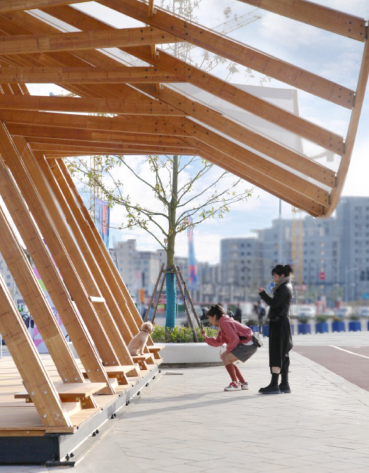
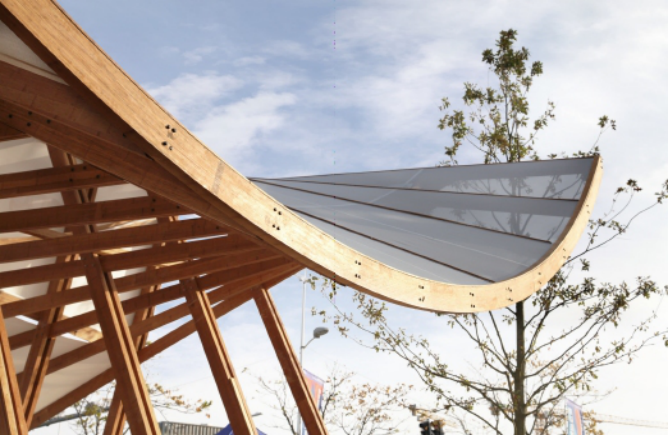
Figure 3: The light and shadow formed by the rotating spokes (structural members), the wooden spokes that stand out in the air, forming a smooth surface. ( Author’s own photo).Figure 4: 2021 Urban Space Art Season - Cycling Event (Author’s own photo).
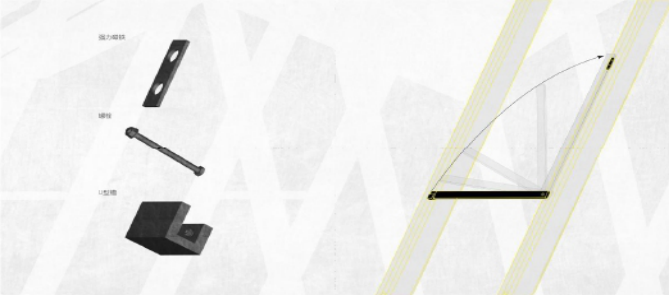
Morphogenesis and Structural Efficiency The morphogenesis is inspired by the trajectory of the wheel, the mechanical movement of the bicycle in four-dimensional space-time constitutes a solid structure in three-dimensional space, providing a place for cyclists to rest and shelter (see Figure 5).
In the way the timbers are assembled, the architects staggered the tim- bers and laminated them together so that the load-bearing and maintenance systems of the timber structure are integrated into one, “weaving” them into a stable triangular structure, thus eliminating diagonal bracing. This straight- forward construction gives the building structure visual certainty and unity (see Figure 6).
Figure 5: Triangular structure of the post (Author’s own photo).Figure 6: The wooden spokes rotate around the bearings while translating, solidifying the trajectory of the bicycle wheel. (Author’s own photo).
Design Strategies of Bamboo Fiber-Based Composites Pavillon Under the Dual-Carbon 33
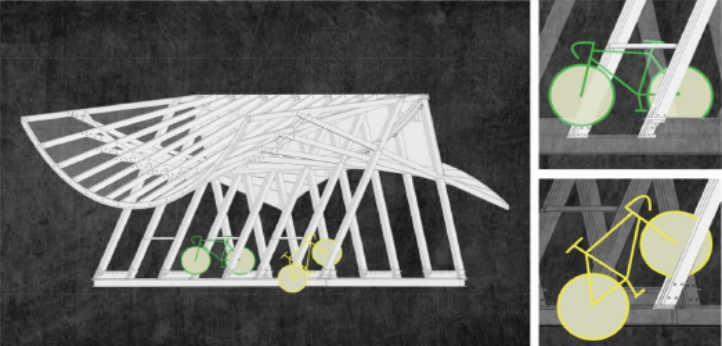
Different Ways to Park Bicycles The design site will host road cycling events like the Tour de France in the future. Based on the problem that professional bicycles cannot be parked independently, the station structure system is adapted to combine bicycle parking methods. The two methods can meet the needs of professional and recreational bicycle parking to the maximum extent, and have little impact on the structure of the station.
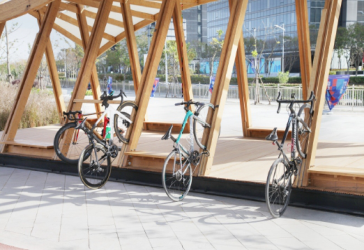
Interspersed Parking The spacing of the structural uprights is set to accommodate the bicycle whe- els, which can be easily inserted for parking, and children can easily park their bicycles into them, which can also meet the parking needs of nearby residents when there is no demand for professional events in general (see Figure 7).
Suspension Parking Suspended bicycle parking method, suitable for professional road cycling events, professional bicycles can not be independently parked and the weight of small, can be suspended on the crossbar to achieve a certain number of bicycle storage and parking (see Figures 8 and 9).
Figure 7: Two types of stops (Self-drawn by the author).Figure 8: Interspersed bicycle parking (left) and Suspended parking for bicycles (right).Figure 9: Hanging crossbar rotates through a combination of bolts and powerful magnets, allowing storage during weekdays when events are not held. (Self-drawn by the author).
CONCLUSIONS
The design of the cycling station is based on the needs of urban public space living, to provide a possibility of public communication while solving the demands of public life in small and micro spaces. More importantly, this is the first time in China that “bamboo steel”is used as a structural material for an outdoor station. Through design research and construction experiments on new materials, the project expands the use of new low-carbon and envi- ronmentally friendly materials, providing reference for the construction of green cities with a low-carbon system in the future and making exploration and efforts for the development of China’s design industry towards the “dual Carbon” goal.
REFERENCES
Chinese specification “wood structure design standards” GB50005-2017. Habibi, S. (2019). Design concepts for the integration of bamboo in contemporary vernacular architecture. Architectural Engineering and Design Management, 1–15. Huang, Y., Ji, Y., & Yu, W. (2019). Development of bamboo scrimber: A literature
review. Journal of Wood Science, 65(1), 1–10. Minke, G. (2022). Building with bamboo: design and technology of a sustainable architecture. Birkhäuser. The highest level of mechanical properties 28E-165f type index requirements as sti-
pulated in the forestry industry standard “Recombinant bamboo for structure” (LY/T3194-2020). Wang, Y. Y., Wang, X. Q., Li, Y. Q., Huang, P., Yang, B., Hu, N., & Fu, S.
Y. (2020). High-performance bamboo steel derived from natural bamboo. ACS applied materials & interfaces, 13(1), 1431–1440. Wei, Y., Tang, S., Ji, X., Zhao, K., & Li, G. (2020). Stress-strain behavior and model of bamboo steel under cyclic axial compression. Engineering Structures, 209, 110279. Xu, M., Cui, Z., Chen, Z., & Xiang, J. (2018). The charring rate and charring depth
of bamboo steel exposed to a standard fire. Fire and Materials. Yu, Y., Zhu, R., Wu, B., Hu, Y., & Yu, W. (2014). Fabrication, material properties, and application of bamboo steel. Wood Science and Technology, 49(1), 83–98.
LISTED IN THE AHFE DIGITAL BOOKSTORE CATALOGUE
Explore the complete digital volume
Sustainable Construction in the Era of the Fourth Industrial Revolution
Read this individual research paper free through the original publisher, or explore the full digital proceedings book.
ISBN 978-1-958651-83-4
Explore this ISBN in the AHFE Bookstore ↗Listed in the July 2026 bookstore catalogue; search by ISBN to confirm current availability · Digital book purchase optional