Daniela Idrovo, Martha Cobos, Nataly Alvarado, Patricia Margarita Ortega Chasi, Esteban Mora, Jaime Burbano, Francisco D Salgado (2023). Use of eye-tracking system to evaluate selective attention in Children with motor difficulties. In: Neuroergonomics and Cognitive Engineering. AHFE Open Access, vol. 102, pp. 232–238. https://doi.org/10.54941/ahfe1003023
This study aimed to use the Eye Tracking System to assess selective attention. Researchers applied the Margarita's Test in a pilot study with a non-probabilistic convenience sample (N=30). Participants were schoolchildren aged 8 (15 males and 15 females). The measurement instruments used were the Margarita's and the Tobii Glasses 2 eye-tracking system. The results showed that 37.11% of correct responses were obtained if the first fixation coincided with the motor response. When analyzing the last fixation, the coincidence of fixations and motor response reached 81.3%, of which 77.2 % were correct. These results suggest that the use of the eye-tracking technology, jointly with the Margarita's test, has the potential to evaluate selective attention in children with motor difficulties.
Attention is a behavioral and cognitive process that allows us to orient our- selves to relevant stimuli and process them to respond accordingly. It is a complex process involved in virtually all of our daily activities.
According to Portellano (2005), it focused on a specific stimulus after fil- tering the information and discarded what was not desired. This capacity plays a fundamental role in the correct functioning of the rest of the cognitive functions.
Therefore, attention evaluation has been developed over the years because it integrates different modalities qualitatively (Portellano, 2014).
Studies have been conducted on attention and eye tracking, demonstrating the significant contribution of new technologies in research.
Lakshman et al. (2020) examined patterns of attentional bias in African American children exposed to trauma to understand possible risk factors for post-traumatic stress disorder. The eye-tracking Tobbi T60 demonstrated that attentional bias toward angry faces was associated with higher childhood trauma exposure. Exposure to childhood trauma accounted for 17% of the
Use of Eye-Tracking System to Evaluate Selective Attention in Children 233
variance in attentional bias toward angry versus neutral faces, independent of gender or post-traumatic stress symptoms.
Sheehy et al. (2020), evidence of attentional phenotypes in childhood and their role in visual cognitive performance, identified suboptimal attentional behaviors in infancy, before the onset of cognitive deficit. The results of this study, which used Eye tracking Tobbi TX-300, varied substantially in attentional efficiency.
The largest of these profiles (“very flexible,” 55%) yielded functionally optimal patterns of attentional functioning with relatively fast, selective, and adaptive orienting responses. The next group (“low reactive,” 39.6%) demonstrated low attentional sensitivity with slow, insensitive orienting responses. Finally, the smallest group (“highly reactive,” 5.4%) demonstrated attentional hypersensitivity with fast, nonselective, and inaccurate orienting responses.
Rajin et al. (2018) studied eye-tracking measures of social attention in young children: how gaze patterns translate into real-life behaviors, asses- sed the extent to which eye-tracking paradigms of social attention combined with synchronous measures of affective arousal are associated with real-life social behavior in 3- to 7-year-old children. They used the Tobii X2-60 Eye Tracking Tobii. The results showed that the mean percentage of time spent looking at the screen was 98.3%. In addition, the primary outcome measu- res of proportion fixation duration for each area of interest did not correlate with age; no gender differences were evident.
In the case of children with motor difficulties, it has historically been not easy to assess cognitive functions. However, Leeway et al. (2012) consider eye movements an essential alternative to measuring attention when hand movement is affected. In this context, it is crucial to conduct a study on the attention of children with cerebral palsy using software applied through “eye-tracking.”
Jara y Barzallo (2018) demonstrate that eye tracking helps evaluate chil- dren with brain injury through the software System to Evaluation with the use of System Assisted (SESA). The eye tracking system seeks to improve their quality of life, allowing them unlimited access to all options such as the inter- net, game, or various applications that help them to communicate with the rest of people; because it fulfills the functions of the mouse with the differe- nce that it is managed only with the use of the gaze and the pointer moves around the entire computer, performing the activities that the user wants.
METHODOLOGY
The research was quantitative, descriptive, and inferential. In addition, this study used a non-probabilistic convenience sample.
The Margarita’s test was used to evaluate selective attention in schoolch- ildren, adapted to the Tablet, and can be applied individually or collectively to children from 6 to 12 years of age. The test consists of 90 images of mar- garitas spread over five screens. On each screen, the images were distributed in two columns of three rows. Each row had a set of three images with two similar images and one different one. The correct answer is the one different.
Each correct answer is 1 point, and each incorrect answer is 0 points. The total score was transformed to percentile. The interpretation of the percentile is a high attention level greater than 60, an average attention level from 40 to 50, and poor attention less than 40.
The Tobii Pro Glasses 2 were also used to identify eye tracking and visual monitoring of schoolchildren. The glasses made it possible to observe in real-time the eye movements of the schoolchildren when they answered the Margarita’s test, thus providing immediate and practical information. This way, researchers evaluated selective attention and recorded the sch- oolchildren’s eye tracking. The duration of data collection lasted three days.
The sample consisted of 30 schoolchildren (15 males and 15 females) between the ages of 8 years and 11 months.
Procedure The Rector of the Unidad Educativa Particular la Asunción gave the autho- rization.
The parents or legal guardians of the students signed an informed consent form.
The institution selected the “A” and “B” parallels of fourth grade for the evaluation.
Researchers assigned a code, which consisted of the number according to the order in which they had been evaluated, with the acronym eh for male and the em for the female students, followed by the initials of their first and last names and the date and the time of evaluation (e.g., 15eh-EXGJ-16-03-0913). In this way, researchers applied an ethics process and maintained the anonymity of the students.
The participant was welcomed and proceeded to calibration, which consi- sted of having the child wearing the eye-tracking glasses observe a card at a distance of one meter, on which there is a black dot inside a white circle.
Research places the participant in front of the margaritas chain test. He was given the instructions and started the test.
Results
A descriptive test was performed for data analysis using frequency and percentage analysis and Chi-square (Sampieri et al., 2014). She was using the R Studio program according to each objective.
The margaritas were classified into A: the first Margarita from the left; B: the second Margarita from the middle and C: the third Margarita from the right for the rating of selective attention automatic note generated by the Margarita’s test on the Tablet was taken into account.
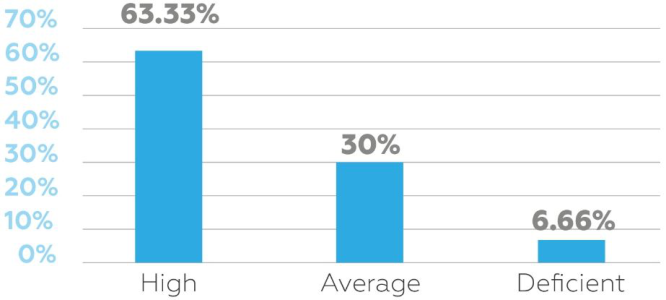
By identifying the level of attention of 8-year-old schoolchildren through Margarita’s test adapted to the eye tracking system, it was possible to obtain the individual attention level scores of the 30 schoolchildren. The results show that 63.33% of the schoolchildren obtained high scores. Thirty percent of the students obtained average grades, and 6.66% obtained poor grades. Therefore, most of the students obtained high scores in their level of selective attention, Figure 1.
Use of Eye-Tracking System to Evaluate Selective Attention in Children 235
Figure 1: Results of the level of attention of the 30 schoolchildren. Note: Results of the selective attention level of 30 schoolchildren evaluated with Mar- garita’s test using the Tobii Pro Glasses 2 eye tracking system according to high, average, and deficient attention levels.
In addition, the level of attention was identified by separating male and female schoolchildren. High scores were obtained by 66.6% of the schoolch- ildren, and 33.3% obtained scores within the average range. In the case of females, 60% obtained high scores, 26.6% average ranges, and 13% poor scores. Males obtained a high level of attention compared to female schoo- lchildren (X2 = 480.9; p-value < 2.2e-16). This chi-square shows that the results are statistically significant. That is, there is a relationship between the level of attention and the gender of the student.
We also considered the first and last fixation related to motor pulsation as an attention selection response. Therefore, for this study, the first fixa- tion was considered the first thing the subject looked at when answering the test, providing us with an initial record of fixation. The last fixa- tion is the last gaze recorded after the eye tracking was performed by the subject.
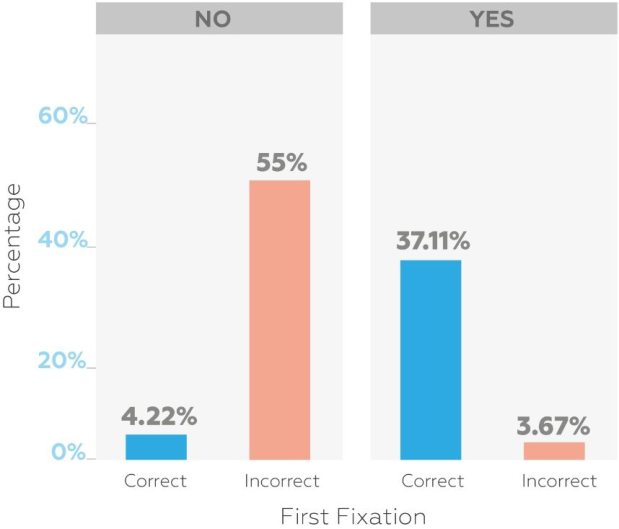
In analyzing whether the first fixation selected coincides with the motor response, 37.11% of correct responses were obtained. That is to say, the sub- ject who fixates the gaze and selects in a motorway has a higher probability of getting it right than the one with incongruence in this process (Figure 2).
Concerning the last fixation (the last thing they saw) of the schoolchil- dren, image B was the most viewed with 45.59%, followed by image A with 37.01%, and finally, C with 17.39%. Therefore, image B had the highest number of last fixations.
The first fixations of the students are in images A, with 28.44%, and B, with 38.89%, had a higher percentage of correct answer options than C, which presented a higher percentage of correct answer options with 8.89%. There was a process of analysis when the students looked at these answer options.
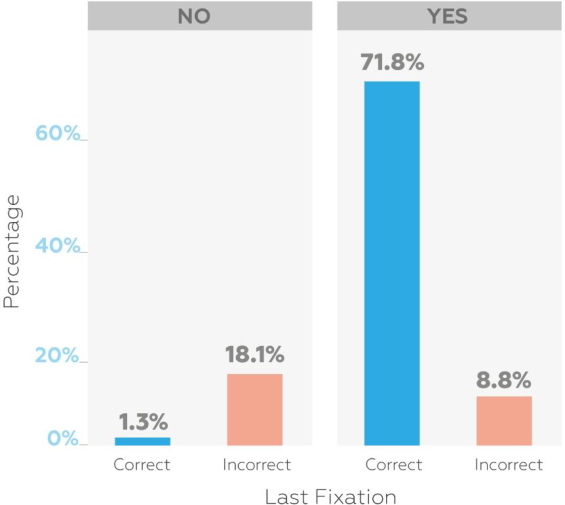
Analyzing whether the last fixation coincides with the motor response, there were 71.8% correct responses. That is to say, the subject who fixates the gaze and selects a motorway is more likely to be correct than the one with incongruence in this process (Figure 3).
Figure 2: First fixation as a motor response. Note. According to first fixation and motor selection, correct and incorrect answers are represented as No (incongruence between first fixation and motor response) and Yes (congruence between first fixation and motor response).Figure 3: Motor selection according to the last fixation. Note. Representation of correct and incorrect answers, according to the last fixation and motor selection.
Use of Eye-Tracking System to Evaluate Selective Attention in Children 237
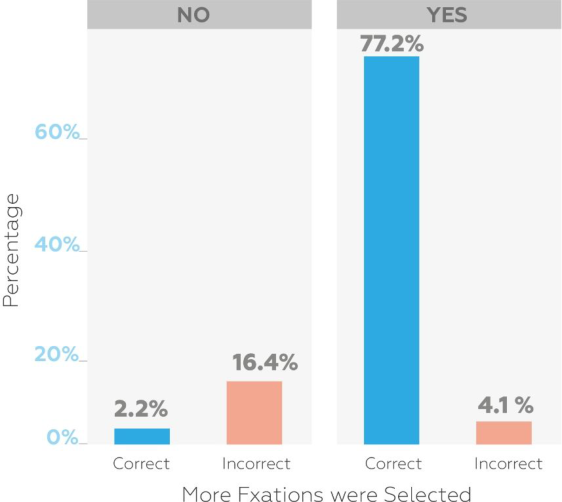
Figure 4: Responses with fixations and motor selection vs correct and incorrect respon- ses. Note. Responses with more fixations were selected and divided into No (incongrue- nce between fixation and motor response) and Yes (congruence between fixation and motor selection) according to percentages.
The response with more fixations and motor selection reached 81.3%, of which 77,2% were correct. These percentages show the congruence of the fixation with visual and motor responses concerning the correct answer (Figure 4).
CONCLUSION
The Tobii Pro Glasses 2 eye tracking system was successfully applied to 30 schoolchildren and demonstrated its validity as an alternative to motor sele- ction to evaluate attention processes, specifically, in the use of Margarita’s test to this system, providing data such as type of fixation and the number of fixations, which otherwise would not be obtained.
From this, we concluded that the application of state-of-the-art techno- logy in evaluating children with motor difficulties constitutes a possibility to obtain accurate information and, therefore, opens the way for future research in this field.
Selective attention was evaluated through Margarita’s test, showing that most of the schoolchildren participating in the present study presented a high level of selective attention. Likewise, results show coherence between the fixa- tion of the schoolchildren’s gaze and their motor pulsation when selecting the answers, most of which were correct.
Results show differences between men and women, which led to the pro- posal’s further research. On the other hand, eye-tracking showed that the schoolchildren presented regular saccadic movements. They present saccadic movements from left to right (as occurs in reading).
REFERENCES
Cobos, M., Astudillo, C., Freire, M. y Bueno, A. (2022). Margaritas Manual. Cuenca: Ecuador. Cobos, M., Ortega, P., Pacurucu, A. (2012). Care processes and their evaluation
using the software. Informe Final. Cuenca: Ecuador. Development Neuro rehabilitation, 15(4), pp. 253–-258. Doi: 10.3109/1758423.
2012.678020. Jara, B. y Barzallo, B. (2018). Development of software to perform educational assessments to children with cerebral palsy between 5 to 7 years old with the use of the eye tracking system. [Graduate thesis Universidad del Azuay, Ecuador] https://dspace.uazuay.edu.ec/bitstream/datos/8617/1/14284.pdf. Lakshman, M., Murphy, L., Mekewai, Y., Carter, S., Briscione, M., Bradley, B.,
Norrholm, S., Jovanovic, T y Poderes, A. (2020). Attention bias towards threat in African American children exposed to early life trauma. Behavioural Brain Research. 146 (1), 89–101 https://www.sciencedirect.com/science/article/abs/pii/ S0166432819314469?via%3Dihub. Lee, H., Lee, S., Lee, J., Lee, S., & Park, H. (2021). Neural mechanisms of selective attention: A review of recent research. Journal of Neuroscience Research, 99(1), 61–70. doi: 10.1002/jnr.24668. Lemay, M., Le, T. y Lemarre, C. (2012). Deficits in two versions of a sustained
attention test in adolescents with cerebral palsy. Portellano, J. y García, J. (2014). Neuropsychology of attention, executive functions and memory, Síntesis, S. A. file:///C:/Users/Windows/Downloads/Neuropsicolog% C3%ADa%20de %20la%20atenci%C3%B3n, %20las%20funciones% 20ejecutivas%20y%20la %20memoria%20(Spanish%20Edition) %20by% 20Portellano%20P%C3%A9rez, %20Jos%C3%A9%20AntonioGarc%C3% ADa%20Alba, %20Javier%20(z-lib.org) %20(1).pdf. Rajin, S., Urbanus, H y Swaab, H. (2018). Eye tracking measures of social attention
in young children: How gaze patterns translate to real-life social behaviors. Social Development 28 (3), 534–580. https://login.research4life.org/tacsgr1onlinelibra ry_wiley_com/doi/full/10.1111/sode.12350. Sampieri, R., Fernández, C. y Baptista, P. (2014). Research Methodology. 6 McGRAW-HILL/INTERAMERICANAfile:///C:/Users/Windows/Desktop/todo %20de%20todo/libros%20de%20investigacion/sampieri.pdf. Sheehy, S., Reynolds, E y Etshman, E. (2020). Evidence for Attentional Phenotypes in Infancy and Their Role in Visual Cognitive Performance. Brain Sciences. 10, 1–24. Thurstone, L. y Yela, M. (2012). CARAS-R. Test de Percepción de Diferencias –
Read this individual research paper free through the original publisher, or explore the full digital proceedings book.
ISBN 978-1-958651-78-0
Explore this ISBN in the AHFE Bookstore ↗Listed in the July 2026 bookstore catalogue; search by ISBN to confirm current availability · Digital book purchase optional