Lei Zeng, Hong Chen (2023). A case study of the Shanghai No. 20 tram on cultural bus service design based on the AT-ONE Rule. In: Human Factors in Transportation. AHFE Open Access, vol. 95, pp. 326–334. https://doi.org/10.54941/ahfe1003817
In the new era environment, the metropolitan public transportation system is constantly evolving. The relevant administrative departments in Shanghai have proposed measures to create cultural buses and build characteristic lines in order to promote Shanghai culture and improve bus service. Using the Shanghai NO.20 tram as an example, this paper investigates how to combine Shanghai culture with tram ride service in order to make the NO.20 tram a distinctive route. The study employed participatory observation and the AT-ONE rule to investigate the entire waiting, boarding, and alighting process, as well as to analyze the passenger experience and service flow of the NO.20 tram, in combined with the urban cultural elements of Shanghai. Based on the service design concept, the corresponding design strategies and measures were proposed.Study content. 1.Service design and the AT-ONE rule The goal of service design, which establishes the service from the customer's perspective, is to ensure that the service meets the user's requirements. One of the most common methods in service design research is the AT-ONE rule. It is a method of user-centered design that connects stakeholders through various touch points.2.Analysis of Shanghai culture Shanghai culture is a unique cultural phenomenon based on the traditional culture of Jiangnan (Wu-Yue culture) and the fusion of modern industrial civilization from Europe and the United States, which had a profound impact on Shanghai after the opening of the port. 3.Analysis of No.20 tram and design elements The "Mobile Bus Museum" is the name given to the No. 20 tram, which connects Jing'an Temple Station and Zhaofeng Park Station. Passengers, ride process, primary touch points, and other design components are all examined. This section examines individual passenger characteristics, focusing primarily on the elderly, with less emphasis on the young and middle-aged populations. The ride has three stages: waiting, riding, and getting off. The main points of contact are the armrests, seats, LED screen, and so on. Analyzing numerous design features is an important part of improving passenger riding experience and creating a cultural bus.4. No.20 tram design strategy External design strategy(1)External painting artistry The purpose of exterior painting artistry is to improve the appearance of the vehicle and the passenger riding experience. It primarily mixes Shanghai's history and contemporary style, with a concentration on Art Deco, technology, Pop, and retro styles.(2)Stylized external shape The outside shape is mostly mixed with Shanghai's characteristic architectural style for local enhancement, such as Art Deco style, in order to evoke a nostalgic feeling of Shanghai culture among local passengers and increase the recognition of No. 20 tram. Internal design strategy (1)Scientific interior layout The scientific layout of the car ensures the passengers' ease, comfort, and safety during the voyage. This part is concerned with the scientific design of the interior space in order to fulfill the needs of various passengers and improve their riding experience.(2)Humanized design of interior facilities Humanized design is a growing trend and an unavoidable requirement in modern urban bus design, and humanized interior facilities can improve passenger travel quality. The intelligent facilities (LED screen, intelligent audio, etc.) and infrastructure (seats, handrails, etc.) inside the bus are designed to effectively improve the comfort and fun of passenger travel based on the results of the pre-AT-ONE rule analysis. 5. 20 cultural bus prototype test The styling elements of the No. 20 tram were taken from the old trolleybus, and the side of the body depicts the major changes of Shanghai trams over the past century, presenting an overall retro style. The interior is predominantly blue, echoing the body painting. To meet the travel needs of different passengers, the interior space is divided into love seat area, wheelchair area, and seating area; the interior facilities are also optimized based on the preliminary contact analysis, such as more beautiful and intelligent LED screen style and interactive interface, more comfortable and safe seats and handrails, etc., which not only improve the travel experience of passengers but also promote the spread of Shanghai culture. 6. Summary Creating an image of Shanghai's 'Century Bus' culture and bus service is a major goal proposed by the Shanghai government, with the goal of combining Shanghai culture with buses, improving bus service, and promoting Shanghai's cultural heritage. The AT-ONE rule guides the exploration of cultural bus service design strategies for its five dimensions of service subjects, touchpoints, service supply, user needs, and user experience, with the goal of improving the original bus service model and enhancing user experience.
Urban public transport is an important infrastructure for people’s life, repre- senting the level of urban development. As the first city to use trams in China, Shanghai is also one of the first “National Model Cities for public transport” awarded by the Ministry of Transport of the People’s Republic of China. Shanghai’s trolleybuses, carrying a hundred years of Shanghai’s history and industrial and commercial civilization, like a “Mobile Museum”. Today, Shanghai’s tram has not only as a means of transport, but also become a city of technology, culture and historical style carrier. In 2021, according to the Shanghai municipal committee of transport, “The design of buses on special routes should tap into the cultural resources of Shanghai City, and create the image of Shanghai’s ‘Century Bus’ culture and bus service”. There- fore, how to combine the historical development and cultural characteristics of Shanghai, for urban residents and domestic and foreign tourists to bring a better service experience is the focus of this study.
SERVICE DESIGN Service Design Concept
The concept of service design was developed by Bill Hollins in his book, “Total Design”, in 1991 (Hollins and Ghollinsb, 1991). The same year that
A Case Study of the Shanghai No. 20 Tram on Cultural Bus Service Design 327
Mr. Michael Erlhoff introduced service design into the design discipline. Service design is about setting up a service from the customer’s point of view in order to ensure that the service meets the user’s needs. The British Nati- onal Standards Institute defines service design as a stage of service shaping in which resources are used economically to meet the reasonable and fore- seeable needs of users. At the beginning of the 21st century, there are many companies providing service design in Europe. At the same time, some colle- ges and universities have carried out service design education and research. Compared with Europe and the United States, China started service design late, but the service design in many areas in China is developing fast.
At-One Rule AT-ONE rule (Schneider J et al., 2015) is one of the commonly used research methods in service design, which is a design approach that connects service stakeholders (service recipients, service couriers, service providers, and so on) through a number of touchpoints. AT-ONE rule is a holistic design approach that considers the entire project process. This method is mostly used in the pre-analysis of service design, mining the opportunity points from the five dimensions of “A”, “T”, “O”, “N” and “E”.
A (Actors) represents a service goal, which is used to center around the service goal and to identify the exact needs of the user. T (Touch point) represents a point of contact, the point of contact between user and service. O (Offering) refers to the provision of a service in order to give the target of the service an understanding of how the service is coming into play. N (Need) represents the user’s needs. By studying the user, obtaining the user’s infor- mation, constructing the corresponding user portrait to find the user’s needs, and then looking for the opportunity. E (Experience) denotes user experience, which is the user’s overall experience of the service.
SHANGHAI CULTURE AND SHANGHAI NO. 20 TRAM Shanghai Culture
Shanghai culture is based on the traditional culture of the south of the Yangtze River in China (WuYue culture), the unique cultural phenomenon of Shan- ghai, which was brought into Shanghai after the opening of the port and had a profound influence on Shanghai. It is manifested in the form of urban arch- itecture and language characteristics (Jianping Luo and Yichen Luo, 2022), the former is the physical existence of urban culture, the latter is the deep paraphrase of urban culture.
Shanghai No. 20 Tram On September 27,1928, the NO. 20 tram line from Jing’an Temple Station to Zhongshan Park station opened. Although the route has changed a lot over the years, it passes through Changning District, Jing’an District, Huangpu District and other places along the way, from the bustling depths through the unique Shanghai Classic, along the road landmarks, ancient businesses
328 Zeng and Chen
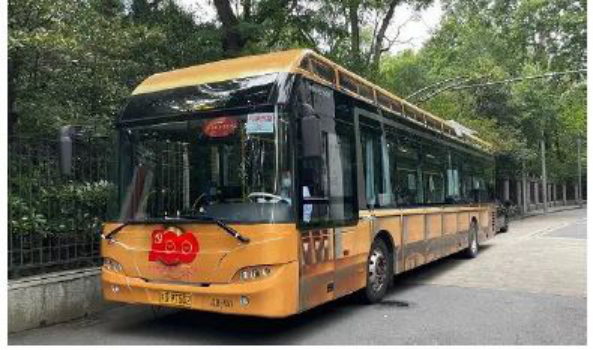
Figure 1: Existing no. 20 tram.
and cultural museums are countless, such as Zhongshan Park, Jing’an Tem- ple, Shanghai History Museum, Tai Xing Building, DeYi building, as well as Wangjiasha, Gongdelin, the first food shop, can be described as a clas- sic collection of Shanghai culture. With a history of nearly 100 years, the No. 20 tram is not the oldest member of the Shanghai bus family, but it is undoubtedly a member of the Shanghai Classic bus, worthy of the “Mobile Bus Museum” reputation.
The existing NO. 20 tram (see Figure 1) is quite common in appearance and internal, which is, its internal and exterior painting and body shape appear very similar to other public transport, it is difficult to highlight the NO. 20 tram as a “Mobile Bus Museum”. In addition, there are some pro- blems in the ride experience of the NO. 20 tram. These are exactly the goal that this topic needs to study.
The Research Method of Shanghai No. 20 Tram This study mainly used AT-ONE rule, participatory observation method. In the early stage, through the five dimensions of AT-ONE rule, we find the pain points of NO. 20 tram and mined the opportunity points, and then screened the opportunity points through the participant observation method to understand the user’s ride process in depth, to lay a good foundation for the follow-up design strategy and measures.
NO. 20 TRAM SERVICE DESIGN ELEMENTS In this study, the 20-route tram service design of the passengers, ride process, ride the main contact as the key elements of analysis, analysis of the existing tram routes, appearance, internal, ride experience.
Users Analysis The researchers used the participatory observation method to get the effe- ctive information of the passenger’s riding process at the starting stations
A Case Study of the Shanghai No. 20 Tram on Cultural Bus Service Design 329
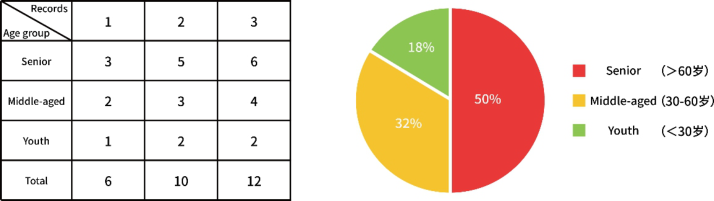
Figure 2: No. 20 tram population proportion map. (Draw by author, 2022.)
of NO. 20 tram, and analysed and theorized the collected data from the perspective of service design.
The study divided the data into three groups: elderly passengers (older than 60 years), middle-aged passengers (older than 30 years and younger than 60 years) and young passengers (younger than 30 years). At the same time, the number of passengers of different age groups in a bus at different time of a working day was recorded, and the proportion of passengers of different age groups was plotted accordingly (see Figure 2). It is found that the elderly passengers account for 50%, the middle-aged passengers account for about 32% and the young passengers account for 18%.
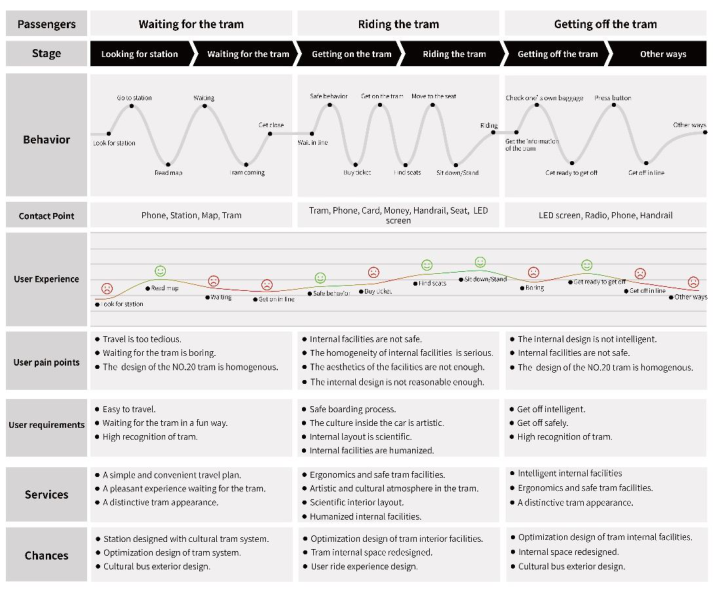
User Travel Process Analysis By using the AT-ONE rule, the whole process of waiting, boarding and ali- ghting is analysed, the contact points of passengers are figured out, and the corresponding user journey diagram is drawn (see Figure 3).
Waiting: The interval of NO. 20 tram is 5–10 minutes. The waiting time is not too long. However, when it is approaching, passengers can identify it by its exterior colour and by the electronic rolling plate on the front of the tram. But the appearance colour dreary, lacks the Shanghai culture characteristic and the aesthetic feeling, also does not have the explicit image characteristic.
Ride: Ride stage is the core stage of the passenger experience, researchers found that there are some problems in this stage.
(1) The homogeneity of the facilities inside the tram is serious. For example, the boarding process includes stepping into the door, swiping the card or scanning the code to enter the car, and it is the same as the ordinary car ride process.
(2) The internal facilities are not safe enough. For example, the arm- rest in the sweep area on the right side is not convenient for passengers to use, especially for old people. And when the tram starts, it is easy to harm passengers.
(3) The internal facilities are not aesthetic. For example, the seat fabric pattern lack of elegance, the surface of plastic film appears to be relatively cheap sense.
(4) The reasonableness of the facilities in the tram is insufficient. For exam- ple, the passenger in the right-hand seat in the back row can be blocked by the TV screen when browsing the arrival information on the rolling screen in
330 Zeng and Chen
Figure 3: No. 20 tram user trip map. (Draw by author, 2022.)
the tram, and only one side of the existing NO. 20 tram has the route infor- mation map, which makes the user’s access to information inconvenient; At the same time the passenger must know the tedious, the words are very small, it is difficult for the passengers to read. All Kinds of information board lack of visual unity and aesthetic.
Get Off: The driver will stop briefly at each station, and the passengers will get off at the middle gate. When there are more passengers, the passengers in the crowd, easy to miss the front of the train scroll screen display information and missed the station, there is a certain optimization space. In addition, passengers do not understand the transfer information after getting off, it is also let the users down.
DESIGN STRATEGY OF THE NO. 20 TRAM FROM THE PERSPECTI-VE OF SERVICE DESIGN According to the results of the previous research and analysis, this research mainly starts from the external and internal aspects of NO. 20 trams, combi- ned with the “line, tram, person, field, station” five-core coordination of ride service, the design strategy of cultural bus is put forward.
External Design Strategy Mr. Donald Norman points out that first impressions of products must be carefully studied. And the tram to the passenger’s first impression is the appe- arance of the tram, at this stage of the study, researchers made reference
A Case Study of the Shanghai No. 20 Tram on Cultural Bus Service Design 331
to some popular public buses such as American colourful buses and Japa- nese water buses, as well as some popular public transport in China such as Xiangyang bus and Zhuhai sightseeing bus.
The study found that most of these famous buses’ style is painting, part of the buses change the shape of the body. Researchers find that painting content may mostly be the city’s representative culture or scenic elements, promote local culture while attracting passengers. In this research, according to the design time limit and considering the cost, the exterior design mainly carries on the exploration to the exterior painting and the exterior modelling.
External-Painting According to the early analysis of Shanghai culture, Shanghai’s urban archite- cture, commerce and dialect have distinct regional characteristics. According to the city’s history and present-day features, this project focuses on the Art Deco, technology style and pop style.
Art Deco: Art Deco from the late 1800s, combines the best of the traditio- nal with the latest trends of the times to create a sophisticated, luxurious and fashionable aesthetic. This style mainly contains radial lines, geometric gra- phics, foreign cultural symbols and so on. Shanghai Art Deco architecture, such as Majestic Theatre, Paramount, Empire Maison, Young Bros Banking Corp, Shanghai Grand Theatre and so on. These buildings have become city landmarks.
Technology style: With the development of information technology, opti- cal technology, artificial intelligence, virtual reality and other technologies, cyberpunk culture is playing a more and more positive role in today’s life (Luxing Zhang, 2021). For example, the Oriental Pearl building, the style elements are mostly neon lights, exaggerated colours, etc. Colour for red, purple, blue, green, black. The passenger places oneself among this condition, between the virtual and reality, enjoy the modern science and technology.
Pop style: Pop style is a very eye-catching work, its colour composition, elements layout and typography style can quickly catch the user’s eyes (Wei Zhang et al., 2021), the application of this style to tram painting is a novel attempt. For example, the Plaza 66 and other modern urban living areas, the style is characterized by exaggeration, colourful and lively performance. Among them, the elements are rich in geometric structure as well as a variety of plane scattered and combination, graphics show a unique charm. Most of the colours are bright tones, such as red, blue and white. What it brings to people is an indelible classic memory, which belongs to the century style of Shanghai.
External-Styling-Design Due to the limitation of time and cost, the external styling design of the tram was carried out in combination with the Shanghai architectural style, such as the Art Deco, to stimulate Shanghai local passengers’ nostalgia, improve the identification of the NO. 20 tram, while attracting tourists to understand and experience the culture of Shanghai.
332 Zeng and Chen
Internal Design Strategy Different people have different requirements for the internal space and facili- ties of trams. It is the premise to understand the behaviour of different people for the internal design of trams. Therefore, analysing the behaviours of pas- sengers and drivers, digging out the contact points created by them can make the internal design of tram more scientific and humane.
To the passengers, they have the most basic behaviour, such as entering, walking, standing, sitting down, leaning back, getting up, grasping, getting off and so on. And there are also such as putting in coins, playing mobile phone, looking at LED screen and other special behaviour. The contact points of these behaviours are tram, armrest, ring-pulling, seat, LED screen, radio and so on. For the driver, the driver has the behaviour of sitting down, pres- sing the button, pressing the accelerator, braking, looking at the instrument and so on. The points of contact with the tram are the seats, gauges, buttons, pedals, etc.
By analysing the behaviour and contact points of passengers and drivers in the tram, this paper puts forward design strategies and measures to optimize the travel experience of drivers and passengers.
Scientific-Layout The modern trams pay attention to send the passengers to the destination in a safe and comfortable way, while the unreasonable layout and public facilities design bring many inconveniences to the passengers and drivers. Based on this, from the perspective of ergonomics, there are a large number of scientific data used in the design of car internal space, improve the comfort and safety for drivers and passengers. According to ergonomics, the reasonable planning of driving area is convenient for the driver to work, and the driving reliability is improved, and reasonable planning of space facilities such as loading area, seating area, standing area, it is convenient for the passengers especially for old people to find the right position quickly after boarding, which improves the safety and convenience of boarding, and improves the satisfaction of the passengers.
Humane-Internal-Facilities Humanized design is the inevitable trend of modern urban bus design, which is reflected in the tram is not just for the elderly, women and children, or reserved a place for people with disabilities, but through a set of humanized internal facilities to give the drivers and passengers a comfortable tour expe- rience. From the driver’s point of view, the driving space and seat, steering wheel, instrument should be in line with ergonomics to ensure the comfort for the drivers, so as to improve the driving reliability. From the passenger’s point of view, the internal environment can be combined with body painting, adding rich Shanghai style elements, to ensure that passengers can blend in and feel the unique cultural of Shanghai; The seat space should be ergonomic to ensure that passengers can ride in the most comfortable state, as well as moving and standing armrests, rings should be designed according to anth- ropometric percentages to ensure that passengers are able to grip in the most
A Case Study of the Shanghai No. 20 Tram on Cultural Bus Service Design 333
appropriate position to ease the muscle pressure of passengers, especially the elderly, to enhance the user experience. In addition, intelligent facilities such as LED screen and radio should fully display its intelligence and technology, improve the efficiency of information dissemination, and improve tourists travel efficiency.
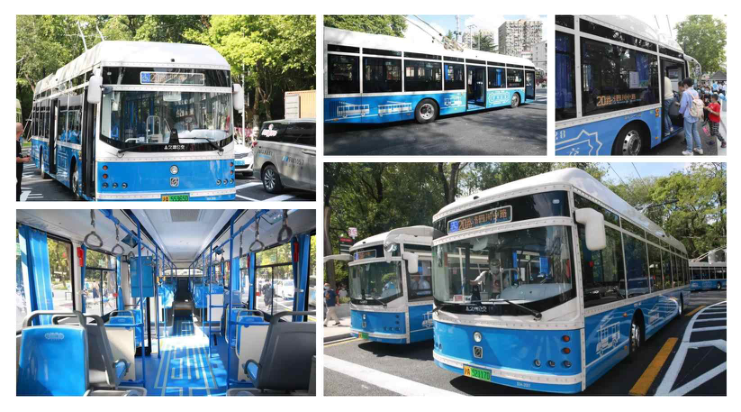
NO. 20 TRAM PROTOTYPE TEST The styling elements of the No. 20 tram were taken from the old trolleybus, and the side of the body depicts the major changes of Shanghai trams over the past century, presenting an overall retro style. The interior is blue, echoing the body painting. To meet the needs of different passengers, the interior space is divided into love seat area, wheelchair area, and seating area; the inte- rior facilities are also optimized based on the preliminary contact analysis, such as more beautiful and intelligent LED screen style and interactive inter- face, more comfortable and safe seats and handrails, which not only improve the travel experience of passengers but also promote the spread of Shanghai culture (see Figure 4).
Figure 4: The new no. 20 tram.
CONCLUSION
At present, with the rapid development of public transport, many new public transports poured onto the streets, but its aesthetics and design rationality still have many problems. In this paper, AT-ONE principle is adopted to explore the construction of Shanghai NO. 20 trams from the perspective of service design, and two design strategies are put forward for the exterior style of NO. 20 tram, two design strategies - scientific layout and humane internal facilities - are put forward for the internal space of trams. These ways can promote the development of Shanghai culture, and promote the process of
334 Zeng and Chen
building a distinctive cultural bus route. In other way, these strategies can also facilitate the “Cultural bus”, “Smart bus”, “Quality Bus” promotion, and bring a better travel experience to urban residents and tourists.
ACKNOWLEDGMENT
First and foremost, I’d want to express my deepest gratitude to everyone who has ever assisted me with this work. My heartfelt gratitude and appreciations go first and foremost to my teacher, Hong Chen, whose recommendations have given me a great deal of understanding into this topic. It is an honor for me to learn under his supervision. I am also really grateful to all of my pals that assisted me with this thesis. In addition, I want to thank my family for their help. Last but not least, I am grateful to everyone who reads my work and provides me advice that will help me in my future studies.
REFERENCES
Jianping Luo, Yichen Luo. The prototype of “Shanghai” and the composition of Shanghai culture [J]. CHENKAN, 2022(02): 28–31. Hollins, Ghollinsb. 1991. Total design: managing the design process in the service
sector[M]. London: Pitman. Luxing Zhang. The expression and application of cyberpunk culture in the design of commercial exhibition space[J]. Art and Design, 2021, 2(11): 54–56. Schneider J, Stikdorn M. Zheng Junrong, Translate. Service Design Thinking[M].
Nanchang: Jiangxi Fine Arts Publishing House, 2015: 130–135. Wei Zhang, Yuting Wu, Heliang Qi. The use of pop style in graphic design[J]. ART EDUCATION RESEARCH, 2021, (02): 63–64.
LISTED IN THE AHFE DIGITAL BOOKSTORE CATALOGUE
Explore the complete digital volume
Human Factors in Transportation
Read this individual research paper free through the original publisher, or explore the full digital proceedings book.
ISBN 978-1-958651-71-1
Explore this ISBN in the AHFE Bookstore ↗Listed in the July 2026 bookstore catalogue; search by ISBN to confirm current availability · Digital book purchase optional