Momoko Kitada, Ellen Johannesen, Renis Auma Ojwala, Susan Buckingham, Zhen Sun, Mariamalia Rodriguez-Chaves, Francis Neat, Ronan Long, Clive Schofield (2023). Barriers to the collection of gender-disaggregated data in ocean science. In: Human Factors in Management and Leadership. AHFE Open Access, vol. 92, pp. 71–80. https://doi.org/10.54941/ahfe1003736
The importance of collecting baseline gender disaggregated data is well acknowledged in science communities, including ocean science. However, the collection of gender disaggregated data is not always actioned or prioritized in organizations. This paper analyzes barriers to the collection of gender disaggregated data in the context of ocean science. The data analyzed in this paper relate to three research projects under the Programme called “Empowering Women in the United Nations (UN) Decade of Ocean Science for Sustainable Development”. These projects collected secondary and primary data about gender equality from ocean-related intergovernmental organizations (IGOs) and non-governmental organizations (NGOs) as well as universities and research institutions in Kenya. To analyze barriers to the collection of gender-related data, researchers’ observations and reflections recorded in field notes and research diaries were used for analysis. To supplement the analysis, IGOs and IGOs’ narratives in their efforts to collect gender-disaggregated data were also analyzed, which highlights the importance of leadership and management to facilitate a systematic data collection about gender in ocean science communities. The paper concludes that a systematic approach to collect gender-related data can be facilitated by gender equality strategies and action plans which are the main deliverables of the Programme.
The United Nations (UN) Decade of Ocean Science for Sustainable Develo- pment (thereafter Ocean Decade) is led by the Intergovernmental Oceano- graphic Commission (IOC)-UNESCO to establish a convening framework for a range of stakeholders to co-design and co-deliver solution-oriented research needed for sustainable oceans. The Ocean Decade was set from 2021 to 2030, supporting the UN Sustainable Development Goals (SDGs), particularly Goal 14 (Life Below Water). The Ocean Decade endorsed the programme, “Empowering Women for the UN Decade of Ocean Science for
Sustainable Development” (the Programme) primarily funded by the Depar- tment of Fisheries and Oceans (DFO) Canada and supported by the Nippon Foundation. The Programme emphasizes the importance of women scientists to contribute to sustainable ocean research, which supports science-informed policy making. One of the early findings of the Programme is that the col- lection of baseline gender-disaggregated data is critical to monitoring and evaluating the progress on empowering women.
In modern organizations where gender equality is a core value, leader- ship and management must reflect this value in action. Data informs and supports decisions and increases the accountability of leaders and managers in organizations (Spisak 2022). This paper examines how leadership and management aspects may influence challenges in collecting baseline gender- disaggregated data in ocean science based on the three research projects under the Programme. The paper reviews existing research approaches to baseline gender-disaggregated data in science fields, including ocean science. From the three empirical research projects under the Programme, data collection challenges were presented through researchers’ observations and reflecti- ons during the research processes. This analysis was further complemented by interviews with the representatives of ocean-related intergovernmental organizations (IGOs) and nongovernmental organizations (NGOs). Three research projects include a policy analysis of gender equality within IGOs and NGOs; action research in promoting gender equality in the Internatio- nal Council for Exploration of the Sea; and a case study of Kenya with regard to gender equality in ocean science at universities and research institutions. The paper concludes with the recommendations on data collection of gender- disaggregated data in terms of how leadership and management aspects can support data collection.
GENDER-DISAGGREGATED DATA IN OCEAN SCIENCE The absence of gender-disaggregated data in various science fields has been one of the obstacles to monitoring progress towards gender equality for a long time. The World Wide Web Foundation (2017) indicates that most coun- tries do not collect gender-disaggregated data to inform policies, and conse- quently very few countries, particularly in the Global South, have technology policies and strategies to target the gender digital divide. The UN Secretary- General’s Special Advocate for Inclusive Finance for Development (UNSGSA) reports their observations in collecting and using gender-disaggregated data in 11 countries, mostly from the Global South. Some countries were moti- vated to collect gender-disaggregated data by development partners such as the International Monetary Fund (IMF). In the countries where a unique national identification system is established, gender-disaggregated data col- lection is better facilitated. Without clear definitions of indicators, however, collecting high quality data is challenging. For better policy design, a com- plementing dataset (such as both demand- and supply-side data) is useful (UNSGSA 2020).
In ocean science, the most cited and recent figure used to represent gender equality derives from the Global Ocean Science Report (GOSR) 2020, which
Barriers to the Collection of Gender-Disaggregated Data in Ocean Science 73
states that 39% of global ocean scientists are women. This is 10% higher than the global share of female researchers in natural science (UNESCO 2020). However, the figure used in GOSR 2020 may not represent the accurate situ- ation in practice due to its limited responses and the methodology used. A questionnaire was administered by IOC-UNESCO to obtain various data, including gender, from their Member States and their response rate was 30% (n = 45) where the majority of the Global South did not respond. Further, gender ratios were asked in Part D (National research capacity and infrastru- cture) of the questionnaire and the response rate went even lower because not all 45 States (roughly 85%) answered. This implies how difficult it is to collect gender-disaggregated data at national level and to produce reliable and valid figures of gender balance in ocean science at global level. Another method to generate gender-disaggregated data in GOSR was to count the number of women ocean scientists who participated in ocean-related conferences. This method by simply counting female participants’ numbers has a limitation in terms of understanding in what capacity women are making contributions to ocean science. In addition, the extent to which ocean conferences were sele- cted for inclusion and the methods used for inferring gender of participants was unclear and this would leave a question of reliability in statistics.
The 2015 OECD Recommendation of the Council on Gender Equality in Public Life highlights the importance of collecting gender-disaggregated data, promoting its dissemination, and increasing coordination among data collecting and producing bodies (OECD 2016). The UN System-Wide Action Plan (UN-SWAP) is one such example providing a common framework used across UN organisations to enhance accountability in their planning and acti- ons for the achievement of gender equality. In the context of Pacific islands, Michalena et al. (2020) call for more systematic collection and use of gender- disaggregated information which will influence ocean management. In 2014, the UN Framework Convention on Climate Change (UNFCCC) initiated the Lima Work Programme on gender, and approved the enhanced work pro- gramme, maintaining data on leadership positions in UNFCCC bodies and delegations in 2019 (UNFCCC, 2019). Despite this documented need for baseline gender-disaggregated data worldwide, there is still a lack of such data in science communities, including ocean science.
LEADERSHIP AND MANAGEMENT IN COLLECTING GENDER-DISAGGREGATED DATA Capacities and resources to integrate gender perspectives in the conduct and delivery of ocean science are the key to achieve the goals of the UN Ocean Decade. In public institutions, leadership and communication make a notable difference to ensure the collection and monitoring of gender-disaggregated data in the area of leader’s responsibility as well as providing clear guideli- nes and tools (OECD 2016). The fact that there are few women in leadership positions in ocean science institutions (WMU 2021) can be considered as one of the factors why there has been less actions to collect gender-disaggregated data. Feminist political theory argues how women’s concerns are conside- red as optional that the male leadership could ignore (Hunt 1996). Indeed,
Lombardo and Mergaert (2016) make a distinction between gender equa- lity strategies undertaken within existing gender unequal structures in which staff are not always sufficiently gender aware, and gender training which is designed to be socially transformative. Gender-aware leadership in ocean sci- ence research is therefore a condition to facilitate the meaningful collection of gender-disaggregated data, while centering women’s realities and voices through feminist research processes in ocean science is necessary to co-design and co-deliver solution-oriented research needed for the UN Ocean Decade.
The collection of gender-disaggregated data in ocean-related fields is parti- cularly challenging because of the multidimensional governance framework. Oceans can be negotiated as territorial or transboundary, divided or common. Papanicolopulu (2019) argues that such potential gender-neutrality under the Law of the Sea has hardly been explored in contemporary issues in ocean governance. From a transnational feminist perspective, the approach to col- lecting gender-disaggregated data at the national level relies on neo-colonial powers which continually mark territorial national borders (Tacheva 2022) and undermines opportunities to map and generate data beyond borders through partnerships and collaboration among IGOs and NGOs. Innova- ting the process of collecting gender-disaggregated data is partly diversifying opportunities to think about alternatives to the current data management systems. Feminists can question who is currently managing data systems for whom. Who are assumed to be the users of ocean science data? If leaders and managers of ocean science data are dominated by men, how would gender-disaggregated data be considered as important and useful for all users?
METHODOLOGY & METHODS To identify barriers to the collection of gender-disaggregated data in ocean science, this paper employs feminist inductive reasoning based on obse- rvations of the data collection process experienced through three research projects under the Empowering Women for the UN Decade of Ocean Science for Sustainable Development Programme between 2019 and 2022. Femi- nist inductive reasoning opposes deductive refutation to prove “objectivity” to a phenomenon and values “other” beliefs and systems of ideas (Moul- ton 1983). We believe that this feminist approach could help reconsider the under-valued contribution of women to ocean science and the absence of gender-disaggregated data in the field.
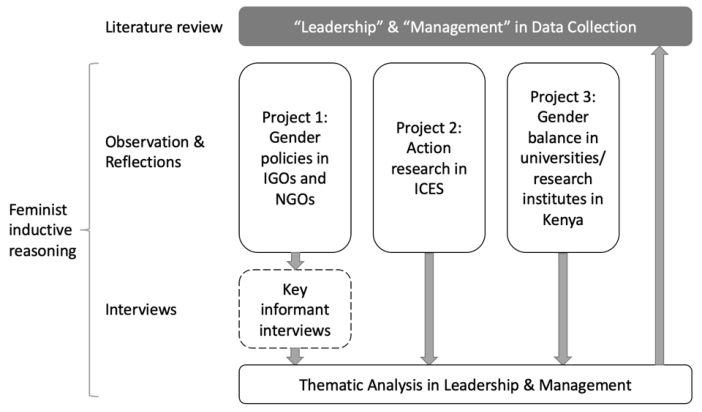
Three research projects used for this study adopted different methods to collect baseline gender-disaggregated data. The first project on gender equ- ality within selected ocean-related IGOs (n = 5) and NGOs (n = 2) used document analysis and key informant interviews where three researchers were involved in data collection. The second project within a single organi- zation (i.e., ICES) used archived data on conference participation, interviews, and feedback from various interventions through action research. The data collection was done by a researcher who has insider access to the orga- nization. The third project was a case study of universities and research institutions in Kenya, offering ocean science courses. A Kenyan researcher
Barriers to the Collection of Gender-Disaggregated Data in Ocean Science 75
Figure 1: Research design.
collected data through surveys and interviews. Gender equality policy docu- ments from different universities were also reviewed. Each research project has a different output, but this paper focuses on its process of learning from observable phenomena rather than actual research outputs.
Barriers to collecting gender-disaggregated data in ocean science were analyzed by using the perspectives of leadership and management which were derived from the literature (Fig.1). To prepare our analysis, researchers’ refle- ctions from the research process in terms of collecting gender-disaggregated data were primarily documented in field notes and research diaries. Interview data with IGOs and NGOs were analyzed by a qualitative software, NVivo.
RESULTS
In this section, we first discuss the analysis of various barriers to gender- related data collection experienced by the researchers in the Programme. Then, the challenges faced by the key informants of IGOs and NGOs are extracted from interview data and analyzed from the theme of leadership and management derived from the literature.
Observations and Reflections The observations and reflections of the rese- archers during the data collection provided insightful evidence of barriers to collect gender disaggregated data in ocean science. The three research pro- jects collected secondary data from documents, websites, and databases as well as primary data through interviews, surveys, and observations with their participants.
For the secondary data, some were accessible from the relevant websites but in many cases, researchers experienced difficulties in accessing documents and databases owned by the organizations for internal use or sometimes did not exist as noted that:
Gender policy documents are not always published on their website and publicly accessible. Some universities had gender policies on their websi- tes but permission or access password was required to access it (only for staff use). Other universities had policy documents in hard copy which was only one copy they had. This resulted in taking pictures of each page. (Ojwala’s field note).
General information on Gender Equality Policies within IGOs was avai- lable, however the implementation of such instruments and more practical information on monitoring and the achievement (or not) of targets or indica- tors was not easy to find. Gatekeepers for such data were not always willing to share. Even if it is shared, some data and information were outdated or reorganised manually in order to make it useful as stated: Gender-disaggregated data in some IGOs was incomplete or not up to date. (Rodriguez-Chaves’s field note)
Regarding ocean science conference data, it was found that gender disaggre- gated data are not always available. Of those currently available data they would be more useful if various roles and contributions of women ocean researchers are acknowledged in the process of data generation: Not all conferences collect self-identified gender disaggregated data. However, this is becoming increasingly common at registration, and is important to track gender balance among all participants, and those that lead, give keynote presentations, and receive awards. (Johannesen’s field note)
Primary data, on the other hand, were a great source of current gender-related information in ocean science organizations. However, during the pandemic, it was extremely difficult to arrange interview schedules and distribute surveys among participants who were quarantined: During the pandemic, both online and paper-based surveys were used to increase response rates, because some students were studying from home and were not on campus. The pandemic added an extra chal- lenge for interviewing. Interview appointments could change at the last minute, resulting in rescheduling or changing from face-to-face to online interviews.
Participants’ “no-show” or internet connection interruption occurred, espe- cially when participants relied on their mobile phone. (Ojwala’s field note) It was observed that female participants, including staff and researchers, had to reschedule their interview appointments because of work-life balance challen- ges. Some were reluctant to be interviewed because of their fear of impacting their career, such as losing their jobs: Female ocean researchers tended to be more difficult to make an appoin- tment for interviews than male counterparts. For instance, some par- ticipants had to reschedule their interview appointment to late in the evening. (...) Some female staff were hesitant to be interviewed with- out their directors’ approval. There was a feeling of intimidation where
Barriers to the Collection of Gender-Disaggregated Data in Ocean Science 77
employees are not free to share their experiences due to their fear that their boss might dismiss or fire them. (Ojwala’s field note) These observations highlight the vulnerability of women in the workplace where ocean science is conducted in Kenya. This was an influencing factor to data collection with regard to accessing information from the participants.
Interviews with IGOs and NGOs To supplement the analysis from researchers’ field notes and research diaries, interview data with the repre- sentatives of ocean-related IGOs and NGOs were coded and analyzed. Even though organizations are aware of the importance of gender-disaggregated data in ocean science, IGO [A] stated that they do not collect gender- disaggregated data while IGO [B] does collect a lot more than they need. Data management, including the selection of relevant and necessary data, may require additional resources such as a consultant if the organization does not have a capacity. Both IGOs explained: We don’t really keep records (…) at gender balance (…) but the ones, I think we do have the historical names of who they are. So it’s easy to if we want to do this. (IGO [A] informant)
We also have a totally different stream of data, which is becoming so big to manage, and we want to go so deep, that we are recruiting an expert. (…) Well, you can do the minimum, but it becomes very complicated. And I think I’ve reached my own limit. So we are recruiting a consultant to create a matrix to manage that because we have so much information. (IGO [B] informant) Both IGOs, however, highlighted the importance of leadership in the col- lection of gender-disaggregated data. Leadership would make a difference in ocean-related IGOs to actively collect data and monitor the progress for gender equality. IGOs stated:
Collecting gender disaggregated data, obviously is important. But then the leadership, I think it does come down to leadership. And making sure that the leadership believes in this and then does something. Yeah. Speak louder than words as they say. (IGO [A] informant) I think it’s leadership, leadership, leadership, because you have the drive from the top. Everything is easy. And also, in this leadership, (…) it’s not only projecting a vision where women need to be empowered, it’s also empowering women to enable that vision to become true. (IGO [B] informant)
In addition to leadership within the organization, when particular jurisdi- ctions impose gender requirements on the conduct of ocean science-related activities in their territory through their national laws, such oversight may become a driver for the organization to submit their gender-disaggregated data for compliance. NGO [F] explained: [A congress] is every four years (…) and this time, it was France that was the host country. Because the event was in France, you have to follow French labour laws, but also they had criteria. That was the first time
we were audited and independently audited for gender equality. (NGO [F] informant) This example illustrates how top-down approaches, including organizati- onal leadership and national laws, can facilitate the collection of gender- disaggregated data in ocean science. Oceans as territorial and non-territorial spaces often present challenges for cooperation, and our data informs us that both approaches from intergovernmental and national efforts to col- lect data are equally important. To respond to this need, critical deliverables from the Programme are the development of a gender equality strategy and action plans for all IGOs and NGOs in ocean science. Our analysis supports potential usefulness of a gender equality strategy which could facilitate the collection of gender-disaggregated data to support SDG 5 (Gender Equality) and 14 (Life below Water) within the Ocean Decade actions.
DISCUSSION
This study demonstrates how challenging it is to collect gender-disaggregated data without incorporating management practices in organizations or with- out leadership for promoting gender equality as a priority.
It is also notable how gender-disaggregated data need to be understood in a given context where meanings can be very different. For example, it was concluded that ocean science has a better representation of women than other science fields in GOSR 2020 (UNESCO 2020), however it can be misleading because there are fewer women in senior roles in ocean science (WMU 2021). Quantitative data therefore require careful attention to its interpretation especially when the context of gender-disaggregated data is unknown.
CONCLUSION
This paper identified several barriers to the collection of gender-disaggregated data in ocean science. Access to data and information about gender equality policies in universities offering ocean science studies was not always publicly available or accessible, and information about progress on implementation was also not available or non-existent. In some cases, such as ocean scie- nce conferences, self-identified gender-disaggregated data were not collected. When researchers wish to collect primary data about gender in ocean scie- nce, access to participants, especially during the pandemic, was difficult, and the vulnerability of participants was also highlighted. In the case of IGOs and NGOs, some did not routinely collect gender-disaggregated data while others faced challenges of data management in quality and quantity.
Leadership and management can make a notable difference in the colle- ction of baseline gender-disaggregated data in ocean science at national or international levels. Such data is useful to incorporate gender perspectives in the process of co-designing and co-delivering solution-oriented research needed for the Ocean Decade. From the findings of this paper, the collection of gender-disaggregated data should not be a separate action but rather an
Barriers to the Collection of Gender-Disaggregated Data in Ocean Science 79
integral part of the regular actions in data management. This can be achieved by gender-aware leadership as well as the adoption and implementation of gender equality strategies and action plans which are the deliverables of the Programme and will guide any ocean science and ocean governance instituti- ons to make contributions to achieving gender equality for the Ocean Decade. This study was based on two perspectives: researchers and representatives of IGOs and NGOs in ocean science and ocean governance fields, which may be limited to address wider perspectives from other stakeholders. Future resea- rch can be designed to include various other perspectives to provide inputs to the understanding of challenges and opportunities.
ACKNOWLEDGMENT
This paper is part of the outcomes of the “Empowering Women for the United Nations Decade of Ocean Science for Sustainable Development Pro- gramme” funded by the Department of Fisheries and Oceans (DFO) Canada and generous support from the Nippon Foundation.
REFERENCES
Hunt, K. (1996) Equivocal Feminists: The Social Democratic Federation and the Woman Question 1884–1911. Cambridge: Cambridge University Press. Lombardo, E., Mergaert, L. (2016) Resistance in Gender Training and Mainstrea-
ming Processes. In: Bustelo, M., Ferguson, L., Forest, M. (eds) The Politics of Feminist Knowledge Transfer. Gender and Politics. Palgrave Macmillan, London. https://doi.org/10.1057/978-1-137-48685-1_3 Michalena, E., Straza, T. R. A., Singh, P., Morris, C. W. and Hills, J. M. (2020) ‘Promoting sustainable and inclusive oceans management in Pacific islands through women and science’, Marine Pollution Bulletin, 150, pp. 110711. Moulton, J. (1983) ‘A Paradigm of Philosophy: The Adversary Method’, in Har-
ding, S. and Hintikka, M. B. (eds.) Discovering Reality: Feminist Perspectives on Epistemology, Metaphysics, Methodology, and Philosophy of Science. Dordrecht: Springer Netherlands, pp. 149–164. OECD (2016) 2015 OECD Recommendation of the Council on Gender Equality in Public Life. https://doi.org/10.1787/9789264252820-en Papanicolopulu, I. (ed.) (2019) Gender and the Law of the Sea. Leiden: Brill. Spisak, B. (2022) ‘How Data Can Make Better Managers’, Harvard Business Review.
Available at: https://hbr.org/2022/03/how-data-can-make-better-managers Tacheva, Z. (2022) ‘Taking a critical look at the critical turn in data science: From “data feminism” to transnational feminist data science’, Big Data & Society, 9(2), https://doi.org/10.1177/20539517221112901 UNESCO (2020) Global Ocean Science Report 2020: Charting Capacity for Ocean
Sustainability. Paris: UNESCO Publishing. UNFCCC (2019) Decision 3/CP.35 Enhanced Lima Work Programme on Gender and Gender Action Plan UNFCCC CP/2019/13/Add 1 Accessed 26 January 2023. UNSGSA (2020) Collecting and Using Gender-Disaggregated Data for Financial Policymaking: Key findings from 11 countries. Available at: https://www.unsgsa.org/sites/default/files/resources-files/2020-09/Policy_Not e_Gender-Disaggregated_Data_FINAL.pdf.
World Maritime University (WMU) (2021) Empowering women for the United Nations Decade of Ocean Science for Sustainable Development. https://commons.wm u.se/lib_reports/68 World Wide Web Foundation (2017) React with Gender-Responsive ICT Policy: The
Key to Connecting the Next 4 Billion. Available at: https://webfoundation.org/do cs/2017/09/REACT-with-Gender-Responsive-ICT-Policy.pdf.
LISTED IN THE AHFE DIGITAL BOOKSTORE CATALOGUE
Explore the complete digital volume
Human Factors in Management and Leadership
Read this individual research paper free through the original publisher, or explore the full digital proceedings book.
ISBN 978-1-958651-68-1
Explore this ISBN in the AHFE Bookstore ↗Listed in the July 2026 bookstore catalogue; search by ISBN to confirm current availability · Digital book purchase optional