Yuqing Liu (2023). Angel or Devil? Public attitudes toward AI arts from cross-cultural perspectives. In: Human Factors in Communication of Design. AHFE Open Access, vol. 90, pp. 155–165. https://doi.org/10.54941/ahfe1003707
AI Art has attracted the attention of researchers due to the ongoing and rapid development of AI art technology. However, limited research has explored the different attitudes toward AI Art from a cross-cultural perspective. Based on the results from social media platforms and Natural Language Processing (NLP), the current study examines the similarities and differences between Eastern and Western cultures in recognizing AI art. Results showed that Eastern and Western cultures might share similar attitudes toward AI art, human-AI relationship, and positive and negative attitudes, while they might have distinct topics, such as contextual application and usage intention. Theoretical and practical implications might also be discussed in this study.
Artificial Intelligence (AI) is a product of science and technology that can perform human-like cognitive tasks with rich technical practices in various fields of major achievements, such as paintings, poems, songs, and even film scripts etc. Over the past few decades, numerous rendering and texture syn- thesis techniques have been created in the context of computer graphics and computer vision research. These algorithms were created to alter images in a variety of ways, one of which was to apply an “artistic style” to the input image. Deep neural networks, however, have just lately been used to stylize photographs and produce new images; this trend has grown rapidly over the past five years.
Discussions concerning the basic issues surrounding the aesthetic character of these works and their position in the history of visual arts were sparked by the rising trend of employing AI technology in art production. It was still theorized controversial whether the works created by computers could be defined as art. And the topic of novelty and creativity of this sort of art within the context of art history was addressed in the search to comprehend the dynamics of AI art. Aaron Hertzmann (2018) held the view that com- puters could not currently be recognized as being the authors of art since it was hypothesized that social agents were who produced art. Xinlu Liu (2020) illustrated the relationship between artificial intelligence painting and traditi- onal painting. In addition to having a significant influence on modern artists
and expanding their creative horizons, artificial intelligence technology also improved the interaction between viewers and art. Because artists were natu- rally sensitive, artificial intelligence technology expanded the scope of their creative thought. Liu supported the esteem of digital technology as a device and means for artistic creation, and the ingenious evolution of art relied on the full combination of digital technology and traditional painting forms. Lu Li (2022) thought, In the future, there will be even more overlap betw- een artificial intelligence and contemporary art. The issues and crises that the continuous advancement of AI in the arts may bring should also be taken into consideration. As AI is used in the arts more and more, it may adva- nce, becoming more and more accurate and subtle in its imitation of human artistic works, producing content texts, visual or musical compositions that convincingly resemble those of humans, or even pushing the boundaries of our current technology and revolutionizing the body of artistic creation while maintaining many of our previous artistic theories and traditions and chal- lenging the position. Salvatore G. Chiarella et al. (2022) pioneered a novel approach to aesthetic assessment by combining self-reported aesthetic evalua- tion of two abstract paintings shown in an ecological art context with implicit psychophysiological parameters like EDA and HR. The results reported the first evidence of the impact of the implicit comparison within the manipula- tion of the pre-assignment of authorship between humans and AI to unknown abstract artworks, demonstrating that the lower pleasantness attributed to an AI-product is the result of prejudice rather than a pure, unbiased judgment. It is clear that the questions of whether AI art displays creativity and whether AI generators will supplant the traditional art world and its practitioners are still up for dispute. But we must acknowledge that it has significantly altered how art is produced, created, and even how people live.
Some research discussed in detail of the attribution of very different atti- tudes towards AI art or AI creators. Yanru Lyu et al. (2022) carried out an evaluated experiment of artists and nonartists that co-created with AI, and found that the action characteristics of artists were still different from those of nonartists, as well as their attitudes and concerns, which were due to their knowledge. A survey experiment was utilized in a different research to ask 288 individuals to rate the artistic merit of two types of works of art (AI-created vs. Human-created) using a scale that is frequently used among art experts. Participants’ assessments of the creative worth of pieces of art were unaffected by participants’ knowledge that artwork was produced by artificial intelligence, according to the research. Nevertheless, the rating was severely impacted by the premise that AI cannot create art (Hong J W et al., 2019). Mikalonyt˙e E S et al. (2022) designed two experiments by manipu- lating the agent type, behavior type and object types to determine whether people will accept robot painters and paintings created by AI-driven artifi- cial intelligence as art. The findings demonstrated that people see human and machine paintings as works of art to a similar degree. The fact that people are far less inclined to attach creative goals to robots than to humans may help to explain why people are much less likely to view intelligent machines as artists than humans. All of the above studies were conducted by recruiting
Angel Or Devil? Public Attitudes Toward AI Arts From Cross-Cultural Perspectives 157
specific participants to carry out the evaluation experiments, among whom there were no differences or types.
When we talked about the reasons why people held ambivalent attitudes in terms of AI technology, not only AI art, there seemed to be many more answers. This suggests that we can broaden our horizons and focus on the potentially vast diversity of evaluators themselves, in particular, whether simi- lar differences exist between groups from different cultural backgrounds. The conclusion was uncertain when it came to the question of whether people from different cultures would differ in their attitudes toward Artificial Intel- ligence technology (Dang, J., & Liu, L, 2021; Persson, A. et al., 2021). This is also based on the fact that AI paintings are so popularly exhibited on social media platforms around the world and have received a large number of com- ments. We are able to find out some of the cultural differences that lead to conflict and convergence behind these comments.
Practically, the ambivalent attitude of people towards AI and the lack of understanding about it indeed hampers measures to facilitate people’s willin- gness to use AI technology to assist them. In the future, when AI-generated technology promotes globally, regional acceptance and attitudes of users will also be an essential part of the consideration. Thus, this study selected comments on several important regional social media platforms as the obje- cts to figure out whether the opinions and attitudes towards AI-generating technologies held by people from all kinds of cultures will show specific characteristics.
Previous studies exploring the attitudes of AI art users have used methods of recruiting certain participants and relying on the survey with close-ended questionnaires to measure it, to a large degree. In order to collect as much data as possible in real and natural contexts, comment data of relevant videos on social media platforms were selected to analyze. As users’ under- standing of machines could be socially constructed and culturally produced (Pinch & Bijker, 1987; Winner, 1980), it is important to expand the rese- arch focus from individual countries to cross-cultural contexts (Kun Xu, Fanjue Liu etc., 2020). Moreover, previous AI art studies have paid less attention to the influence of cultural background or mostly engaged in Western and East Asian cultures of the comparative study. Here comes a question, besides Western culture, is AI more accepted in different ethnic groups within the same East Asian culture? On the basis of previous stu- dies, this study selects three video platforms. The first is YouTube, which represents the English cultural circle and is popular with native English speakers all over the world. In addition, as the representation of Sinosph- ere, the Chinese platform Bilibili and YouTube in Japanese were chosen to investigate the different attitudes of different ethnic groups within the same cultural circle, to better explore the cultural factors of AI art attitude. Each of these three video platforms has a mainstream status and a large number of users in their respective cultural environments, and, because videos have a long time, dynamic display and clear narrative function, they can rapidly allow the general public to understand the process, principles and use of AI painting.
158 Liu
METHODS
Data Extraction Comment data from the top 30 videos in view counts of three languages on Bilibili(Chinese), Youtube (English) and Youtube (Japanese) were used in this study. Each language contains ten videos and the data was retrieved by December 24, 2022. These Videos are collected by searching key words “AI作画”, “AI Art”, “AI画像生成” and then chose by their view counts and relevance. The keywords were expanded to “AI 艺术生成”, “AI Art genera- tion”, and “AIクッキ”. Then we collected all the comments data of those 30 videos. The User IDs, posting date and time, and languages of all comments were also gathered from the query results. The 30 videos were classified into three groups based on language: Chinese, English, and Japanese. Each group was processed and analyzed in the same way, ultimately comparing the results between groups.
In this study, 25,342 comments from three sources (6,915 from the Chinese source, 10,479 from the English source, and 3,455 from the Japanese source) were retrieved. All the English words in the tweets were transferred to half- width and lowercase. After data cleaning, 20,849 comments were used for further analysis.
Tokenization is a fundamental step in many natural language processing (NLP) methods, especially for languages like Chinese and Japanese that are written without spaces between words. We tokenized all comments and analyzed the unigram and bigram tokens. The website links, special chara- cters, numbers, and “amp” (ampersands) were removed from the comments before tokenization. The Python packages SpaCy and GiNZA were used to remove the stop words in each language and implement tokenization. The tokenized words were joined by white space characters into text in the origi- nal order. The Python package scikit-learn was used to convert the white space–joined texts into unigram and bigram tokens and to calculate the counts of tokens.
Latent Dirichlet Allocation and Preprocessing LDA is an unsupervised generative probabilistic model widely used in topic modeling. LDA regards the documents in a corpus as generated from different topics, and each topic generates the documents following a Dirichlet distribu- tion. David Blei has an excellent introduction to probabilistic topic modeling published in the Communications of the ACM. In this particular study, we apply the Latent Dirichlet allocation to categorize the collection of comments into latent topics. In the LDA model, each document (e.g., comment(s) in our study), treated as a vector of word counts using the bag-of-words approach, is viewed as a mixture of probabilities over the topics, where each topic is represented as a probability distribution over a set of words (i.e., the dicti- onary). Before applying the LDA algorithm, we first sanitize the dataset by removing the hyperlinks, hash-tags “#” and reply-tags “@”, and then apply the WordNet Lemmatizer in the Natural Language Toolkit (NLTK) to group the different inflected forms of a word into its lemma. We also remove a list
Angel Or Devil? Public Attitudes Toward AI Arts From Cross-Cultural Perspectives 159
of stop words such as “a”, “I”, etc. and words that occur less than 3 times in our corpus since such infrequently found words do not construct meaningful latent topics in our context. By doing so, we create a “clean” dictionary for the LDA model.
Bag-of-Words Assumption This study used the bag-of-words model to detect top frequent words. A Bag- of-Words model represents the ‘attendance’ of the words in a text document. Regardless of the structure of the terms, or the grammar of a sentence, the text document is thought of as a ‘bag’ where syntax is not considered. The only thing that matters in the bag-of-words model is where a word appears in the text, not where and how.
RESULTS
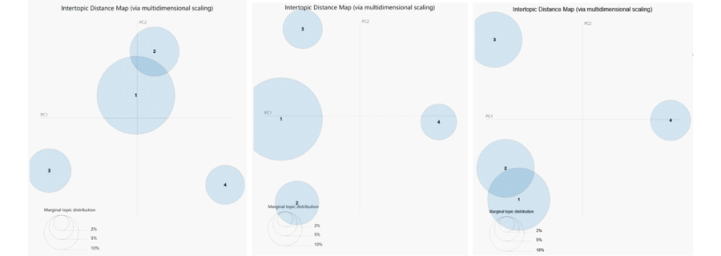
Based on the elbow method, four themes emerged from three sources. The- mes, keywords, and samples are summarized in Table 1. The frequency and inter-topic distance can be found in Figure 1, where the size of the circle refers to the frequency of the topic mentioned in the corpus, and the distance refers to the relationship among different topics.
Figure 1: Intertopic distance map from three sources (Left: English; Middle: Chinese; Right: Japanese). Note: Numbers in the map denote the theme topics’ numbers in Table 1.
CONCLUSION AND DISCUSSION Viewers’ perceptions of machines are shaped by their conventional mindsets, which can be conversely reconfigured by new technological practices,so it is important to understand how cultures may have shaped users’ interpretation of machine-generated content (Kun Xu, Fanjue Liu etc., 2020).
As we can see, topic 1 on these three platforms was labelled as “Human-AI relationship”, as it included several word which reflected a rethinking of the relationship between human and AI, the problems artists may face and how to get along, to some extent. And the top three trending topics on Western and Chinese platforms are similar. Topic 2 consisted of several words like “cre- epy”, “lose”, “disturbing” and etc, so it was labelled as “Negative Attitude”.
160 Liu
Continued
心します
りは出来ないさ
取って代わるとは思わないけど、SNSと
かのアイコンぐらいだったら人にまず
にAIに描かせるみたいな代は来そうだと
思った
凄いし面白かった
AIの技もここまで追い付いたか!!って感
AIのセンス予想の斜め上すぎる、すごい
いくらAIがしようがレトルトさんの代わ
用する人がいなくなればいいのにね
さすがにこのAIがイラストレタに完全に
被代码奴役,黑客帝国的世界可能并不是虚 幻
一律枯燥无味毫无灵魂的艺术作品
来了那么ai的发展就可以脱离人类咯
代人类的想象力,只要有实力和奇妙的灵
感,不管什么职业都不会被取代
人类失去传统艺术,在网络上看AI写的千篇
以后的发展趋势就是代码的世界喽!人类
感觉是AI从0∼90,最后由人从90∼100
AI永远不可能代替人类的美术,如果那一天
得职业画师不必过多焦虑,ai永远不可能取
步, 训练 AI, 代理人, 虐待, 教育の意, 法律, , 消去する
art thing enough to appreciate this... pheno-
menon? for anything other then ‘computer
draw ugly pictures.’ Can anyone steer me in
the right direction?
crazy Ai is and now I am watching your
video which made me realized that this
world is going to change.
come so far in our advancements with tech-
nology. But it also scares me… because
I feel as though we may be creating A.I.
that is a bit…. Too intelligent. But this is
incredible!
I’m convinced I don’t understand this AI
Wow this is amazing, humans have truly
deep 恶魔,死亡,失去,毁灭,孤独,恐惧 インプレッシブ, すっげ, 味深い
English Perspective Chinese Perspective Japanese Perspective
Topic 3 contained words like “amazing”, “awesome”, “cyberpunk” and etc, that we labelled as “Positive Attitude”.We conclude that comments on AI art on these three video platforms are more likely to mention topics that are rela- ted to Human-AI relationships, negative or positive emotions. Furthermore, although the gap in this comparison was not large, more people showed a negative attitude than a positive one.
As is evident, when faced with the convenience and well-being brought by AI technology, people in West and China are still most concerned about whether it can completely replace human painters, whether their works can be confused with those created by humans and the future of artificial intel- ligence and humans. These appear to coincide with what has been focused on in past studies. Furthermore, the results suggest that people tend to show ambivalent attitudes toward AI, perceiving them as both allies and foes in the meantime, but the negative attitude still slightly prevails. On the one hand, some people think the artworks drawn by AI are ugly and boring, which is due to the existing technical constraints. In a way, AI painting is an output of an algorithm that resembles painting in some ways, but it actu- ally demonstrates how technology can duplicate the details of an artwork. Artificial intelligence has a considerably higher business worth than aesthetic value, and exactly because it is far more productive than people, its aesthe- tic value is diminished. This is dictated by its technical instrumental status. On the other hand, people are more concerned about the potential threat and challenge they pose to humans than they are about praise. As early as the Industrial Revolution, factories replaced some of the handmade products with mass-produced machine-made products, with a consequential loss of jobs for the lower-level manual workers. Under these circumstances, “people began to wonder if they were being replaced by machines, or even becoming machines themselves”. A large number of novels and films also take as their theme the threat, destruction and chaos brought by machines. Technology has really changed our lives and production methods while offering the benefits of convenience. Artificial intelligence to replace the painter may only be the first or epitome, and the self-regulation of digital images shakes the subje- ctivity of painting creation, forcing us to return to Heidegger’s examination and questioning of the nature of technology, which is an inevitable issue in the technological revolution.
It’s worth noting that when it comes to positive outlooks for AI pain- ting, some Chinese would mention wanting to see ai painting based on more abstract words [e.g., “想看AI画一些抽象的东西: 人生的意义/爱/成 功/失败……” (Want to see AI draw something abstract: the meaning of life/love/success/failure......)].
Topic 4 displayed a somewhat different tendency in Western and Chi- nese platforms. English culture circle concerns “Application Program” such as “Craiyon”, “Dalle” or other relevant AI painting website. Nevertheless, the users of Chinese Bilibili prefer to mention “Application Context”, like “少女”(maiden), “天空”(sky), “城市”(city) and other such detailed featu- res of character or scene. It is on the basis of these tag lines that artificial intelligence draws.
Angel Or Devil? Public Attitudes Toward AI Arts From Cross-Cultural Perspectives 163
Social constructivism of technology (SCOT) may provide an explanation for various attitudes toward technology from various cultural origins. Tech- nology is interpreted differently by people depending on the social groupings they belong to. Findings indicate that users in the English-speaking cultural world are more attuned to the technology itself, and they would compare or recommend various ai painting sites for it. One rationale might be that because of their early and extensive exposure to intelligent machines, they are better aware of both the capabilities and limitations of AI art. China has only recently started to debate the AI painting craze, people are still more stuck in how to use the technology and what scenes can AI renders to the maximum extent. The growth and use of technology in daily life, rather than cross-cultural disparities between the West and East, is this likely explana- tion for the variations in technological views under consideration. Yet there is there is another, more deep-rooted factor that could account for this dif- ference. Chinese attach great importance to practicality, and the philosophy of pragmatism is one of the long-standing parts of classical Chinese philoso- phy. Chinese pragmatism originated from Confucius and was developed in modern times. In the Analects of Confucius, the story of Confucius’ meeting with Nanzi is a kind of pragmatism, telling future generations to pursue pra- cticality, so as to promote effectiveness in reality, which is most important. This is even more apparent in the religious and technological cult of the Chi- nese. Many people only worship Buddha and burn incense when they have something to wish for, let alone in the face of the more tool-oriented artificial intelligence technology. In addition, Chinese are also accustomed to starting from an empirical habit of thinking, exhausting concrete phenomena, digging out the advantages and shortcomings of the technology, and then carrying out bottom-up integration and generalization.
The situation in Japan might be a little different. A hallmark of Japan’s approach is technological optimism, the West reflects a more precautionary stance (Nancy S. Jecker, Eisuke Nakazawa, 2022). In Japan, critics showed more positive attitudes and intentions toward AI painting, which were also reflected in the results of the analysis. Among them, topic 2 and topic 3 were “positive attitude” and “use intention” respectively, while topic 4 inclu- ded “negative attitude”. The Japanese are highly animism, which further explains their stance on technology. Japanese religious beliefs are diverse, placing more emphasis on ceremonial behaviors than on doctrinal principles, and they perceive God to be present in mundane items. The Japanese saying, Yoyorozu-no-Kami (8 million gods), expresses the idea that the Japanese see gods in everything (Nancy S. Jecker, Eisuke Nakazawa, 2022). So the same applies to their view of technology.
However, this paper also has some limitations worthy of noticing. First of all, the social media used in this study is the video platform to share AI art experience. However, there are many other social media platforms also covering AI art, such as Twitter and Weibo. Future studies will incorporate richer sources to have more comprehensive research on public attitudes tow- ard AI art. In addition, the current research only focuses on online comments regarding AI art. However, senior stakeholders might not use the medium to
164 Liu
express their opinions. A future study might use mixed methods to validate the current conclusion.
ACKNOWLEDGMENT
The author would like to acknowledge Qiaozhuo Li for her support in this paper.
REFERENCES
Blei, D. M., Ng, A. Y., & Jordan, M. I. (2003). Latent dirichlet allocation, journal of machine learning research 3 (Jan). Blei, D. M. (2012). Probabilistic topic models. Communications of the ACM, 55(4),
77–84. Dang, J., & Liu, L. (2021). Robots are friends as well as foes: Ambivalent attitudes toward mindful and mindless AI robots in the United States and China. Computers in Human Behavior, 115, 106612. Hartling, L., & Gates, A.. (2022). Friend or foe? the role of robots in systematic
reviews. Annals of Internal Medicine (7), 175. Hertzmann, A. (2018, May). Can computers create art?. In Arts (Vol. 7, No. 2, p. 18).
MDPI. Hong, J. W., & Curran, N. M. (2019). Artificial intelligence, artists, and art: attitudes toward artwork produced by humans vs. artificial intelligence. ACM Transactions on Multimedia Computing, Communications, and Applications (TOMM), 15(2s), 1–16. Jecker, N. S., & Nakazawa, E. (2022). Bridging East-West Differences in Ethics
Guidance for AI and Robotics. AI, 3(3), 764–777. Li, L. (2022, June). The Impact of Artificial Intelligence Painting on Contemporary Art From Disco Diffusion’s Painting Creation Experiment. In 2022 International Conference on Frontiers of Artificial Intelligence and Machine Learning (FAIML) (pp.52–56). IEEE. Chiarella, S. G., Torromino, G., Gagliardi, D. M., Rossi, D., Babiloni, F., & Cartocci, G. (2022). Investigating the negative bias towards arti- ficial intelligence: Effects of prior assignment of AI-authorship on the aesthetic appreciation of abstract paintings. Liu, X. (2020, October). Artistic reflection on artificial intelligence digital painting.
In Journal of Physics: Conference Series (Vol. 1648, No. 3, p. 032125). IOP Publishing. Loper, E., & Bird, S. (2002). Nltk: The natural language toolkit. arXiv preprint cs/0205028. Lyu, Y., Wang, X., Lin, R., & Wu, J. (2022). Communication in Human–AI Co-
Creation: Perceptual Analysis of Paintings Generated by Text-to-Image System. Applied Sciences, 12(22), 11312. Mikalonyt˙e, E. S., & Kneer, M. (2022). Can Artificial Intelligence Make Art?: Folk Intuitions as to whether AI-driven Robots Can Be Viewed as Artists and Produce Art. ACM Transactions on Human-Robot Interaction (THRI), 11(4), 1–19. Persson, A., Laaksoharju, M., & Koga, H. (2021). We mostly think alike: Indi-
vidual differences in attitude towards AI in Sweden and Japan. The Review of Socionetwork Strategies, 15(1), 123–142. Pinch, T. J., & Bijker, W. E. (1987). The social construction of facts and artifacts: Or how the sociology of science and the sociology of technology might benefit each other. In W. E. Bijker, T. P. Hughes, & T. J. Pinch (Eds.), The social construction of
Angel Or Devil? Public Attitudes Toward AI Arts From Cross-Cultural Perspectives 165
technological systems: New directions in the sociology and history of technology (pp. 17–50). MIT Press. Winner, L. (1980). Do artifacts have politics. The social shaping of technology, 28–40. Xu, K., Liu, F., Mou, Y., Wu, Y., Zeng, J., & Schäfer, M. S. (2020). Using machine
learning to learn machines: A cross-cultural study of users’ responses to machine- generated artworks. Journal of Broadcasting & Electronic Media, 64(4), 566–591.
LISTED IN THE AHFE DIGITAL BOOKSTORE CATALOGUE
Explore the complete digital volume
Human Factors in Communication of Design
Read this individual research paper free through the original publisher, or explore the full digital proceedings book.
ISBN 978-1-958651-66-7
Explore this ISBN in the AHFE Bookstore ↗Listed in the July 2026 bookstore catalogue; search by ISBN to confirm current availability · Digital book purchase optional