Weitong Zhang, Chen Jiaxin (2023). Future automobile driving space voice interaction: adapt to the driving scenarios and user personalities. In: Ergonomics In Design. AHFE Open Access, vol. 77, pp. 605–613. https://doi.org/10.54941/ahfe1003420
This paper investigates in-car voice interaction, where in-car voice assistants are becoming a common form of interaction in the car. However, voice assistants are unable to naturally perform emotional feedback based on traffic scenarios and driver state, so we explore the perspective of voice emotion in order to improve the in-car VUI experience. We designed five driving scenarios and tasks and four typical emotional voices. Participants were asked to experience each of the four emotional voice assistants in these five driving scenarios and tasks via a driving simulator and their feedback was collected through questionnaire ratings and interviews. And we also collected user personality traits (Big Five Inventory).In this paper, we assessed the emotional needs of in-car VUIs in different situations and made design recommendations for future in-car voice assistants. To explore the relationship between voice assistants’ emotional styles, driving scenarios and tasks, and users, we designed a series of voice assistants with four emotional styles (Joy, Relaxed, Urgent, and Neutral), recorded audio samples for five specified driving scenarios and tasks. Seven participants were invited to evaluate the voices, then based on the feedback, the voices were improved until they conformed to the set emotional styles. As dependent variables, we collected user personality traits (Big Five Inventory). Then we conducted a simulated driving experiment. Several participants with driving experience (N=26) were asked to experiment with five different driving scenario tasks in turn, with all four emotional voice assistants being tested in each driving scenario task. Then participants provided their insights through questionnaire scoring and semi-structured interviews.Our results show that users are more satisfied with voice assistants when their emotional style is matched to the driving scenario and task. For example, voice should be serious and brief in situations related to driving performance and driving safety, while in situations not related to driving performance (e. g. in-car entertainment) the voice assistant should be more lively and chatty. The experimental results also show that the user's gender and personality also have an impact on the emotional style preferences of the voice assistant. In the scenario tasks of Passenger assistance, Navigation, and Proactive assistance, the preferences of female users differed significantly from those of male users (p<0.05). In pairwise comparisons, participants who preferred Joy scored significantly higher in extraversion than all other groups (p < 0.05). Consequently, adapting the right emotional voice to different driving situations and user personalities has a positive impact on increasing user satisfaction.
The eyes-free and hands-free characteristics of the voice user interface (VUI) benefit driving situations. Until now, however, it is common that users feel uncomfortable when using VUI in driving scenarios, since the current in-vehicle voice assistant has no capacity to provide reasonable feedback immediately based on the traffic scenes and driver status. However, the emo- tion of the voice actually changes according to the situations in human daily interactions. The monotonous emotion makes the in-vehicle voice assistant lack of naturalness, so that drivers feel like talking to a machine instead of a person, which shows there is still a lot of room for improving the in-vehicle VUI experience.
In-vehicle voice interaction has been explored from different aspects. Marie Jonsson’s research found in-car voice assistants can influence driver attitudes and driving performance(Jonsson and Dahlbäck, 2009). This makes it important to find the most appropriate voice to suit each individual’s pre- ferences in the car driving scenarios (Strohmann et al., 2019). Braun et al. explored the relationship between voice personality and user experience and
found that voice assistants that matched the user’s personality had higher scores (Braun et al., 2019).
To explore the relationship between voice assistant emotional styles, dri- ving scenarios and tasks, and users, we designed a series of voice assistants with different emotional styles (Joy, Relaxed, Urgent, and Neutral), recorded audio samples for five specified driving scenarios and tasks. Seven partici- pants were invited to evaluate the voices, then based on the feedback, the voices were improved until they conformed to the set emotional styles. This was followed by a simulated driving experiment, in which several participants (N = 26) with driving experience were invited to test our voice assistants during five designated driving scenarios and tasks, by using questionnaire scoring and semi-structured interviews.
METHODS AND EXPERIMENTS To investigate emotionally stylized voice assistants for driving scenarios, we first collected several typical emotional tones of in-car assistants. Then we designed a set of assistants which we finally evaluated in a car driving simulation study.
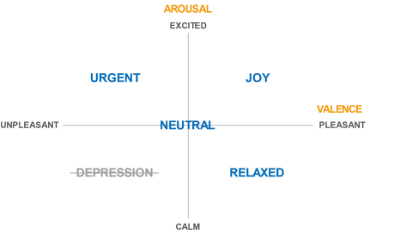
Emotional Voice Assistant Design Our design of five assistants is based on Russell’s two-dimensional emo- tional model (Posner et al., 2005). The model includes the dimensions Excited—Calm and Pleasant —Unpleasant as a basic emotional compo- nent (see Figure 1). We designed assistants to cover the different dimensions of the model. In particular, the emotions and their respective placement were: Joy (Pleasant, Excited), Relaxed (Pleasant, Calm), Urgent (Unpleasant, Excited), Depression (Unpleasant, Calm), Neutral (0, 0). Finally, after discus- sion, Depression (Unpleasant, Calm) was removed, which was generally considered inappropriate.
All emotional voice assistants were designed based on a two-dimensional emotion model. The traits are expressed through choice of words and into- nation, while content and extent of speech output were identical for all
Figure 1: We used Russell’s two-dimensional emotion model to design emotional voice assistants. Each assistant was designed to match the four dimensions and the origin (removing an inappropriate emotion).
Future Automobile Driving Space Voice Interaction 607
emotional voice assistants to ensure comparability. All audio snippets used in the study were recorded by a voice actress.
We provide a brief description of each emotional voice assistant. Joy. This emotion is expressed as a high level of excitement and pleasure. When talking to the assistant, she showed happy emotions, as if she had met something happy.
Relaxed. This emotion shows a high level of pleasure and a low level of excitement. The tone of voice is softer and slower when talking to this voice assistant.
Urgent. This emotion shows a high level of excitement and a low level of pleasure. The assistant speaks faster and with a higher tone of voice. And the speech is more brief and formal.
Neutral. This emotion is expressed as a moderate level of excitement and pleasure. When speaking to the assistant, her tone of voice was unemotional. The assistant simply follows orders and completes tasks.
Car Driving Simulation Study We conducted a driving study (N = 26) in the lab to investigate the emoti- ons of driving assistants by using a mid-fidelity driving simulator. The main question we answer with this experiment is whether the emotional voice assi- stant, based on different driving scenarios and the user’s personality, has an advantage in comparison to a single emotional or personality in-car voice assistant. And whether this can play a positive role in the driving interaction experience.
This study used assistant emotion as a between-subject independent varia- ble. Four emotional assistants (Joy, Relaxed, Urgent, Neutral) were tested in each participant’s experiment. Additionally, we designed five different dri- ving scenario tasks (Passenger assistance, Driving assistance, Navigation, In-car entertainment, Proactive assistance) as independent variables in the experiment for each participant (see Table 1).
As dependent variables we collected user personality traits (Big Five Inven- tory) (Carciofo et al., 2016) and subjective ratings on user experience (UEQ modules Attractiveness and Adaptability and Efficiency)(Laugwitz et al., 2008). Users were asked to experiment with five different driving scenario tasks in turn, with all four emotional voice assistants being tested in each
Table 1. Five driving scenarios and task contents.
Table available in the original PDF paper.
Task Access to amenities Content 1 Passenger Assistance Use the voice assistant to turn on the air conditioning and set it to 25
C. 2 Driving Assistance Use the voice assistant to call Xiao Ming. 3 Navigation Use the voice assistant to navigate to the office. 4 In-car Entertainment Use the voice assistant to play the music of Jay Chou’s “Inari”. 5 Proactive Assistance Follow the voice assistant’s instructions to complete the task of reversing into a parking space.
608 Zhang and Chen
driving scenario task. Accordingly, users were required to perform a total of 20 task experiments (five scenario tasks, four emotional assistants per scena- rio task). At the end of the experiment, participants answered questions on the experienced emotional voice assistants in a semi-structured interview and offered personal insights into the future of in-car voice assistants.
Twenty-six participants aged 20–30 years who took part in the study (11 male, 15 female). All had previous experience of driving a car. None of them had expert knowledge on digital assistants, though most had used one in their everyday life (7 daily, 4 often, 12 rarely, 1 never). Overall, the majo- rity of the participants were familiar with the voice controls as well as the in-car systems.
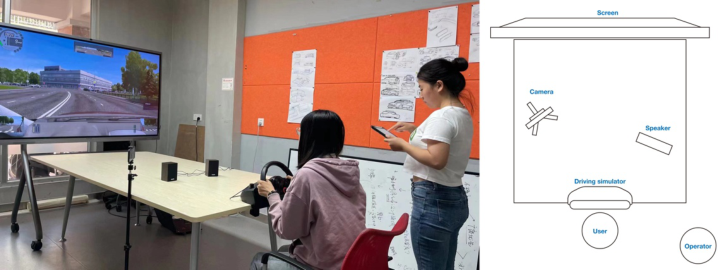
We conducted the experiment as a Wizard of Oz study, with the partici- pants driving a mid-fidelity driving simulator that we had prepared, and the operator sitting in the back. The operator observed the display screen and the driver’s behavior in order to trigger experiment use cases in appropriate situations.
The operator was equipped with a tablet that could run the speaker remo- tely, through which the audio files could be played on speaker on the right front of the user. A display was positioned directly in front of the user to show driving simulation scenes. A camera positioned in front of the user’s left side, directed at the face, was used to record the user’s behavior during the expe- riment. The driving simulator was used to simulate driving scenarios. The driving simulator has a force feedback steering wheel, an accelerator pedal and a brake pedal. Figure 2 shows the driving simulator setup.
The experiment took place in an indoor lab. Driving scenarios are urban roads in a driving simulation game (City Car Driving). The first four dri- ving scenarios (Passenger assistance, Driving assistance, Navigation, In-car entertainment) are free riding in the urban area and the last one (Proactive assistance) is in an urban car park. Firstly the operator will demonstrate the operation of the simulator to ensure that the user knows how to drive using the driving simulator. Before the experiment users were allowed to enter the driving simulation game to familiarize themselves with the vehicle and the roads for 5 minutes. There are pedestrians and other vehicles in the urban
Figure 2: The driving simulator setup. Participants performed the driving simulation in front of a table.
Future Automobile Driving Space Voice Interaction 609
road scene to simulate realistic urban road conditions. Additionally there are virtual traffic lights, buildings, parks and other facilities that simulate rea- listic scenarios, and the user is required to obey the traffic rules within the scenario when driving.
At the lab site, we introduced participants to the concept of intelligent voice assistants and to the procedure. They answered the general questions on demographics and Big Five Inventory questionnaire and signed a declara- tion of consent. After 5 minutes of familiarization with the driving simulation game, the experiment began. Each participant experienced 20 rides: five dri- ving scenario tasks (Passenger assistance, Driving assistance, Navigation, In-car entertainment, Proactive assistance) and four emotional voice assi- stants (Joy, Relaxed, Urgent, Neutral) per driving scenario task. The order of experienced emotional assistants was alternated between participants to prevent sequence effects.
The ride experiences are divided into five groups according to the driving scenario tasks: Passenger assistance, Driving assistance, Navigation, In-car entertainment, as well as Proactive assistance. In each ride experience group, participants had to interact with each of the four emotional assistants to complete the task. After each ride, participants rated the questionnaire on subjective user experience.
RESULTS
We analysed user experience, gender influence, user personality influence and user feedback of the emotional voice assistant.
In terms of external environmental influences, we compared five driving scenario tasks to analyse user preferences and experiences of speech emotions in different driving scenario tasks. From the user aspect, we compared the differences in male and female preferences for speech emotions. Besides this, we also collected user personality traits (Big Five Inventory), which were used to study the differences in their preferences for voice emotions. All values reported in Table 2 were collected on a scale from −3 (low) to +3 (high).
User Experience Participants provided subjective UX evaluations via a questionnaire incor- porating the modules Attractiveness, Adaptability and Efficiency of the UEQ.
The average of the three combined ratings of attractiveness, adaptability and efficiency is what we call user satisfaction. In direct comparison, the Joy emotional assistant is rated the highest in user satisfaction during the pas- senger assistance scenario task (p < 0.05). However, in the scenario of in-car entertainment, Urgent is assessed to have the lowest level of user satisfaction (p < 0.01).
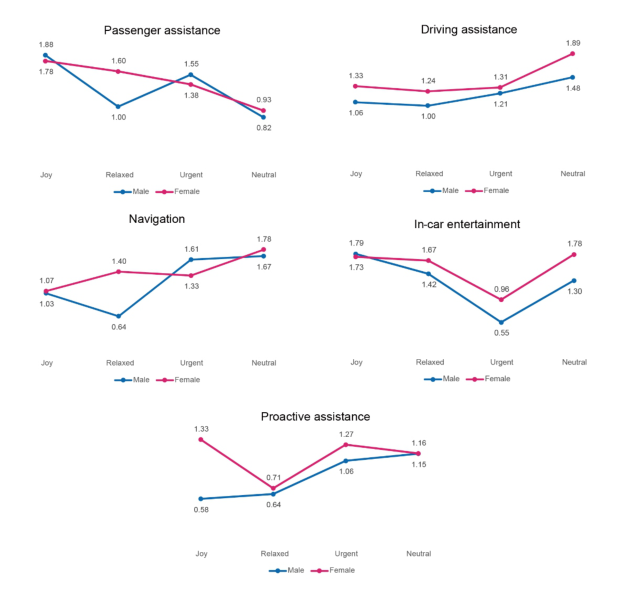
Gender Influence We evaluated the effect of gender on users’ voice preferences in different dri- ving scenario tasks. In this case, gender has an impact on driving style and emotion (Gwyther and Holland, 2012). Figure 3 shows that in the scenario
610 Zhang and Chen
Table 2. User ratings for experienced emotional assistant Joy, Relaxed, Urgent, and Neutral in five driving scenarios.
tasks of Passenger assistance, Navigation and Proactive assistance, gender played a role in users’ preference for voice emotion. All values reported in Figure 3 were collected on a scale of −3 (low) to +3 (high).
In the scenario task of passenger assistance, the satisfaction rating for Rela- xed was higher by female users than by males (Relaxed ranked second very close to first for females while it was very close to lowest for males). In the sce- nario task of Navigation, females rated Relaxed higher than males (Relaxed was rated second by females, but worst by males). For the Proactive Assista- nce scenario task, Joy was rated highest by females but lowest by males in terms of user satisfaction.
In the tasks involving driving assistance and in-car entertainment, the user satisfaction rating tendencies of men and women for emotional voice assistants were relatively consistent.
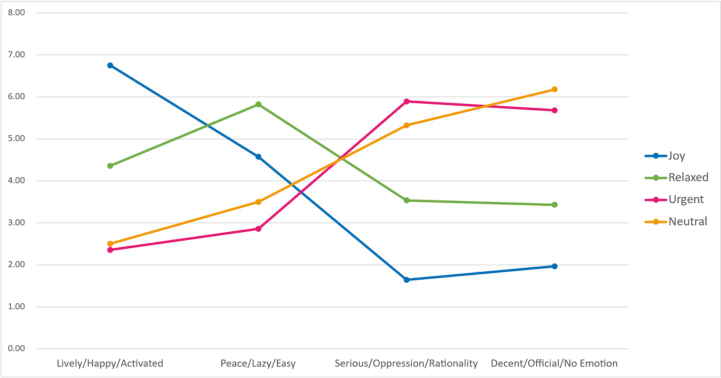
User Personality After all scenario tasks, participants evaluated the experienced emotional voice assistants using a semantic differential scale with 4 dimensions. Figure 4 shows that all the emotional voice assistants were perceived as we designed.
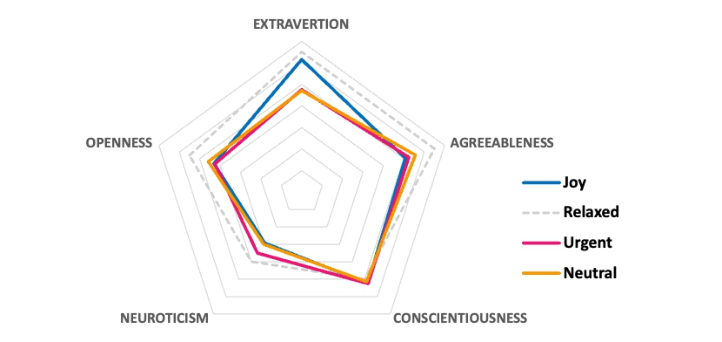
Figure 5 shows the mean personality trait scores of participants, grouped by their preferred emotional voice assistant. We obtained the participants’ preference for the voice assistants based on their user experience scores of the four voice assistants. The results were as follows: of the 26 participants, 13 preferred Joy, 4 preferred Urgent and 7 preferred Neutral, leaving 2 expe- riencers who preferred Relaxed. As such a small sample is considered to have
Future Automobile Driving Space Voice Interaction 611
Figure 3: Male and female ratings of voice assistants in five driving tasks.Figure 4: The semantic differences of perceived assistant emotion scale, which shows that participants’ perceptions were consistent with our design.
a large error, we have omitted the results for this emotion in the comparison that follows.
612 Zhang and Chen
Figure 5: Mean big five scores for participants, split by their preferred emotional voice. Users who chose the joy were significantly more extraverted than all other groups.
In pairwise comparisons, participants who preferred Joy scored signifi- cantly higher in extraversion than all other groups (p < 0.05). The results show that more extroverted people may prefer lively, happy and activa- ted assistants. In terms of agreeableness, conscientiousness, neuroticism and openness, there were no significant differences between the participants who preferred different voice assistants.
CONCLUSION
This paper explored the impact of different emotional voice assistants on user satisfaction (attractiveness, adaptability, efficiency) in five driving sce- narios and tasks. The results show that adapting the right emotional voice to different driving situations and user personalities has a positive impact on increasing user satisfaction. Our research has found that it is necessary to adapt voice emotion based on context-aware, e.g., voice should be serious and brief in situations related to driving performance and driving safety, while in situations not related to driving performance (e. g. in-car entertainment) the voice assistant can be more lively and chatty. And the diversity of users also leads to differences in voice preferences, with gender and extraversion having a significant impact on voice preference.
Follow-up work should study more emotional speech samples and driving scenarios to obtain a model for matching emotional speech to driving con- texts. And work needs to be attempted in different linguistic and cultural contexts in order to generalize the findings to users with different cultural backgrounds.
REFERENCES
Braun, M., Mainz, A., Chadowitz, R., Pfleging, B., Alt, F., 2019. At Your Service: Designing Voice Assistant Personalities to Improve Automotive User Interfaces, in: Proceedings of the 2019 CHI Conference on Human Factors in Computing
Future Automobile Driving Space Voice Interaction 613
Systems. Presented at the CHI ‘19: CHI Conference on Human Factors in Com- puting Systems, ACM, Glasgow Scotland Uk, pp. 1–11. https://doi.org/10.1145/ 3290605.3300270 Carciofo R., Yang J., Song N., Du F., Zhang K., 2016. Psychometric Evaluation of Chinese-Language 44-Item and 10-Item Big Five Personality Inventories, Inclu- ding Correlations with Chronotype, Mindfulness and Mind Wandering. PLOS ONE 11, e0149963. https://doi.org/10.1371/journal.pone.0149963 Gwyther, H., Holland, C., 2012. The effect of age, gender and attitudes on self-
regulation in driving. Accident Analysis & Prevention 45, 19–28. https://doi.org/ 10.1016/j.aap.2011.11.022 Jonsson, M., Dahlbäck, N., 2009. Impact of voice variation in speech-based in-vehicle systems on attitude and driving behaviour, in: Human Factors and Ergonomics Society Europe Chapter (HFES). Laugwitz, B., Held, T., Schrepp, M., 2008. Construction and Evaluation of a
User Experience Questionnaire, in: Holzinger, A. (Ed.), HCI and Usability for Education and Work. Springer Berlin Heidelberg, Berlin, Heidelberg, pp. 63–76. Posner, J., Russell, J. A., Peterson, B. S., 2005. The circumplex model of affect: An integrative approach to affective neuroscience, cognitive development, and psych- opathology. Development and psychopathology 17, 715–734. https://doi.org/10. 1017/S0954579405050340 Strohmann, T., Siemon, D., Robra-Bissantz, S., 2019. Designing virtual in-vehicle
assistants: Design guidelines for creating a convincing user experience. AIS Tran- sactions on Human-Computer Interaction 11, 54–78. https://doi.org/10.17705/1t hci.00113
LISTED IN THE AHFE DIGITAL BOOKSTORE CATALOGUE
Explore the complete digital volume
Ergonomics In Design
Read this individual research paper free through the original publisher, or explore the full digital proceedings book.
ISBN 978-1-958651-53-7
Explore this ISBN in the AHFE Bookstore ↗Listed in the July 2026 bookstore catalogue; search by ISBN to confirm current availability · Digital book purchase optional