Ruolei Yu, Weiwei Yu, Luying Xu, Yasheng Chen, Donglai Lu, Benali Abderraouf, Jin Zhi (2023). Achieving personalized wrist training: apply human factors in the control strategy of rehabilitation robot. In: Ergonomics In Design. AHFE Open Access, vol. 77, pp. 544–554. https://doi.org/10.54941/ahfe1003414
The wrist is severe based on wear and tear caused by stroke and the rehabilitation process is very complex, nearly 1/3 of stroke patients still have serious upper limb dysfunction after half a year of rehabilitation treatment. The wrist rehabilitation process is very complex, and normally be divided according to the human recovery stage into multiple levels, and each stage requires different rehabilitation treatment methods. For example, according to the well-used Brunnstrom motor assessment method, the motor function of patients is divided into six stages from I to VI, and the rehabilitation process of patients can be roughly divided into early, middle and late terms.Although rehabilitation robot plays more and more important role in the wrist rehabilitation training, most of the existing research focus only on mechanical, electronic or controller design, and ergonomics is rarely discussed, resulting in the lack of consideration of human factors in wrist rehabilitation robot. Moreover, the robot control strategy associated rehabilitation theory is seldom studied, which hardly realize personalized training with different stage. Aiming at the problems involved in the above three rehabilitation stages, there are corresponding comprehensive rehabilitation strategies, namely passive rehabilitation training, assisted rehabilitation training and resistance rehabilitation training. Thus, this paper focus on the control strategies design of wrist rehabilitation robot that meets the requirements of human factors according to the different rehabilitation mechanisms and needs of patients at each stage. To define our research methodologies, we first constructed the methodological framework diagram and applied ergonomics to the control strategy of wrist rehabilitation robot. Apart from that, passive, assisted and resistant rehabilitation training modes are set for individuals in different stages of rehabilitation to realize personalized rehabilitation training. In addition, we evaluated the device satisfaction with the subjective evaluation scale. More specifically, the subjective scale was designed based on the Likert scale, and was set up in the order in which the interaction occurred. After the scale was made, we used SPSS to analyze the reliability and validity of the scale. Subsequently, a questionnaire was administered on the non-probability sample. The statistical analysis of the data by one-way ANOVA found that the device was quite comfortable. In conclusion, our NPU-Wrist operates on human factors throughout the design process and provides a valuable approach for subsequent rehabilitation robots.
Stroke patients’ quality of life is significantly reduced by carpal impairment or hemidisability and the rehabilitation process is very complex, nearly 1/3 of stroke patients still have serious upper limb dysfunction after half a year of rehabilitation treatment (Cakar E, 2016). The rehabilitation process based on individual patient normally be divided according to the recovery stage into multiple levels, and each stage requires different rehabilitation treatment methods. For example, according to the well-used Brunnstrom motor asses- sment method (Basteris A, 2014), the motor function is divided into six stages from I to VI, and the rehabilitation process of patients can be roughly divided into early, middle and late terms.
As the most frequently used joint of human upper limb, wrist can achi- eve fine and dexterous movements. If its motor function is damaged, it will seriously affect people’s daily life. Rehabilitation training for stroke patients by wrist rehabilitation robot is of great significance for patients to reco- ver their ability of daily life and improve their quality of life. Based on the
Achieving Personalized Wrist Training: Apply Human Factors 545
comprehensive analysis of all kinds of wrist rehabilitation robots, conside- ring the individual adaptability of different patients, the matching of wrist motion law and the patients capabilities in different rehabilitation stages, the existing rehabilitation robots still have limitations and are difficult to meet the patients’ individual rehabilitation needs. Therefore, this paper introduces human factors in the design of control strategy of wrist rehabilitation robot, aiming at satisfying patients’ requirement of different rehabilitation stages, realizing personalized rehabilitation.
RELATED WORK
A recent area of study combining rehabilitation theory with the rehabi- litation robot control system design is a popular research direction. An upper limb exoskeleton neurorehabilitation robot called IntelliArm (Ren Y, 2012), specifically, for passive mode, is position-controlled by receiving the desired velocity generated from the intelligent stretching strategy (ISS). One research proposed a wrist rehabilitation robot with a novel actua- tion mechanism using an electromagnetic clutch, brake, and motor as well as a safe-related mechanism (Bae, 2019). Additionally, passive rehabilita- tion mode is a mode in which a robot moves without users’ strength. It is measured that the excessive muscle signal is generated through the EMG sensor and is automatically released by the electromagnetic clutch control (free-running).
An impedance control scheme has been implemented for the IIT Genova wrist rehabilitation robot (V. Squeri, 2014), which is used in the assisted training mode. The haptic interaction between the robot and the patients is implemented by a combination of different torques. An assistive torque component helping the subject to carry out the tracking task. ParReEx-wrist abilities for the treatment of patients with upper limb disabilities (Gherman, 2021). The authors target an enhanced control system that is able to ach- ieve an active and assistive control modality. A trajectory tracking control paradigm has been utilized for it in assisted training mode. A cable-driven 3-DOF (degree of freedom) wrist rehabilitation robot was developed to enh- ance human-robot interaction capabilities (Shi, 2020). Through the assisted training strategy, the patient is subjected to force-feedback and the robot used the impedance control paradigm measures the human-induced joint torque by using force sensors.
CR2-Haptic is a one-DOF rehabilitation robot based on the concept of modularity and reconfigurability has been developed at UTM (K. X. Khor, 2017). More specifically, in resistive mode, the controller generated the resistive force based on the end effector’s current position. One research proposed a simple design of a two-DOF balanced and compliant wrist reha- bilitation robotic device with serial kinematic configuration (Yellewa, 2022). It integrates impedance control and hybrid position and force control in resi- stive mode. A novel mechanical proposed in one research has been put out to accomplish a 5-DoF elbow-wrist exoskeleton (Wu, 2019). Additionally, the robot used impedance control in resistance mode, a control method that simultaneously controls force and position.
Human factors and rehabilitation engineering must be connected in the construction of a rehabilitation robot (Hussain, 2021; Zhang, 2020), and a crucial component of that connection is the evaluation of agreeableness. PLUTO - a single DOF robot (Nehrujee, 2020) used System Usability Scale (SUS) and User Experience Questionnaire (UEQ) to evaluate the system and the usability. A comparison between items of the SUS and UEQ questionnai- res across groups was carried out through a two-way ANOVA.
However, the robot control strategy associated rehabilitation theory is sel- dom studied, which hardly realize personalized training with different stage. Aiming at the problems involved in above rehabilitation stages, there are cor- responding comprehensive rehabilitation strategies, namely passive, assisted and resistance rehabilitation training. Thus, this paper focus on the control strategies design of wrist rehabilitation robot that meets the requirements of human factors according to the different rehabilitation mechanisms and needs of patients at each stage.
METHODS
The rehabilitation strategy of the robot can be broadly categorized into pas- sive, assisted, and resistance rehabilitation training depending on the various stages of recovery. More specifically, (1) Patients in the first to second reco- very stages should use the passive rehabilitation training mode. (2) Patients in the third to fourth recovery stages should use the assisted rehabilitation training mode. (3) Patients in the fifth to sixth recovery stages should use the resistance rehabilitation training mode. Patients who are at various pha- ses of rehabilitation need to exercise using various rehabilitation strategies. Additionally, passive wrist joint rehabilitation exercises for stroke patients in stages I ∼II can enhance wrist blood flow, minimize joint degradation, and lessen wrist muscle spasm symptoms. The supported rehabilitation training of the wrist joint for stroke patients in stages III ∼IV can encourage patients’ capacity to move on their own, improve their muscular strength, and restore nerve connections. Resistance rehabilitation training is necessary for stroke patients in stages V ∼VI since they still have inadequate muscle strength, endurance, and coordination compared to normal levels.
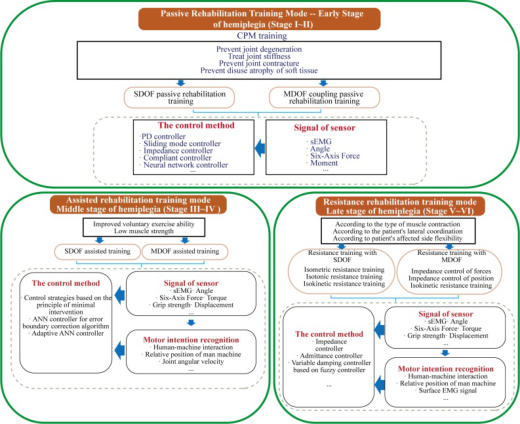
The human factors of patients at various rehabilitation stages (defined by Brunnstrom motor assessment method) are introduced into three training modes (illustrated in Figure 1).
Control Strategy Design of Different Training Mode Hemiplegia Early-Term (Stage I to II) Patients in the early stages of hemiplegia (stage I ∼II) often have delayed paralysis of the affected limb without any voluntary movement ability. The- refore, CPM training for patients in the early stages of hemiplegia can prevent joint degeneration and treat joint stiffness, prevent joint contracture and soft tissue disuse atrophy. The passive rehabilitation training mode of wrist joint rehabilitation robot mainly includes two forms, that is, passive rehabilita- tion training with SDOF (single degree of freedom) and passive rehabilitation training with MDOF (multiple degree of freedom) coupling.
Achieving Personalized Wrist Training: Apply Human Factors 547
Figure 1: Training modes and related control methods for wrist rehabilitation robot.
In order to realize the passive rehabilitation training mode, it is very impor- tant to select the appropriate sensor to transmit the correct sensor signal. The sensors such as torque sensors, six-dimensional force sensors, angle encoders and sEMG signal collectors are mainly used to collect real-time human-computer interaction data. However, in the choice of control method, because of the realization of passive rehabilitation training mode of rehabi- litation robot, it is often necessary to control the position of rehabilitation robot, so as to drive the patients to move according to the predetermined trajectory. In the position control of rehabilitation robots, PD controller are frequently used to achieve passive rehabilitation training mode. In order to improve the preset trajectory tracking accuracy, adaptive PD controller, sli- ding mode controller and other control methods can be widely used. The flexibility of passive rehabilitation training has also attracted attention. For example, impedance controller or compliance controller is introduced, which reduces the accuracy of position control, but improves the comfort and safety of passive rehabilitation training. In order to enhance the participation and initiative of patients, the rehabilitation trajectory judgment method based on sEMG signal can be introduced into the control system, that is, the sEMG signal is used to predict the human intention trajectory, and then the position control is used to realize passive rehabilitation training.
Hemiplegia Medium-Term (III ∼IV) In patients with hemiplegia medium-term (stage III ∼IV), after a series of early rehabilitation treatment, motor nerve system function gradually began to recover and has a certain capacity for independent movement, but the limb muscle strength is still weak, only can finish the small range of motion, is difficult to independently conduct a complete body movement. Therefore, for these patients, assisted rehabilitation training is essential.
In order to realize the assisted rehabilitation training mode, it is not only necessary to select the appropriate sensor to transmit the correct sensor signal, but also to recognize the motion intention of the human wrist joint. The tor- que sensor, force sensor and angular velocity sensor are adopted to collect the real-time interactive data. The sEMG is used to predict the intention of muscle contraction and contraction, nerve and muscle function. As for the selection of control methods, assist-as-needed control strategies have attra- cted more and more attention. For example, the ANN controller using Error Bound Modification Algorithm can make patients with strong autonomous movement ability move ahead of the preset trajectory, and the adaptive ANN controller can provide the required auxiliary force according to the recovery degree of different patients. Similar to the ANN control strategy, there is also a control strategy based on the minimal intervention principle to achieve the assisted training mode that does not interfere with patients’ voluntary move- ments as much as possible. The wrist rehabilitation robot mainly judges the current movement intention through the human-machine interaction force or the relative position of the human-machine, so as to provide the minimum auxiliary force to the patient. This control strategy can improve the patient’s participation in rehabilitation training and stimulate the patient to carry out voluntary movement.
Hemiplegia Last-Term (V ∼VI) In patients with hemiplegia last-term (stage V ∼VI), after the prophase and metaphase stages rehabilitation training, the ability of patients’ movement larger degree of recovery, and can carry on some simple voluntary move- ment. The resistance training, according to the type of muscle contraction can be divided into the isometric resistance training and constant resistance training. In addition, according to the coordination and flexibility of the pati- ent’s affected side, it is necessary to carry out resistance training coupled with degrees of freedom.
Resistance rehabilitation training is helpful to improve the muscle strength and the motor coordination ability of the affected limb. To make the wrist rehabilitation robot realize resistance training is an effective way to help pati- ents recover their motor function to close to the normal level. We select torque sensor, sEMG sensor, angular velocity sensor and six-dimension force sensor to collect real-time human-computer interaction data. In the implementation of resistance rehabilitation training mode, impedance control is a commonly used compliance control strategy. By adjusting or omitting the parameters of impedance controller (inertia coefficient, damping coefficient and stiffness coefficient), resistance rehabilitation training with different control effects and different degrees of difficulty can be achieved. Moreover, according to the rehabilitation mechanism of isokinetic motion, the variable damping con- troller based on fuzzy controller is an effective method to realize the isokinetic resistance training mode.
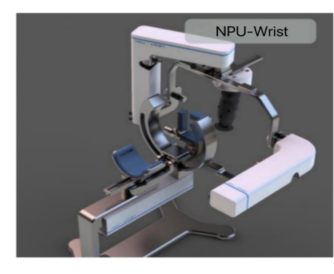
Methods Application on NPU-Wrist Rehabilitation Robot We developed a wrist rehabilitation robot named NPU-Wrist, shown in Figure 2. The entire frame structure of the robot is made of an aluminum
Achieving Personalized Wrist Training: Apply Human Factors 549
Figure 2: The structure of NPU-Wrist rehabilitation robot.
alloy material in order to make it reliable enough and to meet expectations for a light mechanical construction. The joint parts of the robot are made of stainless steel material, so that it has good fatigue resistance and high processing accuracy. In addition, the motion range of robot joints and the designed adjustable mechanism comply with human body dynamic and sta- tic measurement, and the overall mechanism does not appear dislocation and interference.
Based on the motion analysis of the human wrist, the NPU-Wrist rehabili- tation robot has three active DOFs to perform flexion and extension, ulnar and radial deviation and pronation and supination. The three active DOFs can move independently as well as perform multi-degree coupling motion in order to satisfy the patients’ needs for motor function. Besides, NPU-Wrist rehabilitation robot fitted with a range of sensors, such as angular velocity sensor, six-dimension force sensor to track the user’s health throughout reh- abilitation training, record the user’s physiological data, and acheive various rehabilitation control strategies.
Apply Control Strategy in the NPU-Wrist Robot
1. The control method of passive rehabilitation training mode
Aiming at the passive rehabilitation training mode of wrist joint, firstly, the kinematics model of NPU-Wrist robot is established. Combined with the motion characteristics of human wrist joint, the space trajectory planning method is established based on the “dart thrower motion” law of wrist joint, and the trajectory tracking control is realized. The trajectory of the robot inte- grates the functional movement characteristics of wrist joint, which meets the requirements of passive rehabilitation and improves the comfort of patients. The Figure 3 is a control block diagram for one of the degrees of freedom. Where θ d (k) represents the expected trajectory of the kth sampling point, θ a (k) signifies the actual joint angle, θ d (k) and θ a (k) are compared to get e(k), and τ (k) indicates the output joint torque.
2. The control method of assisted rehabilitation training mode
Aiming at the wrist assisted rehabilitation training mode, a resistance con- trol strategy based on motion intention recognition is established. Firstly,
Figure 3: The block diagram use the outer-loop PID controller position control.
Figure available in the original PDF paper.
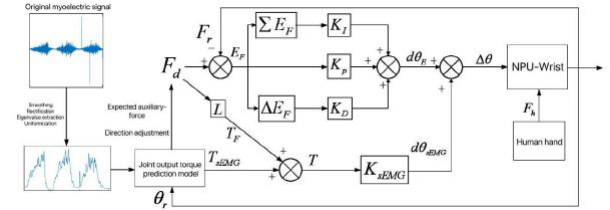
the surface electromyography (sEMG) signal is selected as the basis of wrist motion intention prediction. By using the sEMG signal, human-machine con- tact force and joint angle, the wrist output torque prediction algorithm based on neural network is established. The predicted torque is transformed into position compensation and introduced into the control loop. This control strategy improves the problem of power lag response in traditional control method.
The corresponding control block diagram used in NPU-Wrist was shown in Figure 4, in which EF represents the difference between expected auxili- ary force Fd and the actual man-machine contact force Fr. KP,KI and KD represents the proportional, integral and differential gain of the PID control- ler respectively, while dθ E denotes the robot joint corner increment obtained by the PID controller. The robot joint actual angle θ r is input into establi- shed joint torque prediction model based on sEMG signal, which calculates the prepredicted wrist output torque TsEMG. T indicates the sum of TsEMG and expected auxiliary torque TF,which is calculated by hand length L and expect auxiliary force Fd. KsEMG indicates the proportional coefficient rela- ted to the human inertia and the sampling time, while dθsEMG denotes the feedforward increment of position control. 1θ is the expected rehabilitation robot joint corner increment, which is generated by the sum of joint corner increment dθE obtained by the PID controller and dθsEMG predicted by sEMG.
3. The control method of resistance rehabilitation training mode
According to the resistance rehabilitation training mode of wrist joint, the control methods of isotonic, isometric and isokinetic rehabilitation training are established respectively. The isometric strength resistance training of wrist joint is realized by using the position control of single joint under different angles. Secondly, the isotonic muscular force resistance training is reali- zed by using the force control method. The isokinetic resistance training of
Figure 4: The control block diagram of the assisted rehabilitation training mode.
Achieving Personalized Wrist Training: Apply Human Factors 551
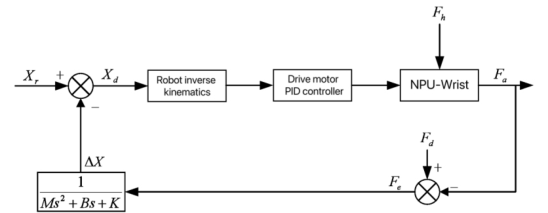
Figure 5: The block diagram of the position-based resistance control.
wrist joint is realized based on the torque angle coupling relationship model. Through the design and implementation of the controller under different reh- abilitation training methods, the personalized rehabilitation requirements of different patients are met. Moreover, to realize the multi DOFs coupling wrist resistance training, a position-based resistance control method is applied on the NPU-Wrist robot (shown in Figure 5).
In Figure 5, Fa indicates the measured man-robot contact force after human put force Fh on robot. Fe is the force error between the expected contact force Fd and actual contact force Fa, which is the input of out-loop impedance controller to obtain the update position increment 1X. For the impedance controller, M, B, K represents the inertia matrix, the damping matrix, and the stiffness matrix, respectively. The final end-effector desired position Xd is calculated by initial expected position Xr and update position increment 1X.
RESULT
Evaluation Scale Design The subjective evaluation scale based on a five-point Likert scale was desi- gned for the system ergonomics assessment of our NPU-Wrist rehabilitation robot, which is focus on the control system performance. The five levels of questionnaire options are: “very dissatisfied”, “relatively dissatisfied”, “average”, “relatively satisfied “and “very satisfied”. The scale consists of 8 questions, and the order of these questions is oriented to the sequence of the interaction. The overall sample size for this study was 9 participants, with 3 participants in each group. The groups were divided according to the rehabilitation process of the patients mentioned above.
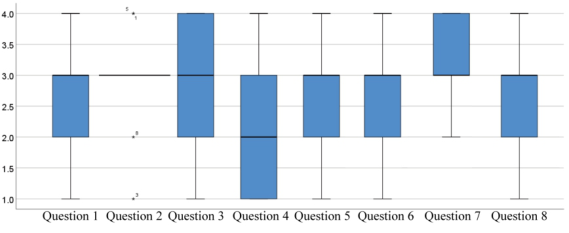
Statistical Analysis The boxplot in Figure 6 shows the median of the collected data, which repre- sents the average level of the sample data. The width of the box reflects the fluctuation of the data. It can be noticed that the box is not present in que- stion 2. The reason is that there are too many identical numbers in the data and the overall average is close to the same number. The evaluation results between the three groups were compared using one-way ANOVA. Before conducting ANOVA, all data in this study were tested for normality and
Figure 6: Boxplot for all data.
homogeneity of variance. More precisely, the former used the Shapiro-Wilk test, and the latter used Levene’s test. The above operations were based on the software SPSS.
In S-W test, if the result shows P > 0.05, the data will be normal. On the contrary, it indicates that the data is not normal. In this test, P is 0.102, 0.068, 0.172, 0.122, 0.132, 0.248, 0.055, and 0.132 respectively, which are all greater than 0.05. It can be seen that the data obeyed normal distribution. Then, the homogeneity of variance test was performed. This test is based on the median because the data obtained by testing based on the median is relatively more stable. If P < 0.05, the level of significance is considered to be reached in Levene’s test, which is uneven variance. In the test, P is 0.579, 0.492, 0.702, 0.746, 0.850, 0.824, 0.729, and 0.850, which are all greater than 0.05. So, the variance is homogeneous. Finally, one-way ANOVA is performed. The significance among all groups is grea- ter than 0.05 (see Table 1), so it can be concluded that the system usability assessment is not significantly affected by the groups.
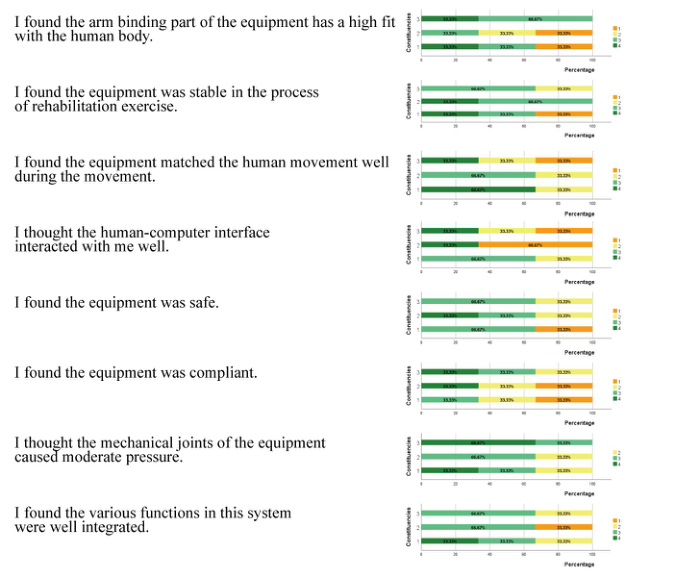
The Results of the Ergonomics Assessment A total of 9 stroke patients were recruited, 4 males and 5 females. For their recovery process, three patients were in the early term (stage I∼II), three pati- ents were in the middle term (stage II∼V), and three were in the late term (stage V∼VI). The distribution of responses from patients in the three terms is shown in Figure 7, where scores from 0 to 4 are indicated by different colors, with red presents 0 and green corresponding to 4, deeper green indi- cates a higher positive evaluation of the problem (ARAVIND NEHRUJEE, 2021). It can be seen that everyone involved in the experiment was relatively satisfied with the NPU-Wrist robot’s performance.
Achieving Personalized Wrist Training: Apply Human Factors 553
Figure 7: The distribution of attitudes towards the same question among the three groups.
CONCLUSION
This paper constructed the methodological framework diagram and applied ergonomics to the control strategy of wrist rehabilitation robot. Apart from that, passive, assisted and resistant rehabilitation training modes are set for individuals in different stages of rehabilitation to realize personalized rehabilitation training. Different patient rehabilitation stage features were introduced into the control strategy installation. Additionally, we applied our design concept in the control strategy of NPU-Wrist rehabilitation robot. Finally, to evaluate the robot’s ergonomics design, the subjective scale was designed based on the Likert scale. Statistical analysis of the data by one- way ANOVA found that the device was quite comfortable. Our developed NPU-Wrist involves human factors throughout the control strategy design process provides a valuable approach for subsequent rehabilitation robots. In subsequent studies, we will gather more samples in order to do ergonomics evaluation more thoroughly and objectively.
ACKNOWLEDGMENT
This research is supported by “111 Project” (Grant No.13044) and Key Research and Development of Shaanxi Province (Grant No.2020SF-152).
REFERENCES
Bae, Ju-hwan, Seok-jin Hwang, and Inhyuk Moon. “Evaluation and verification of a novel wrist rehabilitation robot employing safety-related mechanism.” 2019 IEEE 16th International Conference on Rehabilitation Robotics (ICORR). IEEE, 2019. Basteris A, Nijenhuis S M, Stienen A H A, et al. Training modalities in robot-mediated
upper limb rehabilitation in stroke: a framework for classification based on a systematic review[J]. Journal of neuroengineering and rehabilitation, 2014, 11: 1–15. Cakar E, Akyuz G, Durmus O, et al. The relationships of motor-evoked potentials to hand dexterity, motor function, and spasticity in chronic stroke patients: a tran- scranial magnetic stimulation study[J]. Acta Neurologica Belgica, 2016, 116(4): 481–487. Gherman, Bogdan, et al. “Inverse dynamic modeling of a parallel wrist rehabilitation
robot towards an assistive control modality.” 2021 25th International Conference on System Theory, Control and Computing (ICSTCC). IEEE, 2021. Hussain, Shahid, Prashant K. Jamwal, and Paulette Van Vliet. “Design synthesis and optimization of a 4-SPS intrinsically compliant parallel wrist rehabilitation robotic orthosis.” Journal of Computational Design and Engineering 8.6 (2021): 1562–1575. Nehrujee, Aravind et al. “Plug-and-Train Robot (PLUTO) for Hand Rehabilitation:
Design and Preliminary Evaluation.” IEEE Access 9 (2020): 134957–134971. Ren Y, Kang S H, Park H S, et al. Developing a multi-joint upper limb exoskeleton robot for diagnosis, therapy, and outcome evaluation in neurorehabilitation[J]. IEEE Transactions on Neural Systems and Rehabilitation Engineering, 2012, 21(3): 490–499. Shi, Ke, et al. “Cable-Driven 3-DOF Wrist Rehabilitation Robot with optimized
Human-Robot Interaction Performance.” 2020 8th IEEE RAS/EMBS Internati- onal Conference for Biomedical Robotics and Biomechatronics (BioRob). IEEE, 2020. V. Squeri, L. Masia, P. Giannoni, G. Sandini, and P. Morasso, “Wrist rehabilitation in chronic stroke patients by means of adaptive, progressive robot-aided therapy,” IEEE Transactions on Neural Systems and Rehabilitation Engineering, vol. 22, no. 2, pp. 312–325, 2014. Wu, Kuan-Yi, et al. “A 5-degrees-of-freedom lightweight elbow-wrist exoskeleton
for forearm fine-motion rehabilitation.” IEEE/ASME Transactions on Mechatro- nics 24.6 (2019): 2684–2695. X. Khor et al., “Portable and Reconfigurable Wrist Robot Improves Hand Function for Post-Stroke Subjects,” in IEEE Transactions on Neural Systems and Rehabili- tation Engineering, vol. 25, no. 10, pp. 1864-1873, Oct. 2017. Yellewa, Mwayi E., et al. “Design and hybrid impedance control of a compliant and
balanced wrist rehabilitation device.” IECON 2022–48th Annual Conference of the IEEE Industrial Electronics Society. IEEE, 2022. Zhang, Leiyu, et al. “Design and performance analysis of a parallel wrist rehabilitation robot (PWRR).” Robotics and Autonomous Systems 125 (2020): 103390.
LISTED IN THE AHFE DIGITAL BOOKSTORE CATALOGUE
Explore the complete digital volume
Ergonomics In Design
Read this individual research paper free through the original publisher, or explore the full digital proceedings book.
ISBN 978-1-958651-53-7
Explore this ISBN in the AHFE Bookstore ↗Listed in the July 2026 bookstore catalogue; search by ISBN to confirm current availability · Digital book purchase optional