Yasheng Chen, Weiwei Yu, Jin Zhi, Benali Abderraouf, Runxiao Wang (2023). Integrating Human Factors in the Systematic Mechanical Design of NPU-Wrist Rehabilitation Robot. In: Ergonomics In Design. AHFE Open Access, vol. 77, pp. 50–61. https://doi.org/10.54941/ahfe1003362
The wrist connecting the human hand and the forearm includes multiple joints and interlaced ligaments. In addition, the dimensions of the hand, wrist, and forearm vary from individual to individual, that lead to great challenges to design a wrist rehabilitation robot. However, most research on the mechanical design of wrist rehabilitation robot is on the perspectives of actuators configuration, structure lightweight design, or sensors layout optimization, there are rarely research focus on the systematic study of human factors in the mechanical design, especially how to apply human body structural dimensions, functional dimensions, features of motor functions in the design process. In this paper, we focus on the mechanical structure design of NPU-Wrist rehabilitation robot based on human factors to ensure the harmony between the machine and the human body. Based on the analysis of the dynamic/static dimensions of the human body, the anatomy of the wrist, the kinematics of the wrist, and the human-robot contact surface, the mechanical design of the robot is decomposed into several sub-functional modules and each module is specific designed combining the traditional robot design method and the human factors. Finally, a questionnaire was administered on a group of users with different body static and dynamic dimensions. The statistical analysis is conducted and the results show that our NPU-Wrist rehabilitation robot has excellent adaptability to different individuals, safety and comfort
With the development of social economy and medical technology, and the extension of human average life expectancy, population aging has become an important issue in the 21st century (United Nations, 2022). Due to the deterioration of the functions of the elderly, the probability of the elderly suf- fering from chronic diseases is greatly increased, and the majority of these chronic diseases are strokes. After a stroke, patients may experience a vari- ety of neurological deficits, among which hemiplegia is the most common. Hemiplegia is a manifestation of central nervous system damage that leads to motor dysfunction in some limbs of the patient. It becomes difficult for the patient to move independently and lead a normal life. Therefore, timely,
Integrating Human Factors in the Systematic Mechanical Design 51
effective and economical rehabilitation treatment for patients after a stroke is of great significance to individuals, families and society.
Robot-assisted therapy, as a rehabilitation method based on robot techno- logy, can effectively solve the problems in traditional rehabilitation methods. By using robot technology, rehabilitation physicians can be freed from labor- intensive work, and one rehabilitation physician can train multiple patients, reducing personnel costs (Maciejasz, 2014). Additionally, the upper limbs of the human body perform more complex movements than the lower limbs, and the recovery period after a stroke is longer, making rehabilitation trai- ning for upper limb movements particularly important. The wrist not only includes a variety of bones and muscles, but also includes multiple joints and interlaced ligaments. Moreover, the dimensions of the hand, wrist, and fore- arm vary from individual to individual, leading to significant challenges in designing a wrist rehabilitation robot.
RELATED WORK
There are many research studies in the field of wrist rehabilitation robots design. Some researchers adopt various flexible mechanical structures to make the wrist rehabilitation robot as lightweight as possible. The WG2 robot omits the degree of freedom of wrist joint ulnar-radial deviation, the- reby reducing the complexity of the mechanical structure to reduce the weight of the entire rehabilitation robot and improve the compactness of the mecha- nical structure (Saadatzi, 2015). Another wrist rehabilitation robot, referred to as MOCH, offers portability and a low-cost, simple manufacturing process by placing both actuators at the base, simplifing the design and removing the complexity of feeding power to actuators on a rotating arm (Molaei, 2022).
Furthermore, some researchers aim to use a single motor to drive a multi-degree-of-freedom rehabilitation robot, combined with ingenious reh- abilitation training methods. In (Bouteraa, 2022) a flexible mechanical transformation is designed to perform the two main degrees of freedom (DOF), radial-ulnar deviation and flexion-extension derivation of the wrist joint, with a single motor. CR2-Haptic is a one-DOF rehabilitation robot based on the concept of modularity and reconfigurability (Khor, 2017). By changing the robot orientation and the modular, different movements can be trained. A single DOF wrist rehabilitation robot (WReD) for providing flexion-extension motion is developed, which is portable to use in hospital or home environment due to its reconfigurable structure design (Xu, 2019).
Additionally, some researchers have focused on optimizing the weight distribution of wrist rehabilitation devices to reduce inertia and required torques. A design of two-degrees of freedom compliant and balanced wrist rehabilitation device is proposed, which can provide the radial-ulnar devia- tion and flexion-extension rehabilitation motions (Yellewa, 2022). A custom- designed series elastic unit is proposed to be coupled to the servomotor to achieve the compliance. The WRES wrist exoskeleton is characterized by a spherical serial kinematics, based on tendon transmissions, and adopting a capstan-based tendon driven differential transmission (Buongiorno, 2018).
Additionally, in (Liu, 2019) the Omega.7 end-effector robot can be used for wrist joint rehabilitation. The Omega.7 is powered by servo motors and provides three DOFs to the wrist joint. However, as a commercial pro- duct, Omega.7 does not return feedback signal for interactive adjustment. In (Mayetin, 2022) a low-cost three-degree-of-freedom practical force sensor unit is manufactured for the robot. Some researchers also use new actuation methods to design wrist rehabilitation robots, which make human-computer interaction more secure (Marconi, 2019; Wang, 2019). Although it has not yet met the strength requirements, it has great significance for the future design of wrist rehabilitation robots.
Upon analyzing the current wrist joint rehabilitation robots, it can be found that many robots have unique characteristics, but still exhibit some shortcomings. While most research on the mechanical design of wrist rehabi- litation robot focuses on the configuration, lightweight structure design, and optimization of sensor layout. It is essential to incorporate human factors into human-computer interaction when designing a medical device that directly interacts with human body (Hussain, 2021). This includes considering human body structural dimensions, functional dimensions, and motor functions features during the design process of the wrist joint rehabilitation robot.
METHOD
Before designing the mechanical structure of the wrist rehabilitation robot, it is necessary to fully consider the human factors of different individuals, by analyzing the anatomy of the wrist joint, the kinematics of the wrist joint, and the interaction between the human and the handle.
Wrist Anatomy Analysis The anatomy of the wrist joint is generally the same across individuals, but the sizes of the hand, wrist, and forearm vary from individual to individual. When designing the mechanical structure of the wrist joint rehabilitation robot, it is necessary to ensure the harmony and unity of the machine and the human body. Therefore, according to the design concept in human factors engineering, the type of “double-limit design” is selected. The data comes from the anthropometric measurements of the human hand and forearm in the national standard “Human Dimensions of Chinese Adults”(Standardiza- tion Administration of China, 1988) Finally, the size adjustment range with the percentile of P5∼P95 is selected, and the resulting human body size range is shown in Table 1.
Table 1. Size range of different parts of the human body.
Table available in the original PDF paper.
Body parts Size range Forearm length(mm) 192-257 Hand length(mm) 158-196 Forearm diameter(mm) 57-118
Integrating Human Factors in the Systematic Mechanical Design 53
Wrist Motion Analysis Due to the complex skeletal structure of the wrist joint, including many joints and many ligaments attached to it, the wrist joint has high flexibility. So, the human hand can produce flexion-extension and radial-ulnar deviation.
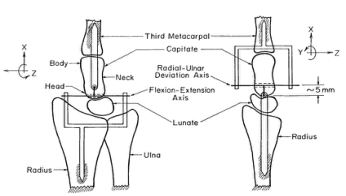
It should be emphasized that the axis of flexion-extension of the human body does not intersect with the axis of radial-ulnar deviation, and there is a deviation between them, as shown in Figure 1. In order to better conform to the rotation axis of the human wrist joint and achieve better rehabilitation results, this deviation must also be considered when designing the wrist joint rehabilitation robot.
Additionally, although forearm pronation-supination are not caused by wrist motion, forearm pronation-supination have complex effects on wrist function and hand position. Therefore, the designed robot needs to include the DoF in the pronation and supination.
Through the analysis of the kinematic characteristics of the wrist joint, the kinematic mode of the NPU-Wrist is determined. Due to individual differe- nces, the range of motion of the wrist joint is also different, the maximum angles that the human wrist joint can rotate are chosen. The corresponding joint range of motion is shown in Table 2.
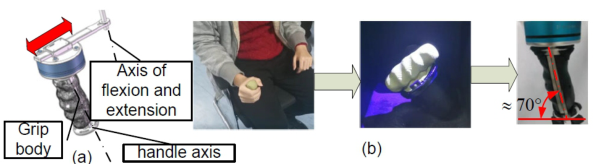
Human-Grip Interaction Analysis In the interaction process between the wrist joint rehabilitation robot and the user, the handle is the most direct and long-term contact structure, which has the most direct impact on the patient’s physiology and psychology. When the axis of the handle and the plane of the forearm are perpendicular to the front of the body, the holding position of the handle should be 60
∼70
from the horizontal plane, which is conducive to keeping the wrist straight and redu- cing fatigue and the resistance and repulsion of the user due to wrist fatigue. In addition, the fit between the curved surface of the handle and the hand will
Figure 1: Axial distance between flexion-extension axis and radial-ulnar deviation axis.Table 2. The range of motion angles of wrist joints and NPU-wrist.
Table available in the original PDF paper.
Direction of joint motion Max value of NPU-Wrist Max value of wrist Wrist flexion-extension +65
/-65
+60
/-60
Wrist radial-ulnar deviation +45
/-20
+35
/-15
Forearm pronation-supination +80
/-80
+75
/-75
affect the comfort of the handle. So, a handle that fits the physiological cha- racteristics of the human hand will be considered to improve the comfort of the user, thereby increasing the enthusiasm for rehabilitation training. For the psychological characteristics of the users, reasonable adjustments should be made to the shape of the handle on the basis of satisfying the basic ergonomic comfort.
Through the analysis of the human factors involved in the wrist joint anatomy, wrist kinematics and human-machine contact, combined with the design requirements of traditional robots, the design requirements of the mechanical mechanism of the wrist joint rehabilitation robot are summarized as follows.
Adaptability to different individuals: The mechanical structure should be adjustable to meet the adaptability requirements of different patients.
Realization of motion function: The mechanical structure needs to have three active degrees of freedom. It can reach the range of motion of the wrist joint, and can perform multi-degree-of-freedom coupling motion.
Safety: Wrist joint rehabilitation robots will directly interact with the human wrist during rehabilitation training, and the safety needs to be guaranteed.
Availability of sensor: Its mechanical structure design needs to consider the size of different sensors, and make reasonable planning for the layout of the sensors.
Human-machine contact comfort: The wrist joint rehabilitation robot should be designed with the user’s comfort in mind, taking into considera- tion factors such as its shape, roundness, and the softness of its materials to ensure a positive interactive experience.
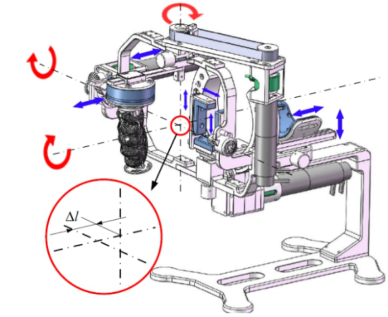
MECHANICAL STRUCTURE DESIGN OF NPU-WRIST ROBOT According to the mechanical structure design requirements, the overall stru- cture of the NPU-Wrist designed in this paper is shown in Figure 1. The rehabilitation robot contains three active degrees of freedom (red arrows), which can respectively realize radial-ulnar deviation, flexion-extension, and pronation-supination of the wrist joint, 7 adjustable degrees of freedom (blue arrows), which respectively represent the adjustable displacement of different mechanisms. The robot is designed to accommodate different indi- vidual sizes and compensate for misplacement in the human-machine rotation joint through adjustable sizing of the mechanical structure. In the figure 1,1l represents the axial distance between the flexion-extension movement axis and the radial-ulnar deviation movement axis.
To describe the mechanical structure of the rehabilitation robot in detail it can be divided into six parts: adjustment mechanism at elbow, pronation- supination mechanism, wrist fixation mechanism, radial-ulnar mechanism, flexion-extension mechanism, and handle structure. In this section, the placement of sensors is also described.
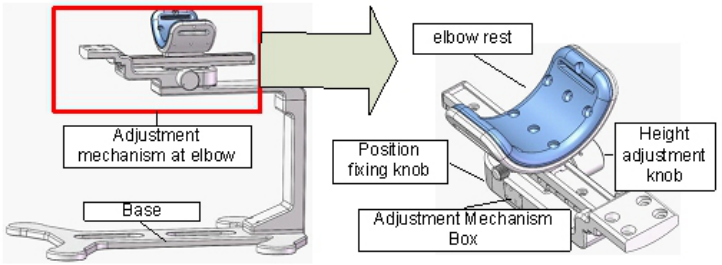
Adjustment Mechanism at Elbow: The function is to provide adjustabi- lity of the spatial position of the elbow rest, which is used to lift the user’s elbow during rehabilitation training. This mechanism is installed on the base
Integrating Human Factors in the Systematic Mechanical Design 55
Figure 2: Mechanical overall structure model of NPU-wrist.
and supports the entire structure. The mechanism consists of an adjustment mechanism box which is associated with a position-fixing knob and a height- adjusting knob. These knobs enable the elbow rest to be adjusted in two directions, allowing for a customized fit for the individual user. Figure 3 shows the adjustment mechanism at elbow.
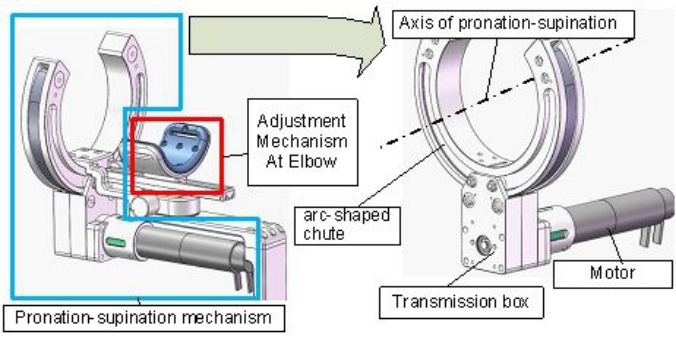
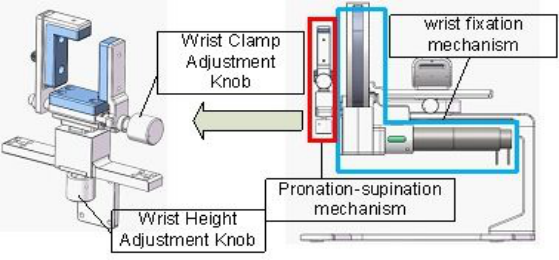
Pronation-supination mechanism: The function is to enable the robot to assist the human wrist in achieving pronation-supination, as shown in Figure 4. The mechanism and the adjustment mechanism for the elbow are fixedly connected by bolts. The motor drives the entire transmission box to move along the arc-shaped chute to realize the pronation and supination motion of the rehabilitation robot.
Wrist Joint Fixation Mechanism: The function is to comfortably fix the user’s wrist on the robot, as shown in Figure 5. The wrist joint fixation mech- anism can adjust the height of the wrist by rotating the height adjustment knob, and the wrist can be fixed by rotating the wrist clamp adjustment knob.
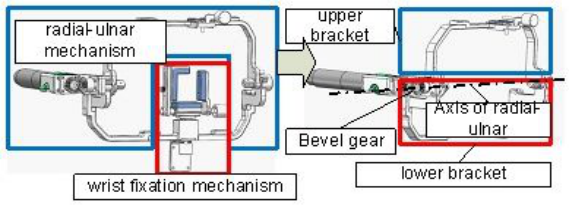
Radial-Ulnar Mechanism: The function is to drive the radial-ulnar move- ment, as shown in Figure 6. In the radial-ulnar mechanism, motor output is transmitted through a pair of bevel gears. So, when the motor rotates, its output torque is reversed through the bevel gear train.
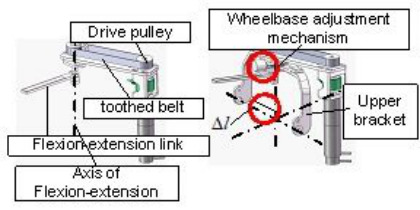
Flexion-extension mechanism: The function is to drive the flexion- extension, as shown in Figure 7. Among them, the flexion-extension link is driven by the torque transmitted by the pulley-toothed belt. In order to adjust the distance between the flexion-extension movement axis of the human body and radial-ulnar movement axis, the wheelbase adjustment mechanism is designed. In addition, the flexion and extension mechanism are also equip- ped with a mechanical limit structure to make sure the range of flexion and extension is forced to move only within the range of −65
∼65
.
Integrating Human Factors in the Systematic Mechanical Design 57
Figure 7: Flexion-extension mechanism diagram.Figure 8: Handle of NPU-wrist.
Handle structure: The function is to contact the human hand and perceive human-computer interaction force, as shown in Figure 8a. The grip structure can slide on the link to change the distance between the grip axis and the flexion-extension movement axis, thereby adapting to and measuring the cur- rent user’s hand length. The manufacturing process of the handles is shown in Figure- 8b.
Sensors placement: Three torque sensors are connected to the motors respectively for further complex compliance control. Two pressure sensors and a gyroscope are installed on the handle to measure the patient’s grip force and handle’s posture. A six-dimensional force sensor is mounted to connect the handle and flexion-extension link.
RESULT
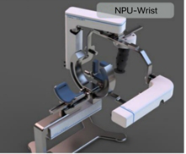
After the above analysis and design, the prototype of NPU-Wrist is finally obtained, as shown in Figure 9. In order to verify whether the robot meets the requirements, a questionnaire survey is conducted on a group of users with different static and dynamic dimensions of the human body.
Figure 9: Prototype of NPU-wrist.
Evaluation Scale Design This subjective evaluation scale is based on a 5-point Likert scale, which is used to evaluate the comfort of the upper limb exoskeleton rehabilitation robot. More specifically, the questionnaire options were: “very uncomfor- table,” “relatively uncomfortable,” “average,” “relatively comfortable,” and “very comfortable.” The scale consisted of 9 questions. The overall sample size of this study is 12 people, with 3 people in each group. The grouping of experiments is determined by the size of the human body. In other words, samples will be grouped according to forearm length, forearm diameter.
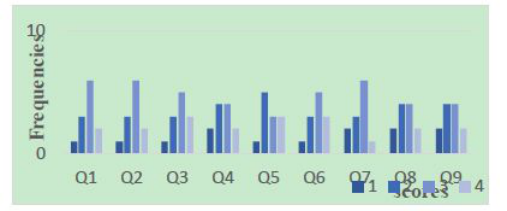
Statistical Analysis The evaluation results between the four groups were compared using one- way ANOVA, all data in this research were tested for normality and homo- geneity. A histogram can be used to determine whether the data conforms to a normal distribution, as shown in Figure 10. In the variance homoge- neity test, the results based on the median are more robust; when P>0.05, it can be judged that the data passed the variance homogeneity test. Finally, one-way ANOVA is performed. The corresponding significance of F is grea- ter than 0.05, so it is consistent with the original hypothesis that there is no significant difference between the four groups of data, that is, the comfort evaluation of NPU-Wrist is not affected by the group.
Integrating Human Factors in the Systematic Mechanical Design 59
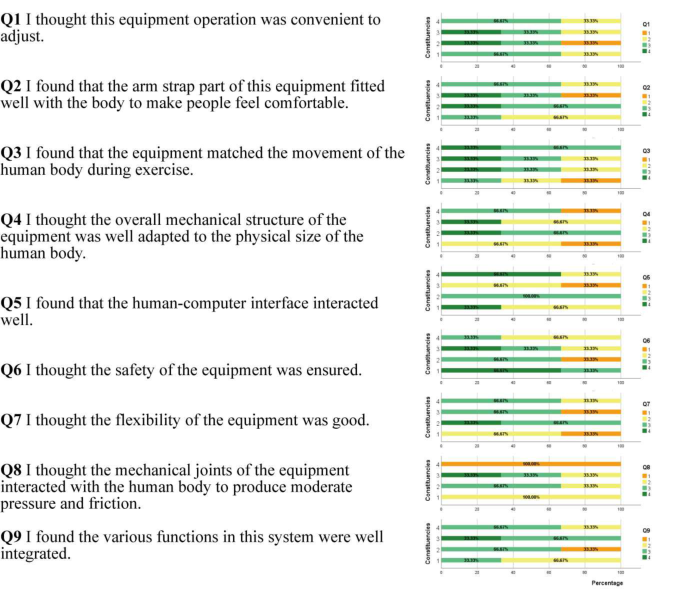
Figure 11: The distribution of attitudes towards the same question among the four groups.
The Results of the Ergonomics Assessment A total of 12 subjects were recruited 6 males and 6 females. The grouping of experiments is determined by the size of the human body. The scores from 0 to 4 are represented by different colors; red corresponds to 0 and green corresponds to 4; more green means more positive evaluation of the system as shown in Figure 11. It can be seen that everyone participating in the expe- riment is relatively satisfied with the performance of NPU Wrist robot as shown in Figure 11.
CONCLUSION
In this paper human factor design factors are introduced, and the research is carried out on the design of wrist rehabilitation training robot. The structu- ral design of the rehabilitation robot is carried out in combination with the human factor design factors such as the motion characteristics of the human wrist joint and the dynamic/static size of the human body. Then the prototype of NPU-wrist is manufactured, assembled and debugged. The questionnaire is administered on a group of users with different human body static and dyna- mic dimensions. The statistical analysis is conducted and the results show that
our NPU-Wrist rehabilitation robot has excellent adaptability to different individuals, safety and comfort.
ACKNOWLEDGMENT
This research is supported by “111 Project” (Grant No. 13044) and Key Research and Development of Shaanxi Province (Grant No. 2020SF-152).
REFERENCES
Bouteraa, Y., Ben Abdallah, I., Alnowaiser, K., Islam, M. R., Ibrahim, A., & Gebali, F. (2022). Design and Development of a Smart IoT-Based Robotic Solution for Wrist Rehabilitation. Micromachines, 13(6), 973. Buongiorno, D., Sotgiu, E., Leonardis, D., Marcheschi, S., Solazzi, M., & Frisoli, A.
(2018). WRES: A novel 3 DoF WRist ExoSkeleton with tendon-driven differen- tial transmission for neuro-rehabilitation and teleoperation. IEEE Robotics and Automation Letters, 3(3), 2152–2159. Chen, C., & Angeles, J. (2007). Generalized transmission index and transmission quality for spatial linkages. Mechanism and Machine Theory, 42(9), 1225–1237. Hussain, Shahid, Prashant K. Jamwal, and Paulette Van Vliet. “Design synthesis
and optimization of a 4-SPS intrinsically compliant parallel wrist rehabilitation robotic orthosis.” Journal of Computational Design and Engineering 8.6 (2021): 1562–1575. Khor, K. X., Chin, P. J. H., Yeong, C. F., Su, E. L. M., Narayanan, A. L. T., Rahman, H. A., & Khan, Q. I. (2017). Portable and reconfigurable wrist robot improves hand function for post-stroke subjects. IEEE Transactions on Neural Systems and Rehabilitation Engineering, 25(10), 1864-1873. Liu, X., Zhu, Y., Huo, H., Wei, P., Wang, L., Sun, A.,... & Fan, Y. (2019). Design of
virtual guiding tasks with haptic feedback for assessing the wrist motor function of patients with upper motor neuron lesions. IEEE Transactions on Neural Systems and Rehabilitation Engineering, 27(5), 984–994. Maciejasz, P., Eschweiler, J., Gerlach-Hahn, K., Jansen-Troy, A., & Leonhardt, S.
(2014). A survey on robotic devices for upper limb rehabilitation. Journal of neuroengineering and rehabilitation, 11(1), 1-29. Marconi, D., Baldoni, A., McKinney, Z., Cempini, M., Crea, S., & Vitiello, N.
(2019). A novel hand exoskeleton with series elastic actuation for modulated torque transfer. Mechatronics, 61, 69–82. Mayetin, U., & Kucuk, S. (2022). Design and Experimental Evaluation of a Low Cost, Portable, 3-DOF Wrist Rehabilitation Robot with High Physical Human– Robot Interaction. Journal of Intelligent & Robotic Systems, 106(3), 65. Molaei, A., Foomany, N. A., Parsapour, M., & Dargahi, J. (2022). A portable low-
cost 3D-printed wrist rehabilitation robot: Design and development. Mechanism and Machine Theory, 171, 104719. Saadatzi, M., Long, D. C., & Celik, O. (2015, October). Torque estimation in a wrist rehabilitation robot using a nonlinear disturbance observer. In Dynamic Systems and Control Conference (Vol. 57243, p. V001T18A001). American Society of Mechanical Engineers. Standardization Administration of China. Human Dimensions of Chinese Adults.
1988. National Standard of the People’s Republic of China. GB/T 10000. United Nations Department of Economic and Social Affairs, Population Division.
(2022). World population prospects 2022: Summary of results.
Integrating Human Factors in the Systematic Mechanical Design 61
Wang, J., Fei, Y., & Pang, W. (2019). Design, modeling, and testing of a soft pneumatic glove with segmented pneunets bending actuators. IEEE/ASME Transactions on Mechatronics, 24(3), 990–1001. Xu D, Zhang M, Xu H, et al. Interactive compliance control of a wrist rehabi-
litation device (WReD) with enhanced training safety[J]. Journal of healthcare engineering, 2019. Yellewa, M. E., Mohamed, A., Ishii, H., & Assal, S. F. (2022, October). Design and hybrid impedance control of a compliant and balanced wrist rehabilita- tion device. In IECON 2022–48th Annual Conference of the IEEE Industrial Electronics Society (pp. 1–6). IEEE.
LISTED IN THE AHFE DIGITAL BOOKSTORE CATALOGUE
Explore the complete digital volume
Ergonomics In Design
Read this individual research paper free through the original publisher, or explore the full digital proceedings book.
ISBN 978-1-958651-53-7
Explore this ISBN in the AHFE Bookstore ↗Listed in the July 2026 bookstore catalogue; search by ISBN to confirm current availability · Digital book purchase optional