Woojin Choi, Siyoung Choi, Ka Sanghoon, Kim Sunwoong, Sohn Moonjun (2023). Analysis of Changes in Spinal and Pelvic Parameters when Optimally Seated on an Automotive Seat Compared to Standing. In: Digital Human Modeling and Applied Optimization. AHFE Open Access, vol. 76, pp. 81–87. https://doi.org/10.54941/ahfe1003357
PURPOSE: The comfort of a seat in a seated posture has been reported to be affected by the alignment of the spine and pelvis in a standing posture when designing an automotive seat. Therefore, in order to find items to improve vehicle seat comfort performance, this study was conducted to measure the change in spinopelvic parameter values according to a change from a standing posture to a seat sitting posture and to reflect them in the design of vehicle seats to improve comfort.METHOD: X-ray data for 15 participants was measured and analyzed while standing and sitting in the optimal posture on an automotive seat. Cervical lordosis angle, thoracic kyphosis angle, lumbar lordosis angle, sacral inclination angle, and C7-SVA (sagittal vertical axis) were measured.RESULTS: Compared to standing, there were no statistically significant changes in the cervical lordosis and thoracic kyphosis angles when sitting in the car seat in the optimal posture, but only the lumbar lordosis changed (from 32.13° ± 8.356° to 6.568° ± 3.048°, p<0.0001). Cervical lordosis varied from 12.78° ± 8.15 to 12.58° ± 9.14° and thoracic kyphosis from 30.34° ± 8.10° to 31.6° ± 9.48° when standing and sitting in an optimal posture, but there was no statistical significance. However, the lumbar lordosis decreased from 32.13° ± 8.36° to 6.57° ± 3.05° and the sacral inclination angle decreased from 27° ± 11.13° to -21.79° ± 6.48°, respectively, and both were statistically significant in the paired t-test (p< 0.0001, p<0.0001, respectively). In the case of C7-SVA, there was a statistically significant change from 22.26 ± 15.17mm to 94.23 ± 46.14mm (p=0.0007). Except for the differences in the cervical lordosis angle change and the thoracic kyphosis angle change, there were statistically significant differences in standing and sitting conditions.CONCLUSION: As a result of this study, the changes in lumbar lordosis angle, sacral inclination angle, and C7-SVA were greater when sitting on a seat than when standing. This is related to the performance of comfort when sitting on a seat, and this data is expected to be used as useful data for designing seat shapes and lumbar support when developing seat designs in the future.
Automotive seats have played an important role since automobiles were first developed. While driving, the seat makes contact with the driver’s body, absorbing shock and transmitting or damping the vibration of the road surface.
Automotive seats are not only related to safety in the event of an accident but are also highly related to comfort. In addition, the driver or fellow pas- senger(s) relies on their body by sitting on the seat from the time of getting into the car to the time of getting out. For this reason, along with the deve- lopment of automobiles, automotive seats are also developing a lot, and they have been further developed through ergonomic design.
However, since the 2000s, as we entered an era of rapid advancement and cutting-edge IT technology and convergence between domains, in relation to automotive seats, there is an increasing interest in grafting medical elements one step further from ergonomic design. X-rays have been used since the 1970s in various ways as a method to evaluate the state of the driver sitting on a car seat, but it was limited and there was analysis of corpses to manufacture a dummy such as BioRID used in crash tests at the IIHS.
In the 2000s, the indicators of the cervical vertebrae and skull were digiti- zed and made into a database, and equations were developed based on this. Subsequent software developments have allowed researchers to construct and alter the geometry of the cervical spine in computer models and experimen- tal test setups used to study head and neck impact response and injury risk (Desantis et al., 2004).
As an evaluation method using X-rays, an evaluation of lumbar spine damage in a rear-end collision during a crash test was conducted in 2000. There was also a study on the alignment of the lumbar vertebrae using X- rays while seated in a driving position. However, there was a limitation in that the study was conducted on the change in the position of the center of the vertebral body and the change in disc thickness while in driving posture and during lumbar flexion and maximal lumbar spine extension in a 50th percentile male subject (Robert et al., 2000).
Recently, radiographic investigations using X-rays have been expanded to the automobile field, and one was to evaluate the effect of the lumbar support protrusion of an automotive seat on the spine and pelvic posture (Diana and Jack, 2012).
Many studies have been conducted on the change when a person is stan- ding and sitting on a chair, and the difference was found using X-rays (Tsagkaris et al., 2022). For example, in a study of healthy individuals com- paring standard standing and chair-sitting postures, the sitting posture was found to mainly affect the thoracolumbar spine from T10-T11 to L5-S1 (Tsagkaris et al., 2022; Baumgartner et al., 2012).
Sitting posture increased cervical lordosis (CL), reduced thoracic kypho- sis (TK) (Nishida et al., 2020) and reduced lumbar lordosis (LL) by about 50% (Suzuki et al., 2018; Nishida et al., 2020; Suzuki et al., 2016; Maekawa et al., 2019; Chevillotte et al., 2018; Endo et al., 2012) and the degree of LL reduction varied greatly with age These changes could be observed through
Analysis of Changes in Spinal and Pelvic Parameters When Optimally Seated 83
Table 1. Participants’ characteristics.
Table available in the original PDF paper.
Parameter Male Female Total n 9 6 15 Age (years) 38.22 ± 6.78 36.98 ± 7.97 38.27 ± 4.06 Height (cm) 175.6 ± 7.318 162.3 ± 5.20 170.4 ± 9.27 Weight (kg) 79 ± 6.91 62 ± 7.85 72.87 ± 11.77 Body mass index (kg/m2) 26.42 ± 2.95 23.48 ± 3.40 25.45 ± 3.55
X-rays (Nishida et al., 2020). The realignment of the spine in the seated posi- tion placed a greater load towards the intervertebral disc (IVD) and displaced the nucleus pulposus posteriorly (Berry et al., 2019). In this study, we tried to examine the changes that can occur when sitting on an automotive seat through X-rays, just as the changes in the spine and pelvis can be confirmed through X-rays when standing and sitting in a chair.
METHOD
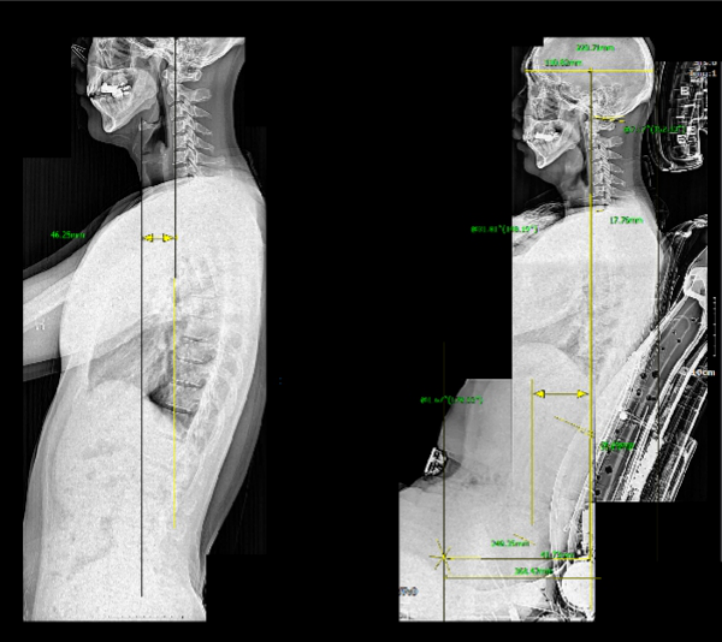
This study was conducted with the cooperation of Hyundai Transys, and there was no conflict of interest other than the provision of seats. X-ray data 15 volunteer subjects was measured and analyzed when standing and seated in an optimal posture on an automotive seat. First, the subjects took a stan- dardized standing position with both feet placed on a marked position on the floor and with their eyes looking straight ahead. Later, a neurosurgeon took a full-body X-ray of the lateral view. The seat used in the test was the 2022 Grandeur (GN7) driver’s seat, and the seat was installed on a large jig with fixed wheels in a flattened X-ray room. After this, the subjects sat down and had both feet placed on the accelerator and footrest positions set in the same position as in an actual vehicle. The test was conducted while main- taining the hip flexion and knee flexion angle to the extent that the knee and thigh did not cover the iliac crest in the X-ray image, and the angle of the backrest was adjusted to a comfortable state for the subject when sitting on the seat. Afterwards, a neurosurgeon took a side-view full-body X-ray while the subjects were seated. The cervical lordosis angle, thoracic kyphosis angle, lumbar lordosis angle, sacral inclination angle, and C7-SVA (sagittal vertical axis) were measured on the X-ray images acquired through two pro- cedures. For all data, the values measured while standing and after sitting were compared, and the difference between the changed values in the two situations was compared. Cervical lordosis was measured by measuring the angle between the lines connected along the inferior endplate of the second cervical vertebra and the inferior endplate of the seventh cervical vertebra. Thoracic kyphosis was measured at the angle between the T1 upper plate and the T12 lower plate. C7-SVA is a vertical line which is drawn from the center of the C7 vertebral body in a caudal direction. The line should connect with, or be within 5mm of, the superior-posterior endplate of S1 (Daniel et al., 2022).
Figure 1: Comparison of standing upright and sitting on an automotive seat by radiographic assessment.
RESULT
When the subjects sat in the optimal posture, the seatback angle was 109.4
± 2.997
. Compared to standing, there was no statistically significant change in the cervical lordosis and thoracic kyphosis angles, but there was a statistically significant change in lumbar lordosis angle (6.568
± 3.048
at 32.13
± 8.356
, p<0.0001). The cervical lordosis angle varied from 12.78
± 8.15 to 12.58
± 9.14
and the thoracic kyphosis angle from 30.34
± 8.10
to 31.6
± 9.48
when standing and sitting in optimal posture, but there was no statistical significance. However, the lumbar lordo- sis angle decreased from 32.13
± 8.36
to 6.57
± 3.05
and the sacral inclination angle decreased from 27
± 11.13
to -21.79
± 6.48
, and both were statistically significant in the paired t-test (p< 0.0001, p<0.0001). In the case of C7-SVA, there was a statistically significant change from 22.26 ± 15.17mm to 94.23 ± 46.14mm (p = 0.0007). Changes in the cervi- cal lordosis angle, thoracic kyphosis angle, lumbar lordosis angle, and sacral inclination angle occurred when standing and sitting in the optimal posture and statistically showed a significant difference.
Analysis of Changes in Spinal and Pelvic Parameters When Optimally Seated 85
Table 2. Comparisons of parameters between standing upright and sitting on an automotive seat.
The arrangement of the spine is different when standing vs. sitting in a chair (Tsagkaris et al., 2022; Sohn et al., 2022; Choi et al., 2022).
Compared to standing, sitting in a chair is known to increase cervical lor- dosis, decrease vertebral kyphosis, and decrease lumbar lordosis (Nishida et al., 2019). In this study, there was no statistical change in cervical lordosis and thoracic kyphosis when sitting in a car seat compared to when standing. However, in the case of the lumbar lordosis angle, it decreased statistically and showed a similar shape to sitting on a chair. These results were also confirmed in other research (Choi et al., 2022). When sitting in a chair, the decrease in lumbar lordosis angle is greater in middle-aged and older adults than in young adults (Suzuki et al., 2016). In this study, the sacral inclination also statistically significantly decreased when sitting on an automotive seat compared to standing. In other studies, the sacral inclination decreased by up to 50% when sitting on a chair, and in the case of the elderly, the decrease was greater by 15% when compared to young adults (Maekawa et al., 2019). Clinically, changes in lumbar-pelvic alignment during sit-to-stand are related to the cause of lower back pain, and the sitting posture is the most influential posture for the occurrence of lower back pain(Suzuki et al., 2018; Choi and Sohn, 2022). In particular, when the change in cervical lordosis and thoracic kyphosis angles are not statistically significant while sitting in an automotive seat, and at the same time the change in lumbar lordosis angle is large, it means that the muscle tone of the muscles around the cervical and thoracic vertebrae is increased. This suggests that the probability of neck and shoulder pain occurring may be relatively higher when sitting in an automotive seat for a long time than when sitting in a chair.
When sitting on a car seat, as the angle of the seatback increases, the kyph- osis of the thoracic spine increases. In particular, there was an increase in the kyphotic angle of the lower thoracic vertebrae between T4-T12 rather than an angle change from T1-T4 (Sato et al., 2021). An increase in the angle of the seatback is proportional to an increase in the distance of the C7-SVA, and this process can cause an increase in thoracic kyphosis (Sohn et al., 2022). An increase in thoracic kyphosis can cause shoulder pain and back pain by increasing the muscle fatigue of the rhomboid muscle and trapezius muscle that occurs when the arm is extended forward during long-term driving. In other words, it can impair comfort and decrease the immediate response of
stiff muscles during a collision, increasing the risk of injury due to collision damage (Saichao et al., 2022).
CONCLUSION
Compared with standing, the changes in cervical lordosis and thoracic kyph- osis angles while sitting were not statistically significant. However, changes in the lumbar lordosis angle, sacral inclination angle, and C7-SVA were sta- tistically significant. This is because the cervical and thoracic vertebrae must be kept relatively close to vertical as the eyes must be kept straight even when sitting. Instead, because the lumbosacral region flexed when seated, lumbar lordosis decreased and the sacral inclination angle changed. At the same time, the increase in C7-SVA leans on the seatback as the upper body moves backw- ard, and as the amount of movement increases, the load applied to the lumbar spine and pelvis increases which can reduce ride comfort. Therefore, there is a need for a seat design that can minimize the decrease in lumbar lordosis angle and C7-SVA while seated on an automotive seat.
REFERENCES
Baumgartner2, D. Zemp, R. List, R. Stoop, M. Naxera, J. Elsig, J. P., et al. (2012).
The spinal curvature of three different sitting positions analysed in an open MRI scanner, Scient World J Volume 2012. Berry, DB. Hernandez, A. Onodera, K. Ingram, N. Ward, S. R and Gombatto S. P.
(2019). Lumbar spine angles and intervertebral disc characteristics with end-range positions in three planes of motion in healthy people using upright MRI, J Biomech Volume 89. Chevillotte, T. Coudert, P. Cawley, D. Bouloussa, H. Mazas, S. Boissière, L., et al.
(2018). Influence of posture on relationships between pelvic parameters and lumbar lordosis: Comparison of the standing, seated, and supine positions. A preliminary study, Orthopaed & Traumatol: Surg & Res Volume 104 No. 5. Choi, W. J. and Sohn, M. J. (2022). Biomechanical Comparison of the Effects of Two Ergonomic Chairs on the Spine and Pelvic Postures: Conical Pendulum Stool Versus Semi-Rigid Flexible Backrest Chair, Journal of the Korean Institute of Industrial Engineers Volume 48 No. 3. Choi, W. J. Yeo, S. Y. Kang, G. C. Kim, S. H. and Sohn, M. J. (2022). A Study on
the Effect of Improving the Balance of the Spine and Pelvis Using an Air Bladder That Can Automatically Control the Left and Right Hips on the Automotive Seats, Transaction of the Korean Society of Automotive Engineers Volume 30 No. 12. Desantis, K. K. Ebert, S. M. Van Ee, C. A. Flannagan, C. A. Prasad, M. Reed, M.
P. and Schneider, L. W. (2004). Cervical spine geometry in the automotive seated posture: variations with age, stature, and gender, Stapp Car Crash J Volume 48. Diana, E. De Carvalho and Jack, P. Callaghan. (2012). Influence of automobile seat lumbar support prominence on spine and pelvic postures: A radiological investigation, Applied Ergonomics Volume 43 No. 5. Endo, K. Suzuki, H. Nishimura, H. Tanaka, H. Shishido, T and Yamamoto K.
(2012). Sagittal lumbar and pelvic alignment in the standing and sitting positions, J Orthopaed Sci Volume 17 No. 6. Maekawa, A. Endo, K. Suzuki, H. Sawaji, Y. Nishimura, H. Y. M., et al. (2019).
Impact of pelvic incidence on change in lumbo-pelvic sagittal alignment between sitting and standing positions, Eur Spine J Volume 28 No. 9.
Analysis of Changes in Spinal and Pelvic Parameters When Optimally Seated 87
Nishida, N. Izumiyama, T. Asahi, R. Iwanaga, H. Yamagata, H. Mihara, A., et al. (2019). Changes in the global spine alignment in the sitting position in an automobile, Spine J Volume 20 No. 4. Robert, Banks. John, Martini. Harry, Smith and Alfred, Bowles. Thomas McNish
and Richard Howard. (2000). Alignment of the Lumbar Vertebrae in a Driving Posture, Journal of Crash Prevention and Injury Control Volume 2 No. 2. Saichao, Yang. Qing, Zhou. Bingbing, Nie. Jisi, Tang. Yasuo, Yamamae and Tadasuke, Katsuhara. (2022). A human body model based method for injury risk prediction considering occupant stature and posture, International Journal of Crashworthiness. Sato, F. Miyazaki, Y. Morikawa, S. Ferreiro, P. A. Schick, S. Brolin, K and Svensson
M. (2021). The Effect of Seat Back Inclination on Spinal Alignment in Automotive Seating Postures, Front in Bioeng Biotechnol Volume 9. Sielatycki, J. A. Metcalf, T. Koscielski, M. Devin, C. J and Hodges, S. (2021). Seated lateral X-ray is a better stress radiograph of the lumbar spine compared to standing flexion, Global Spine J Volume 11 No. 7. Sohn, M. J. Lee, H. H. Lee, B. J. Koo, H. W. Kim, K. Y. and Yoon, S. W. (2022). The
radiographic assessments of spino-pelvic compensation using IoT-based real-time ischial pressure adjustment, Medicine (Baltimore) Volume 101 No. 5. Suzuki, H. Endo, K. Mizuochi, J. Murata, K. Nishimura, H. Matsuoka, Y., et al.
(2016). Sagittal lumbo-pelvic alignment in the sitting position of elderly persons, J Orthopaed Sci Volume 21 No. 6. Suzuki, H. Endo, K. Sawaji, Y. Matsuoka, Y. Nishimura, H. Takamatsu, T. Murata, K.
Seki, T. Konishi, T. Aihara, T and Yamamoto K. (2018). Radiographic Assessment of Spinopelvic Sagittal Alignment from Sitting to Standing Position, Spine Surg Relat Res Volume 2 No. 4.
LISTED IN THE AHFE DIGITAL BOOKSTORE CATALOGUE
Explore the complete digital volume
Digital Human Modeling and Applied Optimization
Read this individual research paper free through the original publisher, or explore the full digital proceedings book.
ISBN 978-1-958651-52-0
Explore this ISBN in the AHFE Bookstore ↗Listed in the July 2026 bookstore catalogue; search by ISBN to confirm current availability · Digital book purchase optional