Yihang Du, Zhang Yao, Niu Ke (2023). Movement Description Method and Application for Dance of Chinese Traditional Drama. In: Digital Human Modeling and Applied Optimization. AHFE Open Access, vol. 76, pp. 41–50. https://doi.org/10.54941/ahfe1003352
The purpose of this research is to propose a description model of human motion for Chinese traditional drama, which contained body structure, spatial orientation and movement force effect three dimensions. A multi rigid model is established based on the relative relationship between nodes and edges, record the movements of each part with geometric figures to establish the skeleton hierarchy of multiple joint points. In addition, we applied the description method on the virtual body in digital CTD performance system, which is designed base on augment reality technique. Also, we extracted the complete set of human motion from CTD such as martial dramatic works and body movement in Bingxi painting dance performance, and design the virtual human action by combining the posture base on the model above. This description method can realize the creative transformation and innovative development of Chinese excellent traditional culture in intelligent media.
Chinese traditional drama (CTD) has the characteristics of ideographism, and formed a comprehensive art modality through thousands of years on the basis of highly refining daily life and folk performance. Based on the experience of real life and the rhythmical of spontaneous movement, the body motion in stage performances emphasize the dancing visual appearance under subjective expression of the creators, and thus contain rich traditio- nal Chinese aesthetic spirit. Body is an important medium for human beings to perceive and connect with the external world. It is through the dance of body that CTD performers convey the connotation of Chinese classical cul- ture, including the world view of unity of heaven and man, the life view of Confucianism and Taoism, and the values of advocating literature and mora- lity. The creative transformation of CTD in the intelligent media platform emphasizes the body movement shaping of virtual characters. This new art form of online and offline integration conforms to the current communica- tion characteristics and can effectively promote the deep integration of art and technology.
Human motion modeling can be described by the complex system of bio- mechanics, and has applied to sports training, computer game development, VR simulation and computer graphics. In this study, the human motion model is established from initial posture and joint motion plane two aspect. First, dance motion posture features are extracted from four dimensions: space, time, gravity and fluency. Then we define the formal description language of motion and establish database of CTD dance. Finally, the model is applied to the digital performance creation of Digital Bingxi sports. The proposed model has function of identifying the emotional expression and performance style in dance movements of CTD, laying the foundation for the development of artificial intelligence CTD dance system.
RELATED WORKS Human motion model was first proposed in computer graphic animation. Noma constructed Peabody structure in Jack simulation software, which can be used to represent the links that make up human body, and these links are connected by joints (Noma, 2000). Peabody data structure contains geome- tric information about link dimension and joint angle. In addition, Peabody can also provide an efficient mechanism to calculate, save and obtain various geometric information.
The most representative musculoskeletal model in open access is the “OpenSim” established by Professor Delp of Stanford University (Seth, 2018). The Anybody model established by Aalborg University in Denmark has muscle anatomical accuracy of bundle level, and has been applied in spinal column (De Zee, 2007) and oral cavity (Andersen, 2017) mode- ling. American Life Modeler Company has developed the Life MOD plug-in based on the commercial software MSC Adams, which is specially applied to the digital design of artificial joints. The University of British Columbia in Canada has developed the “Arti-Synth” tool for the human oral and maxillo- facial system (Lloyd, 2012), introduced large deformation flexible elements into the musculoskeletal model, and realized the coupling simulation of facial (Stavness, 2011), tongue (Stavness, 2012) and other soft tissues with the musculoskeletal system. At present, the more common bone models are Hill (Hill, 1938) and Zajac (Zajac, 1989) models, which include active contra- ction elements and series and parallel passive stretching elements. There are also studies that regard ligament, cartilage and other bone connection auxi- liary structures as hyper-elastic bodies, and use nonlinear spring structures to mode (Blankevoortl, 1991), so as to achieve the correspondence between dynamic model and anatomical characteristics of the musculoskeletal system (Guo, 2022).
Geometrically exact beam formation (GEBF) can also effectively deal with the coupling problem of large rotation and large deformation of fle- xible bodies. Renda proposed a geometrically accurate beam model based on Cosset theory, and introduced shear and torsional deformation into the segmented equal curvature model of the soft gripper (Renda, 2018). Grazioso further verified the prediction accuracy of GEBF on the end displacement of soft robot through experiments (Grazioso, 2019). Lie group theory has been
Movement Description Method and Application for Dance of Chinese Traditional Drama 43
initially applied to human dynamics modeling, and has achieved good results in the field of human posture recognition (Vemulapalli, 2014). Professor Brüls combined GEBF element with Lie group, and disclosed part of its calcu- lation program(Brüls, 2012; Sonneville, 2014). Through Lie group modeling principle, it is expected to achieve deep integration of GEBF element and human dynamics modeling.
Lv adopted the inverse dynamics model to process the input kinematics data, and obtains the dynamic motion data close to the real human motion (Lv, 2016). Dynamic motion data can be further used to generate more reali- stic and physically interactive virtual human motion, and can also be used to build new virtual body motion control methods (Muico, 2009). He establi- shed the multi-body dynamic model of the passive walking robot with knee joint, and realized the fast identification of stable gait parameters (Bencsik, 2017). Zelei proposed a plane model containing the active moment of the joint, and determined the limit cycle satisfying the stable motion process (Zelei, 2019). Nonlinear dynamic analysis is often limited to the simplified human body model with low degrees of freedom, which oversimplifies the skeletal muscle behavior.
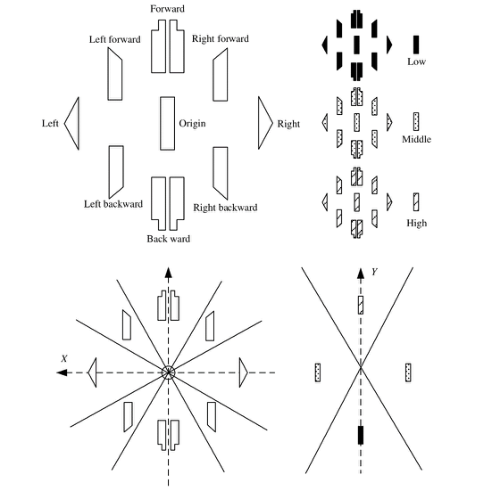
Labanotation is the most famous human body description model aiming at the particularity of dance movement. Labanotation is a symbol recording system which was created by Hungarian Rudolf Laban in the early 20th century (Hutchinson, 1977). The spectrum plane structure of Labanotation is four to eleven columns in the horizontal direction, and each column corresponds to a part of human body. The number of columns can be deter- mined according to creator designed (as shown in Figure 1). The graphical
Figure 1: Twenty-seven basic symsbols of Labanotation. (Guest, 1977).
symbol in column indicates that the corresponding body part movement. The vertical length of graphical symbol indicates the duration of move- ments. Labanotation divides the space into 27 subspaces and each symbol corresponds to a type of movement element. The shape of graphical sym- bol represents different horizontal directions, and the filling style represents different vertical directions.
Therefore, a biomechanical based CTD body motion description method is proposed based on combining the classical human motion model and dance description method of Labanotation, which will contribute to the preserva- tion and innovative transformation of traditional body art in intelligence media.
THE PROPOSED APPROACH FOR THE BODY MOTION MODEL The most intuitive method is to build a body motion model for each bone of dancing body, and define the motion constraints between the related bones. Skeleton motion model is used to describe the data structure and relative motion relationship of human joints. The human lower limb is regarded as a rigid body model composed of six rigid bodies. The thigh and lower leg are divided into four rigid bodies according to the knee joint, and the foot forms two rigid bodies according to the ankle joint. Among them, the thighs are connected to the main body, and these six rigid bodies are all connected through ideal rotation joints. This rigid body description method is based on the following assumptions: x the mechanical motion of the whole human lower limb is independent of the motion of human trunk; y In each joint, bones, muscles and soft tissues are regarded as rigid bodies; z The deforma- tion of muscles and soft tissues will not affect the mechanical properties of rigid bodies. The parameters of each rigid body are based on the human data of adults in the national standard GB10000-1988.
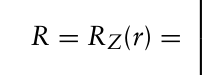
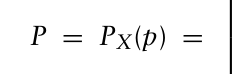
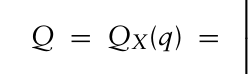
The rotation angle is converted into position information of the joint node based on Euler angles principle. The joint motion plane should be defined to ensure the integrity of the description. In the initial posture, the direction from one shoulder to the other is the x direction, while the y direction is the body vector pointing upward at the anatomical position, and the z direction is perpendicular to the plane composed of x and y axes. Firstly, the Euler angle is transformed into a matrix, and the rotation angle data is converted into the following matrices:
[Equation or mathematical symbol available in the original paper PDF]
[Equation or mathematical symbol available in the original paper PDF] cos r sin r 0 −sin r cos r 0
Equation reproduced from the original PDF.
[Equation or mathematical symbol available in the original paper PDF] (1)
0 0 1
[Equation or mathematical symbol available in the original paper PDF]
[Equation or mathematical symbol available in the original paper PDF]
Equation reproduced from the original PDF.
[Equation or mathematical symbol available in the original paper PDF] (2)
1 0 0 0 cos p sin p 0 −sin p cos p [Equation or mathematical symbol available in the original paper PDF][Equation or mathematical symbol available in the original paper PDF] cos q 0 −sin q
Equation reproduced from the original PDF.
[Equation or mathematical symbol available in the original paper PDF] (3)
0 1 0 sin q 0 cos q
Movement Description Method and Application for Dance of Chinese Traditional Drama 45
where R, P and Q are the rotation matrices of roll angle, pitch angle and yaw angle respectively, rotating around the z, x and y axes, and the rotation angles are r, p and q. According to the properties of the orthogonal matrix, the following rotation matrix N can be obtained: cos r cos q −sin r sin p sin q −sin r cos p cos r sin q + sin r sin p cos q " # N(RPQ)−1 =
(4) sin r cos q + cos r sin p sin q cos r cos p sin r sin q −cos r sin p cos q −cos p sin q sin p cos p cos q
The rotation matrix calculates the position through the relative orientation between the node and the intermediate node of the root, and obtains the position information in the joint coordinate system through the process of de rotation and de translation. The process of de rotation is as follows: [Equation or mathematical symbol available in the original paper PDF]
Equation reproduced from the original PDF.
where (x0, y0, z0) is the initial offset of the node; Nr, Nr−1, Nr−2,..., N1 represent the rotation matrix of all predecessor nodes from node N to root node.
In the process of de translation, calculate the position offset of each prede- cessor node of N. The position offset of these nodes relative to their parent node is O1,..., Or−2, Or−1, Ot, then the world coordinate of node J0 is M = O1 + O2 + · · · + Ot (6)
Since the movement of human body in space will cause the deviation betw- een the world coordinate of the skeleton node in the x and z directions and the initial acquisition position. The root node coordinate (xt, yt, zt) should be calculated as the relative coordinate of the reference point after obtaining the world coordinate, that is M0 = M(x, y, z) −M(xt, yt, zt) (7)
The characteristic parameters describing human motion biomechanics, such as joint pair distance, skeleton pair angle, human orientation, spatial orientation, and weight and fluency in force effect, are calculated.
Joint pair distance and skeleton pair angle are considered from the per- spective of limb structure. The distance v of joint pairs reflects the speed of motion. The distance between joint pairs is calculated by European dista- nce, and its characteristic equation is expressed as equation (8). Skeleton pair angle θ represents the bending state between adjacent bones, and its characteristic equation is equation (9), namely
q υ = (xj −xj−1)2 + (yj −yj−1)2 + (zj −zj−1)2 (8)
∂= arccos(υa
υb/(∥υa ∥× ∥υb ∥)) (9) where the coordinates of joint point j are (xj, yj, zj), and υa and υb respectively represent the distances between joint points a and b.
The eigenvalues human orientation, spatial orientation, and the weight and fluency of force effect are considered from the perspective of spatial orientation, and the human orientation n can be expressed as n = −→ sl × −→ sk = (β1, β2, β3) (10)
where l and k are plane normal vectors composed of different bone points respectively.
The spatial orientation s is divided into vertical and horizontal orientation. The vertical orientation divides human skeleton into upper, middle and lower layers. The horizontal component is divided into {front, front left, left, left, right, back, rear right, front right, and original position}, and each horizontal component is divided at an interval of 22.5
.
Eigenvalue force effect F includes weight and fluency. The weight ω repre- sents the integral of the y-axis coordinate value curve of the joint point to starting and ending points of the time. This parameter represents rise and fall of the motion. Its characteristic equation is
Equation reproduced from the original PDF.
where the smoothness f represents the expansion and contraction of space through distance, and its characteristic equation is f = 2u(u −d12)(u −d13)(u −d23)/d23 (12)
where dij represents the distance between joint points.
Equation reproduced from the original PDF.
MOTION DESCRIPTION AND MODEL APPLICATION The dance movement of CTD is structured from three aspects of human body structure, motion orientation and action force effect. The body posture is described by the continuity and periodicity of dance action data. The dance movement is designed succinctly and described intuitively with a three-dimensional human skeleton hierarchical structure, and is applied to the virtual human control of Digital Bingxi, Virtual Mei and Kun Dance Interactive Space.
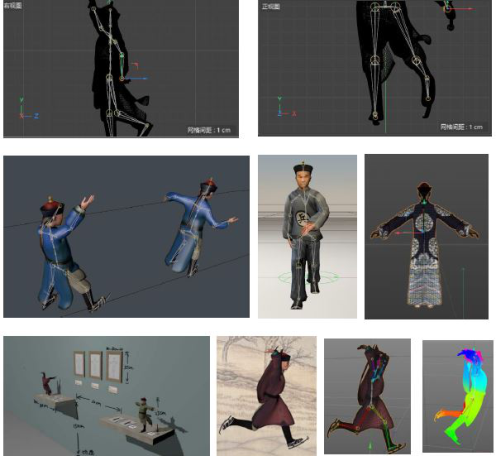
Bingxi painting (Zhang Weibang, Yao Wenhan) depicts the grand scene of figure skating which created in the Qianlong period of the Qing Dynasty. Digital Bingxi (Bai Chenzong, Xu Hui, 2022) takes the Bingxi painting as original material, and extracts representative characters for 3D visual design. According to the creation background of Bingxi and the characteristics of the characters, the CTD performance techniques are fully split and applied to the motion of virtual human in Bingxi. The dance avatar actions of the virtual human can convey the style of the sports scenes. Then, after scene acquisition, image recognition, 3D registration, virtual synthesis, human-computer inte- raction interface and synthesis output and other technical modules, the scene of Bingxi movement was restored through virtual reality fusion in AR media, and providing a new exhibition space for the living display of characters in ancient paintings.
Movement Description Method and Application for Dance of Chinese Traditional Drama 47
The Bingxi Painting is collected in Beijing palace museum, vividly depi- cts the grand scene of Emperor Qianlong’s visit to ice playing. “Bingxi” originated from the production and life of ethnic minorities in northern China in alpine regions, and then gradually changed from production and labor to entertainment. After the Manchu people became masters of the Central Plains, “ice play” gradually merged with the Han culture. During the Qianlong and Jiaqing period, a series of ice projects were carried out in Taiye Pool (now Beihai, Zhonghai and Nanhai). More than 1600 people recruited from army forces and nobles participate in the Bingxi every year, which is a concentrated expression of Chinese traditional sports culture and national body aesthetics (as shown in Figure 2). The Qing Dynasty was the heyday of
Figure 2: Virtual character in digital Bingxi (Bai Chenzong, Xu Hui, 2022).
development of CTD in the capital area, which represented by Peking Opera and Kun Opera. The dancing movements are still alive today, which created by professional artists for generations in CTD. The nationalized body aesthe- tics and performance resources of contemporary CTD are an effective carrier for the activation and utilization of intangible cultural heritage, providing an appropriate reference for the return and reproduction of virtual body in Digital Bingxi.
MOTION DESCRIPTION AND MODEL APPLICATION First, we selected four bare handed performances and six characters using props from original Bingxi painting, and adopted Autodesk Maya 2015 for virtual human modeling (as shown in Figure 2). Second, we used the cube, sphere, humanoid and other primitives in the software to establish the requi- red skeleton. Third, add subdivision surfaces in the model mode, further refine the modeling objects through control points, lines, and surfaces, create deformers during this process to bend, expand, taper and other deformation processes on the required objects to modify the figure shape. Finally, applied the proposed motion model above on the virtual body movement congruence with CTD performance.
Extracted the complete set of martial arts actions from CTD such as Tiao Huache, Jie Dongfeng and Ye Ben, and design the virtual human by com- bining the posture of trunk and limbs. Body movement bound with the virtual human skeleton such as Jump, gambol, turn over and somersault were selected to reconstruct, transformed and exaggerated. Compared with CTD percussion formula such as [big gong Choutou], [small gong Changsitou], [big gong Yiji], [Ba Da Cang], and [Phoenix three nods] to endow with a sense of speed and strength to the Digital Bingxi sports.
CONCLUSION
In order to make the CTD be inherited and widely spread, a description method of human motion has been established, which can not only prese- rve the artistry of dance, but also record the dance movements completely through mathematical models. The proposed human motion model takes the three-dimensional skeleton hierarchy of body as object, and described the dance movement of CTD from the aspects of body structure, spatial orien- tation and movement force effect. The concise action description language and the identification method of performance style restore the ideogra- phic function of dance to the maximum extent. This description method is applied in Digital Bingxi sports of intelligent media, realizing the creative transformation and innovative development of Chinese excellent traditional culture.
ACKNOWLEDGMENT
This work was supported by Key project of Education Research and Reform of the National Academy of Chinese Theatre Arts (Grant Number ZD202205), “Research on the Education mode of digital media” art
Movement Description Method and Application for Dance of Chinese Traditional Drama 49
based on “Chinese traditional drama characteristic discipline” in 2022 Undergraduate Education Reform and Innovation Project of Beijing Higher School, Beijing Municipal Education Commission Science Program (Grant Number KM202110049001), and Research Project of Digital Media Art, Key Laboratory of Sichuan Province, Sichuan Conservatory of Music (Grant Number 22DMAKL10).
REFERENCES
Andersen M S, de Zee M, Damsgaard M, et al. (2017). Introduction to forcedependent kinematics: theory and application to mandible modeling. Journal of Biomechanical Engineering. 139(9): 10–11. Bencsik, L., & Zelei, A. (2017). Effects of human running cadence and experimental
validation of the bouncing ball model. Mechanical Systems and Signal Processing, 89, 78–87. Blankevoort, L., Kuiper, J. H., Huiskes, R., & Grootenboer, H. J. (1991). Articular contact in a three-dimensional model of the knee. Journal of biomechanics, 24(11), 1019–1031. Brüls O, Cardona A, Arnold M. (2012). Lie group generalized-α time integration of
constrained flexible multibody systems. Mechanism and Machine Theory, 48(1), 121–137. De Zee, M., Hansen, L., Wong, C., Rasmussen, J., & Simonsen, E. B. (2007). A generic detailed rigid-body lumbar spine model. Journal of biomechanics, 40(6), 1219–1227. Grazioso, S., Di Gironimo, G., & Siciliano, B. (2019). A geometrically exact model
for soft continuum robots: The finite element deformation space formulation. Soft robotics, 6(6), 790–811. Guo J Q, Wang Y B, Tian Q, et al. (2022). Advances in flexible multibody dynamics of human musculoskeletal systems. Advances in Mechanics, 52(2): 253-310. Hill, A. V. (1938). The heat of shortening and the dynamic constants of muscle. Pro-
ceedings of the Royal Society of London. Series B-Biological Sciences, 126(843), 136–195. Hutchinson, A., & Guest, A. H. (1977). Labanotation: or, kinetography Laban: the system of analyzing and recording movement (No. 27). Taylor & Francis. Lloyd, J. E., Stavness, I., & Fels, S. (2012). ArtiSynth: A fast interactive biomechanical
modeling toolkit combining multibody and finite element simulation. Soft tissue biomechanical modeling for computer assisted surgery, 355–394. Lv, X., Chai, J., & Xia, S. (2016). Data-driven inverse dynamics for human motion.
ACM Transactions on Graphics (TOG), 35(6), 1–12. Muico, U., Lee, Y., Popovi´c, J., & Popovi´c, Z. (2009). Contact-aware nonlinear control of dynamic characters. In ACM SIGGRAPH 2009 papers (pp. 1–9). Noma, T., Zhao, L., & Badler, N. I. (2000). Design of a virtual human presenter.
IEEE Computer Graphics and Applications, 20(4), 79–85. Renda, F., Boyer, F., Dias, J., & Seneviratne, L. (2018). Discrete cosserat approach for multisection soft manipulator dynamics. IEEE Transactions on Robotics, 34(6), 1518–1533. Seth, A., Hicks, J. L., Uchida, T. K., Habib, A., Dembia, C. L., Dunne, J. J.,... & Delp,
S. L. (2018). OpenSim: Simulating musculoskeletal dynamics and neuromuscu- lar control to study human and animal movement. PLoS computational biology, 14(7), e1006223.
Sonneville, V., Cardona, A., & Brüls, O. (2014). Geometric interpretation of a non-linear beam finite element on the Lie group SE (3). Archive of Mechanical Engineering, 61(2), 305–329. Stavness, I., Lloyd, J. E., & Fels, S. (2012). Automatic prediction of tongue
muscle activations using a finite element model. Journal of biomechanics, 45(16), 2841–2848. Stavness, I., Lloyd, J., Payan, Y., & Fels, S. (2011). Towards speech articulation simulation with a dynamic coupled face-jaw-tongue model. In ISSP’2011 pp .1–4). Vemulapalli, R., Arrate, F., & Chellappa, R. (2014). Human action recognition by
representing 3d skeletons as points in a lie group. In Proceedings of the IEEE conference on computer vision and pattern recognition (pp. 588–595). Zajac, F. E. (1989). Muscle and tendon: properties, models, scaling, and application to biomechanics and motor control. Critical reviews in biomedical engineering, 17(4), 359–411. Zelei, A., Krauskopf, B., Piiroinen, P. T., & Insperger, T. (2019). Stable periodic
motion of a controlled segmented leg model of pedal locomotion with inelastic ground-foot collision. Nonlinear Dynamics, 97, 1945-1958.
LISTED IN THE AHFE DIGITAL BOOKSTORE CATALOGUE
Explore the complete digital volume
Digital Human Modeling and Applied Optimization
Read this individual research paper free through the original publisher, or explore the full digital proceedings book.
ISBN 978-1-958651-52-0
Explore this ISBN in the AHFE Bookstore ↗Listed in the July 2026 bookstore catalogue; search by ISBN to confirm current availability · Digital book purchase optional