Woojin Choi, Jueun Shin, Sunwoong Kim, Sohn Moonjun (2024). X-ray Analysis on the Difference in Ride Comfort Affected by Increased Number of Air Bladders in Car Seats. In: Advances in Human Factors of Transportation. AHFE Open Access, vol. 148, pp. 567–574. https://doi.org/10.54941/ahfe1005248
This study investigates the impact of increasing air bladder numbers in car seats on ride comfort through X-ray analysis. It assesses how these changes affect the driver's lumbar support, exploring the relationship between seat design and comfort. Participants, with varied demographics, were tested using seats with different air bladder counts. Utilizing X-ray imagery, the study compares spinal alignment in different sitting positions. Results showed that seats with more air bladders significantly enhanced comfort. This suggests that more air bladders in car seats can improve driver support and reduce discomfort, contributing valuable insights for automotive seat design.
Driving for long distance may increase that drivers will experience back and neck pain. The driver’s seat accommodates approximately 70% of the total body weight (Cvetkovic et al., 2021; Kim Sung Yuk et al., 2016). Furthermore, drivers or passengers have each different anthropometric char- acteristics when seated in a car seat, thereby resulting in different discomfort ratings (Cvetkovic et al., 2021; Le et al., 2014). Long-distance driving involves sitting in one position for long time, and discomfort in the hip area is often associated with the amount of seat cushioning and pressure on the ischial tuberosity (Cvetkovic et al., 2021; Park et al., 1998).
In addition, the ratio of muscle to adipose tissue in the driver’s hip muscle and the distance between the bilateral ischial tuberosity appear to be essential factors in estimating the pressure between the subject and the seat (Cvetkovic et al., 2021; Le et al., 2014).
Furthermore, compared to men, women have a higher percentage of fat in their lower extremities and a greater distance between the protruding bones in the pelvic region, therefore the pressure exerted on the hip may differ by gen- der (Cvetkovic et al., 2021; Diane et al., 2016). Individuals with anatomically
sharper ischial tuberosity are likely to have higher risk of developing discom- fort from prolonged sitting (Cvetkovic et al., 2021; Luboz et al., 2018). The shape of the backrest can also contribute to pain or discomfort when driving for long distance. When driving, their heads, necks, and upper backs are often off the seat because their arms are out in front of them to grip and maneuver the steering wheel and their eyes are focused on the road ahead.
However, the thoracolumbar and lumbar spine are in close contact with the back rest for the duration of the drive. The angle, tilt, and shape of the backrest can affect the driver’s health, even excluding the seat upholstery and foam materials that are different for each vehicle.
In particular, the thoracolumbar spine is subjected to continuous forces that cause thoracolumbar kyphosis when breathing, and the lumbar region is subjected to twisting during handling, such as when turning corners. In addition, the lumbar region remains in a lordotic state when standing, but changes to a kyphotic state when seated. In order to prevent pain and increase comfort for drivers who drive for long distance, automobile companies have made various attempts and developments. Among them, a device, the air bladder has been used a lot recently to improve ride comfort and reduce dis- comfort. In the past, it was mainly installed in high-end cars, but the scope of application is gradually expanding to entry models. In addition, the number of air bladders in car seats is gradually increasing and is likely to increase further in the future to improve driver comfort. There have also been eval- uations of the effectiveness of technologies to improve driver pain relief and comfort.
However, to date, most of the literature related to driver and passenger discomfort analysis has generally focused on simulations rather than real- world situations, i.e., on the road (Falou et al., 2003). This is due to the limitations of conducting all tests on public roads.
Therefore, posture assessment through simulation alone is not sufficient to determine the overall comfort of a passenger sitting on the seat (Smith et al., 2015). Another way to evaluate automotive seats is through surveys. The use of surveys to evaluate seats for comfort proves the fact that seat comfort cannot be quantified without understanding the likes and dislikes of passengers (Luboz et al., 2018).
However, subjective measures such as surveys have been questioned because they rely on the subject’s ability to accurately describe their per- ceived level of discomfort, and a variety of external factors may influence the subject’s choice (George et al., 2017).
Thus, the subjective measurement of discomfort has been questioned. In this experiment, we compared the comfort level of the driver when leaning back against the back rest with 1 air bladder and the back rest with 3 air bladders to check if the driver’s comfort level can be affected in each case, and if there will be a difference in comfort level, we would find the cause through objective indicators such as x-rays rather than subjective areas such as surveys.
X-Ray Analysis on the Difference in Ride Comfort Affected 569
METHODS
A total of 16 participants were subjects in this study. The male-female ratio was 1:1 and the mean age was 35.63 ± 6.29 years. The average height was 170.3 ± 8.67cm and weight was 71.95 ± 12.81kg. None of the participants had a history of musculoskeletal congenital disorders or medical or surgical treatment for spinal or pelvic conditions within the last 6 months.
For this study, driver’s seats used in medium-sized passenger cars were prepared, and two types of seats with 1 and 3 air bladders on the backrest were prepared. The seats for the test were installed in a jig while fixed on a leveled ground. The air bladders mounted on each seat were adjustable via a button on the left side of the driver’s seat to electrically inflate and deflate the air bladders.
The subjects were first X-rayed while standing before being seated in each seat.
After sitting on each seat, the participants used the buttons to adjust the Air bladder to their body shape to achieve the optimal sitting position, and after remaining in the sitting position for 30 minutes, they evaluated the “overall satisfaction of the lumbar support function.”
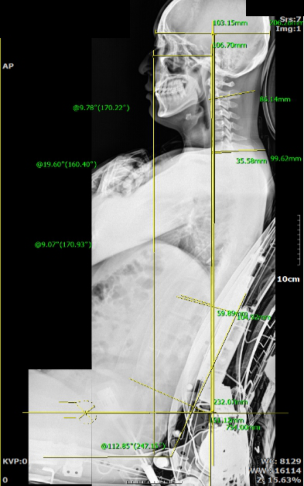
For the evaluation method, a visual analog scale (VAS) is used, scor- ing 1 point for being the most uncomfortable and 10 points for being the most comfortable. Afterwards, X-ray lateral photographs were taken in the seated position to measure and compare the following X-ray parameters in each seated position: cervical lordosis angle, thoracic kyphosis angle, lumbar lordosis angle, C7-SVA (sagittal vertical axis) distance, and seatback angle (Figure 1).
Figure 1: X-ray in optimal seating position (side view).
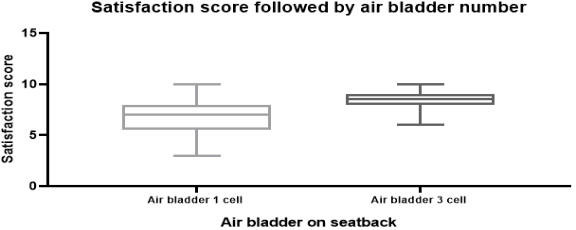
DIFFERENCES IN SATISFACTION DEPENDING ON THE NUMBER OF AIR BLADDERS INSTALLED ON THE SEATBACK Results indicated a notable difference in overall satisfaction with lumbar sup- port function among participants. Thirty minutes after being seated in car seats equipped with either one or three air bladders, participants responded to a questionnaire evaluating their satisfaction. Those seated in the seat with a single air bladder reported a satisfaction level of 6.90 ± 1.89. In contrast, participants using seats with three air bladders reported a higher satisfaction level of 8.31 ± 1.19. This difference in satisfaction levels was statistically sig- nificant, as indicated by a paired t-test result (p = 0.0271), suggesting a direct impact of air bladder quantity on lumbar support satisfaction. See Figure 2 for further details.
Figure 2: Differences in satisfaction depending on the number of air bladders installed on the seatback.
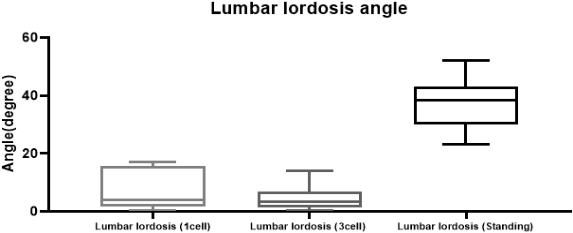
The optimal backrest angle with three air bladders was found to be 112.5 ± 4.01 degrees, compared to 110.4 ± 4.02 degrees in seats with one air bladder. This difference was not statistically significant (p = 0.054). Addi- tionally, cervical lordosis angles in seats with different air bladder counts showed no significant difference (p = 0.0726). The same was observed for thoracic kyphosis angles (p = 0.4752). However, lumbar lordosis angles var- ied significantly in an ANOVA test across different conditions, including standing and sitting in seats with one or three air bladders (p<0.0001), as detailed in Figure 3.
Figure 3: Lumbar lordosis angle difference depending on the standing state and the number of air bladders installed on the back rest.
X-Ray Analysis on the Difference in Ride Comfort Affected 571
Kyphosis Angle Number of air bladder 1 cell 3 cells 1 cell 3 cells 1 cell 3 cells
Mean 110.4 112.5 10.33 13.67 31.13 28.92 Std.Devi 4.02 4.01 8.94 10.40 7.27 8.88 C7 SVA Backset
Seated Lumbar Lordosis Angle
Number of air bladder 1 cell 3 cells 1 cell 3 cells 1 cell 3 cells Mean 7.91 4.42 88.68 119.6 0.56 −8.77 Std.Devi 6.86 3.78 48.83 48 17.36 9.41
H-Point Horizontal
H-Point Vertical VAS
Distance*
Distance**
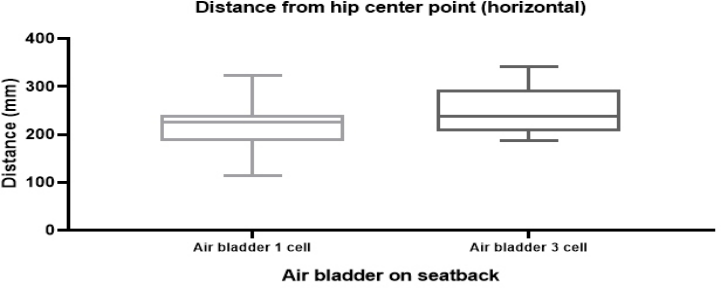
Number of air bladder 1 cell 3 cells 1 cell 3 cells 1 cell 3 cells Mean 220 252 767.5 766.7 6.90 8.31 Std.Devi 48.26 52.48 53.94 42.98 1.81 1.19
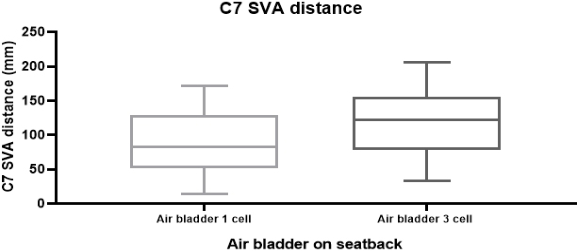
*H-point (horizontal) : distance from hip center point to occipital condyle pin (horizontal) **H-point (vertical) : distance from hip center point to occipital condyle pin (vertical) Participants exhibited a C7 SVA (Sagittal Vertical Axis) of 88.68 ± 48.83 mm when seated in seats with one air bladder, and a notably different mea- surement of 119.6 ± 48 mm in seats with three air bladders. This variation was statistically significant as confirmed by a paired t-test (p = 0.0031), as depicted in Figure 4. This finding underscores the impact of air blad- der quantity in car seats on spinal alignment, specifically the C7 SVA measurement.
The study revealed a significant difference in the H-point indicator to occipital condyle pin (horizontal) distance among participants seated in car seats with different numbers of air bladders. In seats with a single air blad- der, this distance measured 220 ± 48.26 mm. In contrast, seats with three air bladders showed an increased distance of 252 ± 52.48 mm. This difference was statistically significant, as confirmed by a paired t-test (p = 0.0112), and is illustrated in Figure 5. This finding highlights the influence of air bladder quantity on the horizontal alignment of the H-point indicator to the occipital condyle pin in car seats.
H-point indicator to occipital condyle pin (vertical) for participants seated in the seats with 1 and 3 air bladders in the backrest were not statistically different from each other in a paired t-test (p = 0.9524).
Figure 4: Relationship between the number of air bladders installed on the seatback and C7-SVA.Figure 5: Distance from hip center point to occipital condyle pin (horizontal).
DISCUSSION
The automotive industry has continuously enhanced vehicle design for improved comfort, efficiency, and reliability. Car seats, in particular, have evolved ergonomically with features like lumbar support and reclining back- rests, aiming to reduce spinal loads and muscle activity.
Despite this, driving-related musculoskeletal disorders and discomfort still exist, even among professional drivers (Cvetkovic et al., 2003). Driving involves being seated for short periods of time, however it also involves being seated for long distance.
Prolonged sitting can be a risk factor for low back pain, and seated pos- ture reduces lumbar lordosis when compared to standing (Pope et al., 2002): When seated, the pressure from the hips is placed on both hip bones (Pope et al., 2002): and as lumbar lordosis decreases, the load on both hip bones increases.
In addition, the muscle tension in the lumbar spine, including the hip bones increases, and it becomes difficult to reduce increased muscle tension due to various vibrations and impacts caused by driving and road conditions. This may lead to recurrent pain or discomfort. The normal shape of the spine is to have a lordotic curve in the cervical spine, a kyphotic curve in the thoracic spine, and a lordotic curve in the lumbar spine while standing.
X-Ray Analysis on the Difference in Ride Comfort Affected 573
However, sitting changes these normal standing curves. As shown in the results of this study, the lumbar lordosis angle showed a statistically signif- icant change in Air bladder 1 cell and 3 cells in the seated compared to the standing (ANOVA test, p<0.0001). However, there was no difference in lum- bar lordosis angle between Air bladder 1 cell and 3 cells in the seated state (p = 0.1019).
In addition, the changes in cervical lordosis and thoracic kyphosis angles were not statistically different when seated compared to standing. When seated in the seat with 3 air bladders in the backrest, the optimal seat angle was 112.5 ± 4.01 degrees, which was not statistically different from 110.4 ± 4.02 degrees in the seat with 1 air bladder (p = 0.054). However, there was a statistical difference in the distance to the H-point between the 1-cell and 3 cells of air bladder (p = 0.0112) and the C7 SVA between the two groups (p = 0.0031). This means that when seated, the backrest is tilted further back and the upper body is leaned against the seat- back more when creating an optimal seating position with the 3 cells of air bladders than when making an optimal seating position with the 1-cell air bladder.
This resulted in a statistical difference with the 3 cells scoring higher on back rest satisfaction than the 1 cell (p = 0.0271).
CONCLUSION
The study demonstrates that driver satisfaction correlates positively with the number of air bladders in car seats. An increase in the number of air blad- ders enhances the horizontal distance from the hip center to the H-point in a seated position, as well as the C7-SVA measurement. This suggests that a higher count of air bladders allows for a more tailored adjustment, enhancing comfort by enabling the upper body to lean against the backrest without the need to bend forward. These findings are anticipated to serve as a foundation for future advancements in car seat design, focusing on improving comfort.
REFERENCES
Adams MA, Mannion AF, Dolan P. (1999). Personal risk factors for first-time low back pain, Spine Volume 24, No. 23, pp. 2497–2505. Andersson GJB, Murphy RW, Ortengren R, Nachemson AL. (1979). The influence
of backrest inclination and lumbar support on lumbar lordosis, Spine Volume 4, pp. 52–58. Bridger RS, Von Eisenhart-Rothe C, Henneberg M. (1989). Effects of seat slope and hip flexion on spinal angles in sitting, Hum Factors Volume 31, pp. 679–688. Cvetkovic, M. M., Soares, D., Baptista, J. S. (2021). Assessing Post-Driving Discom-
fort and Its Influence on Gait Patterns, Sensors Volume 21, No. 24, p. 8492. De Looze, M. P., Kuijt-Evers, L. F. M., Van Dieen, J. (2003). Sitting comfort and discomfort and the relationships with objective measures, Ergonomics Volume 46, pp. 985–997. Diane E. Gyi, J. Mark Porter. (1999). Interface pressure and the prediction of car seat
discomfort, Volume 30, No. 2, pp. 99–107.
George M. Sammonds, Mike Fray, Neil J. Mansfield. (2017). Effect of long term driving on driver discomfort and its relationship with seat fidgets and movements (SFMs), pp. 119–127 Jordan Smith, Neil Mansfield, Diane Gyi, Mark Pagett, Bob Bateman. (2015).
Driving performance and driver discomfort in an elevated and standard driving position during a driving simulation, Volume 49, pp. 25–33. Lord MJ, Small JM, Dinsay JM, Watkins RG. (1997). Lumbar Lordosis : Effects of sitting and standing, Spine Volume 22, No. 21, pp. 2571–2574. Park, S., Lee, Y., Nahm, Y., Lee, J. et al. (1998). Seating Physical Characteristics and
Subjective Comfort: Design Considerations, SAE Technical Paper: https://doi.org/ 10.4271/980653. Park, S., Min, S., Subramaniyam, M., Lee, D. et al. (2014). Analysis of Body Pressure Ratio for Evaluation of Automotive Seating Comfort, SAE Technical Paper, https: //doi.org/10.4271/2014-01-0456. Peter Le, Joseph Rose, Gregory Knapik & William S. Marras. (2014). Objective
classification of vehicle seat discomfort, Ergonomics Volume 574, pp. 536–544. Pope MH, Goh KL, Magnusson ML. (2002). Spine Ergonomics, Annual Review of Biomedical Engineering Volume 4, pp. 49–68. Sung Yuk kim, Jong Rok An, Key Sun Kim. (2016). A Study on the Stiffness Char-
acteristics according to the Body Pressure on the Seat Cushion for Vehicle, Indian Journal of Science and Technology Volume 9, No. 46. Vincent Luboz, Mathieu Bailet, Christelle Boichon Grivot, Michel Rochette, Bruno Diot, Marek Bucki, Yohan Payan. (2018). Personalized modeling for real-time pressure ulcer prevention in sitting posture, Volume 27, No. 1, pp. 54–58. Wassim El Falou, Jacques Duchêne, Michel Grabisch, David Hewson, Yves
Langeron, Frédéric Lino. (2003). Evaluation of driver discomfort during long- duration car driving, Applied Ergonomics Volume 34, No. 3, pp. 249–255.
LISTED IN THE AHFE DIGITAL BOOKSTORE CATALOGUE
Explore the complete digital volume
Advances in Human Factors of Transportation
Read this individual research paper free through the original publisher, or explore the full digital proceedings book.
ISBN 978-1-964867-24-3
Explore this ISBN in the AHFE Bookstore ↗Listed in the July 2026 bookstore catalogue; search by ISBN to confirm current availability · Digital book purchase optional