Chengjin Qiu, Xiaojun Liu, Changbiao Zhu, Feng Xiao (2023). An ontology-based modeling and CBR method for cable process planning. In: Artificial Intelligence and Social Computing. AHFE Open Access, vol. 72, pp. 160–169. https://doi.org/10.54941/ahfe1003284
Cables exist in a large number of complex electronic devices, the quality of cable process design has a direct impact on the service quality and efficiency of the equipment. Cable process planning is a complex, time-consuming, and typically knowledge-intensive task that involves product information, process routing, parameters, and material selection, depending on the experience and knowledge of the process designers heavily. However, the unstructured and tacit nature of the knowledge makes it difficult to reuse. To implement knowledge-based intelligent cable process reasoning, and increase the design quality of the cable process plan while lowering the cost, it is critical to managing the cable process knowledge systematically and effectively. This paper proposes an ontology-based modeling method for cable product and process knowledge, in this approach, (1) A cable knowledge model containing cable product description and process plan is built; (2) Case-Based Reasoning (CBR) is employed to reuse knowledge from the previous case with the maximum similarity to realize rapid cable process planning, reducing the time and cost of process planning. In addition, a customized control cable process planning is taken as an example to verify the feasibility and effectiveness of the proposed method.
Cable products and the processes are complex,and cable process planning is a typical knowledge-intensive service process. The traditional serial design mode of cable product design, process design, and process review has a series of problems such as a long design cycle, low efficiency, poor inheritance of knowledge and experience, and a large proportion of repetitive non-value- added labor, the knowledge, and experience of process designers are not properly represented and reused. Due to the lack of a standard structure for expressing knowledge, how to express and utilize historical experience, and effectively share knowledge in the process planning and manufacturing process is the key to improving process design quality and reducing costs. Historical process cards, technical documents, and process designers have a wealth of empirical information and knowledge, which is disorganized, scat- tered, and in different format. Acquiring, storing, and sharing knowledge in a reasonable format is an important issue in cable process planning.
An Ontology-Based Modeling and CBR Method for Cable Process Planning 161
Process planning focused on large-scale production, but as products con- tinue to be subdivided, process planning for small-scale production has received increasing attention. The research on process planning can be rou- ghly divided into two stages: core analysis and process planning generation (Jiang, 2019). Process data and knowledge from previous processes are extre- mely helpful in process planning, but they are rarely used in practice. To reuse past successful process planning experience, case-based reasoning (CBR) was introduced to process planning. CBR is an approach for resolving future pro- blems based on previous experience. The classic 4REs model includes four steps: case feature description, case similarity calculation, scheme reuse, and retention (Mántaras, 2005). Zhang et al. (2006) presented a CBR method, indexing process cases via feature-based representation of drawn parts to achieve efficient case retrieval for process planning. Su (2007) proposed a CBR-based method for the assembly sequence planning of assembly process planning, applying genetic algorithms for automatic reasoning of assem- bly sequences. Seo et al. (2007) developed a process planning system based on CBR for block assembly in shipbuilding. You et al. (2010) presented a novel CBR-based method to accelerate the process planning and die design in automotive panel manufacturing. Zhang et al. (2013) proposed a method combining rough set and CBR for retrieval and reuse of camshaft grinding process conditions. Zhou et al. (2014) proposed a remanufacturing process planning method based on case-based reasoning. By identifying feature attri- butes, the nearest neighbor algorithm (NNA) is used to retrieve and reuse historical processes. Wang et al. (2017) proposed a method based on fuzzy theory and CBR, using fuzzy theory to determine the performance level of material cutting, retrieving historical data through the K Nearest Neighbor algorithm, and combining linear extrapolation and parameter adjustment method amendments to determine polishing process parameters. Wan et al. (2019) presented a knowledge reasoning method that improved the effecti- veness of maintenance planning by combining CBR and Adaptation-Guided Retrieval. Li et al. (2023) proposed a hybrid approach based on case reaso- ning and procedural reasoning. In CBR, the Analytic Hierarchy Process(AHP) method and the CRITIC method are used to determine the subjective and objective weights of the feature attributes, and the similarity between the latest cases and the retrieved cases is calculated based on the NNA algori- thm, the most appropriate process solution is selected from the case database to solve specific part process planning problems.
Ontology is a formal method for expressing knowledge in a specific domain, it can define the relations between concepts and attributes, as well as ensure the unity of understanding in the process of knowledge transmission and sharing. Case is an abstract knowledge representation method, which can effectively plan and accumulate knowledge. The core idea of CBR is to use the previous experience to quickly solve existing problems.
Therefore, this paper combines ontology and CBR to propose a know- ledge modeling and reuse method for cable process planning. The following contributions can be obtained through the proposed method: (1) The Appli- cation of the ontology concept unifies the knowledge of cable from the cable product, process planning, and resources and accomplishes the knowledge
integration and sharing. (2) According to the ontology, a cable product know- ledge semantic model is built, which contains product description and process planning. The semantic model enables the computer to understand and rea- son the process plan. (3) Combined with ontology, CBR is employed to retrieve the previous case with the maximum similarity from the case base, which supports the generation of the cable process plan.
CABLE KNOWLEDGE MODEL CONSTRUCTION The cable process plan is primarily designed based on cable type, chara- cteristics, and structures, and is then divided into various process routing according to specifications, using different processing equipment and mate- rials. The foundation for developing effective cable process plans is a detailed analysis of the cable products. Knowledge for cable product and process is consist of relevant, useful information and data that supports generation of high quality process planning. The following contents illustrate the detail steps of knowledge modeling for cable process planning.
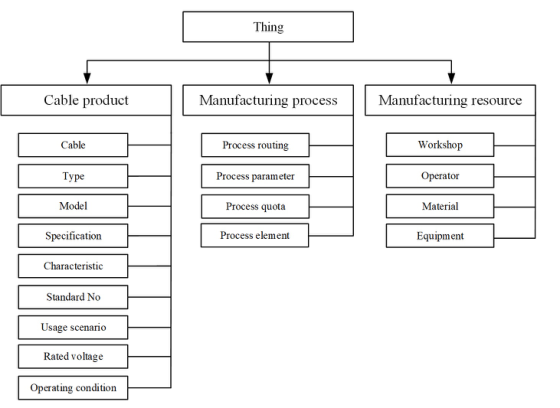
Cable knowledge is acquired by analyzing and summarizing cable pro- duct information, historical process cards, relevant technical standards, and process specialists’ expertise, as well as filtering out invalid, obsolete, and redundant data. The acquired domain knowledge is usually unstructured, it is necessary to organize and represent the knowledge in a structured, standardized manner and build a cable knowledge ontology model. Some concept should be firstly clarified to represent the ontology of cable pro- duct and process. Classes of the concepts can be sorted as Cable product class, Manufacturing process class, Manufacturing resources class, as shown in Figure 1.
Cable product class includes type, model, specification, etc. conveying the product information from product design to process planning. Construction
Figure 1: Classes in the cable ontology.
An Ontology-Based Modeling and CBR Method for Cable Process Planning 163
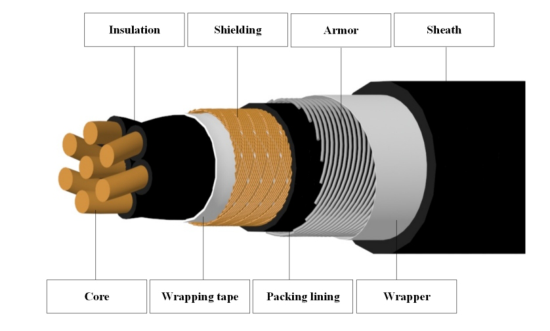
of cable may consist of core, insulation layer, wrapper layer, armor, sheath layer, etc.
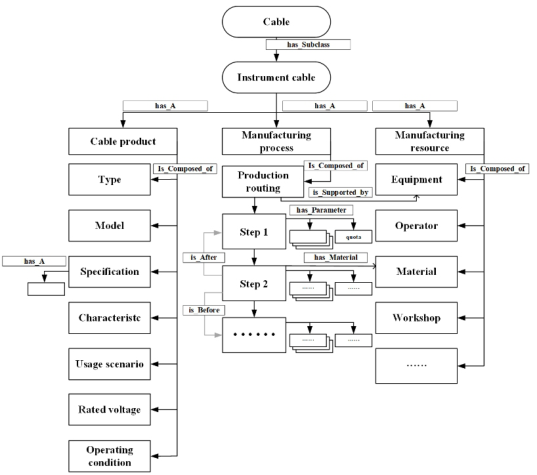
Manufacturing process class includes process routing, process element, process parameter and process quota. Process routing is composed of a series of process elements in a time-sequenced way. Each process element has logical relations (after, before) with another. Meanwhile, each process element has a logical dependent relation with Manufacturing resources class including material, equipment, workshop, and operator.
Manufacturing resource class refer to the collection of materials, machi- nes, molds and other resources involved in the manufacturing and processing of cables. Cable enterprises are generally built with multiple workshops, and workshop production equipment is mostly fixed in layout according to the corresponding kinds of cable processes, and a single workshop is responsi- ble for the production of certain specific kinds of cables, such as medium- and low-voltage cable production workshop, special cable production work- shop, etc. Therefore, the conceptual set of manufacturing resource knowledge model includes workshops, equipment, tools, materials, and operators.
The relationships between the classes of cable knowledge model are described specifically as shown in Table 1. Figure 2 shows the relationships between the classes taking instrument cable as an example.
Table 1. Definition of relationship in cable knowledge model.
Table available in the original PDF paper.
No Relationship Definition 1 has_Subclass To represent the relation between the parent class and the son class. 2 has_A To represent the relation between class and its property. 3 has_Material To record the material of a process element. 4 is_Supported_by To record the equipment of a process element. 5 has_Parameter To record the parameters of a process element. 6 is_Composed_of To represent a process flow. 7 is_Before To represent a process flow. 8 is_After To represent a process flow.
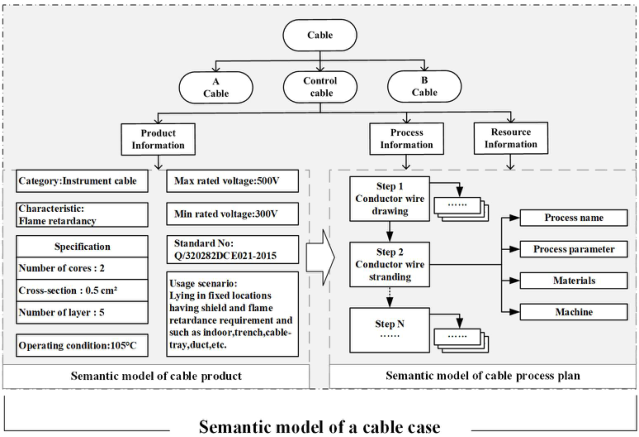
CABLE SEMANTIC MODEL To make the information easy to process, cable cases can be transformed into a semantic model according to the knowledge ontology, and then represented as case. Figure 3 illustrates the semantic model of a cable process planning case, which consists of two parts as the semantic model of a cable product as case problem and The semantic model of a cable process plan as case solution. The semantic model of a cable product contains feature attributes in the product information including model, specification, etc., which will affect the process plan. The semantic model of a cable process contains process routing, process parameters, equipment and materials. A series of process elements constitute the process routing in sequence, each process element has
Figure 2: Classes and relationships of a cable case.Figure 3: Semantic model of a cable case.
several attributes such as process name, materials, technical requirements, as shown in Figure 3.
CBR SYSTEM FOR CABLE PROCESS PLANNING After the cable process case database has been constructed, the previous pro- cess plan will be recorded and stored. A CBR-based system framework for
An Ontology-Based Modeling and CBR Method for Cable Process Planning 165
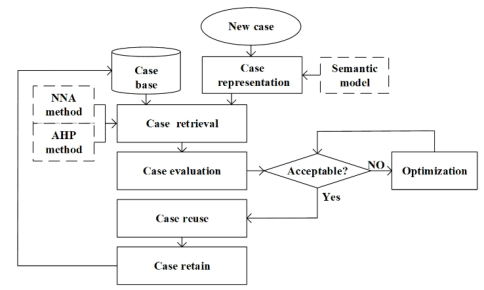
Figure 4: CBR-based system framework for cable process planning.
cable process planning is proposed. Figure 4 shows the flow map of the system, including case representation, case retrieval, case evaluation, case reuse, and case retain. The product information is employed to calculate the weight of each attribute, and the NNA is used to retrieve the case with the maximum similarity, of which the process plan will be reused after passing the evaluation and optimization.
Case representation is the basic part of CBR, which enables the computer to process the information. The cable case is represented in the form of a semantic model mentioned in previous content. The existing case is retrieved by calculating the similarity via the NNA. A cable product case contains many feature attributes, which have different influences on the process plan. The product information from cases will be called to determine the weight of feature attributes by the AHP method according to the importance given by experts. A weighting approach for cable feature attributes based on the AHP method is proposed, which considers the experience of domain experts to make the result reliable: (1) Judgment matrix construction: Construct the judgment matrix = [aij] n × n, n is the amount of feature attributes, aijis the value of importance given by domain experts. The 1–9 ratio scaling method is used in this paper. (2) Normalization: Normalize each column of , the weight of each feature attribute can be approached by (1) as follows:
n
1
Qn
Equations and mathematical formulas are available in the original paper PDF.
n
1 Pn
Where ωi is the weight of the i th feature attribute. (3) Consistency test: Conduct consistency testing to ensure the validity of the weighting result.
Case retrieval is the core of CBR. After determining the weight of each fea- ture attribute, the CBR-based system needs to calculate the global similarity
between the target process problem and each case in the database. The local similarity of each feature attribute is combined to generate the global simila- rity. The NNA is used in this paper to get the case with the highest similarity. Local similarity can be calculated by different methods according to the form of feature attributes that can be sorted as three types, as shown in Table 2.
For numerical factors, local similarity can be calculated by (2) as follow:
q
FX
2/[max(Fi) −min(Fi)] (2)
i −FY i
Where Xi and Yi are the i th feature attribute of case X and case Y, max(Fi) and min(Fi) are the maximum value and the minimum value of the factor.
For Linguistic factors, since they can’t be quantified, local similarity will be calculated by (3). When two linguistic factors are identical, the local similarity is 1. Otherwise, the local similarity is 0.
1 FX
For the enumeration factor, a cable product may have one or more cha- racteristics, described by the defined words. The local similarity of the characteristic can be calculated by (4).
i , FY
i )
(4)
i ) are the count of the characteristics of Case X and Case Y respectively, E(FX
i , FY
i ) is the count of common characteristic between Case X and Case Y.
After all the local similarity is determined, combined with the weight obtained by the AHP method, the global similarity can be calculated by (5):
Through the case retrieval stage, Case Y with the highest similarity to Case X in the case base can be selected. the case plan will be directly adopted
Table 2. Classification for local similarity calculation.
Table available in the original PDF paper.
No Type Feature attribute 1 Numerical factor Number of cores Cross-section Rated voltage Operating condition 2 Linguistic factor Model Layer structure Standard No Usage scenario 3 Enumeration factor Characteristic
An Ontology-Based Modeling and CBR Method for Cable Process Planning 167
If the process plan of Case Y passes the evaluation of the domain experts. Otherwise, the retrieved case needs to be revised to obtain feasible results. After the process plan is adopted, Case X will be stored in the case base for future retrieving.
CASE STUDY The process planning of customized anti-termite control cable is taken to verify the validity of the proposed method. The process plan of the control cable is determined by nine feature attributes, including model, number of cores, cross-section, Layer structure, characteristic, rated voltage, Standard No, usage scenario, and operating condition, which correspond to F1 to F9 in Table 3. And Figure 5 illustrates the structure of the customized cable of Case N.
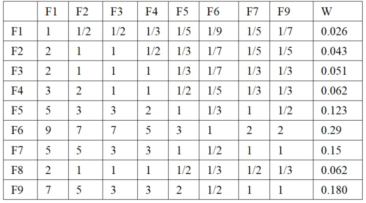
After the weights have been identified, the local similarity is calculated fir- stly for each attribute. Numerical feature attributes (F2, F3, F6, F9), Lingui- stic feature attributes (F1, F4, F7, F8) are determined by (2), (3) respectively., and enumeration feature attributes (F5) are determined by (4). The judgment
Table 3. Classification for local similarity calculation.
Table available in the original PDF paper.
Feature attribute Case N F1 KVVRP F2 7 F3 6 F4 Core/ Insulation/ Wrapping tape/ Shielding/ Packing lining/ Armor/ Wrapper/ Sheath F5 current shielded; anti-termite F6 450/750 F7 Lying in fixed locations having shield requirement such as indoor, trench, cable-tray, duct, etc. F8 GB/T9330-2008 F9 70
Figure 5: The structure of the customized cable of Case N.Figure 6: The judgment matrix and weights.
matrix of feature attributes is given in Figure 6, of which values are deter- mined by domain experts. The consistency index CI = 0.01915, the random consistency index RI = 1.45, and the consistency ratio CI/RI = 0.01311. Thus the judgment matrix passed the consistency test. The weight of each feature attribute is shown in the last column.
By calculation, Case 48 has the highest similarity to Case N with 0.9374. After evaluation by the process designer, the process plan for Case 48 could be reused for Case N except for the special components that had to be added to the sheath material due to the customization needs of Case N.
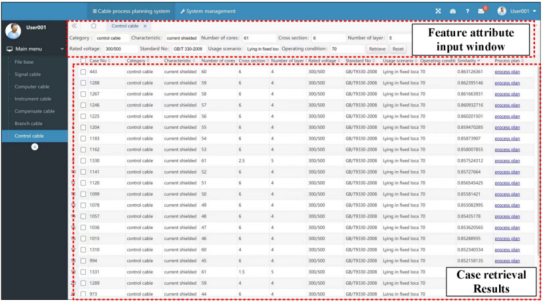
SYSTEM DEVELOPMENT AND INTERACTION PAGE Based on Eclipse, a CBR-based system for cable process planning is develo- ped to facilitate the application of the proposed method. The system allows users to input the information of feature attributes of cable such as type, cha- racteristic, number of cores, section, Layer structure, rated voltage, Standard No, usage scenario, and operating condition. The CBR function performs the calculations to determine similarity and output the case with the maximum value from the case base. The output case will be reused after the evalua- tion. Otherwise, users can revise it. Both the revised case and the reuse case will be retained in the case base to improve the effectiveness of the CBR system. Figure 7 illustrates the main interface of the CBR-based system for cable process planning.
Figure 7: The interface of the CBR-based system for cable process planning.
An Ontology-Based Modeling and CBR Method for Cable Process Planning 169
CONCLUSION
Cable process planning is complex and time-consuming, which is a typi- cal knowledge-intensive task. In this paper, an ontology-based method to reuse the historical empirical knowledge and generate the cable process plan is proposed. Ontology is used to organize the information from cable pro- ducts, process plans, and resources, which provides a structure to describe cable knowledge in a semantic model. In the meantime, CBR is employed to retrieve previous cases, of which knowledge will be reused to formulate the process plan. The proposed method is flexible and customizable since it can be extended to other electric products such as complex electronic component products. A customized control cable process planning has been selected to be an example, which verified the validity of the proposed method. An intera- ctive system was developed to help save time and labor costs in cable process planning.
ACKNOWLEDGMENT
All authors’ contributions to this article is acknowledged.
REFERENCES
Guilian Wang, Xiaoqin Zhou, Jie Liu, Peihao Zhu, Haibo Zhou. (2017) “Polishing process planning based on fuzzy theory and case-based reasoning,” The Int J Adv Manuf Technol, vol. 90, 907–915. Q. Su. (2007) “Applying case-based reasoning in assembly sequence planning,”,
International Journal of Production Research, vol. 45, 29–47. RLD Mántaras, Mcsherry, D., Bridge, D. G., Leake, D. B., & Watson, I. D. (2005) “Retrieval, reuse, revision and retention in case-based reasoning,” The Knowledge Engineering Review, vol. 20, 215–240. Seo, Y., Sheen, D., & Kim, T. (2007) “Block assembly planning in shipbuilding using
case-based reasoning,” Expert systems with applications, vol. 32, 245–253. Shan, W., Li, D., Gao, J., & Jing, L. (2019) “A knowledge based machine tool maintenance planning system using case- based reasoning techniques,” Robotics and Computer Integrated Manufacturing, vol. 58, 80–96. You, C. F., & Liu, T. (2010) “Representation and similarity assessment in case-based
process planning and die design for manufacturing automotive panels,” The Int J Adv Manuf Technol, vol. 51, 297–310. Z. Jiang, Y. Jiang, Y. Wang, H. Zhang, H. Caoand G. Tian. (2019) “A hybrid approach of rough set and case-based reasoning to remanufacturing process planning,” Journal of Intelligent Manufacturing, vol. 30, 19–32. Zhang, W. Y., Tor, S. B., & Britton, G. A. (2006) “Indexing and retrieval in case-
based process planning for multi-stage non-axisymmetric deep drawing,” Int J Adv Manuf Technol, vol. 28, 12–22. Zhang, X. H., Deng, Z. H., Liu, W., Cao, H. (2013) “Combining rough set and case based reasoning for process conditions selection in camshaft grinding,” J Intell Manuf, vol. 24, 211–224. Zhongyang Li, Zhaohui Deng, Zhiguang Ge, Lishu Lv, Jimin Ge. (2023) “A hybrid
approach of case-based reasoning and process reasoning to typical parts grin- ding process intelligent decision,” International Journal of Production Research, vol. 61, 503–519. Zhou, F., Jiang, Z., Zhang, H., & Wang, Y. (2014) “A case-based reasoning method for remanufacturing process planning,” Discrete Dynamics in Nature and Society, vol. 2014, 1–9.
LISTED IN THE AHFE DIGITAL BOOKSTORE CATALOGUE
Explore the complete digital volume
Artificial Intelligence and Social Computing
Read this individual research paper free through the original publisher, or explore the full digital proceedings book.
ISBN 978-1-958651-48-3
Explore this ISBN in the AHFE Bookstore ↗Listed in the July 2026 bookstore catalogue; search by ISBN to confirm current availability · Digital book purchase optional