Yu jian (2023). Meta-verse Non-Heritage in Art Exhibitions: Virtual Reality Contextual Narrative Across Time and Space. In: Intelligent Human Systems Integration (IHSI 2023): Integrating People and Intelligent Systems. AHFE Open Access, vol. 69, pp. 805–809. https://doi.org/10.54941/ahfe1002904
The meta-universe is a digital living space constructed by humans using digital technologies such as digital twin, virtual reality, Internet of Things, and cloud computing to connect reality and imagination. This mirror simulation of the real world breaks the boundaries of time and space and builds a new digital space-time context. Digital technology through sensing and VR makes people experience the retro atmosphere constructed by virtual reality across space and time while perceiving the real space-time embodied experience, which is the missing means to break the boundaries of space-time to experience the contextual narrative, revitalize historical relics, interpret historical stories, and achieve living heritage in art exhibitions. The concept of "contextual narrative" in the meta-universe ICH in the art exhibition will use digital modalities to recreate ICH scenes, and in terms of research methodology, it will draw on the narrative structure, characteristics, characters and plot of ICH scenes for inter-temporal construction.
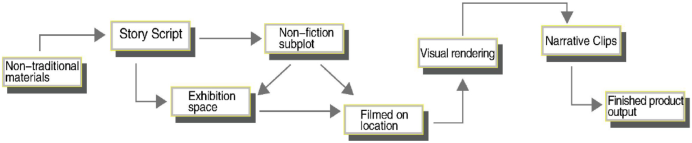
In traditional art exhibitions in real physical space, it is difficult to obtain complete information about the exhibits, and usually we can only see the exhibits in their current state. Therefore, we use meta-verse digital twin tech- nology to reproduce the scenes of non-heritage and combine it with virtual reality for contextual narrative experience, so that the audience can partici- pate in it and break this limitation of information transmission, and make the cultural heritage that no longer exists twin again through meta-verse digital technology. Through the guidance of narrative science and image semi- otics, we combine NRM with narrative context to create a complete NRM story line with narrative context, and complete the whole process from cre- ative planning, script design, site planning and sub-screen design to on-site filming and visual effects rendering through the relationship between plot, characters and space. Through the technical implementation of virtual rea- lity, such as screen display system, lighting system, camera recording system, rendering synthesis system and camera tracking system, the output of the
film is completed. The viewers can feel the macroscopic perspective brou- ght by the non-foreign heritage culture, achieve the inter-temporal dialogue of acquiring, fast-forwarding, abbreviating, enlarging and even reorganizing the complete information, complete the contextual restoration and achieve the living heritage.
METHOD
The Realization of the Non-Traditional Culture of the Meta-Verse in the Art Exhibition Completes the Fusion of Reality and Culture Reproduction of People, Objects and Space In the art exhibition viewing experience, we always pay attention to the relia- bility of information reception and information participation of the audience, to feedback the timeliness of the exhibition theme content and theme tran- smission. The objects in the exhibition become the intermediary and material carrier for transmitting information, and we output the content of the art exhibition through the full information saturation of the exhibition objects and are able to convey it in the spatial media carrier. The effective connection of reliable people, objects and space will form a good information cycle, so we have to make the three balanced and connected to each other. In traditi- onal art exhibitions, there is often an imbalance between people, objects and space, and the lack of spatial environment leads to the limitation of informa- tion about the exhibited objects, thus reducing the access to information for the audience. However, the digital twin, extended reality and virtual reality experience of the meta-verse make up for this, especially in the transmission of intangible heritage. The digital replication of intangible cultural heritage can largely solve the problem of information limitation of exhibits. Through the application of digital twin and virtual reality, the audience can experience the state of cultural heritage in real time in the space at the historical moment, and feel the complete information source in real time (Raskin 2003).
Research on the Intervention Methods and Technical Means of the Virtual Reality Interactive Language of the Meta-Verse Nonfiction to Realize the Form Breaking of the Art Exhibition and the Originality of the Experience The interactive language of the meta-verse nonfiction virtual reality benefits from the intervention of the contextual narrative approach. We analyze the creativity, scripting, and suitability of the nonfiction story to the art exhibi- tion space venue by studying the narrative context of the story. By analyzing the narrative context of the NFA, we derive the characters, the time, the place, the cause, the passage and the outcome of the story of the contextual rela- tionship and choose what narrative device to use for its expression, such as montage, flashback or interpolation. The whole process of on-set shoo- ting and visual effects rendering is carried out using the script designed by sub-screening. The final rendering synthesis and camera tracking are realized through the digital technology of virtual reality, and the contextual output of
Meta-Verse Non-Heritage in Art Exhibitions 807
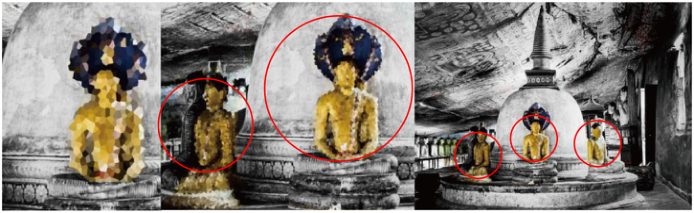
Figure 1: If, in cultural heritage, it is assumed that an exhibit is partially missing, the use of VR technology can attempt to supplement the missing information in the exhibit, with visitors using VR glasses for a virtual experience to achieve the integrity of the exhibition’s information output. This results in the integrity of the cultural heritage and its effective dissemination. (The red circle is the part of the work that the author assumes is missing).Figure 2: Virtual reality spatial contextual narrative production process.
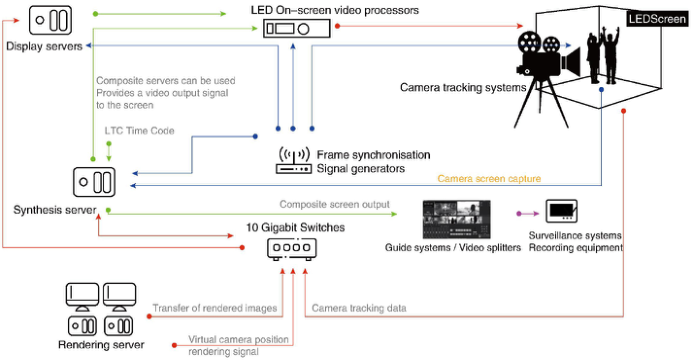
the non-fiction story is completed to construct a mixed reality spatial expe- rience, realizing the topography of the edges of the art exhibition form, and the audience’s original on-the-spot experience. In regards to meta-verse con- tent production, digital technology - XR Extended Reality - provides creators with unlimited spatial content imagination as well as the most valuable cre- ative tools. XR technology breaks traditional photography techniques and forms real-time synthesis technology, giving creators the most intuitive fee- ling of “What you see is what you get”, shooting content and the virtual environment to get a better real-time combination, special effects shots in the field LED directly display special effects environment, and real-time return to the synthesis effect. The latest LED screen customization, lighting camera system, robotic arm and motion capture system, all these latest technologies provide the latest digital technology to expand the reality of the event scenes and content visual effects of non-foreign heritage (Zettl 2003; Carey 2005).
An Analysis of the Unique Media Language of the Meta-Verse Nonfiction to Derive the Significance of the Experiential Pathways of the Meta-Verse in Spatio-Temporal Compression and its Transformation of Number Wisdom The iteration of technology has greatly influenced and promoted the media language of the exhibition, and it has also made an essential expansion of the content of the exhibition, “exhibition objects” that were not suitable for embodiment in art exhibitions can be “moved” to the real physical space of
808 Yu
Figure 3: Virtual reality space scenario production equipment connection diagram (The image is based on a public lecture at Hong Kong University of Science and Technology, Guangzhou).
the exhibition through digital technology. We can experience the boundless universe and the boundless desert under the limited space of physical field, which are the possibilities brought to us by the meta-verse. This is the real meaning of the transformation of the digital intelligence. The audience is no longer restricted by any field to experience the thousands of years of historical changes and cultural reproduction that the world is known for, and to travel freely in the long river of culture and history to feel the human civilization.
Results
Analyzes the narrative structure of the curatorial text of the art exhibition, combines the knowledge of history, sociology and cultural heritage conse- rvation to expand and deconstruct the narrative situation of NFA in the exhibition from content to form, allowing the narrator and the experiencer to interact in history and space-time, achieving the cultural interplay of the NFA meta-universe, breaking the limits of intergenerational communication, and enabling the living transmission of world cultural history.
CONCLUSION
The metaverse provides a wealth of assistance for the representation of cultu- ral heritage and the reproduction of cultural heritage in art exhibitions. New digital technologies offer many possible solutions for reproducing the com- plete habitat, cultural practices and social functions of cultural objects. In an art exhibition, the metaverse constructs a story that is no longer told through the path of physical space, but through virtual reality. The use of digital tech- nology and virtual reality allows us to dismantle the essential functions of physical space in an exhibition. The viewer can experience not only the shape of the real ‘thing’ but also the narrative of the ‘thing’.
Meta-Verse Non-Heritage in Art Exhibitions 809
The art exhibition aims to disseminate valuable information about the history, culture and knowledge of human civilisation to the viewer. At the heart of an art exhibition is the message of the exhibit. Yet, the entire mes- sage of the exhibit benefits from the connection between physical space and content. The content of the meta-verse ICH exhibition is narrated through technology, and we must find such a way to cross the limits of time, people and physical fields in real space, break the intergenerational transmission, complete the complete narrative thread through learning the language of nar- ratology, the output of technical images, and the expression of aesthetics, to realize the expression of context, and finally creatively present the design and essence of the ICH content in the real exhibition space. This realization has a qualitative impact on different audiences, archaeologists, architects, histo- rians, artists and even our children are all beneficiaries and participants in it at the same time, completing the narrative experience together.
REFERENCES
D. Dernie.: Advanced Course of British Exhibition Design, translated by Han Wei, Shanghai people’s fine arts publishing house, 18–40(2007). Degeng Li.: Image, Liquid Museum, Culture and Art Press, 3–14(2020). Diyong Long.: Spatial Narrative Research, Toko Buku Sanlian, 86–123(2014). Dudley, Sandra.: Museum Materialities, 120–136(2009). Herbert Zettl.: Image, Sound, Motion, translated by Zhao Miaomiao, Beijing
broadcasting institute press, 17–30, 207–216(2003). Hong Wu.: The history of art in space, translated by Wenyi Qian,sRumah Penerbitan Rakyat Shanghai, 85–106(2017). James W. Carey.: As the Transmission of Culture, translated by Ding Wei, Huaxia
publishing house, (2005). Jef Raskin.: The Humane Interface, translated by Shi Yuanchun, China machine press, 1–8 (2003). Jer Thorp.: Living in Data, translated by Yixin Lu, Facebook Press, 18–40(2021). Matthew Ball.: The metaverse changes everything, Zhejiang Education press,
68–112(2022). William R. Sherman and Alan B. Craig.: Understanding Virtual Reality,Machinery Industry Press, 42–66 (2022).
LISTED IN THE AHFE DIGITAL BOOKSTORE CATALOGUE
Explore the complete digital volume
Intelligent Human Systems Integration (IHSI 2023): Integrating People and Intelligent Systems
Read this individual research paper free through the original publisher, or explore the full digital proceedings book.
ISBN 978-1-958651-45-2
Explore this ISBN in the AHFE Bookstore ↗Listed in the July 2026 bookstore catalogue; search by ISBN to confirm current availability · Digital book purchase optional