Dimitrios Ziakkas, Abner Del Cid Flores, Michael W Suckow (2023). Human Factors in Aviation and Artificial Systems: The Purdue Aviation Virtual Reality case study. In: Intelligent Human Systems Integration (IHSI 2023): Integrating People and Intelligent Systems. AHFE Open Access, vol. 69, pp. 443–448. https://doi.org/10.54941/ahfe1002864
Because of the COVID-19 pandemic, video conferencing has dramatically expanded as an alternative to traditional face-to-face classroom instruction. It is particularly challenging to replace practical classes with video education since they require theoretical and empirical competence. This research presents a method that uses virtual reality and metaverse techniques in the classroom as well as simulators to solve the limitations present in the current models of practical education delivered at a distance. There is a chance to use emerging hardware and software and integrate them to establish a new paradigm of training platforms and pedagogical methods. This can be accomplished through the utilization of existing resources and the creation of new ones. Traditional flight simulators are very different in their operational aspects from virtual reality (VR) due to VR's more reasonable cost, more accessibility, fewer space requirements, and sustainability. In addition, training with VR can improve a learner's cognition as well as their ability to acquire new skills, as well as their technical and psychomotor abilities, and their willingness to study (Fussel & Hight, 2021). The use of virtual reality (VR) in training could potentially improve the soft skills of aviation workers, according to empirical evidence (Haritos & Fussel, 2018; Oberhauser & Dreyer, 2017). For instance, the findings of Thomas et al. (2021) suggested that real-world aviation illusion VR scenarios might increase pilots' ability to prevent accidents originating from visual illusions when flight operations were being carried out. In undergraduate aviation education programs, innovative teaching methods that leverage VR technologies can increase student engagement and reduce the cost of traditional simulator training for each student. Although VR will not replace the use of traditional simulators in the near future, this does not mean that VR will never replace traditional simulators.We developed a simulated aircraft flight and maintenance environment at the Purdue Artificial Intelligence Lab (Purdue University - SATT) to verify the suggested strategy's efficacy. We then compared this environment to the video-based training system that was already in place. Assessments of the student's ability to acquire and retain information and attendance were carried out to determine whether or not the educational efforts were successful. The experiment findings show that the group that followed the advised technique fared significantly better on both knowledge tests than the group that watched the video training. The results of the presence questionnaire, which validated the participants' perception of physical presence, were used to establish how user-friendly the proposed system would be.
Virtual Reality (VR) is the concept of being immersed in a computer- generated environment that includes visual, auditory, and optionally haptic representations of the environment. This environment, such as a room, land- scape, or cockpit, may be displayed on a screen or head-mounted display (headset). The user may be able to interact with the environment by gestures or physical buttons or levers, for instance.
VR is utilized in a variety of sectors, including entertainment (video gaming), robotic control (operating, robotic surgery), therapy (treatment of anxiety disorders), meditation, and education. Immersion or the impression of “being there” is the primary advantage of utilizing VR. The degree of immersion depends on the sophistication of the VR system. A high screen frame rate, high quality screens, low system latency, and complex visuals are required for an engaging VR experience. Adding 3D audio (binaural audio), controllers for interactivity, and haptic (touch) feedback can boost the immer- sion level. If the VR experience is sufficiently realistic, the user’s mind can be convinced that the virtual world is genuine (Anderson, 2021).
As subjects can be taught in a vastly different manner than by reading a textbook or listening to a lecturer, VR offers new chances to significan- tly improve teaching and learning. Knowledge retention — the capacity to recall what is learned – is one of the most crucial parts of learning (Diamond, 1989). This is especially true for flight crew, who must memorize aircraft systems details, procedures, and rules. According to studies, VR-assisted lear- ning has the potential to increase knowledge retention by up to 400%, hence enhancing the value of time spent studying.
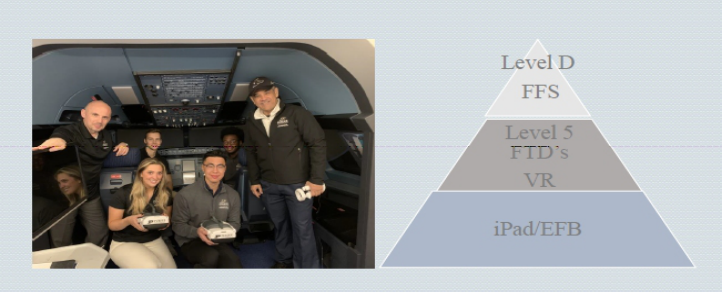
Due to VR-assisted learning, pilots are able to remember the emergency checklist more effectively, requiring less retraining and ultimately resulting in being better pilots. In accordance with Edgar Dale’s Cone of Experience and Purdue Virtual Reality Research Laboratory technology pyramid (see Figure 1), students recall just 10% of what they read, but 90% of what they do (Dale, 1969). This demonstrates the validity of the adage “you learn by doing”.
Studies have demonstrated that VR significantly enhances the student’s involvement in the learning process, resulting in enhanced retention of the material. This is an obvious advantage for flight crew members who have to memorize complicated procedures (Ziakkas, 2022).
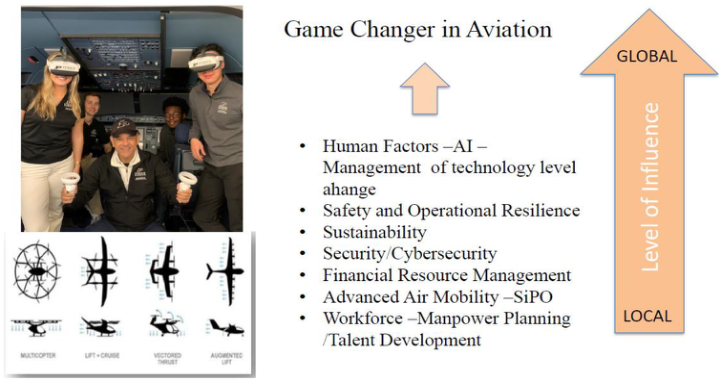
VIRTUAL REALITY IN PURDUE The Purdue Virtual Reality Laboratory envisioned the implementation of an AI training syllabus and the introduction of AI standardization principles in the global AI aviation ecosystem (see Figure 2).
Human Factors in Aviation and Artificial Systems 445
Figure 2: Purdue technology research action plan (Ziakkas, 2022).
Purdue research protocol offers VR applications for both civil and military use as the first phase of introduction in AI (Ziker, 2021). The civil resea- rch flight training plan utilises the VRpilot software for A-320 and B-737 (https://vrpilot.aero/vrflow/). Purdue VR and AR training simulators would enable aviation mechanics to remotely learn and check aircraft parts in a fully immersive environment. Airbus technicians, for instance, use VR tech- nology to check and repair their aircraft utilizing a VR headset, touchpads, and infrared cameras.
Focusing on Professional flight VR training courses, SATT with VRpilot offers the following VR learning experience to Purdue collegiate students:
Normal Procedures Training (A-320/B-737)
Abnormal – Emergency Procedures / Memory Items Training
Memory Training
Cockpit familiarization module
Flow visualizations
Step by step explanations
Multi - crew remote training
Automatic crewmember for solo training
Competency Based Training and Assessment (CBTA) - Exam
Dynamic Pilot Flying (PF) – Pilot Monitoring (PM) task sharing
Eye tracking monitoring
Errors monitoring
Debriefing
Data analytics
Machine Learning More explicit, developing accurate distance perception is a crucial part of pilot training (Rogers, 1962). Virtual reality headsets typically have ste- reoscopic displays, where two slightly offset images of the same scene are presented to the user. Like the stereoscopic vision we have naturally with our two eyes, this conveys a sense of depth and distance. Thus, virtual reality can
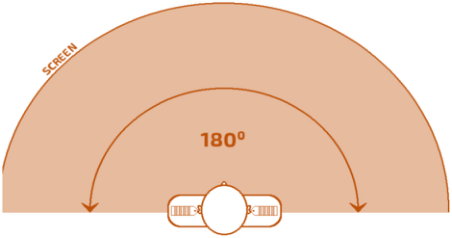
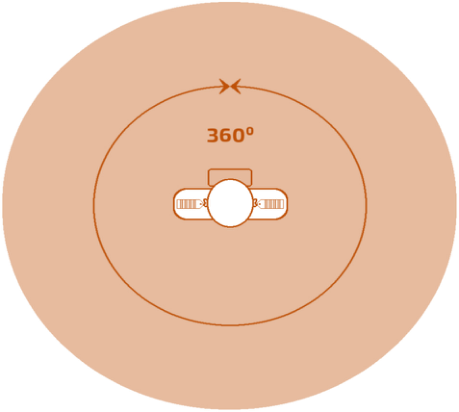
Figure 3: Field of view on a curved screen – typical simulator view, (Ziakkas, 2022).Figure 4: Field of view with VR goggles.
precisely and intuitively portray distances in a flight simulation where this feature is critical, such as when practicing landings where the altitude above the runway in the flare is important to assess correctly the touchdown zone and the aiming point. A proper lookout is another crucial skill that every pilot must master. When executing a landing circuit and watching for traffic, lookout is required. Rarely do traditional flight simulators include a field of vision that extends beyond 180 degrees (see Figure 3), greatly restricting the ability to conduct a proper lookout.
Furthermore, pilots in the simulators cannot utilize the lookout protocols as they would use in a real aircraft, and in training must frequently turn to alternative methods of reference, such as timing of their maneuvers. Using accelerometers and gyroscopes, virtual reality goggles allow the trainee pilot to view in any direction (see Figure 4). This enables the Purdue student to practice lookouts in the same way they would in a real aircraft by allowing the student to look beyond the 180-degree field of view offered by conventional flight simulators.
Realism and eye error – eye tracking / monitoring capabilities allow Purdue to offer Competency based training – simulator courses. Following an AI data
Human Factors in Aviation and Artificial Systems 447
analytics recommendations (EASA, 2020), Purdue analyses the training data focusing on:
Faster Learning rate
Better knowledge retention
Reduce negative training.
VR INTEGRATION IN SATT From the onset of SATT development, Human System Integration (HSI) experts contribute by ensuring that human capabilities and limitations are considered in the design of AI training syllabus. The Purdue HSI team is developing a research protocol that could be easily incorporated into the systems engineering test plan to implement AI in aviation training globally and evaluate the results. SATT experts established and are working within a framework consisting of systems’ engineering processes and methodologies to ensure successful human systems integration (Rotolo, 2015). The frame- work was based on the simple to complex approach to meet functional and non-functional requirements (Veletsianos, 2010). The Purdue research roa- dmap is focused on AI certification process (FAA, EASA), implementation of an AI training syllabus followed a change management approach, and intro- duction of AI standardization principles in the global AI aviation ecosystem. Moreover, the VR systems engineering team assisted in analysing collegiate aviation program requirements.
Purdue studies have demonstrated a significant reduction in training time by utilizing VR simulators - from one year to four months for aviation training applications. The identified benefits are:
Reduced instructor hours
Competency based training – simulator preparation
Training – scheduling flexibility
Improved System Knowledge
Faster Learning rate
Better knowledge retention
Reduced negative training The preliminary results from Purdue AI use in aviation training are not only promising as training added value but a proof that sound HSI can be effective and efficient.
CONCLUSION
Due to the reduced requirement for big hardware components and modula- rity options, the adoption of virtual reality as a core component of the flight training process has the potential to significantly cut flight training expenses. Not only may VR training save expenses for aviation training organizations, but students are also more likely to learn more quickly and efficiently, as well as retain the information better (Rushby, 2016). Moreover, VR Purdue Human Factors team examines the introduction and implementation of VR in aviation training.
The Purdue human systems integration team is developing a research pro- tocol that could be easily incorporated into the systems engineering test plan to implement AI in aviation training globally and evaluate the results. Finally, the Purdue research roadmap is focused on AI certification process (FAA, EASA), implementation of an AI training syllabus following a change mana- gement approach and introduction of AI standardization principles in the global AI aviation ecosystem.
ACKNOWLEDGMENT
The authors thank faculty members of Purdue University for their invaluable feedback contributing to this work.
REFERENCES
Alnagrat, A. J. A., Ismail, R. C., & Idrus, S. Z. S. (2021). Extended Reality (XR) in Virtual Laboratories: A Review of Challenges and Future Training Directions. Journal of Physics. Conference Series, 1874(1), 12031–. https://doi.org/10.1088/ 1742-6596/1874/1/012031 Anderson, A., Boppana, A., Wall, R., Acemyan, C. Z., Adolf, J., & Klaus, D. (2021).
Framework for developing alternative reality environments to engineer large, com- plex systems. Virtual Reality: the Journal of the Virtual Reality Society, 25(1), 147–163. Diamond, Robert M. Designing and Improving Courses and Curricula in Higher Education. San Francisco, Jossey-Bass, 1989. Dale, Edgar. Audio-Visual Methods in Teaching, 3rd ed., Holt, Rinehart & Winston,
New York, 1969, p. 108 EASA. (2020). Artificial Intelligence Roadmap: A human-centric approach to A.I. in aviation. Irvin, W., Goldie, C., O’Brien, C., Aura, C. J., Temme, L. A., & Wilson, M. (2021).
A virtual reality aviation emergency procedure (ep) testbed. Virtual, Augmen- ted, and Mixed Reality (XR) Technology for Multi-Domain Operations II. https://doi.org/10.1117/12.2585952 Rogers, E. M. (1962). Diffusion of innovations. New York, NY: Glencoe Free Press. Rotolo, D., Hicks, D., & Martin, B. R. (2015). What is an emerging technology? Research Policy, 44(10), 1827–1843. https://doi.org/10.1016/j.respol.2015. 06.006 Rushby, N., & Surry, D. (2016). The Wiley handbook of learning technology (Vol. 1).
Wiley Blackwell. Veletsianos, G. (2010). A definition of emerging technologies for education. In G.
Veletsianos (Ed.), Emerging technologies in distance education. Athabasca, AB: Athabasca University Press. Ziker C., Truman B., Dodds H. (2021) Cross reality (XR): Challenges and opportunities across the spectrum. In: Ryoo J., Winkelmann K. (eds) Innovative learning environments in STEM higher education. SpringerBriefs in Statistics. Springer, Cham. doi: 10.1080/10508414.2017.1313096 Ziakkas, D., Plioutsias, A., Pechlivanis, K., 2022. Artificial Intelligence in avi-
ation decision making process. The transition from extended Minimum Crew Operations to Single Pilot Operations (SiPO). Artificial Intelligence and Social Computing. AHFE (2022) International Conference. AHFE Open Access, vol 28. AHFE International, USA. http://doi.org/10.54941/ahfe1001452
LISTED IN THE AHFE DIGITAL BOOKSTORE CATALOGUE
Explore the complete digital volume
Intelligent Human Systems Integration (IHSI 2023): Integrating People and Intelligent Systems
Read this individual research paper free through the original publisher, or explore the full digital proceedings book.
ISBN 978-1-958651-45-2
Explore this ISBN in the AHFE Bookstore ↗Listed in the July 2026 bookstore catalogue; search by ISBN to confirm current availability · Digital book purchase optional