Dimitrios Ziakkas, Abner Del Cid Flores, Michael W Suckow (2023). The Implementation of Competency-Based Training and Assessment (CBTA) Framework in Aviation Intelligence Human Systems. In: Intelligent Human Systems Integration (IHSI 2023): Integrating People and Intelligent Systems. AHFE Open Access, vol. 69, pp. 862–868. https://doi.org/10.54941/ahfe1002911
At the current stage, one of the most critical aspects of workforce planning in Human Resources Management (HRM) entails ensuring that employees possess the appropriate skills and competencies to fulfill the organization's job description requirements. The global competitiveness in the modern aviation business has undergone a profound change (Intelligence Human Systems Integration) and the proliferation of a diverse network of low-cost and traditional carriers that has increased the reach, breadth, and frequency of traditional passenger-carrying services. As a result of the constantly expanding gap between demand and supply for qualified and highly competent experts in Intelligence Human Systems Integration, airline recruiters are under increasing pressure to find novel techniques for attracting and communicating with potential employees.This study aims to develop a strategy for incorporating the Competency-Based Training and Assessment (CBTA) framework into aviation personnel planning, training and management of the Intelligence Human Systems Integration - change. Research objectives include a theoretical study of the CBTA framework, an examination of the existing state of human resources planning, training and operations; the identification of the pilot performance gaps and the function of quality training; and a recommendation for adopting the CBTA framework in aviation human resources framework and Intelligence Human Systems Integration. When establishing the worldwide CBTA framework for the aviation industry, the authors analyzed the controlling elements and trends in the industry, proposing a global approach of managing the Intelligence Human Systems Integration - change.The components of putting the CBTA framework into action were considered in light of the pandemic repercussions. According to the findings of the subsequent study, aviation programs should encourage learning beyond the minimum knowledge requirements during the ab initio phase of the training, as well as provide opportunities for ongoing education and emphasize the quality of education rather than the quantity (building hours), implementing new aspects of technology (AI). As a result of the research, several conclusions have been formed, and one of them is that the demand for human factors is a top priority in the aviation business. This demand is affected by organizational culture, resistance to technological change, and legislative employment constraints.In the following study, a synthesis of the Lean Six Sigma (L6) strategy and implementation of the CBTA framework is proposed as an alternative to the existing method in many countries, which restricts management of change and causes unneeded organizational pressure. Additional recommendations include implementing validated CBTA – EBT / psychological applications during the implementation process and management of change to assist airlines in becoming an employer of choice in the sector and expedite the Intelligence Human Systems Integration .
Many organizations around the world struggle with effective manpower planning as they try to match people with specific skills and talents with their short- and long-term needs and goals (Marchington, 2015). There have been a lot of books and articles written about effective manpower planning. These provide both theoretical and practical principles for effective and effi- cient human resource management (HRM). Organizations are encouraged, both theoretically and strategically, to think about how they can and should organize their staff resources to achieve strategic differentiation (Paauwe and Boon, 2018). On the other hand, many organizations get stuck in a cycle of controlling employee availability day-to-day to meet short-term resourcing needs at the operational and tactical levels, which takes them away from their strategic planning (Armstrong and Taylor, 2014).
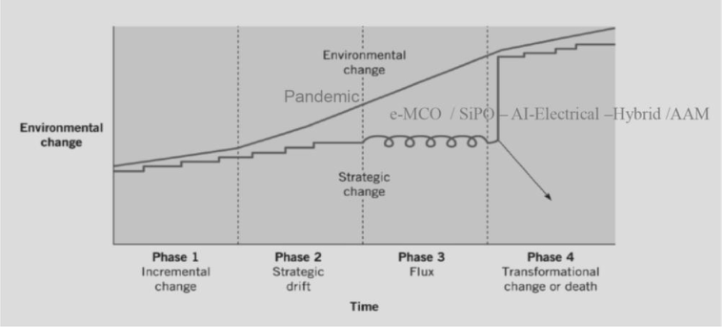
Also, from a broader perspective, hiring process in aviation has a number of problems that have been written about and seen in practice (Taylor and Cotter, 2019). In addition to COVID-19 distracting the aviation industry and causing more people to lose their jobs, there aren’t enough aviation Subject Matter Experts with the right training and experience around the world right now. Additionally, aviation environment changes brought on by technologi- cal improvements and legislative limits on the adoption of new technology (AI) result in deviance from the intended change plan (Phases 1-4, Figure 1).
Strategic boundaries for airlines include factors like organizational culture, competition for strategic goals, and a lack of strategic alignment. One of the most important things to consider when hiring for a job in the aviation indu- stry is how specialized the skills are that make up a candidate’s qualifications and experience (Lewis et al., 2015). Since the skills needed to work in the flight operations and flight training departments are clear and can be veri- fied by a certificate, it takes more than generic or blanket passive recruiting methods to find the right people competent to Aviation Intelligence Human Systems (Gnanprakash and Kulkarni, 2016).
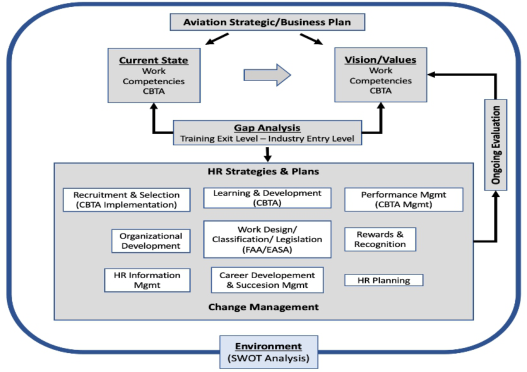
Also, Paauwe and Farndale (2017) suggested a similar model to the avi- ation HR Planning and Analysis Model, which is shown in figure 2 below. The proposed model shows how a business’s strategic plan figures out how the company will move from its current state to a set of values that will help it reach its goal. So, to get to the desired state, gaps in performance (compete- ncies) and human resources (manpower planning) are found. HR plans and strategies focus on a number of performance areas, such as Aviation Intelli- gence Human Systems job design, job description, and classification, as well as HR information management. The model shown (figure 2) shows how the HR functions help the business achieve its strategic goals.
Figure 1: Aviation environmental and Change management presentation (Ziakkas, 2022).Figure 2: Aviation Performance Gap analysis and Change management (Ziakkas, 2022).
DEVELOPING HUMAN SYSTEMS INTEGRATION TOOLS TO SUPPORT AVIATION SYSTEMS DESIGN Human Systems Integration (HSI) is becoming a critical piece of complex systems to help resolve system designs This is a significant opportunity for the aviation sector to shorten development cycles, but it also presents a num- ber of issues regarding the dependability of Machine Learning/Deep Learning ML/DL software. The Purdue human systems integration team is developing a test plan with CBTA tools that could be easily incorporated into the systems engineering test plan to implement AI in aviation training globally and eva- luate the results. Moreover, the Purdue Research roadmap is focused on the following identified challenges:
The Implementation of Competency-Based Training and Assessment (CBTA) Framework 865
Traditional frameworks for development assurance are not suitable to machine learning ML emphasizes various aspects of the procedure, such as data prepara- tion, architecture and algorithm selection, hyper-parameter tweaking, etc. There is a need for a paradigm change to establish learning-specific assurance procedures (‘learning assurance’ building block, EASA, 2020).
Difficulties in maintaining an exhaustive description of the desired function It is expected that development assurance principles will continue to be used to capture the desired function at a higher level and to describe the plat- form requirements (hardware + core software) that will be used as a resource for executing ML applications at a lower level. However, when it comes to learning processes, the behavior will be determined by both the data set used to train the algorithm and the learning process itself. Maintaining a trace- ability relationship with higher-level needs and ensuring the completeness and accuracy of the data collection may become increasingly difficult. More- over, the quality of the dataset will be of utmost relevance, as insufficient or inaccurate data may affect the training model’s behavior. The amount of difficulty will also depend on the type of ML process: Unsupervised or rein- forcement learning may result in less predictable behavior than supervised learning.
The lack of predictability and explicability of the machine learning application’s behaviour ML applications are probabilistic by nature. Even if a machine learning (ML) model is mathematically deterministic (e.g. fixed weights in a neu- ral network), the output for any new input will depend on the correlation between that input and the training data set. This can result in results that are difficult to predict and understand. Consequently, it is necessary to further investigate the concept of ‘Explainability of AI’ (‘explainability’ buil- ding block, EASA, 2020) in order to expand the capability of making the conditions that led to a specific output more accessible.
The current vision of Purdue University on competency-based training (Keller et al., 2020) and the evaluation of ongoing technology opportunities (e.g., AI) in aviation training suggests a holistic aviation training approach to address these areas following the simple-to-complex method. The trai- ning concept shift suggested under CBTA should not be regarded as merely a replacement set of critical events to an older and obsolete one. Instead, the concept is a means for developing and accessing crew performance by making use of human factors aspects and clearly defined Artificial Intelligence student learning objectives.
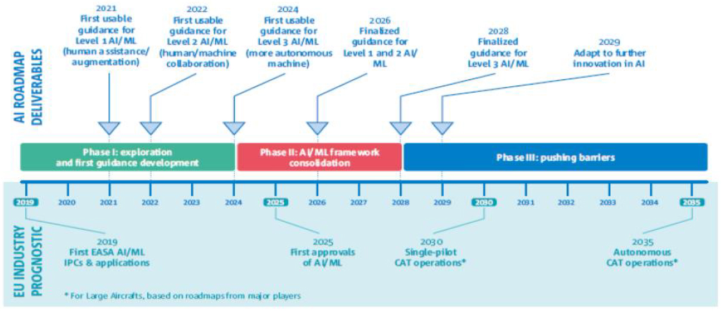
The content efficiency, teaching experience, and the aviation market needs are implemented through the competencies and the standardization of AI in aviation. Increased adoption of competencies from airlines and regulators and support for flight schools will be needed as the industry moves to CBTA. SATT revised the AT-38800 course (Large Aircraft Systems) to familiarize the students with Phase I and link them with phases II & III as presented in Figure 3.
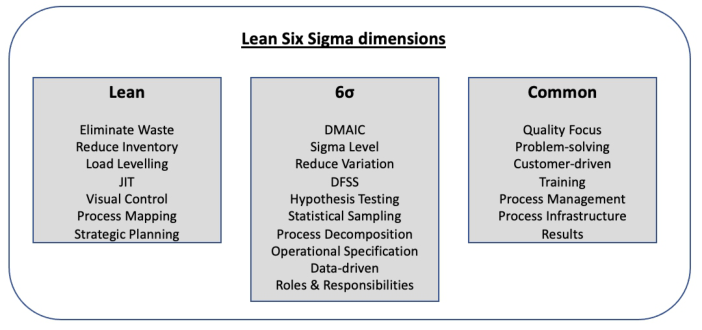
Figure 3: Artificial Intelligence in Aviation Roadmap (EASA, 2020).Figure 4: Lean Six Sigma dimensions. (Ziakkas, 2022).
In addition, the outcomes of Purdue research indicate that there is a tight connection between lowering operating and training expenses and applying the CBTA - lean process (Ziakkas 2022). As a consequence of this, strategic goals should be formulated and implemented in the business while simul- taneously maintaining lean processes and keeping operating expenses at an appropriate level, as will be seen in the common area below (Figure 4).
CBTA as a Supportive Framework for Design and Modelling The term “competency” refers to a characteristic of human performance that is utilized in the aviation sector to reliably predict successful performance while on the job. The manifestation and observation of a competency occurs when an individual engages in behaviors that call upon the appropriate kno- wledge, abilities, and attitudes in order to carry out activities or tasks within predetermined parameters. The ICAO description of knowledge, abilities, and attitude is followed by the research (ICAO, 2022):
The Implementation of Competency-Based Training and Assessment (CBTA) Framework 867
“Knowledge is specific information required to enable a learner to develop and apply the skills and attitudes required to recall facts, identify concepts, apply rules or principles, solve problems, and think creatively in work,”
“Knowledge is specific information required to enable a learner to develop and apply the skills and attitudes required to recall facts, identify concepts, apply rules or principles (ICAO, 2022).
An individual’s attitude is a persistent mental state or disposition that may be learnt, and it determines the individual’s choice of personal behavior toward any item, person, or event. Attitudes can be positive or negative, and they can change over time. Attitudes can be broken down into three categories: affective, cognitive, and the behavioral effects they produce. An aviation SME needs to “know how to be” in each different setting in order to display the “correct” attitude.
Based on guidelines from the International Air Transport Association (IATA), the professional flying program at the Purdue University School of Aviation and Transportation Technology (SATT) recognized both technical and nontechnical competencies. Purdue research used both qualitative and quantitative approaches in order to validate the hypothesis that implemen- ting Competency-Based Training Assessment in conjunction with a structu- red recruitment and selection plan results in an increase in organizational performance.
The inductive research approach that was selected looks into ways to cut down on delays in pilot recruiting and training by introducing personnel com- petencies that reduce performance disparities. In addition to this, the study investigates how an airline’s operating costs are affected by the Lean Six Sigma personnel planning process and training (Figure 4). There is a con- nection between the research and the lean mentality due to the fact that removing unnecessary steps from the recruitment process can help reduce the amount of money and time spent on recruitment, as well as the costs associated with training employees at airline firms.
CONCLUSION
Human Systems Integration (HSI) is becoming a critical piece of complex systems to help resolve system designs. The purpose of this study is to develop a strategy for incorporating the Competency-Based Training and Assessment (CBTA) framework into aviation personnel planning, training and manage- ment of the Intelligence Human Systems Integration - change. A standardized and consistent process will be provided by the proposed implementation of CBTA to a modern recruitment approach utilizing lean manpower planning. This process will be in harmony with the proposed SIPOC workforce plan- ning process, which will allow for a long-term relationship with candidates and reduce the identified inconsistency in workforce planning.
The globalized nature of the aviation industry makes it necessary for many airlines to engage in the recruitment of individuals across global lines. This requires recruiters to transition from their traditional roles as passive human resource agents to those of active CBTA specialists who are able to build
a larger pool of qualified applicants downstream. As the industry transiti- ons toward CBTA models, there will be a demand for more adoption of competences from airlines and regulators, as well as assistance for flight schools.
Moreover, the Purdue Research roadmap is focused on AI certification process (FAA, EASA), implementation of an AI training syllabus following a change management approach and introduction of AI standardization pri- nciples in the global AI aviation ecosystem. In conclusion, the findings of this research project indicate that in order to solve the issue of recruitment and selection of new aviation SME’s, the organization must rethink its organiza- tional culture, adopt an integrated CBTA approach, and put into practice the proposed Lean Six Sigma Recruitment method. This is necessary in order to address the problem of recruitment and selection of new employees.
ACKNOWLEDGMENT
The authors thank faculty members of Purdue University for their invaluable feedback contributing to this work.
REFERENCES
Armstrong, M. and Taylor, S., 2014. Armstrong’s handbook of human resource management practice. London: Kogan Page Publishers. EASA. (2020). Artificial Intelligence Roadmap: A human-centric approach to A.I. in
aviation. Gnanprakash, J. & Kulkarni, P.V. 2016. Social CRM in the airline industry: A case study of Indian airline companies. Journal of Marketing Management and Consumer Behavior, 1(1), 1–17. ICAO. 2019. ICAO addresses shortage of skilled aviation professionals. ICAO, Retri-
eved from: https://www.icao.int/Newsroom/Pages/ICAO-Addresses-Shortage-of- Skilled-Aviation-Professionals.aspx. Lewis, A., Thomas, B., James, S. 2015. A critical analysis of the implementation of social networking as an e-recruitment tool within a security enterprise. Cogent Business & Management, 2(1), 1–21. Paauwe, J. and Boon, C., 2018. Strategic HRM: A critical review. In Human Resource
Management. London: Routledge.
LISTED IN THE AHFE DIGITAL BOOKSTORE CATALOGUE
Explore the complete digital volume
Intelligent Human Systems Integration (IHSI 2023): Integrating People and Intelligent Systems
Read this individual research paper free through the original publisher, or explore the full digital proceedings book.
ISBN 978-1-958651-45-2
Explore this ISBN in the AHFE Bookstore ↗Listed in the July 2026 bookstore catalogue; search by ISBN to confirm current availability · Digital book purchase optional