Turgut Refik Caglar, Roland Jochem (2023). A System Approach for Creating Employee-Oriented Quality Control Loops in Production for Smart Failure Management System in SMEs. In: Intelligent Human Systems Integration (IHSI 2023): Integrating People and Intelligent Systems. AHFE Open Access, vol. 69, pp. 175–185. https://doi.org/10.54941/ahfe1002835
The basis of effective processes for failure elimination and prevention is formed by quality control loops, which aim to detect and analyse deviations/failures from quality specifications and to take appropriate measures to correct them in time. Quality methods can either be used as controllers (e.g. statistical process control, failure mode and effects analysis) in quality control loops or as a special form of these (e.g. Plan-Do-Check-Act cycle, 8D Report, Six Sigma methodology). For the successful introduction of quality control loops, relevant data should be systematically collected, evaluated and interpreted in order to derive targeted measures as a consequence. Small and Medium Enterprises (SME) rarely have a systematic quality management system for the comprehensive collection and analysis of quality data and their embedding in quality control loops. On the other hand, the increasing complexity of production systems requires the digitalisation and expansion of quality control loops already in use, although they have delivered good results so far. At this point, Artificial Intelligence (AI) is a future key technology that holds significant potential for future value creation. AI-driven data science methods (e.g. machine learning) enable the explanation of complex, correlationally directed relationships in large amounts of data and accordingly contribute to process improvement as well as failure management. In this context, the expansion of quality control loops through digitalised elements and AI methods can help to achieve a smart failure management system.In terms of content, failure management also includes the term "failure prevention" and is not a one-time process, but a continuous process that requires the motivation and understanding of all employees. Furthermore, the concept of "Total Productive Management" also aims at defect-free products and effective production processes and involves all employees in improvement activities to maximise plant efficiency and minimise losses. At this point, SMEs need intelligent, digital and employee-oriented error management systems. The core objective of the paper is to present the conceptual development of a smart failure management system that is in a continuous learning process through interaction with the employee and in this way learns human cognitive problem-solving skills. This approach is intended to detect failures on the shop floor at an early stage in order to identify possible causes of problems and derive measures. If the defect type, cause or measure are not known, the system suggests suitable methods/tools of quality and data science to support employees in problem solving process. In order for the assistance system to have human cognitive problem-solving capabilities, the system must be trained in advance by qualified employees who have extensive technical and methodological knowledge and can apply it confidently. With this in mind, the failure management system is expanded to include two additional subsystems. Firstly, the less competent employees must be taught missing methodological knowledge on the basis of digital learning methods. Then, the learning phase is followed by the employee training, in which the employee is supported digitally and dialogue-based in the selection and implementation of methods as well as the interpretation of results.
Companies must produce their products and services in better quality, in less time and at lower cost than their competitors in order to survive in a constan- tly intensifying competition (Wappis and Jung, 2014). Failures (problems) that occur in production are a serious disruptive factor in the manufacture of high-quality products because they cause both costs and time expenditure and, in the case of failure tolerance, lead to a reduction in quality (Kukulies
and Pohlmann, 2019). An important competitive factor between successful and less successful companies is how they deal with failure knowledge (Plach et al. 2012). However, failure knowledge is a taboo subject in companies (Hornfeck et al. 2011). A study from 2019 showed that more than 58% of the companies surveyed do not systematically manage their internal failure knowledge (Rüßmann et al. 2019). Another study published in 2020 shows that manufacturing companies consider the functions “prediction of future failure events”, “determination of the probability of failure causes”, “disco- very of unknown failure correlations” and “detection of failure hotspots “to be relevant on the shop floor in the future. Nevertheless, they are far from using a suitable failure management system (Günther et al. 2020).
Failure management requires the involvement of all employees in the problem-solving process (PSP) (Kamiske, 2015). In this process, experie- nce knowledge plays a central role as a regulator in quality loops of PSP (Mark et al. 2022). As a result of increasing individualisation, more flexi- ble production is assumed, in which the activities and requirements become more and more complex for the employees due to the increasing diversity of variants (Deuse et al. 2019). Furthermore, problem-solving activities incre- ase the mental strain on employees (Kersten et al. 2014). To counteract this stress, minimise failures in the production process, reduce failure costs and increase product quality, employees must be enabled to make decisions in the PSP by reducing complexity (Kamiske, 2015). These needs can be eli- minated by using the methods/tools of quality science, innovative and novel data analysis methods (data mining methods -e.g. machine learning-) and the systematic use of historical failure knowledge (Günther et al. 2021). In order to better exploit these potentials, this paper aims to show a system approach for creating employee-oriented quality control loops in production for smart failure management system that enables the systematic use of the failure knowledge base and is in a continuous learning process through the interaction with employees. The smart failure management system to be developed should predict future failure events via its failure knowledge base (failure management-based knowledge base), recognise failure correlations in production at an early stage, identify possible causes of problems and derive measures from them. A problem-solving knowledge base (problem- solving method-based knowledge base) is also integrated into the failure management system as part of the Berlin Problem-Solving Circle to be deve- loped. If the type of failure, the cause or the measure is not known, the failure management system shall enable the computer-aided and dialogue- based selection and implementation of problem-solving methods within the framework of a systematic PSP via its problem-solving method-based kno- wledge base (cf. Figure 1). To this end, the Berlin Problem-Solving Circle will merge components of the PDCA (Plan-Do-Check-Act) and CRISP-DM (Cross Industry Standard Process for Data Mining) cycles into a knowledge- based expert system (ES) to support employees in PSP within the framework of failure management (cf. Figure 2). The Berlin Problem-Solving Circle aims at digitalised and dialogue-based support of professionals in method sele- ction and implementation as well as interpretation of results. Furthermore, the introduced failure management system will be expanded to include an
A System Approach for Creating Employee-Oriented Quality Control Loops 177
E-Learning platform on which employees with fewer skills can improve their problem-solving method skills through digitalised learning methods.
Need for the Smart Failure Management System in SMEs Since failures in SMEs are often recorded in manually filled out check lists or in locally stored files (e.g. Microsoft Excel), the development of the failure knowledge base, the data-based failure analysis and the sustainable hand- ling of failures are hardly possible, although a well-maintained knowledge base forms the core of the smart failure management system (Rüßmann et al. 2019). The manual collection of data is very time-consuming and requires a lot of personnel and time, which leads to a limited collection of defect data and a long time for failure detection and PSP (Parlings et al. 2020). The fault cause analysis also ties up a lot of time and manpower when a failure occurs (Toyosi, 2017). Furthermore, many manufacturing SMEs do not have a system for describing problems and usually do not take into account the extensive description and documentation of a failure event (Ohling et al. 2019).
The studies, research and industry projects conducted in manufacturing companies identified great potential for optimisation in the area of failure management (Rüßmann et al. 2019). On the one hand, SMEs rarely have a methodology for digitally recording failure data, and on the other hand, companies that already have a failure database only use the information hid- den in these data for descriptive analysis purposes (Kukulies and Pohlmann, 2019). The fact that know-how and production-relevant data are evalua- ted systematically and in a way that adds value is only partially applied on the market and is usually not used by SMEs (Buxmann and Schmidt, 2019). According to another study conducted, about 80% of the compa- nies surveyed rate the information content of internal failure data (a failure occurs on the shop floor level) as insufficient for effective and efficient fai- lure management (Crostack and Klute, 2008). Although in many companies external failures (e.g. customer complaints) are investigated in detail and explicitly, there is often a lack of transparency in the processing of internal failures (Rüßmann et al. 2019). This leads to problems in process quality, significant defects in the final products and thus to uneconomic produ- ction results (Ellouze, 2014). Since failure costs in manufacturing companies correspond to approx. 2.8% of the annual turnover, defect costs in a manufa- cturing SME with an annual turnover of 50 million euros amount to slightly more than 115 000 euros per month (Günther et al. 2020). Only manu- facturing SMEs in Germany generated an annual turnover of more than 546 billion euros in 2020 (Destatistis, 2022). In this context, failure costs in Germany for processing SMEs, which make up only a part of manufactu- ring SMEs, caused more than 15 billion euros for the year 2020. Failure costs often correspond to significantly more than 30% of manufacturing costs (quality-engineering, 2022). In this context, the establishment of a smart failure management system is of eminent importance for manufactu- ring industries in order to reduce quality, failure and manufacturing costs (Ehrlenspiel et al. 2014).
178 Caglar and Jochem
Particularly due to limited human and financial resources, systematic fai- lure management systems are not used by SMEs (Kakuliesm et al. 2022). However, in order to survive in the growing global competition, the use of effective failure management is necessary for companies (Crostack et al. 2008). In an effective failure management, a control loop should be establi- shed, which begins with problem detection and recording and is closed with the implementation and evaluation of measures (Ellouze, 2014). The zero- defect principle promotes the shortening of quality control loops, the aim of which is to enable the early detection of failure patterns as well as their eli- mination prior to the occurrence of problems through rapid decision-making capability in failure management, since in this way failure correlations can be detected and the appropriate measures can be taken in time (Schmihing and Jochem, 2019). The improvement of quality control loops offers a cost saving potential of up to 20% in production (Bracke, 2016). Although the potential for accelerated problem handling arises from the systematic use of historical defect knowledge, the use of a smart failure management system with the accompanying innovative data analysis methods is a major challenge, espe- cially for SMEs, due to the high implementation costs and demands on the infrastructure (Parlings et al. 2020).
Only if failures are handled at the point of origin (workplaces), it is pos- sible to reduce time losses and increase the reaction speed for problems that occur (Lendzianand Martin-Martin, 2016). Correct and short-term decision- making is the most important lever for corporate success (acatech, 2022). Furthermore, the performance of routine tasks such as problem description or creative work such as root cause determination is neglected in the failure management process in SMEs due to a lack of time and staff compete- nce, which results in unsustainable failure prevention (Plach et al. 2012). From this point of view, the competence analyses carried out among emplo- yees in manufacturing companies have made it clear that employees should have comprehensive knowledge of problem-solving methods and apply their relevant methods confidently in order to actively shape and continuously improve work processes. An important strategy is to train and support employees in the area of PSP (Lendzianand Martin-Martin, 2016).
Need for the Integration of PSP Into the Failure Management System Although the use of quality methods is an essential contribution to success for SMEs and the main component of PSP, these methods are only modera- tely to rarely used by SMEs. In particular, data-based quality methods and data mining methods are hardly used by SMEs (Schober, 2019). For exam- ple, according to a survey, 63% of SMEs know about the “Six Sigma”quality method, but only 13% use it, although the average savings achieved by a Six Sigma project (net benefit) amount to 125 000 euros (Töpfer, 2002).
Various studies show that the correct selection and successful application of quality management methods promote the faster production of high- quality products, lower defect rates and cost reductions (Theden, 1997). Furthermore, high product and process quality should be ensured in a cost- efficient manner regardless of the increasing individualisation efforts and the
A System Approach for Creating Employee-Oriented Quality Control Loops 179
rising process complexity in production (Wuest, 2013). In this context, the methods of data mining make it possible to explain complex relationships between process parameters/influencing variables and quality characteristics and thus systematically contribute to holistic process improvement and cost reductions (Schmihing and Jochem, 2019). However, the digitalisation of the systematic selection and application of methods and the quality control loops is indispensable due to the subject matter in the context of Industry 4.0 (Schober, 2019).
While big companies often have their own quality department, where indi- vidual employees are responsible for the statistical analysis of production data, for example, in SMEs this has to be done on the side (Wagner and Zacharnick, 2006). This poses another challenge for SMEs, as the large amount of problem-solving methods makes it difficult even for experts to determine the most suitable method for a specific application situation (Bojko et al. 2017). At this point, choosing an inappropriate method can lead to misinterpretation and more costs (Günther et al. 2021). Lack of method kno- wledge, misleading training, lack of method description/guidance and faulty method implementation are among the most important barriers to method application (Schober, 2019).
Need for the Integration of E-Learning Platform SMEs often have insufficient capacity and lack know-how for systematic trai- ning management for skilled workers (Vollmar, 2013). In this context, the use of digital learning methods (e.g. a case study detached from the factual con- text in the form of gamification) can represent a forward-looking educational alternative (Peter, 2019). However, companies can save direct and indirect costs thanks to learning methods in the form of digital training offers, which consist of participation fees, travel, meals and loss of employment during the training. From this point of view, the qualification of employees with regard to problem-oriented methods on a digital learning platform represents a further optimisation potential for SMEs.
METHODOLOGY
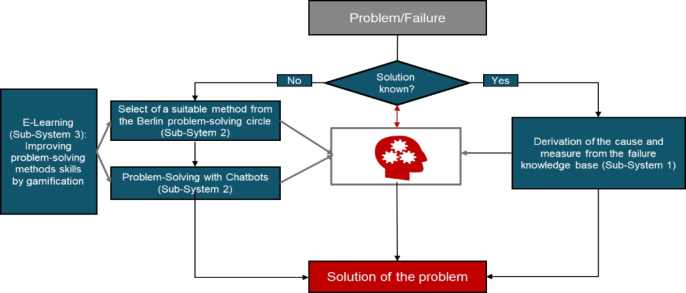
The aim of this paper to show a system approach for developing of an AI- based smart failure management system, which enables the systematic use of the failure knowledge base and is in a constant learning process through inte- raction with employees to learn human cognitive problem-solving skills. The AI-based failure management system consists of a failure knowledge base and a problem-solving knowledge base. The system presented in this paper not only extends a classic failure management system with E-Learning methods and employee support in method application, but also offers other potenti- als for improvement for a systematic PSP in quality control loops. The entire system of the research project consists of three essential sub-systems (SS) and is shown in Figure 1.
The failure management system to be developed is to predict future failure events via its failure knowledge base (failure management-based knowledge base), detect failure correlations in production at an early stage, identify
180 Caglar and Jochem
Figure 1: Methodical Procedure of the smart failure management system.
possible causes of problems and derive measures from this (Sub-System 1). A problem-solving knowledge base (problem-solving method-based kno- wledge base) will also be integrated into the failure management system as part of the Berlin Problem-Solving Circle to be developed. If the type of failure, the cause or the measure is not known, the failure manage- ment system shall enable the computer-aided and dialog-based selection and implementation of problem-solving methods (Sub-System 2). The smart fai- lure management system should be extended by an E-Learning platform, on which employees with less competencies can improve their problem- solving method skills by digitalized learning methods to use Sub-System 2 (Sub-System 3).
The smart failure management system presented in this paper is used in the case of a known problem (for a failure pattern available in the defect knowledge base) as a defect cause and (remedial) action catalogue and for an unknown failure pattern as a systematic PSP. In the case of an unknown problem, a dialogue-based and less complex method selection and appli- cation can be carried out and results interpreted with chatbots. In this process, the appropriate methods and tools are selected in the correct order in the PSP using pre-defined models for the Natural Language Process (NLP) based on failure definitions. With many open-source software that have alre- ady been trained in advance with large amounts of data, an NLP model can be built with only a relatively small amount of data for certain sce- narios (fine-tuning), which can enable the selection of the most suitable method class (classification) with a lower failure rate (Nasev, 2022). The information gained during method selection and application (e.g. research- ing the possible causes of problems with the Ishikawa diagram) is stored in the problem-solving knowledge base and made available as suggestions for similar but unknown problem types. An E-Learning platform can be used to acquire the required theoretical methodological knowledge with detached case studies in the form of gamification. Employees who do not have enough theoretical knowledge to apply methods in the Berlin problem- solving circle can improve their skills in a playful and interactive way on this platform.
A System Approach for Creating Employee-Oriented Quality Control Loops 181
IMPLEMENTATION Within the framework of the implementation of the entire failure manage- ment system (including the integration of the systematic PSP), the focus is placed on open source programmes, which are recommended by the EU. Open source programmes are free of charge, enable property extensions, opti- misation of the source code, adaptations of the existing software in other possible areas of application and increase data security by means of indepen- dent audits and open verification of algorithms (Beckert et al., 2017). For example, this failure management system can be built with the programming language R.
When a failure occurs, the employee should enter the failure with the corresponding information (e.g. location and date of the failure) into the digital system via an input mask. Subsequently, it must be checked whe- ther the described failure pattern exists in the failure knowledge database. Problem descriptions may contain individual, non-structural or fuzzy state- ments. Although these statements do not have a clear meaning, they must also be classified and problem-solving tools retrieved from the failure kno- wledge base (reasoning with uncertainty) (Nasev, 2022). For this purpose, the inference mechanism of ES with Bayesian network (BN) is used. At this point, the “reasoning with uncertainty” method with the BN procedure is a very good alternative, which plays a central role in everyday life even with limited resources and can map a problem representation with probabilities very well (Ertel, 2021).
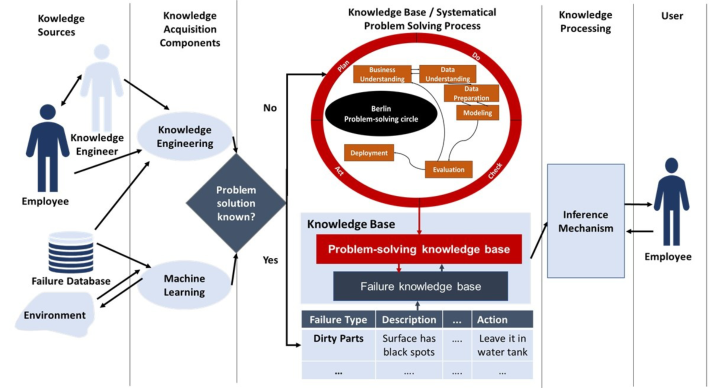
If a problem is known (has similarities with the other problem types in the knowledge base), problem-solving tools (possible causes and actions) with probabilities are provided. In this case, the employee can make a selection from the suggested catalogue or enter a new cause or action, as BN allows for the expansion of the underlying knowledge base with new information and automated updating of the probability algorithms through feedback (Ertel, 2021). By introducing the BN-based ES, the smart failure management system is in a continuous learning process with the user interaction. The smart failure management system, which extends the failure management system presen- ted in (Caglar and Jochem, 2022), is illustrated in Figure 2, based on (Ertel, 2021). In case of an unknown problem (failure pattern does not exist in the kno- wledge base), the worker (or the problem-solving team) can systematically perform the PSP and select appropriate problem-solving methods that are assigned to the phases of the Berlin Problem-Solving Circle. To support the selection, implementation and interpretation of these methods, digitalised and dialogue-based user interfaces will be built as part of the smart failure management system. This smart failure management system will be trai- ned in advance with published publications using text-mining methods (e.g. BERT) and will have a pre-trained model for the smart selection of methods from the method catalogue, in which each problem-solving method (class) is labelled. Based on the labels, the possible applicable methods are displayed with probabilities after the requirement input via the smart failure manage- ment system and made available for selection. At this point, the user is able
182 Caglar and Jochem
Figure 2: Implementation of the system with Berlin Problem-Solving Circle.
to look at properties, prerequisites and best practice examples of proposed methods and tools on the E-Learning platform to get theoretical support for method selection and application. After the method selection, results of the method implementation as well as preferences in the method selection with requirement inputs are written into the built problem-solving method-based knowledge base and the probability algorithms for the method proposal are updated based on expert preferences with BN.
CONCLUSION
Most companies apply a company-specific PSP over the years (Cloft et al. 2018). But not every PSP makes a positive contribution to efficient and sustai- nable problem-solving (Ohlig et al. 2019). For this reason, the PSP to be introduced in this paper aims at developing a structural and unified PSP based on the strongest Continual Improvement Process (CIP) instrument PDCA (Pötters et al. 2018). In this sense, a systematic PSP is built up, which brings together the PDCA cycle with the CRISP-DM cycle in a knowledge-based ES. This synergy results in the Berlin Problem-Solving Circle.
Since all tools within the framework of the presented system are to be implemented with open-source programmes, the authors estimate the indu- strial implementation possibilities of the smart fault management system for entrepreneurial practice as very good. At this point, this paper aims to offer a free solution approach for the use of a smart failure management system and creates the transfer effect in manufacturing companies across dif- ferent sectors, production areas and project plans. Manufacturing SMEs can either benefit from their existing historical defect information and/or from open source tools of the presented failure management system to build up a company-specific and maintained knowledge base, retrieve the required information from it, interpret it, evaluate it and store it again. At this point,
A System Approach for Creating Employee-Oriented Quality Control Loops 183
companies can transfer the entire system to their own server, customise it and run it on it.
REFERENCES
acatech, ed. (25 November 2022) Deutschlands Zukunft als Produktionsstandort sichern: Umsetzungsempfehlungen für das Zukunftsprojekt Industrie 4.0, Absch- lussbericht des Arbeitskreises Industrie 4.0, Website: https://www.acatech.de/wp- content/uploads/2018/03/Abschlussbericht_Industrie4.0_barrierefrei.pdf Beckert, B., Schleife, K., Dupuis, D., Wydra, S., Niemann, F. (2017) The econo-
mic and social im-pact of software & services on competitiveness and innovation. Directorate-General for Communications Networks, Content and Technology (European Commission). Bracke, S. (2016) Prozessfähigkeit bei der Herstellung komplexer technischer Produkte. Statistische Mess- und Prüfdatenanalyse. DOI: 10.1007/978-3-662-48214-8 Bojko, M., Nendel, N., Riedel, R. (2017) Per Mausklick zum Durchblick: Rechnerge-
stützte Auswahl von Qualitätsmethoden, Qualität und Zuverlässigkeit (QZ). Heft 8, Carl Hanser Verlag, München. Buxmann P., Schmidt H. (2019) Ökonomische Effekte der Künstlichen Intelligenzm, in: Buxmann P., Schmidt H. (eds) Künstliche Intelligenz. Springer Gabler, Berlin, Heidelberg. Caglar, T., Jochem, R. (2022) A System Approach for Integration of Human-centered
Smart Problem-solving Process in Digital Shop Floor Management, IEEM22- F-0341, International Conference on Industrial Engineering and Engineering Management (IEEM), Kuala Lumpur, Malaysia Cloft, P.W., Kennedy, M.N., Kennedy, B.M. (2018) Success is Assured: Decision- Focused Mapping of Reusable Knowledge and Innovation to Achieve First-Time Quality. Taylor & Francis, Milton Park Crostack, H.-A., Klute, S. (2008) Die Bedeutung von Fehlerfolgekosten im Rahmen
des Fehlermanagements, Carl Hanser Verlag, München, ZWF, Band 103, Heft 6 Destatistis (25 November 2022) Produzierendes Gewerbe: Betriebe, Tätige Personen und Umsatz des Verarbeitenden Gewerbes sowie des Bergbaus und der Gewinnung von Steinen und Erden nach Beschäftigtengrößenklassen, Fachserie 4 Reihe 4.1.2, Website: https://www.destatis.de/DE/Themen/Branchen-Unternehmen/Industrie- Verarbeitendes-Gewerbe/Publikationen/Downloads-Struktur/betriebe-taetige- personen-2040412207004.pdf;jsessionid=E8229057FB18E014449BD40925625 39D.live722?__blob=publicationFile Deuse, J., Weisner, K., Hengstebeck, A., Busch, F. (2019) Gestaltung von Produkti-
onssystemen im Kontext von Industrie 4.0. In: Bosse, C. -K., Zink, K.-H: Arbeit 4.0 im Mittelstand Chancen und Herausforderungen des digitalen Wandels für KMU, Springer Verlag, Berlin Ehrlenspiel, K., Kiewert, A., Lindemann, U., Mörtl, M. (2014) Einflüsse auf die Herstellkosten und Maßnahmen zur Kostensenkung, in: Ehrlenspiel, K., Kiewert, A., Lindemann, U., Mörtl, M.,(Ed.). Kostengünstig Entwickeln und Konstruieren. Springer, Berlin Ellouze, W. (2014) Entwicklung eines Modells für ein ganzheitliches Fehlermanage-
ment: Ein prozessorientiertes Referenzmodell zum effizienten Fehlermanagement, Dissertation, Dortmund Ertel, W. (2021) Grundkurs Künstliche Intelligenz, Computational Intelligence, Eine praxisorientierte Einführung, 5., überarbeitete Auflage, Springer Vieweg, Wiesbaden. https://doi.org/10.1007/978-3-658-32075-1
184 Caglar and Jochem
Günther R., Beckschulte, S., Bennerscheid, N., Schmitt R. (2021) (Selbst-) lernendes Fehlermanagement: Expertise der Fehlerbearbeitung systematisch nutz- bar machen, Qualität und Zuverlässigkeit (QZ), Heft 10, Carl Hanser Verlag, München Günther R., Wangerow K., Schmitt R. (2020) Fehlermanagement 4.0: Effiziente
Fehlerabstellung und -vermeidung mittels Künstliche Intelligenz, Qualität und Zuverlässigkeit (QZ), Heft 12, Carl Hanser Verlag, München Hornfeck R., Plach A., Höhn J. (2011) Wissensbasiertes Unternehmerisches Fehlermanagementsystem: Fehlerwissen ist Macht, Qualität und Zuverlässigkeit (QZ), Heft 16, Carl Hanser Verlag, München Kakuliesm, J., Oellers, P., Hemmers, P. (25 November 2022) Digitales Fehlerma-
nagement für kleine und mittlere Unternehmen: Fehler passieren, Zeitschrift: Quality Engineering (QE), Website: https://quality-engineering.industrie.de/top- news/fehler-passieren/#slider-intro-2 Kamiske, G.F. (2015) Handbuch QM-Methoden: Die richtige Methode auswählen und erfolgreich umsetzen, 3., aktualisierte und erweiterte Auflage, Hanser Verlag München Kersten, W., Koller H., Lödding H., ed. (2014) Industrie 4.0 Wie intelligente Vernet-
zung und kognitive Systeme unsere Arbeit verändern, GITO mbH Verlag, Berlin, S.144 Kukulies, J., Pohlmann, G. (2019) Fehlermanagement profitiert von Digitalisierung, Qualität und Zuverlässigkeit (QZ), Heft 10, Carl Hanser Verlag, München Lendzian, H., Martin-Martin, R. (2016) Shopfloor-Management: Nachhaltige Pro-
blemlösungen schaffen, in Künzel, H. (Ed.) Erfolgsfaktor Lean Management 2.0, Springer-Verlag, Berlin Heidelberg Mark, B. G., Rauch, E., Matt, D. T. (2022) Systematic selection methodology for worker assistance systems in manufacturing, Computers & Industrial Enginee- ring, Volume 166, 107982, ISSN 0360-8352, https://doi.org/10.1016/j.cie.2022. 107982. Nasev, D. (25 November 2022) German BERT Applications: Google BERT – deut-
schsprachige Anwendungen entwickeln und bereitstellen, Website: https://next- rtc.com/publications/German_Bert_Applications.pdf Ohlig J., Pötters, P., Leyendecker (2019) Planspielkonzept zur Quantifizierung des Effekts von digitalem Shopfloor Management bei der Anwendung der Problem- lösungsmethode 8D im Qualitätswesen, in: Schmitt, R. H., (Ed.): Datengetriebenes Qualitätsmanagement, Bericht zur GQW-Jahrestagung 2019 in Aachen, Springer Vieweg, Aachen Parlings, M., Lindemann, M., Kühn, A (2020) Künstliche Intelligenz im Mittel-
stand: Potenziale und Anwendungsbeispiele, Mittelstand 4.0 Kompetenzzentrum Dortmund, Dortmund Peter, B. (2019) Kombinieren wie Poirot. Wirksame Schulung zur Abweichungsanalyse am Beispiel eines Krimis. In: QZ Qualität und Zuverlässigkeit 64 (4) Plach, A., Hornfeck R., Rieg F., Roth J. (2012) FAMOS - ein ganzheitlicher Ansatz
zum Fehlermanagement, Georg-Simon-Ohm-Hochschule Nürnberg-Universität Bayreuth Pötters, P., Leyendecker, B., Ohlig, J, Schmitt R. (2018) Verbreitungsgrad von Optimierungsmethoden in der Produktion – Eine quantitative Untersuchung, in: Wissenschaftliche Schriften des Fachbereichs Wirtschaftswissenschaften, Hoch- schule Koblenz – University of Applied Sciences, Nr. 28
A System Approach for Creating Employee-Oriented Quality Control Loops 185
quality-engineering (25 November 2022) Fehlermanagement in Ausnah- mesituationen, Website: https://quality-engineering.industrie.de/allgemein/ fehlermanagement-in-ausnahmesituationen/ Rüßmann, M., Haghi, S., Bergstein, D., Schmitt, R. H. (2019) Smartes Fehlermanagement auf dem Shop Floor. Ein Lösungsansatz für KMU. In: Bosse, C. -K., Zink, K.-H: Arbeit 4.0 im Mittelstand Chancen und Herausforderungen des digitalen Wandels für KMU, Springer Verlag, Berlin Schmihing, F., Jochem, R. (2019) Steigerung von Daten- und Prozessqualität mit Hilfe
von Visual Analytics in der Produktion, in: Schmitt, R. H. (Ed.). Datengetriebenes Qualitätsmanagement, Bericht zur GQW-Jahrestagung 2019 in Aachen, Springer Vieweg, Aachen Schober, J. (2019) Systematische Methodenanwendung im dynamischen Qualitätsmanagement bei KMU, Diss., TU Berlin, Fraunhofer Verlag Stuttgart Theden, P. (1997) Analyse und Rentabilität von Qualitätstechniken, Berichte aus dem
Produktionstechnischen Zentrum Berlin, zugl. Dissertation, Berlin Toyosi, T. (2017) A Review of Current Machine Learning Techniques Used in Manufacturing Diagnosis, in: Lödding, H., Riedel, R., Thoben, K.-D., von Chiemniski, G, Kiritis, D. (Ed..) Advances in Production Management Systems. The Path to Intelligent, Collaborative and Sustainable Manufacturing (Proceedings of: IFIP WG 5.7 International Conference, APMS 2017, Hamburg, Germany, Heidelberg Töpfer, A. (2002) Ansatz und Nutzen von Six sigma. Business Excellence. Wie Sie
Wettbewerbsvorteile und Wertsteigerung erzielen Vollmar, M. (2013) Berufliche Weiterbildung in Unternehmen 2010. Methodik und erste Ergebnisse der CVTS4-Studie. Wiesbaden: Statistisches Bundesamt. Wagner, K. W., Zacharnick, M. (2006) Qualitätsmanagement für KMU: Qualität
sensibilieren, realisieren, leben, Bd. 046, Pocket-Power, Hanser-Verlag, München Wappis, J., Jung, B. (2014) Null-Fehler-Management: Umsetzung von Six Sigma, 4.
Überabeitete und erweiterte Auflage, Hanser Verlag, München Wien Wuest, T., Irgens, C., Thoben, K.-D. (2013) An approach to monitoring quality in manufacturing using supervised machine learning on product state data. Journal of Intelligent Manufacturing. Jg. 25, Nr. 5, S. 1167–1180. DOI: 10.1007/s10845- 013-0761-y
LISTED IN THE AHFE DIGITAL BOOKSTORE CATALOGUE
Explore the complete digital volume
Intelligent Human Systems Integration (IHSI 2023): Integrating People and Intelligent Systems
Read this individual research paper free through the original publisher, or explore the full digital proceedings book.
ISBN 978-1-958651-45-2
Explore this ISBN in the AHFE Bookstore ↗Listed in the July 2026 bookstore catalogue; search by ISBN to confirm current availability · Digital book purchase optional