Didzis Rutitis, Eduards Aksjonenko (2022). The impact of digital transformation on corporate identity management. In: Human Interaction & Emerging Technologies (IHIET 2022): Artificial Intelligence & Future Applications. AHFE Open Access, vol. 68, pp. 751–759. https://doi.org/10.54941/ahfe1002802
Digital transformation concept has emerged as an essential concept within management sciences in recent considering the influence of pandemics on the way how companies provide service, arrange manufacturing, and perform business operations in general. This paper analyzes digital transformation in the context of management of corporate identity by highlighting possibilities of managing individual corporate identity dimensions considering the role and impact of digital transformation and competitive strategy formation. The newly developed framework is based on the synthesis of corporate identity and digital transformation conceptual frameworks. Literature review identifies gaps in how to accelerate and support small and medium enterprises (SME) in their path of digitalization and maximizing their value delivery to customers - while maintaining competitiveness and keeping the active, specific and valuable scorecard of strategic goals. Further exploration and research will indicate potential roadmap solutions and will enable to answer the question of – how to optimize resources, competence, and ability to execute digital transformation in parallel of building strong corporate identity and business strategy.
The concept of corporate identity in the management and marketing sciences has been known since the 1970s, when the research distinguished between the concepts of corporate identity and corporate image. The concept of cor- porate identity is often used in marketing in connection with image building, corporate brand management, but in public relations it is associated with the concept of reputation. However, the concept of corporate identity is interdisciplinary, as it covers the strategic and organizational management of companies, as well as marketing, corporate communication, personnel management, other areas (Melewar, 2003).
Digital transformation can cover anything from IT modernization (such as cloud computing) to digital optimization and the invention of new digital business models. The term is widely used in public sector organizations to describe modest initiatives such as the online deployment of services or the modernization of legacy information systems. Thus, the term tends to be more reminiscent of “digitalization” than “digital business transformation” (Gartner, 2022).
The aim of the research is to assess the topicality of corporate iden- tity dimension management based on the research of corporate identity dimension management models and digital transformation concept, and to develop conceptual framework for management of corporate identity dimen- sions in the context of tools and solutions enabled by digital transformation processes.
Identified research gaps relate to the lack of data on the extent to which do executives of SMEs rely on outsourced help from advisors, consultants or IT support and service management companies involved in daily operations. Also, there has been little exploration done on what are the main consi- derations for SMEs in developing strategies with strong base of the digital transformation. Future strategy development, including digital strategy, is assumed to be one of corporate identity dimensions.
Building on this discussion, the following propositions are presented and examined throughout the paper: P1: Digital transformation is a significant part of corporate identity mana- gement processes and company strategy on it’s growing path from SME level. P2: Value creation for customers is crucial in SME product innovation process and includes delivery of efficient solutions within digital tran- sformation. P3: Decision making process is more openly oriented towards higher level digitalization in SME’s – but there is a lack of competence – how to find a balance in managing resources and limit the risk exposure while on the way of disruptive path. Outsourced help or high-level competence from executives is needed to take bold and smart business minded actions. P4: There should be strict and adopted balanced scorecard method that indi- cates the goals reached and areas impacted that can help monitoring and assuring the success of both, corporate identity management and digital transformation.
WHAT DOES DIGITAL TRANSFORMATION MEAN TODAY?
Disruption happens in various industries because of unstable and fast chan- ging business environment. C-level executives are investigating opportunities that digitalization can bring to the strategy, business model and product innovation.
Digitalization today is a synonym for broadly used digital transformation that according to Stolterman E. and Fors A. (2004), refers to “the changes that digital technology causes or influences in all aspects of human life”. Even if it covers wider potential of scope – the most topics about digitalization are about technological innovations – but it should include different angles as leading author of the field like Henriette et al. (2015) states in their research.
After research article reviews and case study analysis of various industries – academics agree that business transformation prompted by digital technolo- gies takes no specific exceptions and can be implemented in various segments (Ivanˇci´c L., Vuksic V., Vugec D., 2018)
The Impact of Digital Transformation on Corporate Identity Management 753
Bharadwaj N. et al. (2013) expressed that IT should not been viewed as functional level strategy, but as a part of business level strategy resulting to digital transformation strategy. But in the literature reviews we find an often conflict of frameworks’s, concepts and definitions of digital transformation strategies (Chanias, Myers, & Hess, 2018; Nadeem et al., 2018).
In order for businesses to be efficient and can gain from decision-making process, Fonstad (2017) defines a digital strategy: “A business strategy, inspired by the capabilities of powerful, readily accessible technologies (like SMACIT), intent on delivering unique, integrated business capabilities in ways that are responsive to constantly changing market conditions”, where SMACIT refers to - social, mobile, analytics, cloud and Internet of things [IoT] technologies - that present both game-changing opportunities and existential threats to the companies.
When the value chain of the company is changing (being transformed or impacted) – there are operational and a human element. According to Ismail et al. (2018) both are important in creating digital management systems to lead the changes. Digital transformation requires companies to rethink their business in the path of innovation – and specific challenge for SME’s is shortage of time and resources allowed for experiments (Bouwman H. et al. 2019).
Can Management Consulting Services Help in Digital Transformation for SME’s?
SMEs are a distinct group of organizations. Duan, X., Deng, H., & Corbitt, B. (2012) stresses out unique characteristics of SMEs that are different from large sized companies and often face lack of technical expertise, poor infra- structure, inadequate capital, inadequate organizational planning, strong executive controlled decision-making system and huge dependence on busi- ness partners, limited resources. It also indicates and exposes them to external uncertainty. On the same time SMEs are more responsive to digital disruption that is even more enabled in digital entrepreneurship: growing access to emer- ging platform service providers and tools help if the path of digitalization (Li, L. et al., 2018).
The scholarly interest in SME-focused digitalization and digital transfor- mation has also grown significantly in recent years. Kraft C. (2022) indicates growing number of publications in business end entrepreneurship journals. Studies of SME digitalization and digital transformation explains:
sources of value creation
dynamic capabilities (Cannas, 2021),
digital strategies and innovation strategies/performance
product, services, and process digitalization (Proksch D. et al., 2021) Company level digital capabilities are based on employee digital skills that enable use of digital tools and platforms. Currently there is a lack of stu- dies that indicate employee skills in using the digital tools towards digital transformation in SMEs (Scuotto D. et al., 2021).
754 Rutitis and Aksjonenko
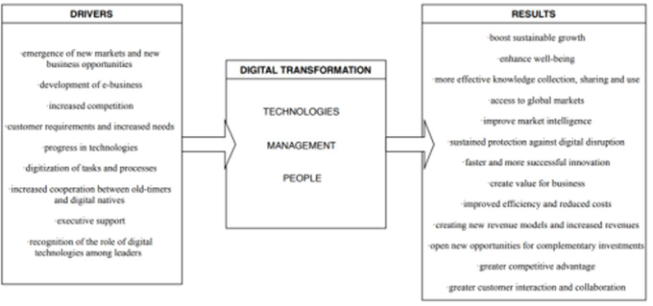
Figure 1: A conceptual model of digital transformation (Verina and Titko, 2019).
Reviewing literature and summing up opinions of internal factors that companies at various sizes are in control - Nasiri M. (2020) mentions that successful theories and practices applied to large companies might not neces- sarily apply to SMEs even if their exposure for disruptive and digitally oriented innovation is higher. Larger companies even with decent corpo- rate and sustainable strategies are afraid of losing their competitive edge and stable situation.
OVERLAP OF CORPORATE IDENTITY AND DIGITAL TRANSFORMATION FRAMEWORKS Disruption happens in various industries because of unstable and fast chan- ging business environment. C-level executives are investigating opportunities that digitalization can bring to the strategy, business model and product innovation. The integration of corporate identity management and digi- tal transformation frameworks proposes opportunities for new blend of managerial instruments to emerge to facilitate successful supervision of com- pany development during times of increasing uncertainty and new kind of managerial challenges.
Fig. 1 depicts a conceptual model by Verina and Titko (2019) that descri- bes relationship between drivers of digital transformation and the expected results that can derived from proper implementation in form of technologies, management, and people.
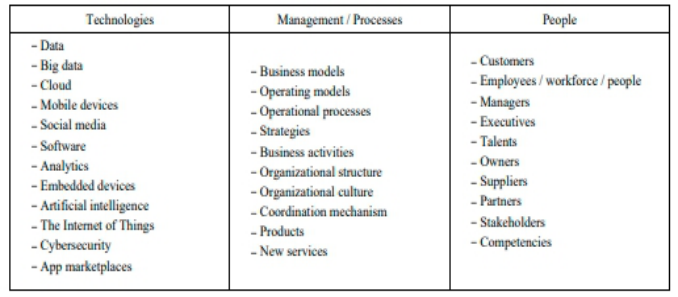
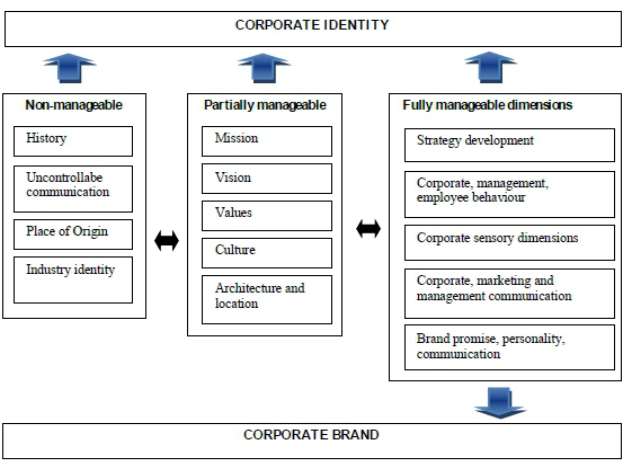
This model clearly states why digital transformation is essential for SMEs since emergence of new markets and opportunities and several other challen- ges relevant to any manager of SME are among drivers towards numerous benefits listed within results to be experienced by the SME after successful implementation of digital transformation. If a more detailed look is taken at the middle stage (see Fig. 2), then the Management and processes cate- gory within digital transformation concept contains numerous elements from corporate identity framework (see Fig. 3).
Also, the category People includes majority of stakeholders (e.g. top and middle managers, regular employees, customers, and owners) that are directly
The Impact of Digital Transformation on Corporate Identity Management 755
Figure 2: Categories of the concept “Digital transformation” and the elements within (Verina and Titko, 2019).Figure 3: Conceptual model for categorization of corporate identity dimensions (Rutitis, 2016).
involved in corporate identity management or have indirect impact on its formation through one of dimensions.
It is important to note that these two conceptual frameworks serve dif- ferent purposes, but at the same time they can be regarded as important managerial tools that help company management to navigate company tow- ards more competitive position in the market and stronger competitive advantage, which is one the main benefits from proper corporate identity management (Melewar, 2003).
756 Rutitis and Aksjonenko
The Role of Digital Transformation For Management of Corporate Idenity By blending a concept of digital transformation together with a conceptual model for categorization of corporate identity dimensions it is possible to identify several corporate identity dimensions and align them with rele- vant managerial processes that have certain impact and role within digital transformation of any SME company.
These correlations and assumptions derived by the authors regarding spe- cific corporate dimensions and management process having experiencing impact of digital transformation are depicted in Table 1.
Corporate identity dimension column states the respective fully manage- able or partially manageable dimension, which can be managed through one of the management processes listed right next in the middle column. Next, the impact (high/medium/low) and role of digital transformation is assessed along with tools for implementation. Authors have also intro- duced a categorization of role of digital transformation to indicate if it relates to Management/Processes or People, while Technology is assumed to be embedded in each dimension as given variable to implement digital transformation.
DISCUSSION AND CONCLUSION Decision making process is hard when there is little or knowledge for exe- cutive teams of SMEs of how to digitalize in parallel of creating competitive strategy. Either internal level competence or external and outsourced help is needed to be attracted. Challenge is to keep the focus on the business, poten- tial disruption possibilities and management plus allocation of the resources. How to maximize value for customers and how to do it in the best way – should be explored in further.
There is a practical necessity to explore potential of roadmap and balanced scorecard method combination that as a tool can be developed and widely used by SME in their way of creating competitive strategy within and with digital transformation. The model proposed by authors to assess impact of digital transformation on management of corporate identity dimensions and related management processes serves as the first attempt to bring together two different conceptual frameworks to introduce such roadmap and balanced scorecard.
Further research should generate primary data with interviews from lea- ding experts in the field who both work with business and digitalization dimensions while consulting and implementing various projects for SMEs. The questions should include factors influencing and defining roadmap from practical aspects that can be adjust to specific industries and various levels of digitalization. Also, they should be asked to discuss possibility of corpo- rate identity management in the context of digital transformation drivers and expected results. Next, the approbation and tests should be run on SME com- panies with respective frameworks, models and methods developed for them to incorporate them in daily set of managerial tools.
The Impact of Digital Transformation on Corporate Identity Management 757
Table 1. The model assessing impact of digital transformation on management of corporate identity dimensions and related management processes (based on Rutitis et al., 2014; Rutitis, 2016, Verina and Titko, 2019).
Table available in the original PDF paper.
Corporate identity dimension
Management processes The impact and role of digital transformation
1. Profile, specialization, positioning
Development of business plan
Strategic decision-making Impact: High Tools: Internal financial and business analytics, BI Category: Management 2. Visual identity, other sensory dimensions
Development of visual identity and other sensory dimension guidelines
Visual and other sensory dimension audit once a year
Impact: Medium Tools: audit of visual identity and other sensory dimensions once a year Category: Management 3. Scientific research, employee achievements
Decision-making regarding investment in R&D once a year
Development of scientific projects and collaboration with other research institutions
Impact: Medium Tools: monitoring of scien- tific paper databases, use of database and website craw- lers, including artificial intel- ligence (AI) Category: Management 4.Customer service culture
Impact: High Tools: internet environment monitoring, online customer surveys and feedback forms, quality audit and certification Category: People
Development of patient service standards and process descriptions
Development and implementation of rules and guidelines for interaction between staff and patients
Development and implementation of service quality model
5.Corporate communication
Corporate communications planning, including crisis communication
Implementation of guidelines for staff communication over the Internet
Impact: Medium Tools: external research, media monitoring, social media review, website visitor analytics, customer surveys online Category: Management 6. Internal communication
Development and implementation of internal regulations
Impact: Medium Tools: use of intranet platform, additional communication, and collaboration tools Category: Management 7. Future development strategy
Digital strategy
EU fund acquisition for improvement of infrastructure, products, and processes
Impact: High Tools: financial and business analytics Category: Management 8. Corporate structure
Strategic decision-making according to shareholder goals
Impact: Medium Tools: internal financial and business analytics, internal surveys Category: Management
758 Rutitis and Aksjonenko
ACKNOWLEDGMENT
This researched has been financed by the Project “Rıgas Tehnisk¯as uni- versit¯ates un Banku augstskolas doktorantu un akad¯emisk¯a person¯ala sti- prin¯ašana strat¯e´gisk¯as specializ¯acijas jom¯as”, Nr. 8.2.2.0/20/I/008.
REFERENCES
Bharadwaj, A., El Sawy, O.A., Pavlou, P.A., and Venkatraman, N. (2013). Digital Business Strategy: Toward a Next Generation of Insights, MIS Quarterly Volume 37, No. 2. Bouwman, H., Nikou, S., de Reuver, M. (2019). Digitalization, business models,
and SMEs: How do business model innovation practices improve performance of digitalizing SMEs, Telecommunications Policy Volume 43, No. 9. Cannas, R. (2021), Exploring digital transformation and dynamic capabilities in agrifood SMEs, Journal of Small Business Management. Chanias, S., Myers, M. D., and Hess, T. (2018). Digital transformation strategy
making in pre-digital organizations: The case of a financial services provider, The Journal of Strategic Information Systems, (January). Duan, X., Deng, H., & Corbitt, B. (2012). Evaluating the critical determinants for adopting e-market in Australian small-and-medium sized enterprises, Manage- ment Research Review Volume 35, No. 3/4. Fonstad, N. (2017). How big old companies navigate digital transformation, MIS
Quarterly Executive Volume 16, No. 3. Gartner. (April 9, 2022). Digital Transformation. Gartner Glossary, Gartner.com Website: https://www.gartner.com/en/information-technology/glossary/digital- transformation Henriette, E., Feki, M., Boughzala, I. (2015). The Shape of Digital Transformation:
A Systematic Literature Review, MCIS 2015 Proceedings. Paper 10. Ivanˇci´c L., Vuksic V., Vugec D. (2018). “A Preliminary Literature Review of Digital Transformation Case Studies”, proceedings of the 20th International Conference on Managing Information Technology, Italy, Rome. Kraft C. (2022). The digital transformation of Swiss small and medium-sized enter-
prises: insights from digital tool adoption, Journal of Strategy and Management. Li, L., Su, F., Zhang, W. (2018). “Digital transformation by SME entrepreneurs: A capability perspective”. Information Systems Journal Volume 28, No. 6. Ismail, M.H., Khater, M., Zaki, M. (2018). Digital Business Transformation and Stra-
tegy: What Do We Know So Far?, University of Cambridge, Cambridge Service Alliance. Meier, A. (2021). “Systematic review of the literature on SME digitalization: multisided pressure on existing SMEs”, in: Digitalization. Approaches, Case Studies, and Tools for Strategy, Schallmo, D.R.A. and Tidd, J. (Eds), Springer, Cham, pp. 257–276. Melewar, T.C. (2003). Determinants of the corporate identity construct: a review of
the literature, Journal of Marketing Communications Volume 9, No. 4. Mitroulis D., Kitsios F. (2019). (PDF) Digital transformation strategy: a literature review (researchgate.net). Nadeem, A., Abedin, B., Cerpa, N., Chew, E. (2018). “Editorial: Digital transforma-
tion & digital business strategy in electronic commerce - The role of organizational capabilities”. Journal of Theoretical and Applied Electronic Commerce Research, Vol. 13, No. 2.
The Impact of Digital Transformation on Corporate Identity Management 759
Nasiri M. (2020). Shaping Digital Innovation Via Digital-related Capabilities, Information Systems Frontiers. Proksch, D., Rosin, A.F., Stubner, S. and Pinkwart, A. (2021), “The influence of a
digital strategy on the digitalization of new ventures: the mediating effect of digital capabilities and a digital culture”, Journal of Small Business Management. Rutitis, D., Batraga, A., Skiltere, D., Ritovs, K. (2014). Evaluation of the Conceptual Model for Corporate Identity Management in Health Care, Procedia - Social and Behavioral Sciences, Volume 156. Scuotto, V., Nicotra, M., Del Giudice, M., Krueger, N., Gregori, G.L. (2021). A
microfoundational perspective on SMEs’ growth in the digital transformation era, Journal of Business Research Volume 129. Stolterman E. and Fors A. (2004). Information technology and the good life, Information Systems Research. Verina, N., Titko, J. (2019). “Digital transformation: conceptual framework”, pro-
ceedings of the conference Contemporary Issues in Business, Management and Economics Engineering 2019, Vilnius, Lithuania.
Read this individual research paper free through the original publisher, or explore the full digital proceedings book.
ISBN 978-1-958651-44-5
Explore this ISBN in the AHFE Bookstore ↗Listed in the July 2026 bookstore catalogue; search by ISBN to confirm current availability · Digital book purchase optional