Existing smart helmets in the market provide only limited functionalities for convenience and lack safety considerations to proactively prevent accidents. We followed a user-centered design process from which we present three major steps in this paper: user research, prototyping, and testing. Our user research revealed core use cases of a new smart helmet. An important usability issue is the way micro-mobility riders make their input while riding. Three alternatives (head gesture, push button, kick button) were evaluated and both quantitative and qualitative feedback was gathered from participants. The results show that head gesture interaction is natural and satisfactory considering the specific riding posture and traffic situations of micro-mobility users. We also present detailed specifications of the rolling head gesture used in our final prototype, as well as the user feedback methods for other functionalities such as a rear approach warning light and rear light.
The importance of wearing a helmet has grown in recent years as micro- mobility accidents become more frequent. According to the Korea Consumer Agency, there were 1,252 e-scooter accidents between 2017 and November 2020, more than doubling from 257 (2019) to 571 (2020). Traffic regulations were strengthened to protect users from these accidents. A penalty is imposed on riders who do not wear a helmet when riding a micro-mobility scooter, according to the Road Traffic Act (No. 17891), which took effect on May 13, 2021. However, preventing road accidents is difficult because a normal helmet only helps to reduce the risk of head injury in the event of an accident. In this study, we propose a smart helmet that helps to prevent accidents in advance.
We analyzed products from six brands of, including Sena, Lumos, and Livall, which are representative of existing smart helmets. Most smart hel- mets are designed for cyclists and convey one-way signals. Micro-mobility users face two issues with these products. First, these helmets are controlled by hand. On all three helmets with a direction indicator, a physical button
must be pressed by hand to operate it. But most micro-mobility vehicles have small wheels, and the moment of inertia is low, so users can easily lose bala- nce if they make hand signals or push a physical button by hand. Therefore, the current smart helmet input method is not appropriate for micro-mobility users. Second, these helmets convey only one-way communication. When compared to vehicles, e-scooters users have higher tension while driving at high speeds, and users always ride with caution (Sun-Young Ko, et al., 2019; Jae-yong Song, et al., 2019). Some smart helmets use a rear light to commu- nicate the user’s intention to those behind, but users are unable to recognize the situation behind them. Users of smart helmets feel safer if they not only convey their riding intentions to others but also recognize what is going on around them.
SMART HELMET CONCEPT User Research & Analysis
In-depth interview with a variety of micro-mobility users were conducted, and natural interactions were observed while riding on the road using Shadowing method. The problem statement was defined as “How can micro- mobility users avoid becoming physical and informational underdogs in traffic environmnet by smart helmet?” as a result of user research. and focu- sed on the three key use cases. First, ‘Users want to convey their intention to turn left or right.’, Second, ‘Users want to recognize when vehicles are appro- aching fastly from behind.’, Third, ‘Users want to convey their intention to sudden stop and slow down to behind.’
Prototype System input and output by use cases required for interaction are listed on [Table 1].
Some existing helmets already have a function that conveys the user’s inten- tion to turn left or right. But a physical push button is used for operating
the direction indicator on existing smart helmets. This is not appropriate for micro-mobility users. Because e-scooters have small wheels and a low moment of inertia, it is easy to lose balance when letting go of the handle, making them less safe when using a push button. Furthermore, a push but- ton is not appropriate in the case of micro-mobility such as hoverboards and electric wheels because there is no handle to install a push button. In these cases, head gestures and kick buttons can be used as alternative. Commonly used gestures are interaction methods that can be used in a variety of situ- ations, including movement and driving, where touch-based interaction is impossible or difficult (Kwang-soo Cho, et al., 2012). A head gesture is a hands-free and easy to use interface system (Yi, Shanhe, et al., 2016). This is a feasible alternative for micro-mobility users. The rolling type is appropriate for operating the direction indicator by head gesture. The [rolling] type was selected because it has smaller malfunctions than other types that can be used while driving on a road. The [yawing] type can be used to conduct a shoulder check, and the [pitching] type is used to observe the road surface and traf- fic lights (Dey, Prannah, et al., 2019). By turning on an external side LED light, users can convey their intention to change direction to communicate with the traffic environment. Second, a radar sensor embedded in the back of the helmet is used to detect vehicles approaching quickly from behind. In this case, it is necessary to consider how to properly warn users in outdoor traffic situations. Third, an IMU sensor embedded in the helmet is used to detect users’ intention to stop/slow. When users suddenly stop or slow down, an LED light on the back of the helmet blinks.
Design Issue In the Development and Delivery phases, the design issue in prototyping was deciding on an appropriate user input method that did not interfere with micro-mobility users’ riding. Alternatives include 1) head gesture, 2) push button, and 3) kick button. In addition to conducting an evaluation of the alternatives, the concept of communicating with the traffic environ- ment through smart helmets and proactively protecting user safety was also evaluated.
METHODS
The test verified usability and the overall concept of interactions with an ini- tial helmet prototype while riding an e-scooter that represents micro-mobility.
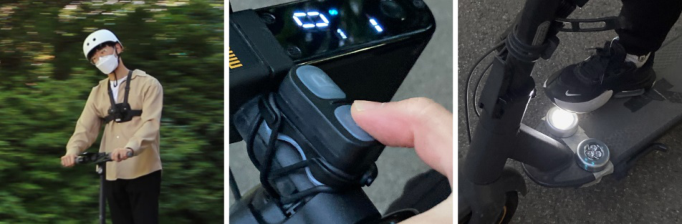
Test Setup and Apparatus A head gesture recognition sensor was installed on the helmet to implement a direction indicator. For the push button, a wireless push button of the Lumos helmet was installed on the handle. For the kick button, buttons with a dia- meter of 70 mm were installed on the upper end of the body on the left and right respectively (see Figure 1).
To identify riding stability for the input method, we collected riding data on the Y-axis gyroscope value by an IMU sensor installed below the body. To check unexpected factors in riding data, we installed a first-person
Interaction Design of a Smart Helmet for Micro-Mobility Riders 39
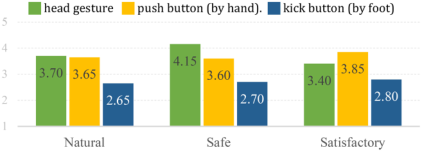
Figure 1: Three input methods (head gesture, push button, kick button) tested.Figure 2: Natural, safe, and satisfaction scale (Likert scale-5) of input methods.
view camera on participants. To identify posture change while operating the direction indicator, we installed a third-person view camera at the corner.
Procedure After we explained the procedure to the participants, they put on a helmet and did practice riding. The riding course consisted of a straight road and two right-turn corners. When the participants started, we recorded the IMU sensor log and cameras. After the end of the test, the participants answered a survey and there was a post-test interview. Survey questions included a mea- surement scale (natural, safe, and satisfaction) based on the riding experience with questions scored by a 1-5 point Likert scale.
Participants We recruited 20 participants (13 males, seven females) with a mean age of 24.95 years through a Snowball sampling method. All of the participants had e-scooter riding experience, and 12 were proficient, and eight were not.
RESULTS
Survey Results
Figure 2 shows the results of evaluating the natural, safe, and satisfaction scale in which 20 participants input their intention to change direction with each input method at the corner while riding an e-scooter. Compared to other input methods, head gesture had the highest average score on the natural scale and safe scale. Push button had a higher average score on the satisfaction scale. In addition, kick button was significantly low overall.
To verify whether the differences were statistically significant, we con- ducted one-way ANOVA with natural, safe, and satisfaction as dependent variables, and the three input methods as independent variables. As a result, we found a significant difference in the natural scale (p-value = .013) and safe scale (p-value = .001) according to input method. Satisfaction had no signifi- cant level of difference according to input method (p-value=.062). According to the post-hoc test results, it was clear that head gesture was more natural and safe than kick button, and there was no significant difference between head gesture and push button. We concluded that kick button can certainly be excluded as an alternative to push button, and head gesture can be cho- sen as an equivalent alternative in terms of naturalness and safety compared to push button. In addition, we tried to further confirm why they made this evaluation through qualitative feedback and video analysis.
Qualitative Feedback After analyzing the feedback and the behavior observed in the recorded video, the following issues were found.
Absence of Operation Feedback in Head Gesture Four participants said that they could not identify whether a head gesture works after making it, such as “It is difficult to identify whether the head gesture input works,” and “It is difficult to check whether the direction indi- cator is successfully turned on.” We could infer that the average score on the satisfaction scale was low due to the absence of feedback after the input of a head gesture.
Issue of Additional Physical Effort in Head Gesture The initial prototype used in the test was designed to tilt the head left or right (rolling method) to operate the direction indicator and additionally tilt the head up and down (pitching method) to turn it off. Two participants raised a usability issue about the turning off method, such as, “It’s okay to tilt my head sideways (rolling type), but I felt it was a little dangerous to tilt up and down when turning off,” and “It’s awkward to turn it off after inputting a signal.” We could infer that the average score of the safe and natural scale was low due to the additional physical effort of the head gesture.
Confusion in Pressing Push Button As a result of video analysis of the first-person view camera, seven partici- pants were observed to check the location of the push button before pushing it and to check whether it was pressed properly for the intended direction. It seems that it is difficult to distinguish the left or right button without che- cking the location of the button while riding. We could infer that the average score of the safe scale was low due to the physical limitations of the push button.
Interaction Design of a Smart Helmet for Micro-Mobility Riders 41
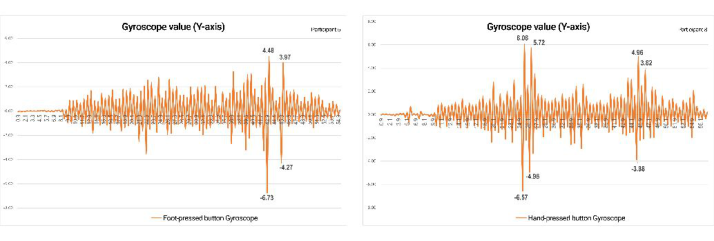
Figure 3: Example of instability of riding data.
Issue of Universality of Push Button As a result of video analysis of the first-person view camera, we observed that in the case of participants with small hands, they had difficulty pressing the push button by stretching their fingers while holding the handle. We also observed visible shaking of the body by these participants while trying to press the button after letting go of their hand from the handle. We could infer that the average score of the safe scale was low due to the universality limit of the push button.
Importance of Maintaining Body Posture As a result of video analysis of the third-person view camera, five participants were significantly observed to decrease in speed and there was shaking of the e-scooter body when the kick button was used. We could infer that the average score of all scales was low because the kick button influenced the center of balance of the user’s body while riding. In addition, we could infer that maintaining a balanced body posture is essential when doing input.
Riding Stability Analysis The moving average difference for each input method was not significant, but the instability of gyroscope results as seen in Figure 3 was observed more when the push button and kick button were used compared to the head gesture. The criterion of instability is when the measurement value is above an absolute value of 4. Among the 20 driving data for each input method, the instability data value out of the normal range was observed two times for head gesture, four times for push button, and six times for kick button.
ITERATION AND DEVELOPMENT Design Consideration for Input of Head Gesture
We considered operation feedback design after inputting a head gesture based on analysis from qualitative feedback. When the user operates the direction indicator with a head gesture, the feedback was specified so that the user can recognize whether the operation is successful. Vibration, ambient lighting, and sound were considered as feedback, and an appropriate method was selected through prototyping. In the case of vibration, it was confirmed that
it is hard to detect and make an annoying buzzing in the head. In the case of ambient lighting, it was excluded from the alternatives to prevent confusion with the rear approach warning light. Therefore, a “ding-dong” sound was selected as operating feedback.
Through the analysis of 4.4.2, the appropriate operating time without additional effort was set. The traffic laws recommend turning on the direction indicator light 30 meters before turning. The average speed of an e-scooter is about 15 km/h and the time it takes to travel 30 meters is 5.4 seconds. So, the operating time was set to 6 seconds so that it would automatically turn off after turning.
The threshold value of head gesture operation was set to 15 degrees because a normal person’s head can sufficiently tilt to left or right 20 degrees for the rolling type (Seong-Yoon Shin et al., 2020).
Design Consideration for Output of Head Gesture We considered a lighting design that puts out the result after a head gesture. It is hard to recognize whether the direction of existing rear direction indicators is left or right when it recedes more than a certain distance due to its small size (Won-joo Chang et al., 2017). In this study, a flow type lighting interaction was applied in which direction indicators were divided into left and right based on the rear light for a clear distinction. According to a study by Han- tae Kang (Han-tae Kang, 2019), in the case of near-distance recognition in terms of visibility of external lighting, it is impossible to recognize in side view, so the lighting area on the side or fender part needs to be expanded. Therefore, the shape of the direction indicator was designed to surround the helmet so that a vehicle or pedestrian in any direction can check the user’s intention about turning.
Design Considerations for Rear Approach Warning Light Users mainly use the center of the human visual area when riding (Wickens, 2002). While riding, a peripheral display using peripheral vision can draw attention without cognitive effort because it uses different resources of a cognitive channel than central vision (Leibowitz et al., 1982; Matthews et al., 2004). Therefore, the rear approach warning light is located in the front brim of the helmet so that the user can easily recognize it while riding. For lighting interaction setting, the blink interaction was applied because ambient vision is affected more by dynamic stimuli than static stimuli (Neville & Lawson, 1987). The rear approach warning light operates when a rear vehicle approaches at a relative speed of 15 km/h or more considering that the maximum speed of a back road in Seoul is 30 km/h while the average speed of the e-scooter is 15 km/h.
Design Considerations for Rear Light The rear light is used to convey the user’s intention to stop/slow. There is a brake light on existing micro-mobility vehicles, but due to the characteri- stic of micro-mobility with low vehicle bodies such as e-scooters and electric
Interaction Design of a Smart Helmet for Micro-Mobility Riders 43
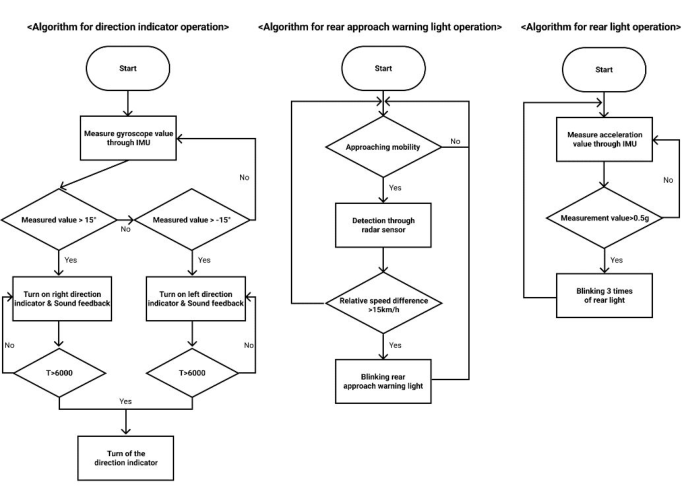
Figure 4: Algorithm for operation.
wheels, brake lights are located below the eye level of the rear vehicle driver. By applying the rear light to the helmet, the driving intention of the user can be provided at the eye level of the driver.
CONCLUSION
In this study, we proposed a smart helmet to prevent accidents of micro- mobility users in advance with a helmet that is capable of real-time interaction with the traffic environment. This study is meaningful in that it proposes inte- raction while riding that is appropriate for micro-mobility users and improves the system algorithm for the concept discovered through iterative prototyping and usability test in a user-centered design process. Through user research, core use cases were discovered, and with the iteration of prototyping imple- menting use cases, usability evaluations of the interaction method of the new smart helmet were conducted. Significant results were confirmed on the scale of natural and safe among alternatives. Head gesture had the highest score on the scale of natural and safe. On the satisfaction scale, the score for push button was higher than that of head gesture, but further interpretation is required. The limitations of a physical button were confirmed through quali- tative analysis. This seems to be because head gesture is an input method that can maintain a stable posture while keeping hands on the handle while riding. It was inferred that the evaluation scale of head gesture could be impro- ved, and an elaborate system algorithm of the smart helmet was proposed in Figure 4 through additional prototyping. Our final working prototype is shown in Figure 5.
Figure 5: Usage scene of smart helmet.
ACKNOWLEDGMENT
This work was supported by University Innovation (Hongik University) and partially by Basic Science Research Program through the National Research Foundation of Korea(NRF) funded by the Ministry of Edu- cation(2021R1F1A1047870). This design is pending patent application in Korea and China. Korea Patent No. 10-2021-0106568. Filing date: September 21, 2021. / China Patent No. 202111497302.0. Filing date: December 09, 2021.
REFERENCES
Dey, P., Hasan, M.M., Mostofa, S. & Rana, A.I. 2019, “Smart wheelchair integrating head gesture navigation”, 2019 International Conference on Robotics, Electrical and Signal Processing Techniques (ICREST)IEEE, pp. 329. Gwang su Cho, Sang mi Lee, Jeong e chae, Won young Jung. 2012, “Gesture
Interaction design”, The HCI Society of Korea, pp. 1407–1409. Kang Han-tae, 2019, A Study on Interaction Design through Lighting in Autonomous Vehicle Exterior Styling : Focused on communication between autonomous vehicles and pedestrians, null. Leibowitz, H.W., Post, R.B., Brandt, T. & Dichgans, J. 1982, “Implications of recent
developments in dynamic spatial orientation and visual resolution for vehicle guidance” in Tutorials on motion perception Springer, pp. 231–260. Matthews, T., Dey, A.K., Mankoff, J., Carter, S. & Rattenbury, T. 2004, “A toolkit for managing user attention in peripheral displays”, Proceedings of the 17th annual ACM symposium on User interface software and technology, pp. 247. Neville, H.J. & Lawson, D. 1987, “Attention to central and peripheral visual space
in a movement detection task: An event-related potential and behavioral study. I. Normal hearing adults”, Brain research, vol. 405, no. 2, pp. 253–267. Seong-Yoon Shin, Kwang-Seong Shin, Hyun-Chang Lee, 2020, Abnormality of Lateral Flexion and Rotation in Man’s Neck, null. Song Jaeyong, Ryu Ingon, Lee Seunghyeon, Choi, Keechoo, 2019, A Study
on the User Characteristics and Perception-reaction Time of Personal Mobi- lity.Proceedings of the KOR-KST Conference, (), 288–292. Wickens, C.D. 2002, “Multiple resources and performance prediction”, Theoretical issues in ergonomics science, vol. 3, no. 2, pp. 159–177. Yi, S., Qin, Z., Novak, E., Yin, Y. & Li, Q. 2016, “Glassgesture: Exploring head
gesture interface of smart glasses”, IEEE INFOCOM 2016-The 35th Annual IEEE International Conference on Computer CommunicationsIEEE, pp. 1.
Read this individual research paper free through the original publisher, or explore the full digital proceedings book.
ISBN 978-1-958651-44-5
Explore this ISBN in the AHFE Bookstore ↗Listed in the July 2026 bookstore catalogue; search by ISBN to confirm current availability · Digital book purchase optional