Salvatore Di Dio, Mauro Filippi, Francesco Massa, Domenico Schillaci (2022). Gamification or Game Design? A case study in the field of sustainable commuting. In: Human Interaction & Emerging Technologies (IHIET 2022): Artificial Intelligence & Future Applications. AHFE Open Access, vol. 68, pp. 261–269. https://doi.org/10.54941/ahfe1002741
In the last few years, the debate among designers and sustainability experts has brought attention to many different behavioural change approaches and techniques and particularly on “gamification” processes able to better motivate and engage students or even nudge people (consumers) to more environmentally and socially responsible habits (Mousumi, 2021).But since 2011, most of the contradictions about “gamifying” boring or unpleasant experiences have been loudly shared by game designers and thinkers worldwide (Bogost, 2014). It seems that the goal of changing people’s unsustainable behaviours can be achieved by designing brand new sustainable experiences instead of gamifying the unsustainable ones (Yusoff and Kamsin, 2015).This change of perspective represents the foundation of applied games, and it has been deeply studied during the applied research MUV2020 (723521 – muv2020.eu), led by the PUSH design laboratory within the Horizon2020 framework in the field of sustainable urban mobility (Di Dio et al., 2020).From June 2017 to August 2018, the research consortium has run extensive user research across Europe and developed a mobile app game based on the main gain mechanic of recording personal urban travels and a game narrative of sport.From September 2018 to February 2020, the consortium had run several tests in more than 20 cities to study the value of different interactions in terms of engagement and sustainability impact.After the COVID-19 outbreak, further experiments have been carried out by the research project spin-off’s MUV Benefit Corporation (muvgame.com). Thanks to more than 16.000 downloads, 500.000 kilometres recorded, and the CO2 reduction algorithm (validated in April 2020 according to ISO 14064-2), this contribution shows how various game dynamics nudged, with a different rate of efficacy, MUV’s players commuting behaviours.This contribution will extensively deepen applied and persuasive games, MUV App user research and game design, actual field data analysis on engagement rate and sustainable impacts.
Behavioural change is one of the feasible solutions to many different syste- mic problems of our society (Shankar and Foster, 2019). Since many of the primary issues of our planet are systematically connected, a possible and sustainable way to tackle them is to manage people’s perception of them by using informational and structural methods and creating influence by sedu- ction strategies (Schacter, 2019). The first part of the problem-solving process is the formation of the problem and, for complex social and environmental issues, it is mainly related to the creation of awareness about them and their possible related causes and effects. But purely informational strategies are not
enough to do it (Fogg, 2009), and Positive motivation is required to encou- rage people to perform concrete actions (Vegt et al, 2013). People’s actions are often driven by the urgency of needs, which are influenced by many dif- ferent factors such as cultural environments, information sources, and social conditions. Cues, by the way, can alter the context of behavior or prompt a change (Coulton, 2015), so persuasive design and technologies can support motivation by providing an active trigger for behavior change (Bogost, 2007). In this scenario, game experiences can be a valuable tool to create the best environment for experimentation and self-improvement. By playing, a user can live emotions through the impersonification into an avatar or through an immersive simulation. ≪Some game experiences (e.g. soccer) are closer to the real world experiences than others, some real-world experiences (e.g. stock exchange) are closer to a game world experience than others. The Transfer of the game world onto the real one can occur on different levels and can be applied gradually, by leaving parts of the game world into the real one≫ (Nakashima et al., 2017). Depending on the specific purpose of the game, once it is used with a clear goal related to behavioral change, we can define it as a “serious game”, “game for change” or “persuasive game”.
When game rules apply to non-game situations, we are using gamifica- tion methods. At the same time, while applied games aim to get at intrinsic motivation and produce long-term impacts, gamified experiences generally remain at a much higher level, moving predominantly to extrinsic motiva- tion and generating shorter and lower effects. Gamification does not imply transfer, while Persuasive Games can act as rhetorical tools through which a designer can make arguments or influence players (Mcgonigal, 2011). The most recent applications try to merge User Experience Design methods with Human-Computer Interaction approaches and experimental psychology pri- nciples to promote rhetoric and reveal the underlying processes or concepts that drive a system or activity by playing the game (Duhigg, 2013) using procedural and interactive methods persuasively. So, what is the main diffe- rence between gamifying an unpleasant experience and creating a brand new sustainable one?
It is the exact difference between being rewarded for choosing a sustainable means of transport for commuting or competing in an international tourna- ment of a new contemporary sport as a brand new athlete. It’s a matter of experience, engagement, motivation, and behavioral transfer effect. Howe- ver, sometimes the line between gamifying an experience, such as moving around the city, and creating an entirely new one, such as inventing an ori- ginal sport, is unclear because it depends on the details, the metaphor used, and its dynamics.
FROM GAMIFICATION METHODS TO GAME DESIGN APPROACH: THE CASES OF TRAFFICO2 AND MUV The examples described in this chapter come from the same initial assum- ption, which intends the approach to gameplay as a means of engaging people to “move” in their neighbourhoods and cities more actively and sustainably.
Gamification or Game Design? A Case Study in the Field of Sustainable Commuting 263
Managing routinary mobility habits requires solid reasons for people to change without receiving immediate results to their actions or efforts in terms of gratification. It is usually not considered feasible and worthwhile. Activity recognition algorithms track how people move and give the possibility to cre- ate a wide range of rewards typologies to those who choose more sustainable mobility systems. By playing a game, for every urban trip, on foot, by bicycle, public transportation or car-pooling, citizens gain a certain amount of points, which allow them to get rewarded. The data produced along this process is then used to foster evidence-based decision-making processes for designing innovative mobility policies (MUV2020, 2020).
The project TrafficO2 (an action-research activity co-funded in 2012 through the call “Smart Cities and Communities and Social Innovation” pro- moted by the Italian Education, University and Research Ministry), during four testing phases and three years of experimentation in Italy, tested different motivational strategies such as social motivation (through a leaderboard with all the users) and monetary rewards (through the product giveaways from the sponsors). Still, it was weaker about the intrinsic benefits, which were mainly connected to a game narrative based on creating a new “urban hero” chara- cter. The results from TrafficO2 have shown for active players an average CO2 pollution reduction of 54% (Di Dio et al., 2018). By interviewing active users, it was assessed that the successful gameplay strategies have been to not simply providing gifts (monetary motivation) to the highest-ranked pla- yers, but rather engaging users as drivers and agents of the cultural change in their city (social reason) and, at the same time, provide an achievable per- sonal challenge (intrinsic benefit) which players can recognize individually. This result has then also been demonstrated during the last testing phase of the project when monetary rewards were removed entirely. Despite the drop of students involved, the average results were easily comparable with those of previous experimentations.
This experiment showed how these measures should not rely only on extrinsic incentives but, to become more effective, they might develop new motivational strategies to trigger intrinsic rewards. These findings have been then elaborated further in the context of the “MUV – Mobility Urban Values” project, funded in 2017 by the European Commission under the call Hori- zon 2020 “Mobility for Growth”. MUV uses self-rewarding game dynamics as an empowering tool to develop broader interaction among citizens, local businesses and public authorities and address new sustainable and active life- styles. MUV is a mobile activity-based game that turns urban mobility into a professional sport in which citizens become “athletes”, local business owners act as “sponsors” and get data about their customers, and public authori- ties act as “trainers”, directly involving citizens in data-driven processes for co-creation of mobility policies. This brand new basic concept signifies the radical change between the first gamified solution, which aimed to improve the routinary experience of everyday mobility habits, to a wholly unique game experience that radically changes people’s relation to the cities and their citizens. The sports metaphor served to become accessible to common under- standings as sports practices are carriers of values like fairness, team-building, equality, inclusion, etc. The new narrative is, in fact, the main feature which
marks the passage from the gamified experience to the real persuasive and pervasive game.
As described by Jane McGonigal (McGonigal, 2011), each game comprises four distinctive traits: a goal, rules, a feedback system and voluntary parti- cipation. MUV is no exception, and its main features are well summarized within this frame. The goal of MUV players (i.e., MUVers) is to score as many points as possible.
The game mechanics of MUV, i.e. the mechanisms governing the awarding of points, are simple and quite similar to TrafficO2: MUVers score points by moving sustainably. They choose to track their sustainable movements through the app and, once validated, obtain a certain amount of points depending on the distance covered and the mobility system selected. Some multipliers provide extra points depending on weather conditions, peak traf- fic hours, altitude, etc. Points in MUV represent only the unit of measurement of the players’ performance; what makes the game varied, deep, and always new are the different game dynamics they have to face each time. MUV’s feedback system consists of two elements: experience level and points. The former is based solely on completing the training; at any moment, the pla- yer can see where they are on the path, the next goal and how far they are from leveling up. Points, on the other hand, are contextualized according to the specific game dynamic: in the case of a team tournament, the pla- yer’s points form the team score and help them win the head-to-head match against their opponent; in the case of the weekly challenge, the points serve to draw up a ranking among all MUVers, and the position in the ranking determines the player’s weekly performance; finally, in the case of special challenges, the points are linked to the objective to be achieved. In all cases, the feedback provided is immediate and updated in real-time. Finally, MUV promotes voluntary participation by exploiting the features of ease of access and sharing values with its players. In addition, the value of CO2 saved is calculated and displayed after each trip to show the impact that each player is making with their sustainable behaviour.
MUV Game Dynamics There are three core MUV game dynamics: Training Sessions, Challenges and Tournaments. They have different characteristics and are designed to engage several users at various times and with different lengths. The table below (Table 1) summarizes for each game dynamic the key characteristics, namely: typology, intent and reward.
Training sessions represent the first and simplest level of play. They are a series of objectives that the player is called upon to achieve individually to level up and unlock new game modes. Training sessions are made up of trai- ning events and have no time limit so that they can be accomplished at any time. Challenges provide a more complex and varied game dynamic. There are two types of challenges: the weekly challenge, which is played periodi- cally and rewards those who score the most points over seven days, and the special challenges, which do not have a fixed frequency but are launched from time to time and target specific groups of users on particular goals.
Gamification or Game Design? A Case Study in the Field of Sustainable Commuting 265
Table 1. Game dynamics vs features.
Table available in the original PDF paper.
Typology Intent Reward Individual Team-
Game Dynamics vs Features
based
Competitive Collaborative Virtual (Badge)
Real (Prize)
X X X
Training Sessions
X X X
Weekly Challenges
X X X X
Special Challenges Tournaments X X X X X
The former always follow the exact mechanism: the first three on the lea- derboards (both at global and city level) are rewarded with a badge (i.e. a virtual trophy, either gold, silver or bronze), while the latter can be compe- titive or collaborative and whoever wins them receives a reward (usually a prize or a discount). Lastly, Tournaments enable players to experience a team- based game mode. The teams in the experiment were represented by the cities supporting MUV, and the players have had to choose which team to play for during the registration phase. Tournaments consist of a series of head- to-head matches between teams and are divided into two phases: regular season, in which everyone plays against everyone else, and playoffs, in which only the best teams from the regular season compete in knockout matches until the final. Each match lasts an entire week and assigns the victory to the team with the highest score. The team points are calculated from the sum of the three best players of the week plus the average of the remaining players. This calculation mechanism has been designed to ensure a balanced competition even if teams with a widely varying number of players compete against each other. The best players in each match are included in a dedica- ted leaderboard that counts how many times they have directly contributed to their team’s score. The prize for the winning team is generally a gift intended for the city and its citizens, such as a mural made with special pollution- absorbing paint (Tournament 2) or the planting of trees in a city area to be regenerated (Tournament 3). Special Challenges and Tournaments offer the two different approaches to behavior change MUV consortium tested during the action-research project: the first one, in line with the TrafficO2 initial hypothesis, represents the “gamification” approach, the second one, following TrafficO2’s findings, builds on a more complex approach (where also Trainings offer a contribute) has to be considered as the “game design” one.
During the whole project 78 Special Challenges have been launched in 7 different Cities (Table 2) with an average duration of 10 consecutive days.
Also 3 Tournaments (Table 3) have been launched with an average dura- tion of 52 consecutive days.
Table 2. Special challenges.
Table available in the original PDF paper.
Amsterdam Barcelona Fundao Ghent Helsinki Palermo Teresina
ENGAGEMENT RATE AND IMPACT Starting from the launch of the app on the iOs and Google app stores in September 2018 to February 2020, MUV Game has been downloaded 8.000 times, with a 60% activation rate, 11% monthly retention rate and a 6,6% referral. According to the demographic of the sample population, the big dif- ference with the TrafficO2 study is that the downloading campaign has been addressed not to a specific and homogenous target (i.e. university students) but a broader public (i.e. people living in identified neighbourhoods). The app has recorded 262.100 sustainable km traveled up to 1st March 2020, 67.725 (26%) of which were covered by routine trips (i.e. home-to-work, home-to-school, etc.). MUV impact evaluation is a prospective study based on a before-and-after comparison of the outcomes registered by program par- ticipants over time. The so-called “before situation” is the counterfactual, and it represents what the outcome would have been if MUV action had not been implemented. This information is necessary to isolate the MUV impacts from the observed changes during the evaluation. In this way, any behavioral change in mobility patterns can be estimated by the difference between the observed and the counterfactual. In MUV, the counterfactual is called “base- line”, and it is estimated using as a reference scenario the travel behaviour information provided by the player during the registration of each frequent route (Caroleo, 2019). The CO2 reduction algorithm was validated in April 2020 according to ISO 14064-2.
Overall Impacts The impact assessment study conducted during MUV’s research phase sho- wed that the engagement rate is a factor that significantly influences MUV’s impact in terms of emissions reductions (Di Dio et al., 2020). In particular,
Gamification or Game Design? A Case Study in the Field of Sustainable Commuting 267
Table 4. Overall CO2 impact according to players’ activity rate.
Table available in the original PDF paper.
% change (monit-count) of CO2 emissions from road traffic [g/km] on frequent routes) Players active at least 10% of weeks Players active at least 30% of weeks −4,23% −5,98%
Table 5. CO2 impact during special challenges & tournaments.
Table available in the original PDF paper.
% change (monit-count) of CO2 emissions from road traffic [g/km] on frequent routes) Players active during Special Players active during I and II
Challenges
Tournament −16,73% −32%
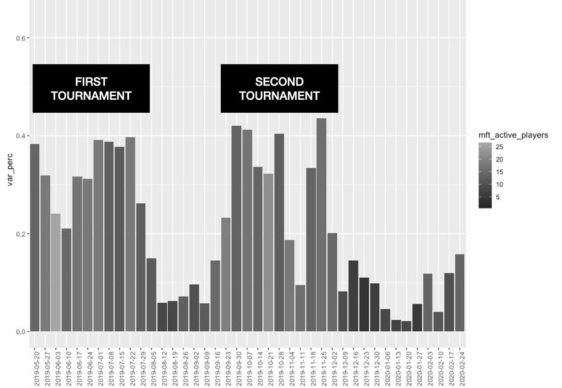
Figure 1: Variation in CO2 emissions and number of active users per week.
the focus concerned the players who have been active for many weeks within the game (a player is defined as ’active’ in a given week if they have registe- red at least three frequent routes in that week). The following table (Table 4) shows how the emission reduction changes concerning two different scena- rios of MUV active users (those where at least three frequent routes have been registered).
These results show that players who have been active during the 20-month trial, regardless of the game dynamic, have shown a small yet significant reduction of CO2 emissions. But if we look at the data in more detail, analy- zing the two main game features, the results appear significantly different (Table 5).
On average, those involved in Special Challenges all across the pilot cities have significantly changed their commuting habits during those events. But, compared to that, those involved in Tournaments (excluding the last one
because of the inference of COVID-19 outbreak) all across the pilot cities have drastically changed their commuting habits and for a more extended time (Figure 1).
CONCLUSION
The game dynamic that showed the best results, both in terms of user involve- ment and behavior change, was the Tournament, even if Tournaments have a longer duration, fewer prizes and are more challenging to win than Special Challenges. This result first answers the question we raised in this working paper. Among the different behavior change techniques in sustainable mobi- lity, the “game design” approach works better than the “gamification” one. The reasons why players got more involved will be further investigated by running a causal inference analysis of the data recorded and through specific surveys to understand better what characteristic was more relevant among the following drivers:
Identity: because of the City Teams and the sense of belonging;
Social: because of the peer-to-peer influence;
Goal: because of the mission and the prizes;
Flow experience: because of the app UX/UI.
Further research will be performed thanks to the MUV2020 spin-off “MUV B Corp” (www.muvgame.com); this will allow us to investigate and determine more clearly the differences among the different Special Challenges features in terms of engagement and impact.
ACKNOWLEDGMENT
The authors would like to acknowledge the MUV2020 EU’s Horizon 2020 RIA (GA No. 723521) project consortium and MUV Benefit Corporation.
REFERENCES
Bogost, I., (2007). “Persuasive games: The expressive power of videogames.” MIT Press. Bogost I., (2014). “Why Gamification is Bullshit”, in The Gameful World: Approa-
ches, Issues, Applications, MIT Press, pp. 65–79. Caroleo, B., Morelli, N., Lissandrello, E., Vesco, A., Di Dio, S., & Mauro, S.
(2019). “Measuring the change towards more sustainable mobility: MUV impact evaluation approach”. Systems, 7(2), 30. Coulton P. (2015). “The role of Game Design in addressing behavioural change. The value of Design Research.” 11th European academy of design conference. Paris Descartes University. Di Dio S., Massa F., Nucara A., Peri G., Rizzo G., Schillaci D., (2020). “Pursuing
softer urban mobility behaviors through game-based apps”. In: Heliyon, vol.6, issue 5. Amsterdam (Netherlands): Elsevier Ltd. Di Dio, S., Peri, G., Rizzo, G., & Vinci, I. (2018). “The serious game of TrafficO2”. Participatory Design Theory: Using Technology and Social Media to Foster Civic Engagement.
Gamification or Game Design? A Case Study in the Field of Sustainable Commuting 269
Duhigg C. (2013). “The power of habit. Why we do what we do and how to change”.
Random House Books, London. Fogg, B. J. (2009). “Creating persuasive technologies: An eight-step design process.”
In Persuasive Technology. Fourth International Conference, PERSUASIVE 2009, pp. 1–6. Mcgonigal, J. (2011). “Reality Is Broken: Why Games Make Us Better and How They Can Change the World”. Penguin Group USA, New York. Mousumi R., (2021). “Greening behavior toward sustainable development,” in
Sustainable Development Strategies, , Butterworth-Heinemann, pp. 53–90. MUV2020, Mobility Urban Value. European Union’s Horizon 2020 RIA, GA No.
723521. https://www.muv2020.eu Nakashima, R., Sato, T., Maruyama T. (2017). “Gamification Approach to Smartphone-app-based Mobility Management”, Transportation Research Proce- dia, 25, pp. 2344–2355. Schacter D.L., (1992). “Priming and multiple memory systems: Perceptual mechani-
sms of implicit memory”, Journal of Cognitive Neuroscience, 4 (3), pp. 244–256. Shankar M., Foster. L., (2019) “Behavioral Insights at the United Nations”, UNDP. Vegt, N.J.H.; Anderiesen, H.; Van der Kooij, K., (2013). “Persuasive Game Design: A model and its definitions”, CHI 2013: Workshop Designing Gamification: Creating Gameful and Playful Experiences, Paris, France, 27 April-2 May 2013. Yusoff Z., Kamsin A., (2015). Game Rhetoric: Interaction Design Model of Persua-
sive Learning for Serious Games. In: Zaphiris P., Ioannou A. (eds) Learning and Collaboration Technologies. LCT 2015. Lecture Notes in Computer Science, vol 9192. Springer, Cham.
Read this individual research paper free through the original publisher, or explore the full digital proceedings book.
ISBN 978-1-958651-44-5
Explore this ISBN in the AHFE Bookstore ↗Listed in the July 2026 bookstore catalogue; search by ISBN to confirm current availability · Digital book purchase optional