Nikita Rajendra Sharma, Jai Prakash Kushvah, Gerhard Rinkenauer (2022). Attention and action preparation during lane change maneuvers: The role of irrelevant information. In: Human Factors in Transportation. AHFE Open Access, vol. 60, pp. 359–366. https://doi.org/10.54941/ahfe1002467
Safe driving behaviour during lane change is the function of selecting and processing task relevant cues from the ongoing driving environment; enabling the goal-directed preparatory process. Such preparatory information typically facilitates reaction time to the anticipated event. However, it is unclear how the additional information other than task specific cues from the driving environment act on preparatory processes while driving a car. We implemented a pre-cue paradigm in a simulated lane change task (LCT) to answer this question. In contrast to the standard paradigm, additional information was presented either just before the preparatory stimulus (pre-cue) or the target stimulus (pre-target) that was either congruent, incongruent, or neutral to the lane change direction. Reaction time and amplitudes of steering out and in angles (A1 and A2) were measured as dependent variables. Results showed that reaction time and steering in amplitude A2 were increased when the additional information was presented before the final target for intended action and similarly when the additional information presented in the same lane changed direction (congruent). Later one accounts for contingent attentional capture. To accommodate the entire pattern of results observed in the study, we tentatively suggest that any information which is not relevant for the intended action have considerable influence on attention and action preparation on the basis of the temporal and visuo-spatial positioning. A strong effect is found especially at the time of the final determination of the upcoming driving manoeuvre.
High cognitive demands steaming out right from sustained attention to perce- ption and action planning are among core and essential features for driving a car. Advance planning of driving actions (both covert and overt) within the ongoing driving scenario ascertains safe car driving. Such planning involves extensive use of cognitive resources to attend the advance information from the driving environment in order to anticipate the immediate future goals and plan motor actions. In general, these are the preparatory processes concerning
both perceptual and motor systems functioning for optimal adaptation to the immediate future. Time given to prepare a speeded response while driving is described within a state of nonspecific preparation, fore-period interval, in order to process task relevant information and respond to the imperative sti- mulus at when it appears. When the fore-period remains uninterrupted, it facilitates the preparatory process but when it is interrupted with additional information similar to the imperative stimulus, it could impact the driving behaviour. Here, the information other than cue-facilitating, target-oriented actions is the additional information. The same additional information turns out to be irrelevant information if it interferes with the processing of cue for the intended actions. Whether any piece of information is a cue or a potential distractor depends entirely upon the visuo-spatial and temporal properties, intended goal and the current driving environment. Importance of cues and additional information can be better understood in the light of the experimental paradigm based on “movement pre-cueing technique” to assess covert preparatory processes within the motor system (Rosenbaum, 1980, 1983). In experimental set-up, the movement pre-cueing technique is realised in as a modified choice reaction task in which an imperative sti- mulus requires a participant to perform a specific reaction as quickly as possible (Hofmann, 2011). Varying spatial-temporal presentation of the irre- levant additional information on the movement pre-cueing paradigm not only manipulates action preparation, but simultaneously influences attentional preparation too. While performing the lane change task (LCT), the simulta- neous occurrence of additional information during the presentation of cues might impact the motor preparation and driving performance. Thus, the pre- sent study is an attempt to investigate the impact of additional information (seemingly irrelevant to the task) on preparatory process and motor acti- ons. For this purpose, the movement pre-cueing paradigm was replicated and introduction of the irrelevant additional information between warning signal and imperative stimulus during the Lane Change Task (Hofmann, 2013). Additional information was presented in congruent and incongruent conditi- ons (additional information feature sharing to the imperative stimulus) prior to cue or before target stimulus. Experimental task measures of reaction time and steering wheel behavior by ascertaining the respective angels are provided to conclude the preparatory process and motor action control. Literature on distracted driving has received increasing attention since past decades (Young et al. 2013). Our investigation could aid in understanding how the irrelevant additional information causes distraction, particularly when they appear near the cues that help in action preparation for the subsequent task or other way around.
METHOD
Participants Fifteen young, right-handed, valid driving license bearing participants (range = 2-13 years; mean = 6 years) were recruited for the study (MAge = 23.80 years, SD = 3.12 years; average car driving per month = 604 km). All the participants had corrected to normal vision as well as normal
Attention and Action Preparation during Lane Change Maneuvers 361
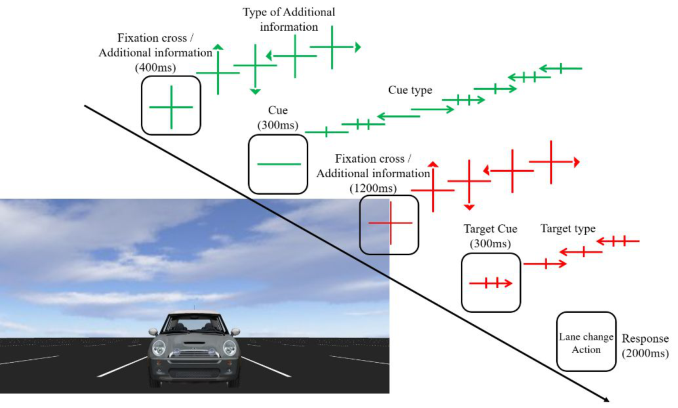
Figure 1: Time course of the stimuli in the lane change task and the possible manifestations of the stimuli before the steering response.
color vision and hearing. All the participants were naive about the purpose of the actual study and received either course credit or monetary compensation for their participation (€10 / hour). Written informed consent for the study participation was obtained during the recruitment procedure.
Driving Task Adopted version of Drivers’ Lane Change Task (LCT, cf. Hofmann & Rinkenauer, 2013) was employed in the current study. LCT was modified by including 4 cues (no cue, only lane cue, only direction cue and cue with both lane and direction) within the trials by changing the number of lane changes (1 or 2) and direction of lane change (left or right). Total 16 pos- sible combinations deployed in the experiment. Additional information was presented by including four types of arrows around the four directions of fixation cross (arrows pointing up, down, left or right) in before cue and before target conditions, comprising total 8 possible combinations. 512 task trials per participants were presented in randomized manner by repeating 128 combinations twice; along with the equal number of task trials without additional information. Each trial was roughly around 4.2 s (figure 1). Parti- cipants were instructed to keep their virtual vehicle in the middle of the lanes and to respond as fast and accurate for lane change direction condition. Error messages of ‘too early’ was displayed when participants moved the steering wheel before the imperative stimulus (RT, 150ms), ‘too late’ for reactions being too slow (RT, 1000ms) and ‘wrong lane’ for changing the lane in the wrong direction or when participant missed the target lane. All participants first finished the practice session before the main experimental session. Each participant took around 50 minutes to complete the experiment.
The dependent variables were reaction time (RT: time from onset of the imperative stimulus to movement onset, in ms) the maximum steering wheel
angle when leaving the start lane (A1 in °) and the maximum steering wheel angle when turning into the target lane (A2 in °) (cf. Hofmann & Rinkenauer, 2013).
RESULTS
A series of 4 (Preparatory cue information: no cue, lane only, direction only, both direction and lane) X 2 (stimuli congruency: Congruent, incon- gruent) X 2 (event of additional information: pre-cue, pre-target) within- subject-repeated measure ANOVAs were conducted to see the impact on reaction time and steering wheel angles (A1 and A2). Statistical analysis was performed using R and the open-source statistical software JASP.
Reaction Time (RT) ANOVA results showed that the main experimental effect of preparatory cue information [F (3, 42) = 27.42, p < .001, ω2 = .28], stimuli congruency [F (1, 14) = 12.50, p = .003, ω2 = .19] and event of additional information [F (1, 14) = 10.41, p = .004, ω2 = .14] was significant on RT. Bonferroni- corrected post-hoc pairwise comparisons showed that RT reduced when direction related or both lane-direction related preparatory cue was presen- ted compared to when no cue or lane related cues were provided. [(No Cue (M = 519.07 ms, SD = 37.21 ms) ≈lane only (M = 518.25 ms, SD = 29.41 ms)) > (Direction only (M = 493.43 ms, SD = 33.48 ms) ≈Both Lane and direction (M = 492.32 ms, SD = 35.97 ms))]. RT decreases when the additional information was same as the lane change direction [Incongruent (M = 517.01 ms, SD = 34.96 ms) > Congruent (M = 494.52 ms, SD = 34.96 ms). Interestingly, RT was less when the event of additional information was presented before the cue (M = 499.92 ms, SD = 33.21 ms) compared to the pre-target condition (M = 511.61 ms, SD = 38.43 ms). Two-way inte- raction effect of stimuli congruency and event of additional information was significant on reaction time [F (1, 14) = 9.45, p = .01, ω2 = .06]. Reaction time for incongruent stimuli presented before target was higher (M = 528.22 ms, SD = 34.78 ms) compared to congruent stimuli presented before the target (M = 495 ms, SD = 34.76 ms; t = 4.58, p < .001) and; congruent (M = 494.05 ms, SD = 35.45 ms; t = 5.02, p < .001) and incongruent sti- muli presented before the cue (M = 505.8 ms, SD = 29.96 ms; t = 5.26, p < .001). Thus, overall, the congruency of additional information in context of lane change direction facilitated the preparatory process and especially when the addition information was presented before the LCT cues. Further, direction and both lane-direction guiding LCT cues were more effective on improving reaction time.
Steering Wheel Angles (A1 and A2) Two separate ANOVAs for A1 and A2 were performed to evaluate the main experimental effects. Results showed a significant main effect of preparatory cue information [F (3, 42) = 3.02, p = .04, ω2 = .003] on A1. In post- hoc pairwise comparisons, A1 was reported less when both lane-direction related cues were provided (M = 5.73°, SD = 1.82°) compared to no cue trials
Attention and Action Preparation during Lane Change Maneuvers 363
(M = 6.06°, SD = 2.07°). Two-way interaction effect of stimuli congruency and event of additional information was significant on A1 [F (1, 14) = 17.31, p < .001, ω2 = .005]. A1 for incongruent stimuli presented before the target, was found higher (M = 6.14°, SD = 1.87°) compared to congruent stimuli presented before target (M = 5.67°, SD = 1.89°; t = 3.56, p = .01) and incongruent stimuli presented before LCT cues (M = 5.78°, SD = 1.86°; t = 3.81, p = .004).
Further, steering wheel angle A2 was significantly modulated by prepa- ratory cue information [F (3, 42) = 2.81, p = .05, ω2 = .004], stimuli congruency [F (1, 14) = 14.97, p = .002, ω2 = .01] and event of additio- nal information [F (1, 14) = 8.40, p = .01, ω2 = .003]. Bonferroni-corrected post-hoc pairwise comparisons showed that increased A2 was associated with the direction related preparatory cue (M = 6.12°, SD = 1.91°) when compa- red with the lane-direction related cues (M = 5.73°, SD = 1.73°; t = 2.86, p = .04). A2 decreased when the additional information was congruent with the lane change direction cues (M = 5.77°, SD = 1.84°) compared to the incongruent condition (M = 6.09°, SD = 1.93°). Also, reduced A2 was found when the event of additional information was presented before the cue (M = 5.82°, SD = 1.84°) compared to the pre-target presentation (M = 6.04°, SD = 1.94°). Two-way interaction effect of stimuli congruency and event of additional information was significant on A2 [F (1, 14) = 9.87, p = .01, ω2 = .01]. A2 for incongruent stimuli presented before target was higher (M = 6.37°, SD = 1.99°) compared to congruent stimuli presented before tar- get (M = 5.71°, SD = 1.84°; t = 4.85, p < .001) and; congruent (M = 5.83°, SD = 1.85°; t = 4.81, p < .001) and incongruent stimuli presented before the cue (M = 5.81°, SD = 1.85°; t = 4.24, p = .002). Overall, the congruency of additional information with lane change direction reduced the steering wheel repositioning (A2) more effectively when the additional information was presented before the LCT cues.
Thus, results revealed experimental main effects did not impact the steering wheel angle much immediately after the targeted stimuli (A1) but in the later phase (A2). Interestingly, we found similar experimental effects on RT and A2, suggesting that pre-cued preparatory processes have their relevance on steering wheel repositioning, i.e., steering into the target lane.
DISCUSSION
We have pursued the idea that attention and motor preparation are integral part of advance motor control behavior like driving and that modifying the precision of movement pre-cuing paradigm causes consequences on antici- pated actions. The current study aimed at confirming the costs and benefits of response preparation in simulated lane change task with regards to speed of information processing and response dynamics (Hofmann & Rinkenauer, 2013) in the presence of irrelevant information. The lane change task was employed because the maneuverer required in this study corresponds to a standard traffic situation and has been used in many previous studies (Salvucci & Liu, 2002). The obtained findings are consistent with the exi- sting results, i.e., the pre-cuing effect, obtained in former movement pre-cuing
paradigm (short RTs full advance information) (Anson et al. 2000; Leuth- old et al. 1996; Hofmann, 2011). Participants took longer time to react in conditions where advance lane change direction and lane-direction related information were provided to participants. An interesting effect was found in the current study when the advance cue information (Lane change direction cues) was congruent with (additional) irrelevant cues; RTs were faster as com- pared to conditions where cues were incongruent with irrelevant information. Explanation of these findings could be possible from the literature available on contingent attentional capture (Theeuwes, 2004). Human visual system only selects relevant locations and objects and restrict processing for irrele- vant others due to capacity limitations (Ito & Kawahara, 2016). However, our attention is attracted by salient but goal-irrelevant stimuli occasionally (Theeuwes, 1994). Our attention-allocation system is configured to prioritize process attentional capture while searching for a target defined by a particular visual property. Such is considered being influenced by parallel/serial search strategy (Theeuwes, 2004). Thus, processing of additional information sali- ent to the target could be seen as possible attentional capture because of the unintentional shift towards the additional information (Theeuwes, 2010).
Abbreviated, this can be explained as our attentional awareness is modula- ted by a specific attentional template or “set” (Most et al. 2005). Distracting events generates an attentional set, and the distracting event would be more likely to be detected if it matches with the intended goal. Such events impose decremental impact. So, the increase in task load would have an effect on the filtering mechanism and might impair prevention from the capture of atten- tion by salient distractors sharing common features with the targets. Such load could be well depicted in the results under the conditions where RTs were longer for the conditions where irrelevant information appeared just prior to targets. And the similar trend was observed when irrelevant infor- mation was incongruent with cues and, along with being incongruent, they appeared prior to the target, resulting in costing the performance, leading to Longer RT’s.
Since, advance information about the lane change direction can be inter- preted analogously to the movement amplitude, the findings are consistent with the previous work on aiming movements: Anson et al. (2000) found that the benefit of mere directional advance information was larger than the exclu- sive advance information about movement extent (Hofmann, 2011). Current study assessed the vehicle’s dynamic state by measuring steering wheel angles (A1 and A2) to understand the motor control behavior during simulated lane changing task (Xing et al. 2020). A1 was measured as a direct response to the lane crossing/changing instruction provided by on road driving cues. On the other hand, A2 is more informative about the driver’s control ability. A2 is the resultant smooth leaving-off process in which the driver straigh- tens the vehicle and maintains its position in the destination lane. A1 has the direct implementation of preparatory processes, thus, considered as inten- ded action to execute in a short temporal span. Drivers might be unaware about the irrelevant information presented while lane changing, which might cost the safety if it interferes information processing. Results showed that A1 was less in the presence of direction-lane cue but remained unaffected by
Attention and Action Preparation during Lane Change Maneuvers 365
other LCT cues. Interestingly, irrelevant information, when presented in the lane changing direction in both pre-cue and pre-target conditions, lowered the A1; consistent with the concept of CAC. It suggests that the impact of irrelevant information sharing the direction feature similar to the imperative stimuli on preparatory processes was strong enough to impact A1. Further, driver’s control ability to position the vehicle on destination line (A2) was vastly affected by the experimental manipulations. A2 improved for the lane change direction related cue type. Similar to A1, the impact of additional information presented before target in congruent condition on preparatory processes was strong enough to impact A2 as well. These findings about vehi- cle status information stating the impact of additional information, are novel for driver-vehicle interactions. Additional information presented just before the imperative stimulus adversely impacts the preparatory process. And if additional information and imperative stimulus share some common fea- ture, then if facilitate the preparatory process and the driving motor control. Findings have implication in understanding driver’s intention inferences and road safety.
ACKNOWLEDGMENT
The authors would like to thank Mr. Hanno Mussmann for his technical support and Ms. Annika Schuetz for her support in the data collection.
REFERENCES
Anson, J. G., Hyland, B. I., Kötter, R., & Wickens, J. R. (2000). Parameter precuing and motor preparation. Motor Control, 4, 221-231. Hofmann, P. (2011). On the influence of action preparation on steering performance
in a lane change task (Doctoral dissertation, Universitätsbibliothek Technische Universität Dortmund). Hofmann, P., & Rinkenauer, G. (2013). Response preparation in a lane change task. Ergonomics, 56(2), 268–281. Ito, M., & Kawahara, J. I. (2016). Contingent attentional capture across multiple
feature dimensions in a temporal search task. Acta Psychologica, 163, 107–113. Leuthold, H., Sommer, W., & Ulrich, R. (1996). Partial advance information and response preparation: Inferences from the lateralized readiness potential. Journal of Experimental Psychology: General, 125(3), 307–323. Most, S. B., Scholl, B. J., Clifford, E. R., & Simons, D. J. (2005). What you see is what
you set: sustained inattentional blindness and the capture of awareness. Psycho- logical review, 112(1), 217. Rosenbaum, D. A. (1980). Human movement initiation: specification of arm, direction, and extent. Journal of Experimental Psychology: General, 109(4), 444. Rosenbaum, D. A. (1983). The movement precuing technique: Assumptions, appli-
cations, and extensions. Advances in psychology, 12, 231-274. Salvucci, D. D., & Liu, A. (2002). The time course of a lane change: Driver control and eyemovement behavior. Transportation Research Part F 5, 123–132. Theeuwes, J. (1994). Stimulus-driven capture and attentional set: selective search
for color and visual abrupt onsets. Journal of Experimental Psychology: Human perception and performance, 20(4), 799.
Theeuwes, J. (2004). Top-down search strategies cannot override attentional capture. Psychonomic bulletin & review, 11(1), 65–70. Theeuwes, J., Olivers, C. N., & Belopolsky, A. (2010). Stimulus-driven capture
and contingent capture. Wiley Interdisciplinary Reviews: Cognitive Science, 1(6), 872–881. Xing, Y., Lv, C., & Cao, D. (2020). State of the art of driver lane change intention inference. Advanced Driver Intention Inference; Elsevier: Amsterdam, The Netherlands, 21–51. Young, K. L., Salmon, P. M., & Cornelissen, M. (2013). Distraction-induced driving
error: An on-road examination of the errors made by distracted and undistracted drivers. Accident Analysis & Prevention, 58, 218–225.
LISTED IN THE AHFE DIGITAL BOOKSTORE CATALOGUE
Explore the complete digital volume
Human Factors in Transportation
Read this individual research paper free through the original publisher, or explore the full digital proceedings book.
ISBN 978-1-958651-36-0
Explore this ISBN in the AHFE Bookstore ↗Listed in the July 2026 bookstore catalogue; search by ISBN to confirm current availability · Digital book purchase optional