Erzhuo Huang, Lin Du, Xiaohui Hao, Xiaodan Zheng, Chunling Zhao, Tan Hao (2026). Effects of Acoustic Design Parameters of Aural Alerts on Reaction Time in Commercial Aircraft Cockpits. In: Advances in Human Factors of Transportation. AHFE Open Access, vol. 224, pp. 212–222. https://doi.org/10.54941/ahfe1007848
In high-workload and time-critical commercial aircraft cockpits, pilots must rapidly perceive aural alerts and initiate operational responses. However, systematic evidence on how specific acoustic design parameters influence operational reaction time remains limited. This study investigates the effects of alert temporal structure and prosodic modulation on reaction time. A laboratory-based auditory reaction experiment was conducted with 30 participants using a fully within-subject design. Three representative alert categories were tested: tonal alerts, voice alerts, and combined tonal–voice alerts. Signal duration, interval structure, and voice tone (monotone vs. urgent) were systematically manipulated. Reaction time data were analyzed using linear mixed-effects modeling. Results indicate that increasing acoustic temporal density—by shortening signal duration and intervals—significantly reduces reaction time. The most pronounced improvements were observed in combined tonal–voice alerts under temporal compression. However, diminishing returns emerged at higher compression levels. In the voice alert condition, urgent prosody further shortened reaction time compared with monotone delivery. Semi-structured interviews with ten active commercial pilots supported these findings, suggesting that temporally compact and clearly articulated alerts facilitate faster responses. This study proposes a reaction-time-based quantitative evaluation framework for cockpit aural alert design and provides empirical guidance for optimizing safety-critical auditory systems in commercial aviation.
In the safety-critical environment of a commercial aircraft cockpit, pilots must rapidly perceive alerts and initiate appropriate actions under high workload and time pressure. Cockpit aural alerts play a key role in directing attention and supporting timely responses. According to EASA CS-25.1322 Flight Crew Alerting, alerting systems should enable flight crews to detect non-normal conditions and take corrective action promptly. Understanding how alert signals influence behavioral response time is therefore an important issue in cockpit design.
Effects of Acoustic Design Parameters of Aural Alerts on Reaction Time 213 Reaction time (RT) is widely used in cognitive psychology to evaluate information processing speed and behavioral readiness. It reflects the efficiency of the perception–decision–action process in complex tasks (Li et al., 2024). Previous research has shown that acoustic properties of alert signals can influence attention allocation and response performance. Poorly designed alerts—such as those with excessive duration or inappropriate acoustic characteristics—may interfere with task processing and delay responses (Peryer, 2005). Fercho et al. (2024) argue that the traditional concept of “average pilot reaction time” no longer reflects response behavior in highly automated cockpits, indicating the need to reassess alert parameters and reaction time.
Despite these insights, systematic evidence on how specific acoustic parameters—such as signal duration, temporal intervals, and tonal characteristics—affect operational reaction time remains limited. To address this gap, the present study examines the effects of temporal structure and tonal modulation of cockpit aural alerts on reaction time. Using controlled experiments and linear mixed-effects modeling, the study provides empirical evidence to inform the engineering optimization of cockpit aural alert design.
METHOD
Participants A total of 30 healthy male participants (aged 18–45 years, M = 28.6, SD = 4.3) were recruited. All participants had normal hearing and reported no history of neurological or auditory disorders. A hearing screening test was conducted prior to the formal experiment, and only individuals meeting the screening criteria were included. All participants provided informed consent and received monetary compensation. The study protocol was approved by the relevant ethics committee.
Experimental Design A within-subject design was employed to examine the effects of cockpit aural alerts under different acoustic parameter manipulations on behavioral performance.
The experiment included three alert conditions as sub-experiments: tonal alerts, voice alerts, and combined tonal–voice alerts. All participants completed all experimental conditions. The order of sub-experiments was counterbalanced across participants, and stimulus presentation within each sub-experiment was randomized.
Apparatus The experimental tasks were programmed using E-Prime 3.0. The experiment included both visual and auditory stimuli. Visual stimuli were presented on a white background covering the entire screen, subtending a visual angle of approximately 2° and measuring 72 pixels in size.
Auditory stimuli consisted of three categories of cockpit alert sounds: tonal alerts, voice alerts, and combined tonal–voice alerts. All auditory stimuli were presented through calibrated Sony MDR-7506 headphones.
Visual stimuli were displayed on a 27-inch monitor (resolution: 1920 × 1080 pixels; refresh rate: 60 Hz). Behavioral responses were recorded using the arrow keys on a Cherry MHD10 keyboard. The keys were clearly labeled (up, down, left, right). Left and right responses were made using the index finger, and up and down responses were made using the middle finger.
Procedure After providing informed consent, participants sequentially completed three sub-experiments corresponding to tonal alerts, voice alerts, and combined tonal–voice alerts.
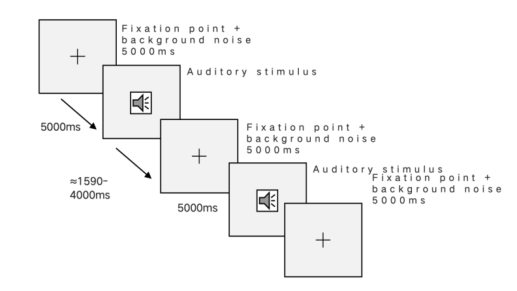
The experiment was based on an auditory oddball paradigm. Cockpit background noise served as the standard stimulus, whereas alert sounds served as deviant stimuli. Participants were instructed to respond via keypress according to the alert category. Reaction times were precisely recorded using E-Prime 3.0, Figure 1.
Figure 1: Schematic diagram of the experimental procedure.
Experimental Variables Duration, interval, and tone were defined as independent variables.
Duration referred to the playback length of the minimum acoustic unit and was controlled by adjusting playback speed following Krokar et al. (2024). Three levels were used: 1×, 1.5×, and 1.75×.
Interval was manipulated based on the pulse interval control method proposed by Burr et al. (2013), with three levels (250 ms, 500 ms, 750 ms). Depending on alert type, intervals were categorized as intra-signal and inter- signal intervals. In tonal alerts, these represent the timing between pulses and pulse groups, respectively. In combined tonal–voice alerts, the intra-signal
Effects of Acoustic Design Parameters of Aural Alerts on Reaction Time 215 interval refers to the delay between the tonal cue and the voice message, while the inter-signal interval refers to the spacing between repeated voice messages. For voice alerts, a single interval parameter was used.
Tone referred to the vocal delivery style in voice alerts. Following Arrabito (2009), two levels were used: monotone and urgent.
The dependent variable was operational reaction time (RT), defined as the interval between alert onset and keypress response (Bouvier et al., 2023), recorded with millisecond precision in E-Prime 3.0.
Three alert conditions were tested: tonal alerts, voice alerts, and combined tonal–voice alerts. All conditions employed a fully crossed within-subject factorial design (see Table 1).
Table 1: Design of independent and dependent variables.
Intra-signal interval: 250 ms, 500 ms, 750 ms Inter-signal interval: 250 ms, 500 ms, 750 ms
Tone: Monotone, Urgent
Data Analysis Data analysis was conducted using SAS OnDemand for Academics. Separate models were constructed for the tonal, voice, and combined tonal–voice alert conditions.
Given the within-subject design, linear mixed-effects models (LMMs) were used to analyze repeated-measures data. Participants were specified as random intercepts, and experimentally manipulated factors were entered as fixed effects.
Reaction time data exhibited positive skewness; therefore, logarithmic transformation (logRT) was applied prior to modeling. Model parameters were estimated using Restricted Maximum Likelihood (REML), and degrees of freedom were approximated using the Satterthwaite method. Fixed effects were evaluated using Type III tests. Significant main effects were followed by post hoc comparisons with Tukey–Kramer correction. The significance level was set at α = 0.05.
Semi-Structured Interviews To enhance the contextual validity of the experimental findings, semi- structured interviews were conducted with 10 active civil aviation pilots after
completion of the experiment. All interviewees held valid Airline Transport Pilot Licenses and had extensive cockpit operational experience. Written informed consent was obtained prior to the interviews.
Based on the experimental findings, 20 optimized alert sounds were developed, covering tonal, voice, and combined tonal–voice alert types. Interviews were conducted in a quiet environment, with alert sounds presented through headphones in randomized order. A one-on-one interview format was adopted, and follow-up questions were asked as appropriate based on participants’ responses.
All interviews were audio-recorded and transcribed. Thematic analysis was used to extract common themes, with particular emphasis on comparing pilots’ subjective feedback with experimental results, thereby providing contextual support for the discussion section.
RESULTS
Effects of Temporal Parameters and Tone Type on Operational Reaction Time Linear mixed-effects models (LMMs) were used to examine the effects of pulse duration, intra-signal interval, inter-signal interval, and tone type on operational reaction time across different alert audio conditions. Participants were included in the model as random intercepts.
Post hoc comparisons for multi-level factors were conducted using Tukey– Kramer correction. The Type III tests of fixed effects for each dependent variable are summarized in Table 2, and the adjusted significant pairwise comparison results are presented in Table 3.
Table 2: Type III tests of fixed effects in the linear mixed model for operational reaction time.
1.75× vs 1× –0.27 (0.04) –6.43 <.0001*** [–0.37, –0.17] Tone Monotone vs Urgent 0.12 (0.03) 3.48 0.0005*** [0.05, 0.19]
Duration 1.5× vs 1.75× 0.059 (0.016) 3.80 0.0004*** [0.02, 0.10]
Combined Tonal–Voice Alerts
1.5× vs 1× –0.131 (0.016) –8.35 <.0001*** [-0.17, -0.09] 1.75× vs 1× –0.190 (0.016) –12.15 <.0001*** [–0.23, –0.15]
Intra-signal interval
250 ms vs 750 ms
–0.053 (0.016) –3.39 0.0021** [–0.09, –0.02]
Note. *p < .05, **p < .01, ***p < .001.
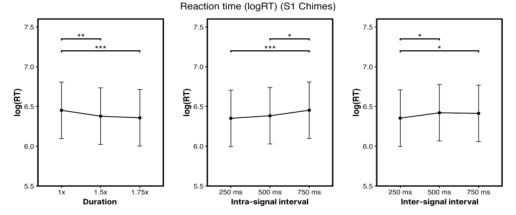
Operational Reaction Time in the Tonal Alert Condition Under the tonal alert condition, pulse duration, intra-signal interval, and inter-signal interval all showed significant main effects on reaction time (η²p = 0.011–0.022), with no significant interactions among factors.
Post hoc pairwise comparisons using Tukey–Kramer correction indicated that reducing duration from 1× to 1.5× significantly decreased reaction time, whereas further compression to 1.75× did not yield additional significant benefits. Similarly, shortening the intra-signal interval from 750 ms to 500 ms significantly reduced reaction time, but further reduction from 500 ms to 250 ms was not significant. For the inter-signal interval, reaction time significantly decreased when reduced from 500 ms to 250 ms, whereas no significant difference was observed between 750 ms and 500 ms. Overall, temporal compression in the tonal alert condition reduced reaction time; however, diminishing marginal returns were observed within certain compression ranges (see Figure 2).
Figure 2: Operational reaction time in the tonal alert condition.
Operational Reaction Time in the Voice Alert Condition In the voice alert condition, pulse duration (η²p = 0.087) and intonation type (η²p = 0.024) showed significant main effects, whereas interval factors and interaction effects were not significant.
Specifically, reducing duration from 1× to 1.5× significantly shortened reaction time, while further compression to 1.75× did not produce stable additional improvement. Regarding intonation, the urgent prosody significantly reduced reaction time compared to the monotone condition, indicating faster behavioral responses under urgent vocal delivery (see Figure 3).
Figure 3: Operational reaction time in the voice alert condition.
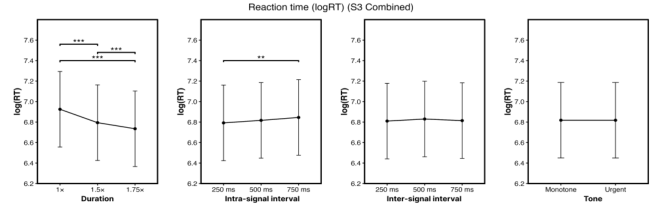
Operational Reaction Time in the Combined Tonal–Voice Alert Condition In the combined tonal–voice alert condition, pulse duration (η²p = 0.091) and intra-signal interval (η²p = 0.007) showed significant main effects. The main effects of intonation and inter-signal interval were not significant; however, a significant interaction between these two factors was observed.
Unlike the tonal and voice alert conditions, reaction time in the combined tonal–voice alert condition decreased systematically with increasing temporal compression. The 1.75× duration condition was significantly faster than the 1.5× condition, demonstrating a more stable compression effect. In addition, reducing the intra-signal interval from 750 ms to 250 ms significantly shortened reaction time.
Overall, the combined tonal–voice alert condition exhibited a more pronounced improvement trend under temporal compression (see Figure 4).
Figure 4: Operational reaction time in the combined tonal–voice alert condition.
Results of Semi-Structured Interviews Semi-structured interviews with ten active commercial pilots were conducted to complement the experimental findings. Twenty optimized alert sounds were presented in a quiet environment through headphones in randomized order.
Pilots consistently reported that temporally compact alerts facilitated faster action initiation, whereas prolonged alert sequences could delay response onset. For combined tonal–voice alerts, excessive lead-in structures were considered likely to postpone processing of the core message. Pilots also indicated that tolerance for temporal compression depends on alert urgency, with high-risk alerts benefiting from more compact timing and urgent vocal delivery.
DISCUSSION
This study used reaction time (RT) to examine how acoustic design parameters of cockpit aural alerts influence operational responses. The results show that increasing acoustic temporal density—by shortening signal duration and intervals—significantly reduces RT. Urgent prosody further improved response speed in voice alerts, while combined tonal–voice alerts exhibited the largest improvement under temporal compression. However, the benefits tended to plateau at higher compression levels. Findings from pilot interviews were consistent with these experimental results.
Temporal Structure and Intonation Effects Shorter signal duration and reduced intervals significantly decreased RT, indicating that temporal organization plays an important role in attentional capture and response initiation. Suied et al. (2008) similarly reported that
shorter inter-pulse intervals reduce reaction time to warning sounds in dual- task environments, suggesting that compact temporal structures facilitate faster behavioral responses. The present findings therefore support the view that acoustic temporal density is a key factor influencing response latency.
However, further compression from 1.5× to 1.75× did not consistently produce additional improvements. This pattern reflects a diminishing-return effect similar to the nonlinear relationship reported by Einhäuser et al. (2024), who showed that once stimulus salience exceeds a threshold, further enhancement may not continue to reduce reaction time. The results therefore suggest the existence of an effective compression range rather than a strictly linear relationship between temporal parameters and RT.
In the voice alert condition, urgent prosody significantly shortened RT. Arrabito (2009) similarly demonstrated that voice style influences recognition speed and response performance in cockpit warning systems. These findings indicate that prosodic modulation can enhance acoustic salience and facilitate faster behavioral initiation.
Previous research has also emphasized that acoustic characteristics such as pitch, rhythm, and spectral structure influence alarm detectability and response efficiency (Foley and Anderson, 2020). The present findings extend this perspective by showing that temporal structure and prosodic cues jointly affect behavioral responses to cockpit alerts.
Engineering Implications From an engineering perspective, the results suggest that both temporal structure and voice tone can serve as effective design variables for improving pilot response performance. Cross-industry research on alarm design has shown that high-risk systems require alarms with strong detectability and discriminability to support rapid responses (Pruitt et al., 2023). The present findings provide quantitative behavioral evidence supporting this principle.
Rather than optimizing a single parameter, cockpit alert design should therefore consider coordinated adjustments of multiple acoustic features, including temporal structure and prosodic characteristics. Furthermore, alert timing and vocal urgency may be configured according to alert priority to enhance response efficiency in high-workload situations.
Limitations Several limitations should be noted. First, all participants were male and the sample size was limited; future studies should include more diverse samples. Second, the experiment was conducted in a laboratory environment without realistic cockpit noise or multitask demands. Future work should validate the findings in high-fidelity simulation environments. Finally, the interview sample consisted only of Chinese flight crew members, and cultural differences in auditory perception may influence responses to alert sounds.
CONCLUSION
This study examined how temporal structure and intonation modulation of cockpit aural alerts influence operational reaction time. Using a within- subject experimental design and linear mixed-effects modeling, the results show that increasing acoustic temporal density—by shortening signal duration and intervals—significantly reduces reaction time across tonal, voice, and combined tonal–voice alert conditions. These findings confirm that temporal structure is a key adjustable acoustic parameter influencing behavioral response latency.
Urgent prosody in voice alerts further improved response speed, indicating that vocal delivery not only conveys semantic emphasis but also enhances acoustic salience and attentional triggering. In addition, the results revealed a diminishing-return effect in temporal compression: increasing playback speed beyond 1.5× did not consistently produce additional improvements, suggesting the existence of an effective compression range for alert design.
Pilot interviews supported these findings, indicating that temporally compact alerts with clear urgency facilitate faster operational responses, whereas prolonged alert sequences may delay action initiation.
Overall, this study provides a reaction-time-based framework for evaluating cockpit aural alert design and offers empirical guidance for optimizing safety-critical auditory warning systems in commercial aviation.
ACKNOWLEDGMENT
The authors acknowledge the support of the School of Design at Hunan University and the Shanghai Civil Aircraft Design and Research Institute (Shanghai 201210, China) for providing research resources and technical assistance during this study.
REFERENCES
Arrabito, G.R. (2009). Effects of talker sex and voice style of verbal cockpit warnings on performance. Human Factors, 51(1), 3–20. Bouvier, B., Susini, P., Marquis-Favre, C., and Misdariis, N. (2023). Revealing the
stimulus-driven component of attention through modulations of auditory salience by timbre attributes. Scientific Reports, 13(1), 6842. Burr, D., Rocca, E.D., and Morrone, M.C. (2013). Contextual effects in intervalduration judgements in vision, audition and touch. Experimental Brain Research, 230, 87–98. https://doi.org/10.1007/s00221-013-3632-z EASA (European Union Aviation Safety Agency). (n.d.). CS-25.1322 Flight Crew
Alerting. In Easy Access Rules for Large Aeroplanes. Retrieved from https://www. easa.europa.eu/en/document-library/easy-access-rules/online-publications/easy- access-rules-large-aeroplanes-cs-25 Einhäuser, W., Neubert, C.R., Grimm, S., et al. (2024). High visual salience of alert signals can lead to a counterintuitive increase of reaction times. Scientific Reports, 14, 8858. https://doi.org/10.1038/s41598-024-58953-4 Fercho, K.A., Beringer, D.B., and Donovan, C. (2024). Factors that affect pilot response
times to alerts: Findings from a literature review and Aviation Safety Reporting System (ASRS) reports. Proceedings of the Human Factors and Ergonomics Society Annual Meeting, 68(1), 50–55. https://doi.org/10.1177/10711813241260286
Foley, L., Anderson, C.J., and Schutz, M. (2020). Re-sounding alarms: Designing ergonomic auditory interfaces by embracing musical insights. Healthcare, 8(4), 389. https://doi.org/10.3390/healthcare8040389 Krokar, L., Atkinson, A.G., Nguyen, D.T., et al. (2024). The effect of listening speed
on comprehension: Are you sacrificing comprehension by speeding up? Global Surgical Education, 3, Article 13. Li, M., Dang, X., Chen, Y., et al. (2024). Cognitive processing speed and accuracy are intrinsically different in genetic architecture and brain phenotypes. Nature Communications, 15, 7786. https://doi.org/10.1038/s41467-024-52222-8 Pachella, R.G. (1973). The interpretation of reaction time in information processing
research. In B.H. Kantowitz (Ed.), Human Information Processing: Tutorials in Performance and Cognition. Hillsdale, NJ: Erlbaum. Peryer, G., Noyes, J., Pleydell-Pearce, K., and Lieven, N. (2005). Auditory alert characteristics: A survey of pilot views. The International Journal of Aviation Psychology, 15(3), 233–250. Pruitt, Z.M., Bocknek, L.S., Busog, D.N.C., et al. (2023). Informing healthcare alarm
design and use: A human factors cross-industry perspective. Patient Safety, 5(1), 6–14. https://doi.org/10.33940/med/2023.3.1 Suied, C., Susini, P., and McAdams, S. (2008). Evaluating warning sound urgency with reaction times. Journal of Experimental Psychology: Applied, 14(3), 201– 212. https://doi.org/10.1037/1076-898X.14.3.201
LISTED IN THE AHFE DIGITAL BOOKSTORE CATALOGUE
Explore the complete digital volume
Advances in Human Factors of Transportation
Read this individual research paper free through the original publisher, or explore the full digital proceedings book.
ISBN 979-8-950676-00-0
Explore this ISBN in the AHFE Bookstore ↗Listed in the July 2026 bookstore catalogue; search by ISBN to confirm current availability · Digital book purchase optional