Cesar Guevara, Carlos Manuel Núñez Michuy, Diego Mauricio Bonilla Jurado, Verónica Teresa Veloz Segura (2022). Pedagogical Model Based On Edgar Morín's Complex Thinking In School Management. In: Training, Education, and Learning Sciences. AHFE Open Access, vol. 59, pp. 246–253. https://doi.org/10.54941/ahfe1002407
The objective of this research was to propose a pedagogical model based on the complex thinking of Édgar Morín to strengthen the School Management of the Ángel Polibio Cháves Educational Unit, Ecuador. This research was of an applied type, descriptive scope, quantitative approach and non-experimental design; the non-random sample for convenience. The research technique used was the survey and the instrument a questionnaire composed of 24 closed polytomous items on a Likert scale, Cronbach's alpha consistency 0.895; Within the framework of the study variable and for each of its dimensions, the results found showed that 37% is at a low level, 60% at a medium level and 3% at a high level, from which it is inferred that the school management of The educational unit must be strengthened through the pedagogical model, which is based on the theory of complex thought and the seven necessary knowledge for the education of the future, emphasizing the principles of pertinent knowledge, teaching human understanding and the ethics of gender. What will motivate students the value of learning and the importance of knowledge, contrast concepts in search of relevance and respect the human condition.
Pedagogical Model Based on Edgar Morín’s Complex Thought in School Management 247
features of rigor, tolerant and open in both educators and learners, both can face reality building a practical education tailored to all.
In the case of the Ángel Polibio Cháves Millennium Educational Unit, it has a high number of teachers with low knowledge in didactics or pedagogy, this happens because they are professionals in profiles unrelated to educati- onal work; There is no proper accompaniment and supervision of teachers by academic authorities. In addition, the educational unit has several school levels from initial to the Unified General and Technical Baccalaureate; they do not have adequate articulation between levels, the proposal of the Ministry of Education is old and the educational model implemented in the institution lacks relevance and contextualization to the medium. Relevance in education emanates regularly among teachers and thinkers, intervention is necessary to help students generate links between what they learn in the educational unit and their reality, this translates into the way that this motivation should be related to the educational productivity (Albrecht & Karabenick, 2018). In this context, the research problem was how a pedagogical model based on the complex thought of Edgar Morín will strengthen school management in the Ángel Polibio Cháves Ecuador Millennium Educational Unit in the year 2020? The present investigation was of an applied type, the scope of the investi- gation was of a descriptive type. The quantitative approach was used with a non-experimental cross-sectional design. A non-probabilistic sampling was applied for convenience, therefore, for this study the unit of analysis is made up of 30 students between 14 and 17 years old, second year of the 2nd uni- fied general high school section B. The procedure applied to characterize the School Management and consolidating the instrument was by inspecting the weaknesses perceived during school learning in the institution, which was a guide for the search for the concepts related to the dependent variable and their respective definitions, which was contextualized in the context of the pandemic. and of the cognitive process applied in the guide of the student towards the construction of his own knowledge (Guevara, 2019). It was applied with a questionnaire with the reliability and consistency of the research instrument, this was carried out through descriptive statistics with Cronbach’s alpha, which yielded a coefficient of 0.895, placing it in an excellent range.
The data obtained through the virtual application of the instrument were obtained with the correlation between the variable with its dimensions, the results can range from moderate to very high, which indicates that the correla- tion is positive. When the correlation is in the range 0 to 0.25 the relationship is null, between 0.26 and 0.5 it maintains a weak relationship, when it is between 0.51 to 0.75 the relationship is moderate and with a range of 0.76 to 1, the relationship is strong and positive.
School Management and the pedagogical dimension maintain a very high positive relationship with a coefficient of 0.900, while the relationship of the variable with the educational quality dimension is evidenced with the value of 0.733, which presents a high correlation; but the formative evalua- tion dimension presents a very high positive relationship with 0.809; while
Table 1. Dependent variable correlations and their dimensions.
Table available in the original PDF paper.
School Manage-
D1: Pedagogical
D 2: Educational
ment
Quality
D 3: Formative Assessment
D 4: Student Counseling 1 .900** .733** .809** .451*
School Management
Pearson correlation .900** 1 .542** .646** 0.273 Next (2-sided) 0.000 0.000 0.000 0.012 D 1: Pedagogical Pearson correlation
.733** .542** 1 .370* 0.127 Pearson correlation
Next (2-sided) 0.000 0.002 0.000 0.145 D 2: Educational Quality .809** .646** .370* 1 .383* Pearson correlation Next (2-sided) 0.000 0.002 0.044 0.505 D 3: Formative Assessment
.451* 0.273 0.127 .383* 1
Next (2-sided) 0.000 0.000 0.044 0.037 D 4: Student Counseling
Pearson correlation Next (2-sided) 0.012 0.145 0.505 0.037
in the student counseling dimension, the correlation with the dependent vari- able is moderate with 0.451. The level of the students’ learning process and the effect on academic performance was very low. In consideration of the results, a proposal is proposed centered on the thought of Edgar Morín and his seven knowledges of an education of the future, this model leads the teacher towards the elaboration of didactic tools to train students with stru- ctured, scientific knowledge and at the same time with a base directed to feeling sensitive for a harmonious relationship with the educational commu- nity and society. From this conception, the different dimensions that make up the independent variable are revealed, being fundamental pillars for a sci- entific and evaluative construct of knowledge, such as pertinent knowledge, teaching understanding, and gender ethics.
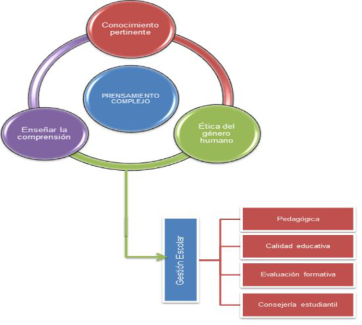
The graphic synthesis of the pedagogical model based on the complex thought of Édgar Morín to strengthen the School Management of the Ángel Polibio Cháves Educational Unit, clearly evidences the complex thought in three dimensions (Pertinent knowledge, teaching the understanding and ethics of the human race), as basis of the theoretical foundation, thus streng- thening school management in the dimensions (pedagogical, educational quality, formative evaluation and student counseling). The objective of the study was to propose a pedagogical model based on the complex thinking of Édgar Morín to strengthen the School Management of the Ángel Polibio Cháves Educational Unit, Ecuador. According to the above, it is necessary for teachers to manage changes in their teaching methodology and imple- ment the pedagogical model based on the complex thinking of Edgar Morín and to instill awareness in students about the value and importance of mana- ging their knowledge, away from misconceptions that they maintain students in conformist zones.
Pedagogical Model Based on Edgar Morín’s Complex Thought in School Management 249
Figure 1: Pedagogical model based on the complex thought of Édgar Morín to strengthen the school management of the Ángel Polibio Cháves educational unit.
The results found at the level of the dependent variable are located at a medium level with 60%, which infers that it is necessary to improve the lear- ning process by applying a different model so that students achieve better academic performance, this finding is contrasted with the data from those surveyed in the school management dimension. On the contrary, it differs from what was found by Apolinario (2020) in his results there was a high level with 90%. Based on the foregoing and observing the similar results, it is inferred that the more optimal the school management is, the students will in turn have optimal results in the learning obtained.
In the same way, the results obtained for the pedagogical dimension are located at a low level with 60%, this indicates that the pedagogical dimen- sion must be strengthened by applying strategies that reinforce the academic process, the applied pedagogy is not adequate and is in disagreement with the educational model. constructivist because it is oriented in the opposite dire- ction to the planning carried out. On the contrary, it differs from Cruzalegui (2020) who in his research obtained that 65.8% had a good level (Guevara, 2014). The results and conclusions presented manage reflection on the pedagogi- cal change that must be carried out by the teacher managed by the director in communion with the educational community, corrections in an appropriate time serve to improve the learning process. Everything exposed and analyzed is supported by Guerriero (2017); Loaiza (2018); (Silva, 2020) who argues that educators are the ones who should specialize in educational work and manage knowledge with relevance to the learner, given that a good pedagogy generated with humanism promotes social equity, developing skills in stu- dents to achieve educational inclusion clearing the path of knowledge, free of exclusive obstacles.
In addition to this, the results obtained for the educational quality dimen- sion were located at a medium level with 43%, with this result it is inferred that the educational quality of being strengthened to go from medium to high level. With the above, it is concluded that the need to maintain high levels of
quality in education, in the case of moderate data, teachers must change the learning strategy and achieve progress from moderate quality to high qua- lity, with good education the system is strengthened. productive and school permanence is guaranteed.
Regarding the formative evaluation dimension, the findings show that the low level predominates with 57%. In contrast, it differs from what was found by Rosales (2018) presents a high level of 80%. Formative evaluation is essen- tial during the learning process, training with authentic activities allows the learner to manage knowledge that later transfers it to their daily context.
In relation to the Student Counseling dimension, the results obtained indi- cate that the management of the DECE towards pedagogical support is not sufficient, this can be observed at the low level with 53% and verified in the results referring specifically to the student counseling of the educational insti- tution. Similarly, at the low level Coronel (2016) in his study, when estimating the extent that the DECE implements processes for educational improvement, he finally maintains that management is not enough, therefore the proposed purpose is not specified, with this it is inferred that the work of the DECE, since it is not enough, presents a low level of performance. The data found in the investigation generates a counterpart and differs with the proposed objective when implementing the Student Counseling Departments - DECE, which says: promoting the comprehensive training of students to achieve per- sonal development is their academic process (SNI, 2021). The argument is corroborated by Rodríguez et al. (2018) who in the publication of his sci- entific article exposes, the main activity of the professional in the DECE lies in the orientation of the students to their harmonic development; which is inferred that this development refers to learning and the relationship with the members of the community.
Regarding the inferential analysis, the correlation between the study vari- able School Management and the pedagogical dimension showed a high relationship with a coefficient of 0.900, with this it is inferred that despite the fact that teachers apply their knowledge, it is necessary that their pedagogical skills and that they strengthen the means with which they conduct know- ledge, the above is reaffirmed by Touriñán (2019) expresses that pedagogy in education is a fundamental basis for improving knowledge and conso- lidating quality in learning, it is directly dependent on the quality of the teacher despite being a teacher. process shared by the educational community, education depends directly on the teaching staff.
Similarly, the correlation of school management with the educational qua- lity dimension yielded a coefficient of 0.733; good school management results in the improvement of educational quality for this achievement the inte- rvention of the community. The aforementioned is supported by what was mentioned by Castelló-Climent and Hidalgo-Cabrillana (2012) where they emphasize that educational quality is the path through which the increase in human talent is traveled and this in turn intensifies social investment with the development of professional talent.
Regarding the correlation of the variable with the formative evaluation dimension, it indicates a positive relationship, the formative evaluation is the axis of the educational process, every educator must plan authentic activities
Pedagogical Model Based on Edgar Morín’s Complex Thought in School Management 251
that are both evaluated and self-evaluated by the student with emphasis on the link to the In reality, this entire learning process activates the participation of the students and manages positive emotions that allow the consolidation of permanent knowledge in the students. This is reinforced by Joya (2020) who, in the publication of her article, maintains that every educator must carry out formative evaluation during learning sessions to ensure that stu- dents consolidate the skills developed during the day to induce active student participation.
Finally, the correlation of the student counseling dimension with the study variable is moderate; It is important that the DECE activate its processes with greater emphasis on the pedagogical component, currently the DECE dedi- cates most of its time only to the protection of the student. This argument is confirmed by what was mentioned by Rodríguez et al. (2018) who emphasi- zes that the purpose of the student counselor is to guide and guide students towards the harmonious development of their cognitive abilities to improve learning and provide pedagogical support to the teacher.
It is estimated that the strength of the methodology defined for this resea- rch where the descriptive scope is used allows confirming what happens in the institution in which the study is carried out, being quantitative, the relative value of the causes that cause the problem is estimated. among the weaknesses is the non-experimental design which only raises the proposal as a possible solution to be taken as a reference and a pedagogue will carry out a new fea- sibility study after its application, among the weaknesses the non-face-to-face educational process is estimated, the same one that was a factor that hindered the realization of a quasi-experimental type experimental design.
CONCLUSION
The state in which school management is found and how it is related to the pedagogical activity in the Ángel Polibio Cháves Educational Unit was esta- blished, with which the impact it has on the learning process and what actions should be taken was known. to improve teaching performance and cogni- tive development of the student. Similarly, in this study, school management was characterized epistemologically, with which it was possible to clearly understand the aspects that make up the management process, knowledge management in the context of pedagogical, didactic and humanistic actions, including the theoretical bases of thought. complex of Edgar Morín and his seven knowledges, by incorporating Morín’s theory, the student is induced to give greater importance to knowledge and value its relevance.
In the same sense, the design of the proposed educational model was fina- lized. This study emerged from the problem detected by the high number of professionals in other disciplines who practice teaching, being unrelated to pedagogical training, they need the respective didactic support. Finally, given the above, it is estimated that, by applying the pedagogical model based on the complex thought of Morín and the seven knowledges neces- sary for the education of the future; the value of learning and the importance of knowledge in their lives is provoked in students, contrasting concepts and
definitions in search of relevance and respecting the human condition in all areas in which it is developed.
REFERENCES
Albrecht, J., & Karabenick, S. (2018). Relevance for Learning and Motivation in Education. The Journal of Experimental Education, 86 (1), 1–10. https://www.ta ndfonline.com/doi/pdf/10.1080/00220973.2017.1380593?needAccess=true Apolinario, N. (2021). School management and teaching practice at the “José Miguel
García Moreno”Fiscal Basic School Guayaquil, Ecuador, 2020 [César Vallejo Uni- versity]. https://repositorio.ucv.edu.pe/bitstream/handle/20.500.12692/57095/Ap olinario_BNE-SD.pdf?sequence=1&isAllowed=y Castelló, A., & Hidalgo, A. (2012). The role of educational quality and quantity in the process of economic development. Economics of Education Review, 31 (4), 391–409. https://www.sciencedirect.com/science/article/abs/pii/ S0272775711001762 Colonel, M. (2015). The efficiency of the student counseling department at the Mena del Hierro educational institution [Equinoctial Technological University]. http: //repositorio.ute.edu.ec/bitstream/123456789/16492/1/64843_1.pdf Cruzalegui, R. (2021). Pedagogical management and inclusive education in primary
school teachers in institutions of the district of Carabayllo - UGEl 04 Comas, 2020 [Universidad César Vallejo]. https://repositorio.ucv.edu.pe/bitstream/handl e/20.500.12692/61248/Cruzalegui_DR-SD.pdf?sequence=1&isAllowed=y Fierro-Saltos, W., Sanz, C., Zangara, A., Guevara, C., Arias-Flores, H., Castillo- Salazar, D., ... & Yandún-Velasteguí, M. (2019, September). Autonomous learning mediated by digital technology processes in higher education: A systematic review. In International Conference on Human Systems Engineering and Design: Future Trends and Applications (pp. 65–71). Springer, Cham. Guevara, C., Sanchez-Gordon, S., Arias-Flores, H., Varela-Aldás, J., Castillo-Salazar,
D., Borja, M., ... & Yandún-Velasteguí, M. (2019, September). Detection of student behavior profiles applying neural networks and decision trees. In Inter- national Conference on Human Systems Engineering and Design: Future Trends and Applications (pp. 591–597). Springer, Cham. Guevara, C., Santos, M., & López, V. (2014, August). Data leakage detection algorithm based on sequences of activities. In Proceedings of the 17th Internati- onal Symposium Research in Attacks, Intrusions and Defenses RAID (Vol. 8688, pp. 477–478). Guerrero, S. (2017). Pedagogical Knowledge and the Changing Nature of the
Teaching Profession. OECD. https://doi.org/10.1787/9789264270695-en Jewel, M. (2020). Formative evaluation, an effective practice in teaching performance. Scientific Magazine, 5 (16), 179–193. https://doi.org/10.29394/Scientific.iss n.~2542--2987.2020.5.16.9.~179--193 Loaiza, Y. (2018). Editorial - Teachers and pedagogy. Latin American Journal
of Educational Studies, 14 (1), 7–13. https://www.redalyc.org/journal/1341/ 134156702001/html/ Ministry of Education of Ecuador. (2021). Department of Student Counseling. Ministry of Education. https://educacion.gob.ec/departamento-de-consejeria-estudian til/ Rodríguez, L., Loor, M., & Duran, U. (2018). Educational Social Work: Perspective
from the Department of Student Counseling. Synapse Scientific Journal, 1 (12), 1–16. https://doi.org/10.37117/s.v1i12.135
Pedagogical Model Based on Edgar Morín’s Complex Thought in School Management 253
Rosales, M. (2018). The level of knowledge about formative evaluation in the practice of the teaching work of a Secondary Educational Institution of Trujillo, 2017 [Universidad César Vallejo]. https://repositorio.ucv.edu.pe/bitstream/handl e/20.500.12692/11767/rosales_am.pdf?sequence=1&isAllowed=y Silva, M. (2020). The pedagogical dimension of equity in higher education. Educati-
onal Policy Analytical Archives, 28 (46). https://epaa.asu.edu/ojs/index.php/epaa/ article/view/5039/2410 Touriñán, J. (2019). Pedagogy, profession, knowledge and education: a mesoaxiological approach to the relationship from the discipline, the career and the function of educating. Pedagogical Trends, 34, 93–115. https://doi.org/10.15366/tp2019. 34.008
LISTED IN THE AHFE DIGITAL BOOKSTORE CATALOGUE
Explore the complete digital volume
Training, Education, and Learning Sciences
Read this individual research paper free through the original publisher, or explore the full digital proceedings book.
ISBN 978-1-958651-35-3
Explore this ISBN in the AHFE Bookstore ↗Listed in the July 2026 bookstore catalogue; search by ISBN to confirm current availability · Digital book purchase optional