Cesar Guevara, Raquel Lara Guevara, Diego Mauricio Bonilla Jurado (2022). Bricoleurs: Resilience in Improvised Work in a Publishing House. In: Industrial Cognitive Ergonomics and Engineering Psychology. AHFE Open Access, vol. 35, pp. 118–124. https://doi.org/10.54941/ahfe1001610
This study analyzes one of the issues that organizational psychology has dealt with in the last decade in a more exhaustive way: resilience is the result of having an optimistic nature as long as optimism does not distort the sense of reality. From a phenomenological perspective, publishing house Queyám was analyzed from the strategic part of the company, in this case a married couple that is in the presidency, as a sample the 6 employees were chosen in their different areas applying the focus group technique where the wife served Moderator of the structured interview with open questions of in vivo coding analyzing literal phrases that express the words used by the employees. It is discussed with the Nobel Prize in Physics Richard Feynman who became an expert in opening safes without knowing the combination, not only trying to find the mechanisms that allowed him to do so, but also collecting the psychological impressions of the people who used those safes or to find out how they chose the opening codes, finally this company has built resilience using improvisation as a fundamental capability
Psychology needed to take a new step; it was necessary to study everything that makes human beings happy from a scientific point of view. Since the 1990s it has been called positive psychology, and this brings together a force for change in the area of psychology, from a concern only for repairing the worst things in life to also building the best qualities in life. To correct the above imbalance, strength building must be brought to the forefront in the treatment and prevention of mental illness.
The field of positive psychology at the subjective level deals with the three pillars or three access routes to a full life, or a positive subjective experience: the first route is through positive emotions or, as other authors say, the plea- sant life. This route is perhaps the best known and obeys the most commonly extended notion of happiness, for this, the proposal must be very hedonistic and considers that happiness consists in having the greatest number of happy moments throughout our lives, these moments can be reached by focusing on the past, by cultivating gratitude and forgiveness (past); rescuing the pre- sent moment but in the most genuine way, flow, joy, sensual pleasures and
Bricoleurs: Resilience in Improvised Work in a Publishing House 119
happiness (present); and constructive cognitions about the later: optimism, hope and faith (future).
At the individual level it is about positive personal traits such as the capa- city for love and vocation, courage, interpersonal skills, aesthetic sensitivity, perseverance, forgiveness, originality, future mentality, great talent and wis- dom. At the group level, it is about the civic virtues and the institutions that move individuals towards better citizenship: responsibility, caring, altruism, civility, moderation, tolerance and work ethic (Seligman & Pawelski, 2003).
Companies face an unprecedented exogenous event, caused by COVID-19, so that companies tried to establish adaptation processes in suggestion and operation in the face of the environment, even more so when smaller compa- nies, such as SMEs, they suffer more severely from the impact of the crisis due to their management weaknesses, legal frictions, lack of government support, informality, financial and technological incapacity, competition and depen- dence on other companies (García et al., 2021). This is where companies have different ways of responding, adapting and getting ahead in difficult situations, and this is where Llorens et al. (2019) classify it as “resilient orga- nizations”. The term resilience means the ability of a living being to adapt to a disturbing agent or an adverse state or situation or the ability of a mate- rial, mechanism or system to recover its initial state when the disturbance to which it had been subjected has ceased (Jadán-Guerrero, 2019).
Siddiqui (2022) mentions that having a strong culture of resilience in the organization and developing skills among individuals to promote individual resilience can counteract the effects of moral distress during crisis situations. Having the capacity and ability to remain strong in conditions of change and great stress is a factor for the success of an organization, Siddiqui (2022), expresses that resilience has been shown to improve job satisfaction and, in general, engagement, adding a sense of purpose, which lowers stress levels.
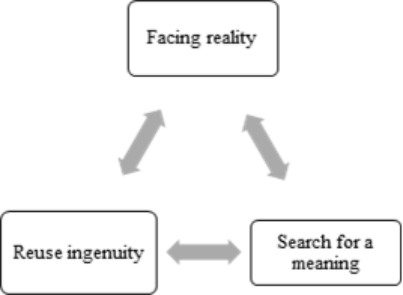
Theories abound about what builds resilience, but three key characteristics seem to set resilient people and businesses apart from the rest (Acosta-Vargas, 2018). One or two of these qualities make it possible to bounce back from difficulties, but true resilience requires all three. The first characteristic is the ability to accept and face reality. By looking closely at reality, we prepare our- selves to act in ways that allow us to endure and survive difficulties: we train ourselves to survive before we have to. Second, resilient people and organiza- tions have the ability to find meaning in some aspects of life. And the values are as important as the meaning; value systems in resilient companies change very little in the long term and are used as scaffolding in times of trouble. The third building block of resilience is the ability to improvise. Within a range of personal skills or company rules, the ability to solve problems without the usual or obvious tools is a great strength. we prepare ourselves to act in a way that allows us to endure and survive difficulties. We train ourselves on how to survive before we have to.
Facing Reality A common belief about resilience is that it stems from an optimistic nature. That’s true, but only as long as that optimism doesn’t distort your sense
Figure 1: Resilience – Harvard Business Review (HBR) emotional intelligence series (Coutu, 2017b).
of reality. In extremely adverse situations, rosy thinking can actually spell disaster.
The Search for Meaning The ability to see reality is closely related to the second component of resilie- nce, the propensity to make sense of terrible times. We all know people who, under pressure, throw up their hands and yell, “How can this be happening to me?” These people see themselves as victims, and living through difficul- ties does not teach them any lessons. But resilient people devise constructions about their suffering to create some kind of meaning for themselves and for others.
Searching for a meaning is a dynamic that can begin with questioning, for example, instead of saying why me? Better to say why not me? I would add to these two questions, and who do I think I am to avoid these problems? Maybe life wants me to learn something new? Can I think of an efficient way to solve this problem? or no matter how strong it is? This meaning-making dynamic, according to most researchers, is the way in which resilient people build brid- ges between the difficulties of the present and a more complete and better built future. Those bridges make the present manageable, for lack of a better word, removing the feeling that the present is overwhelming. This concept was beautifully articulated by Viktor E. Frankl, an Austrian psychiatrist and Auschwitz survivor. In the midst of overwhelming suffering, Frankl invented “meaning therapy,” a humanistic therapy technique that helps people take the kind of decisions that will create meaning in their lives.
Reuse Ingenuity The third building block of resilience is the ability to cope with whatever is at hand. Psychologists follow the lead of French anthropologist Claude Levi- Strauss in calling this bricolage skill. Interestingly, the roots of that word are closely tied to the concept of resilience, which literally means “bounce back.” Says Levi-Strauss: “In its ancient sense, the verb bricolage...was always used
Bricoleurs: Resilience in Improvised Work in a Publishing House 121
with reference to some strange motion: a bouncing ball, a swerving dog, or a horse straying from its direct course to avoid a obstacle” (Coutu, 2017a, p. 26).
BRICOLEURS in the modern sense can be defined as a type of inventive- ness, the ability to improvise a solution to a problem without appropriate or obvious tools or materials. Bricoleurs are always playing, building radios out of household items or fixing their own cars. They make the most of what they have, giving objects to unknown uses. In concentration camps, for example, resilient inmates were known to pocket pieces of string or wire whenever they encountered them. The rope or wire could come in handy later, perhaps to fix a pair of shoes, which in freezing conditions could mean the difference between life and death.
When situations fall apart, bricoleurs get by, imagining possibilities where others are confused. It is here that the term bricolage begins to have force, Lévi-Strauss calls for the action of elaborating structured sets, not directly with other structured sets, but using residues and remains of events, deve- loping the company and the knowledge of the work team from of previous structures that are built day by day, for this purpose, and that are repea- ted regularly and methodically. That is to say, that the thought derived from bricolage, that Lévi-Strauss presents the term bricoleur, as the person who responds to what he is doing with what he has or can dispose of. It is an epistemological strategy that seeks to structure in an orderly manner how chaotic nature can be. It is not about creating structures from brute facts, but from fragments of pre-existing structures that responded to a world in which we no longer find ourselves and that, however, serve to create new taxonomies.
This third element of resilience refers to the ability to build with what we have within our reach, that is, it can be defined as a kind of inventiveness, the ability to improvise a solution to problems without having the tools or materials appropriate. the bricoleur is always trying to fix something; for example, writing jobs in other areas that a publisher is dedicated to. This is where the company must analyze if it simply does not accept a job and does not provide that service that the client is requesting, in this confusing situation the publisher seeks to improvise by imagining possibilities where others would only feel blocked.
The company needed money, it had many debts and we were in a transition of administrative and operational change after the arrival of COVID, which further complicated the situation and helped the partners want to sell the company, this company was made up of 4 partners initially from which 3 of them wanted to liquidate the company, to the point of losing everything that had been invested in its beginnings in 2018, it was really a time of economic crisis that the company went through, it is here where one of the partners together with his wife made decisions and despite the fact that the scenario was very negative, the company and its remaining members decided to con- tinue, proposing a purchase of the partners’ shares, with the debt that had been dragging on. Therefore, with what was available, improvised solutions were invented based on the pending deliveries that the publisher had.
Among the improvised solutions, it was found to find the right personnel to finish the areas, since we are treading the field of personnel recruitment, the company is not based on hiring profiles, but neither is it a parameter to be followed in a mandatory way to hire or reject, in the event that the people are not perfect or that the profile is not ideal, specialized training was managed so that through systematic training the real/ideal distances were reduced. This was achieved by taking into account the strengths of people, strengths are understood as pre-existing capacities to behave, think or feel in a specific way (Castro Solano, 2010). In most cases, the application of this strategy energizes the worker, allowing adequate psychological capital.
Despite the care taken in selecting the strengths of the staff, some emplo- yees after the long training decided to disassociate themselves from the company. It is inferred that this happened because job stability adequate to the needs of the staff was not provided. At that point, the company had adapted to work and make agreements with universities that generated new activities and new lines of business (typical of a bricoleur ), in 2022 the com- pany became stronger and had a more solid administrative structure. strategic and tactical, thus the company survived the crisis based on improvisation as a fundamental capacity.
The president of the company asked his employees to finish the jobs and if that means they have to improvise, then improvise. Otherwise, it would not have been possible to obtain the philosophy that made the company develop the impressive improvisation skills, looking for solutions in the midst of chaos. Empirical data began to be collected, language and forms of expression, stories and to foster relationships between the members of the publishing house, bricolage processes were detected in the environment and these operated in each action, because of course there are works on different topics and areas of the knowledge that clients need, these research works are complemented by editorial services since the authors do not have enough time to finish the editorial process. When a client sends a work to be edited, that edition is complemented with the reinforcement and updating of the texts, this is where the publisher improvises as a company and looks for the most creative way to understand the issues that the authors are presenting and after that, reinforce the idea that they want to present and try to make the work a contribution to knowledge.
Since 2020, when we had a time of crisis due to the Editorial partners, they remained stagnant. Resilience was a growth factor, the employees and the company faced reality firmly, gave meaning to the difficulties and, instead of screaming in despair, we improvised solutions out of thin air. This type of improvisation also encouraged the team to develop their creativity both in scientific research techniques and editing methods, layout, and layout of the texts to be published, for this, specialized knowledge was needed and that caused investment funds to be allocated to better specialized training in technology and digitization, as well as strategic digital marketing in network with other companies. Therefore, business networks are positively correlated with organizational resilience capacity (Xie et al., 2022); This sheds light on how companies can build organizational resilience beyond their own limits. In this way, our research enriches previous work on strategic approaches to
Bricoleurs: Resilience in Improvised Work in a Publishing House 123
building organizational resilience. It is necessary to consider this perspective from the theoretical and empirical approach of the contingent role of digital technologies as a critical environmental factor in the digital age.
In the context of our digital age, advanced digital technologies are emer- ging and developing rapidly, thus encouraging business adaptation is neces- sary. Although digital technologies have attracted widespread attention from business researchers, recent studies on digital technologies have mainly focu- sed on normal situations, while not enough attention has been paid to the impact of digital technologies in crisis situations, this point, clearly expresses the main limitation that arises during this investigation.
CONCLUSION
COVID 19 has created distress for organizations and a significant transition for our company. For most, the setbacks and challenges in work and life have been relentless and profound. But this is a phenomenon that is prevalent globally to varying degrees and has resonated throughout society. Often the most lasting growth occurs in the midst of deepest despair and wrestling with ethical and moral choices. In short, significant investment in BRICOLEURS expands our resilience and builds an organizational culture of strength to deal with problems in times of calm or chaos.
It is understood that positive psychology is discovering something surpri- sing, it is believed that the discovery of facts is the value of science to a great extent, in that sense, positive psychology research has produced not- so-instinctive results, which a person with stories positive has the tendency to seek new experiences.
In another case, it can be mentioned that optimistic people are more likely than pessimists to benefit from the information generated in some adverse social situation. In some nations, wealth is weakly related to Happiness, however, trying to maximize happiness can lead to unhappiness in some way, also considering that resilience can be quite ordinary; therefore, it is known that people who show positive emotions maintain a healthier life and consequently live longer.
ACKNOWLEDGMENT
To Universidad Indoamérica for financing this project.
REFERENCES
Acosta-Vargas, P., Esparza, W., Rybarczyk, Y., González, M., Villarreal, S., Jadán, J.,... & Nunes, I. L. (2018, July). Educational resources accessible on the tele- rehabilitation platform. In International Conference on Applied Human Factors and Ergonomics (pp. 210–220). Springer, Cham. Castro Solano, A. (2010). Foundations of Positive Psychology (1st edition). Paid. Coutu, D. (2017a). How resilience works. In Resilience- Harvard Business Review
Emotional Intelligence Series. I reversed. 978-84-946066-7-0 Coutu, D. (2017b). How resilience works. Harvard Business Review, 80 (5), 46–55.
https://pubmed.ncbi.nlm.nih.gov/12024758/
Garcia, R., Valle, D., & Canales, R. (2021). Organizational selection: resilience and performance of SMEs in the era of COVID-19. Managerial Studies, 37 (158), 73–84. https://doi.org/10.18046/j.estger.2021.158.4291 Jadán-Guerrero, J., Guevara, C., Lara-Alvarez, P., Sanchez-Gordon, S., Calle-Jimenez, T., Salvador-Ullauri, L.,... & Bonilla-Jurado, D. (2019, July). Buil- ding hybrid interfaces to increase interaction with young children and children with special needs. In International Conference on Applied Human Factors and Ergonomics (pp. 306–314). Springer, Cham. Llorens, S., Martinez, I., & Salanova, M. (2019). Healthy Organizations: An
Approach from Positive Psychology (1st edition). Aranzadi. Seligman, M., & Pawelski, J. (2003). Positive Psychology: FAQs. Psychological Inquiry, 14 (2), 159–163. http://www.jstor.org/stable/1449825. Siddiqui, S. (2022). Building organizational and individual resilience in times of
moral distress. Journal of Critical Care, 67, 184–185. https://doi.org/10.1016/j. jcrc.2021.09.014 Xie, X., Wu, Y., Palacios, D., & Ribeiro, S. (2022). Business networks and organizational resilience capacity in the digital age during COVID-19: A perspective utilizing organizational information processing theory. Technological Forecasting and Social Change, 177, 1–16. https://doi.org/10.1016/j.techfore.2022.121548
LISTED IN THE AHFE DIGITAL BOOKSTORE CATALOGUE
Explore the complete digital volume
Industrial Cognitive Ergonomics and Engineering Psychology
Read this individual research paper free through the original publisher, or explore the full digital proceedings book.
ISBN 978-1-958651-11-7
Explore this ISBN in the AHFE Bookstore ↗Listed in the July 2026 bookstore catalogue; search by ISBN to confirm current availability · Digital book purchase optional