María López, Mónica Acosta-Rodas, Mónica Bolaños-Pasquel, Carlos Ramos-Galarza (2022). Technological Innovations for the treatment of impulsiveness. In: Industrial Cognitive Ergonomics and Engineering Psychology. AHFE Open Access, vol. 35, pp. 90–93. https://doi.org/10.54941/ahfe1001606
1 Facultad de Psicología, Pontificia Universidad Católica del Ecuador. Av. 12 de octubre y Roca, Quito-Ecuador ↗
2 Centro de Investigación en Mecatrónica y Sistemas Interactivos MIST/Carrera de Psicología, Universidad Tecnológica Indoamérica. Av. Machala y Sabanilla Quito-Ecuador ↗
Impulse control, or also called inhibitory control, refers to the capacity of controlling attentiveness, behavior, thoughts, and/or emotions, and, at the end, to control internal willingness that is in charge of our behavior. It is important to mention that impulsiveness can be associated to three main factors, first, to behave without a direct implication of frontal lobe functioning; second, increased rate of the response given; and, behavior directed towards immediate reward. This article arises from the need to include technological innovations for the treatment of impulsiveness, thus, literature revision of the available applications about this topic has been made.
Impulse control, or also known as inhibitory control is a theoretical concept and must not be taken as a unity, because it is considered, and redefined according to the perspectives of the study made (Macizo et al., 2006), alth- ough, there is no doubt that inhibitory control is essential in the executive functions, since it allows to humans to be capable of controlling attention, behavior, thoughts, and/or emotions, and to control internal willingness, and, at the end, to behave in a controlled manner (Diamond, 2013). Also, impulse control is known as conscious impulse, which allows the conscious automatic and semi-automatic behavior control, its development starts in early years of life, together with pre-frontal cortex development that allows to control and adjust human behaviors when the environment demands it (Ramos et al., 2020).
If inhibitory control is not functioning adequate in an individual, impul- siveness arises. Impulsiveness is the tendency to give a response as soon as possible, and without thinking about the consequences or effects of this beh- avior, meaning that, the behavior/acting is not comprehended, without any inhibition or planning, where spontaneity, and immediacy play a key role (Medina et al., 2017). In addition, an impulsive act would be understood as
Technological Innovations for the Treatment of Impulsiveness 91
Figure 1: Screenshot of MiyabiAr mobile application.
an involuntary, stereotyped, and paroxysmal behavior. Jaspers (Medina et al., 2017). proposes that an impulsive act occurs rapidly, is direct, there is not the existence of an internal conflict, or a process of decision making, because of these, the absence of a known motivation, and missing reflection are qualities that define the impulsive acting (Medina et al., 2017).
Impulsiveness can be associated to three main factors, first, to behave without a direct implication of frontal lobe functioning; second, increased rate of the response given; and behavior directed towards immediate rew- ard (Sánchez-Sarmiento et al., 2013). However, definitions described from the psychopathological perspective of impulsiveness have been categorized in three different meanings: other pathologies symptoms, a tendency to pro- voke harmful acts without planning, such as reactive aggression, and, as a personality trait (Sánchez-Sarmiento et al., 2013).
It is considered that difficulties within executive functioning are linked to the inhibitory control, presenting direct repercussion in humans since their childhood and adolescence, to face adaptatively the challenges that interper- sonal relationships involve (Hoyos De los Ríos et al., 2013). In addition, deficits in the inhibitory control are placed among the abilities belonging to the group of executive functions highlighted as influential factors of aggressive behavior, and low social capabilities of children and adolescents, these difficulties do not disappear, but are carried into adulthood involve (Hoyos De los Ríos et al., 2013).
Within this context, impulse control is in charge to adjust in humans’ beh- avior that allow to adapt to the environment, thus, being functional. This article arises from the need to include technological innovations developed in pro of the treatment of impulsiveness, because of it, a literature revi- sion of the mobile applications available has been done and are described next.
MOBILE APPLICATIONS FOR THE TREATMENT OF IMPULSIVENESS
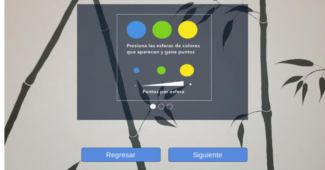
MIYABIAR MiyabiAr (Miyabi, sf.), it is a mobile application that works on attentiveness, and impulsiveness, through augmented reality. This app is characterized in a 3D format, that counts with accessibility to the mobile’s camera, while the camara is activated some figures are showed, and, the user must choose the right one as it has been directed, which helps to evaluate, and exercise automatic and semi-automatic impulses.
Figure 2: Screenshot of MiyabiAr mobile application.
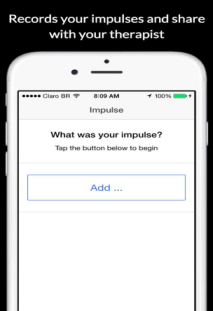
IMPULSE DBT Impulse DBT (Spotwish) is a mobile application for those who need to keep track of their daily impulses, it allows them to record any number of impulses by just touching the screen, also, it offers the possibility of adding details such as emotions, skills, and many others, that will be essential to work with their therapist weekly, but that is not all, Impulse DBT allows to send these notes to the therapist or any other person that the user choose to, becoming a tool that can contribute to any psychological therapy, especially to the Dialectical Behavior Therapy.
CONCLUSION
Impulse control refers to those mental processes in charge of intentional and voluntary control, as well as the capacity to prevent interferences of unne- cessary stimuli to achieve a goal or objective, however, it helps individuals to stop responses already in progress, and to remove previous relevant informa- tion that brings a reward immediately, even if it does not contribute to the task to be performed at that time. Inhibitory control, as it was mentioned before, can be associated to three different factors: acting without the impli- cation of frontal lobe, an increased rate in the response given, and a response directed towards an immediately reward even if it is not beneficial to achieve the planned goal.
The inhibitory control is one of the multiple functions of the executive brain, thus, it has been necessary to implement technological innovations that our current era offers that is linked to the support and treatment of impul- siveness, since to patients with inhibitory control deficits and their families can become a useful tool that helps their improvement, and recovery. In the literature revision made, it was possible to observe the lack number of mobile applications to help treating impulsiveness, in this short list are: MiyabiAr, and Impulse DBT.
As future investigation for the research team, we propose two aims: the first one is to develop technological applications for treating impulsiveness,
Technological Innovations for the Treatment of Impulsiveness 93
and the second one is to make an ecological validation of the application to be created, this will contribute to create an appropriate application according to the improvement processes and to know if there are similarities of sym- ptomatology in the population, such as the age of beginning, development, similar reactions, among others.
REFERENCES
Diamond, A. (2013). Executive functions. Annual Review of Psychology 64(1), 135–168. Hoyos De los Ríos, O. O. (2013). Flexibilidad Cognitiva y Control Inhibitorio. Un
acercamiento clínico a la comprensión del maltrato entre iguales por abuso de poder. Revista Argentina de Clínica Psicológica, 219–227. Macizo, P., & Soriano, B. (2006). Memoria operativa y control ejecutivo: procesos inhibitorios . Psicothema 18 (1), 112–116. Medina, A., Lilo, R., & Guija, J. (2017). Los trastornos del control de los impulsos
y las psicopatías. Barcelona : Fundación Española de Psiquiatría. Ramos, C., Acosta-Rodas, P., Ortiz-Granja., & Lepe-Martínez, N. (2020). The Role of Inhibitory Control in the ability to solve problems. Revista Ecuatoriana de Neurología, 47–52. Sánchez, S., Giraldo-Huertas, J., & Quiroz-Padilla, M. (2013). Impulsividad: una
visión desde la neurociencia del comportaiento y la psicología del desarrollo. Avances en Psicología Latinoamericana, 241–251.
LISTED IN THE AHFE DIGITAL BOOKSTORE CATALOGUE
Explore the complete digital volume
Industrial Cognitive Ergonomics and Engineering Psychology
Read this individual research paper free through the original publisher, or explore the full digital proceedings book.
ISBN 978-1-958651-11-7
Explore this ISBN in the AHFE Bookstore ↗Listed in the July 2026 bookstore catalogue; search by ISBN to confirm current availability · Digital book purchase optional