Micaela Silva-Barragán, Pamela Acosta Rodas, Mónica Bolaños-Pasquel, Carlos Ramos-Galarza (2021). Conceptual Proposal of a Technological Application to Improve the Decision Making Process. In: Human Systems Engineering and Design (IHSED2021): Future Trends and Applications. AHFE Open Access, vol. 21. https://doi.org/10.54941/ahfe1001097
1 Facultad de Psicología, Pontificia Universidad Católica del Ecuador. Av 12 de Octubre y Roca, Quito, Ecuador ↗
2 Centro de Investigación en Mecatrónica y Sistemas Interactivos MIST/Carrera de Psicología, Universidad Tecnológica Indoamérica Av. Machala y Sabanilla, Quito, Ecuador ↗
Brain’s functions imply the necessary cognitive processing to solve daily life problems. In this context, the frontal lobe has a predominant role in the decision-making process, and, when its functioning is not accurate, it generates severe problems in the person suffering of it. As a technological solution to help adolescents to take the best decisions, the aim of this article is to propose the conceptual development of a mobile application to compensate frontal lobe role and allow a person to improve the decision-making process, considering the diversity of implications and consequences that this action encompasses.
Human Systems Engineering and Design (IHSED 2021) https://openaccess.cms-conferences.org/#/publications/book/978-1-7923-8987-0
INTRODUCTION
Executive functions (EF) are those cognitive abilities settled in the prefrontal cortex functioning (PFC). They are recognized by allowing the establishment of goals, following the plans made, behavioral self-regulation, appropriate behavior selection according social context, affective, emotive, cognitive and behavioral integration. In other words, are those in charge of regulating and organizing the other cognitive abilities (Delgado-Mejía and Etchepareborda, 2013). It is known that these functions are the base for appropriate decision making, since it has been observed deficits in this ability in patients with damage in the prefrontal cortex. It is important to mention that, the process of decision making implies an incorporation of cognitive and emotional elements, it allows to anticipate the consequences of every possible scenario (Verdejo-García and Bechara, 2010). From Luria’s cerebral organization model, decisions making would be in charge of the third functional unity. This last one is in correspondence with abilities related to intentionality, inhibitory control, conscious behavioral regulation, objective’s verification, resolution of novel situations, among other necessary competences to select an option and reject others (Ramos-Galarza et al, 2020). The components of the EF that are involved are working memory, categorization, attentional changing, and cognitive flexibility (Tamayo- Lopera et al, 2018).
Throughout adolescence, the EF reach their maximum development playing a transcendental role in the academic and social success, influencing directly in daily problem-solving. For example, an investigation conducted by Ramos and Lozada demonstrates that a deficient monitoring is related to difficulties for, behavioral supervision, being completely conscious of behavioral consequences, class assistance, to avoid activities that involve immediate gratification, etcetera (Ramos- Galarza et al, 2017). Adolescence is a vital stage that is characterized by physical growing and an accelerate bio-psycho-social changes, it allows a progressive socio- economic independence, as well as the development of identity, and the acquisition of abilities for the adult stage of life. It means, teenagers need to take important decisions by their own, gaining autonomy. Many factors are related to a good or bad decision-making, among them, it is found the adequate cognitive stimulation to promote the development of PFC (OMS, n.d.). For this reason, it’s important to create an accessible and attractive cognitive stimulation method for young people, which allows improving the decision-making process by influencing the PFC. In this article it’s proposed this method trough the conceptual development of a mobile application.
It is important to highlight that even when the problematic of the adolescence stage is wider complex and multifactorial, the present proposal looks for the cognitive stimulation of the prefrontal cortex and executive functions, through the presentation of daily-life situations close to those occurring to teenagers, and the feedback given about the elections that the user realize into the application.
Human Systems Engineering and Design (IHSED 2021) https://openaccess.cms-conferences.org/#/publications/book/978-1-7923-8987-0
TECHNOLOGICAL PROPOSAL FOR DECISION MAKING Mobile Application
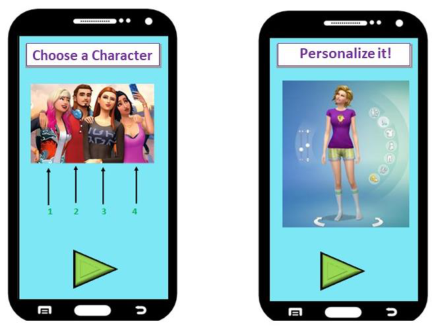
The proposal for a mobile application consists in the development of a game where the user may register, choose and personalize a character. Then, the user may choose among different options that represent daily teenager topics. The user must analyze each of them and then, has to choose between four options. According to the one chosen, the character will suffer the positive or negative consequences of it. At the end of each situation displayed, there will be showed a feedback that includes relevant data about daily risks and the reasons of making a good decision. This will enable cognitive stimulation of brain zones involved in the decisions making, influencing the user to consciously integrate the cognitive, emotional, and social spheres. Content Initial Page: In this section the user will be asked to register himself/herself, then, it will be asked to choose a character that will interact in many different situations, as it may be seen in the Figure 1.
Character: The objective of this section is that the user could personalize the chosen character as he/she wants, for example, by choosing the hair or dressing style, or skin color (Figure 1)
Figure 1. Prototype of the content of the application
Human Systems Engineering and Design (IHSED 2021) https://openaccess.cms-conferences.org/#/publications/book/978-1-7923-8987-0
Election of a topic In this section, there is presented to the user six topics that are common in the teenagers´ daily life: party, friends, romance, alcohol and drugs, school, and family. Each topic proposed counts with the different situations from where the user could choose the actions that the character will execute (Figure 2). Decision making according to the situation
There is displayed graphically a situation, problem or dilemma. Also, there is explained by text what is going on, then some questions will appear, such as, ¿What should the character do? At the same time, there are presented four possible options to answer the question, among those, the user must choose one (Figure 2). It will allow the stimulation of those brain zones involved in the decision making process, specially the PFC, since the executive functions as planning, conscious inhibitory control, cognitive flexibility, and others related are working.
Fig. 2. Prototype of the contents of the application Decision consequences There is visualized through an image what happens to the character once the decision was made, whether it is a positive or negative one. Feedback This section gives feedback to the user about the risks of the situation previously presented. It helps to promote learning from different contexts, this knowledge will encourage good and positive decision making, generating new neuronal connections
Human Systems Engineering and Design (IHSED 2021) https://openaccess.cms-conferences.org/#/publications/book/978-1-7923-8987-0 when associating a stimulus to a specific consequence (Figure 3).
Fig. 3. Prototype of the contents of the application DECISION MAKING IN REAL LIFE
As it might be observed, the situations presented in this mobile application aims to be close to the real teenager life. It means, there is expected a high level of ecological validity, so, teenagers would acquire the knowledge about behavioral risks and future planning. It is important to mention that, the executive function to train from this activity is the inhibitory control, which reaches the highest development between 12 and 14 years old, ending its formation by the age between 15 and 19 years (Tamayo-Lopera et al, 2018). Also, ecological validity enables a good process of decision making in the real life of user - teenagers.
CONCLUSIONS
Adolescence is considered a critical stage where a variety of risks are present, the decision making occupies a central place, representing the progressive autonomy and independency that a teenager goes gaining, capacities that will allow his/her to face successfully the different stressing or problematic situations where teenagers would be immerse. The principal issues in this stage are around sexuality, being accepted in a friend group, being autonomous in front of authority figures, and acquisition of social abilities that allow adolescents to develop appropriately in the next stage of life, adulthood (Herrera-Santi, 1999). Every situation implies necessarily to decide how to react and behave, here is where our proposal accomplishes the role of
Human Systems Engineering and Design (IHSED 2021) https://openaccess.cms-conferences.org/#/publications/book/978-1-7923-8987-0 contributing to this process in adolescence, through the stimulation of the PFC and the integration of it to the brain zones involved in emotions. The aim of this work consists in reporting the conceptual development of a mobile application that is interesting for adolescents, and, at the same time, will enable them to learn about many different risking situations and the possible consequences of them, stimulating cerebral plasticity and formation of new neuronal connections in favor of the decision making process. Other studies have demonstrated that technological proposals could even support neuropsychology rehabilitation processes in vulnerable population suffering of brain damage (Ramos-Galarza et al, 2021).
ACKNOWLEDGMENTS
The authors of this work thank CEDIA for the financing within the CEPRA project Integration of New Technologies for the Design of Cognitive Solutions in Assisted Living Environments for Older Adults: Evaluation of Attention and Memory Areas.
REFERENCES
Delgado-Mejía I., Etchepareborda M. (2013). Trastornos de las funciones ejecutivas: diagnóstico y tratamiento. Rev. Neurol. 57(1), 95-103. Herrera-Santi, P. (1999). Principales factores de riesgo psicológicos y sociales en el
adolescente. Rev. Cub. Pediatr. 71(1), 39-42 Ramos-Galarza, C., Jadán-Guerrero, J., Paredes-Núñez, L., Bolaños-Pasquel, M., Santillán-Marroquín, W., Pérez-Salas, C. (2017). Funciones ejecutivas y conducta de estudiantes secundarios ecuatorianos. Rev. Mex. Neuroci. 18(6), 32-40 Ramos-Galarza, C., Cruz-Cárdenas, J., Silva-Barragán, M. (2020). Escala de
Funciones Ejecutivas basada en la teoría de Alexander Luria EOCL-1. Editorial de la Universidad Tecnológica Indoamérica, Quito Ramos-Galarza, C., Acosta-Rodas, M., Sanchez-Gordon, S., Calle-Jimenez, T.
(2021). Mobile Technological Apps to Improve Frontal Lobe Functioning. AHFE 2020, AISC 1201, 88-93. Sitio Web de la Organización Mundial de la Salud (OMS). (n.d.). Desarrollo en la adolescencia. https://www.who.int/maternal_child_adolescent/topics/adolescence/dev/es/ Tamayo-Lopera, D., Merchán-Morales, V., Hernández Calle, J., Ramírez Brand, S.,
Gallo Restrepo, N. (2018). Nivel de desarrollo de las funciones ejecutivas en estudiantes adolescentes de los colegios públicos de Envigado- Colombia. Rev. CES Psico. 11(2), 21-36 Verdejo-García, A. , Bechara, A. (2010). Neuropsicología de las Funciones Ejecutivas. Psicothema. 22(2), 227-235
Human Systems Engineering and Design (IHSED 2021) https://openaccess.cms-conferences.org/#/publications/book/978-1-7923-8987-0
LISTED IN THE AHFE DIGITAL BOOKSTORE CATALOGUE
Explore the complete digital volume
Human Systems Engineering and Design (IHSED2021): Future Trends and Applications
Read this individual research paper free through the original publisher, or explore the full digital proceedings book.
ISBN 978-1-7923-8987-0
Explore this ISBN in the AHFE Bookstore ↗Listed in the July 2026 bookstore catalogue; search by ISBN to confirm current availability · Digital book purchase optional